Overbite correction usually means moving teeth with braces or clear aligners until the upper front teeth no longer cover too much of the lower ones. Rare cases with a jaw-growth problem may also need surgery. Children respond fastest, but adults can be treated successfully too. The right plan depends on how deep the bite is, whether the cause is in the teeth or the jaw, and the health of your gums and teeth. A dental exam and X-rays settle that.
Below, we explain what an overbite is, how it differs from an overjet, which treatments exist, what to expect at different ages, and how to think about cost.
TL;DR
- An overbite is too much vertical overlap of the upper front teeth over the lower ones. An overjet is the upper teeth sticking out too far forward. Many people have a bit of both.
- Braces (metal or ceramic) and clear aligners are the main fixes. Jaw surgery is reserved for a small number of skeletal cases.
- Adults can be treated, though it may take longer than in children. Treatment often runs from six months to two years or more.
- Retainers are not optional. Without them, teeth can drift back.
- Most dental plans do not cover adult orthodontics, so ask for an itemized, all-inclusive quote before you start.
Table of Contents
- What an overbite is, and when it needs correcting
- Overbite vs. overjet: what is the difference?
- How an overbite is diagnosed
- Overbite correction options
- Overbite correction for children and teens
- Can adults fix an overbite?
- How long does treatment take?
- Risks, hygiene and retainers
- What does overbite correction cost, and does insurance help?
- Our perspective: treat the bite, not just the smile
- Start with a bite evaluation at Towne Dental
- Frequently asked questions
- Sources
What an overbite is, and when it needs correcting
When you bite down, your upper front teeth normally sit slightly in front of and over your lower front teeth. That is healthy. The problem starts when the overlap is excessive. The American Association of Orthodontists (AAO) describes a deep bite, also called an excessive overbite, as significant vertical coverage of the lower front teeth by the upper front teeth when the back teeth are closed.
A normal vertical overlap is often described as about 2 to 4 millimeters. You may also hear overbite expressed as a percentage of the lower tooth that is hidden. A bite where the upper teeth hide most of the lower teeth is a deep one, and it is the kind that tends to cause trouble.
Not every overbite needs treatment. Mild overlap that does not cause wear, pain or chewing problems may simply be watched. Correction is worth discussing when you notice any of these:
- Lower front teeth that look worn, chipped or flattened
- Gum irritation or soreness where the lower teeth touch the gums behind your upper teeth
- Difficulty biting or chewing certain foods
- Jaw discomfort or tension
- A smile you feel self-conscious about
The AAO notes that an untreated deep bite can contribute to premature tooth wear, enamel damage, gum recession, chewing difficulty and painful sores where teeth contact the gum or palate. So for many people this is a health question, not only a cosmetic one.
Overbite vs. overjet: what is the difference?
People use “overbite” for two different things, which is why the terms get confused.
| Overbite | Overjet | |
|---|---|---|
| Direction | Vertical (top to bottom) | Horizontal (front to back) |
| What you see | Upper teeth hide too much of the lower teeth | Upper teeth stick out in front of the lower teeth |
| Common nickname | Deep bite | Protruding front teeth, “buck teeth” |
| Can both happen? | Yes | Yes |
The AAO’s family guide puts it this way: an overbite is excessive vertical overlap, while an overjet is excessive horizontal projection of the upper front teeth beyond the lower ones. You can have a deep overbite with no overjet, a large overjet with little overbite, or both together.
This matters because the treatment differs. A deep overbite often calls for moving front teeth up or back teeth down to change bite depth. An overjet usually calls for moving the upper front teeth back or the lower teeth forward. A dentist or orthodontist measures both before recommending anything.
How an overbite is diagnosed
Diagnosis starts with a routine exam. According to MedlinePlus, malocclusion is usually identified during a dental examination, when the dentist looks at your bite and at how the back teeth meet. The dentist may then refer you to an orthodontist.
A thorough evaluation typically includes:
- A visual and physical exam of your teeth, gums and jaw joints
- X-rays to see roots, bone levels and jaw relationships
- Digital scans or impressions to map how your teeth fit together
- A review of your history, including thumb sucking, mouth breathing, grinding and previous dental work
The key question is whether the overbite is dental (teeth sitting in the wrong positions) or skeletal (the upper and lower jaws are out of balance). Dental cases are the large majority of what braces and aligners handle. Skeletal cases take more planning and, in children, may use growth-guiding appliances.
Overbite correction options
Braces
Braces remain a dependable choice, especially for deeper bites. The AAO explains that braces apply continuous pressure to move teeth, and the orthodontist adjusts brackets and archwires throughout treatment to change bite depth. Ceramic (tooth-colored) brackets give the same mechanics with a less noticeable look, which many teens and adults prefer.
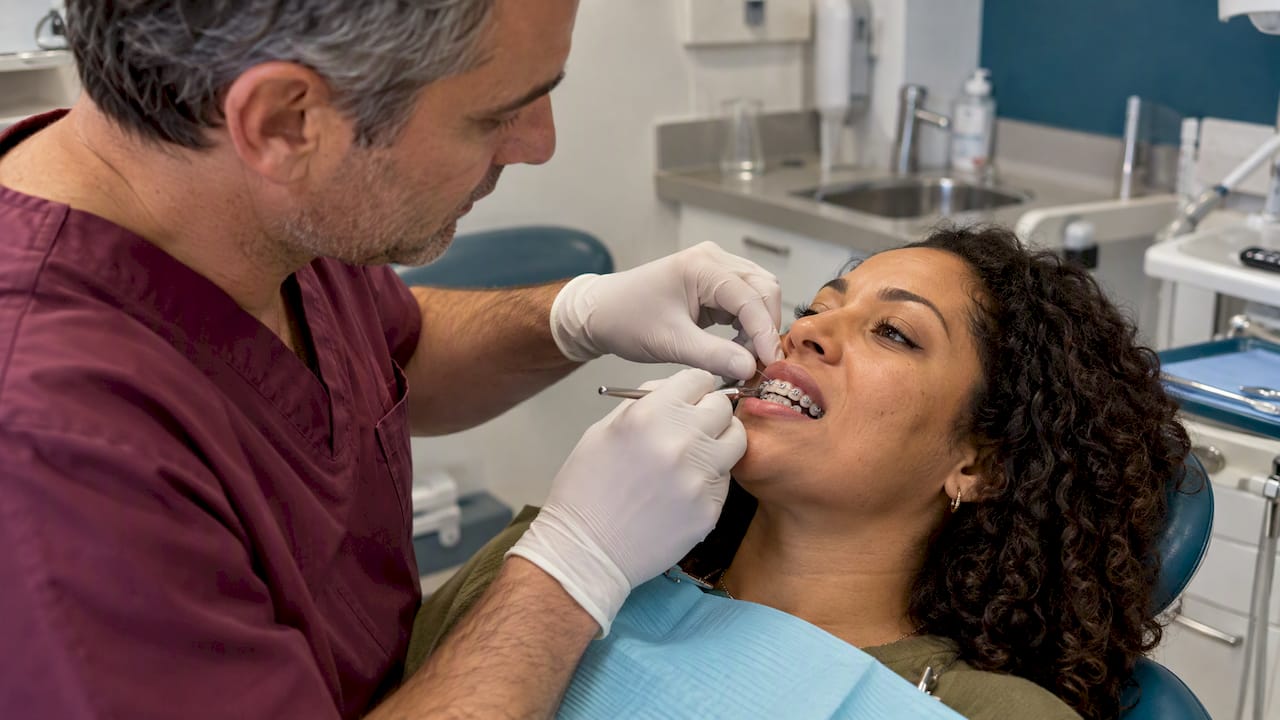
Braces work well when the bite needs to be controlled in three dimensions at once, because the brackets stay attached the whole time and do not depend on how many hours a day you wear them.
Clear aligners
Clear aligners are a series of removable, custom-made trays that shift teeth in small steps. The AAO lists them as another option for correcting a deep bite. They suit many mild to moderate cases, and they are popular with adults who want a low-profile treatment. You need to wear them most of the day for them to work, and a very deep bite may be better served by braces. You can read about clear aligners at our practice.
Elastics and small add-ons
Rubber bands, limited expansion, or temporary anchorage devices (tiny screws that act as a fixed anchor) may be used to fine-tune the correction, according to the AAO guide. Elastics only work if you wear them as directed. Our guide to orthodontic elastics explains why consistent wear matters and why doubling up does not speed things along.
Tooth extraction
Sometimes a dentist removes teeth to make room. MedlinePlus notes that extraction may create space for the teeth to move into better positions. This is a decision based on crowding and bite measurements, not a default step.
Jaw surgery
Surgery is the exception. MedlinePlus says jaw surgery is reserved for rare skeletal problems, and the AAO notes that severe adult cases may require orthognathic surgery. If your jaws are the main cause, expect your dentist to coordinate with an oral surgeon.
Which option fits which situation
| Situation | Often considered |
|---|---|
| Mild to moderate overbite, adult who wants discretion | Clear aligners, ceramic braces |
| Deep bite with crowding | Braces, sometimes with extractions |
| Child still growing | Early evaluation, braces, or growth-guiding appliances |
| Bite problem rooted in jaw size or position | Orthodontics plus possible jaw surgery |
| Overbite with missing or damaged teeth | A combined plan with restorative work |
This table is a starting point, not a prescription. Only an exam can tell you which row you belong in.
Overbite correction for children and teens
MedlinePlus explains that early treatment is generally easier, quicker and less expensive because children’s bones are still developing. That is why a bite check at routine dental visits is useful. If a child’s upper front teeth cover the lower ones too deeply, or the teeth protrude, the dentist can monitor the pattern and refer for treatment at the right time.
Habits and breathing patterns can influence how the jaws and teeth develop. If your child breathes through the mouth a lot, it is worth understanding toddler mouth breathing and when ENT care helps, because airway and oral habits can shape the way a young face grows. A dentist can then fold that information into the bite evaluation.
Our team also treats children, so a family can often handle checkups and orthodontic questions in one place. See our pediatric and general services.
Can adults fix an overbite?
Yes. The AAO states that adults can successfully receive orthodontic treatment for overbites. It adds that treatment may take longer because adult teeth are more firmly set in the jaw, and that the choice of appliance is individualized.
MedlinePlus says the same thing in plain terms: adult correction is often successful but can take longer than treatment in childhood. So if you are wondering whether 20, 40 or 60 is too late, the evidence points to no, as long as your teeth and gums are healthy enough to be moved.
That last condition is the one adults should take seriously. The AAO says adult planning is tailored to goals, gum health and restorative needs. In practice:
- Gum health comes first. Teeth should not be moved while there is active gum disease. If you have deep pockets or bleeding, you may need periodontal care before alignment. Our article on gum pockets treatment covers what that looks like.
- Existing dental work affects the plan. Crowns, bridges and implants do not move the way natural teeth do, so they have to be accounted for.
- Missing teeth change the options. Gaps may be closed with orthodontics or restored afterward, depending on your goals.
The AAO also points out that adult treatment can improve hygiene, distribute chewing forces and reduce abnormal wear or bite-related discomfort. If you want a broader cosmetic result, orthodontics can be one stage of a larger plan, which we describe in our smile makeover process guide. Digital smile design can also help you preview the end result.
Can you fix an overbite naturally?
No exercise, mouth device sold online, or chewing routine has been shown to reposition adult teeth and jaws in a meaningful way. Teeth move through controlled pressure applied over time, which is what braces and aligners provide. Be wary of any “natural” fix that promises a result without a dental professional guiding it, because forcing teeth without monitoring can damage roots and gums. If you want to avoid the look of braces, ask about ceramic braces or clear aligners instead.
How long does treatment take?
MedlinePlus says orthodontic treatment may last six months to two or more years, depending on the correction needed, and that adult treatment may require longer appliance use. A mild overbite with straight teeth sits at the short end. A deep bite with crowding, extractions or a skeletal component sits at the long end.
What shapes your timeline:
- Severity of the bite. Deeper overlap takes more movement.
- Your age. Younger bone responds faster.
- Consistency. Missed aligner hours, skipped elastics and broken brackets all add months.
- Complexity. Extractions, anchorage devices or surgery lengthen the plan.
Ask for an estimated range in your first consultation, and expect it to be refined after the first few months once you see how your teeth respond.
Risks, hygiene and retainers
Orthodontics is safe and routine when supervised, but it asks something of you. MedlinePlus warns that plaque can build up around braces and permanently mark teeth or cause decay unless you keep up brushing and flossing. A few habits make the difference:
- Brush after meals and before bed, paying attention to the gumline around brackets
- Floss daily, using floss threaders or interdental brushes if needed
- Keep up regular cleanings during treatment
- Limit sticky and hard foods that break brackets
Then comes the stage people underestimate. MedlinePlus states that a retainer is required to stabilize teeth after treatment, and the AAO says consistent retainer wear helps protect results for life. Our guide to retainers after braces walks through the usual schedule of full-time wear at first, then nights.
If a wire pokes or a bracket comes loose, you do not need to wait for your next visit. Our orthodontic emergency guide explains what to do and when to call.
What does overbite correction cost, and does insurance help?
Cost varies with the appliance, the length of treatment and what is included, so any number you read online should be treated as a rough, regional guide at best. We do not publish a flat price for orthodontics, because the plan depends on your exam. What we can say with confidence is how to evaluate any quote.
Insurance. The AAO says most dental plans do not cover adult orthodontics, although some offer annual or lifetime maximums. Medically necessary orthodontics may sometimes be considered by medical insurance, and HSA or FSA funds may help you pay. Policy maximums and medical-necessity rules can change your out-of-pocket cost a lot, so call your plan before you commit.
The quote itself. The AAO advises patients to ask whether a quoted fee is all-inclusive and what is excluded. Good questions to ask:
- Does the fee include retainers?
- Are the X-rays, scans and follow-up visits covered?
- What happens to the cost if treatment runs longer than planned?
- Is there a charge for replacing a lost aligner or a broken bracket?
- Are payment plans available?
Cost is a real barrier across American dentistry. The ADA Health Policy Institute has testified that cost is the leading reason working-age adults and seniors cannot get needed dental care. If cost is what has kept you from asking, a consultation is a low-pressure way to learn your actual options before deciding.
Our perspective: treat the bite, not just the smile
At Towne Dental, we see overbite correction as a health decision first and a cosmetic one second. A deep bite can quietly wear down teeth and irritate gums for years before it hurts, so we like to catch it early and explain it plainly. We would rather show you the measurements and the options than push one appliance.
We also know that many of our patients feel anxious about dental work, or have put off care for years. We build treatment plans around the individual: your goals, your gum health, your schedule and your comfort. Where a bite problem overlaps with other needs, such as a missing tooth or a worn restoration, we can plan the whole picture together, including gentler options such as sedation dentistry for anxious patients when it is appropriate.
Our advice is simple. Get the bite evaluated, ask what is causing it, and choose the least complicated treatment that solves it well. Then commit to the retainer.
— Towne Dental
Start with a bite evaluation at Towne Dental
If you live in Fort Myers, Cape Coral, Naples, Bonita Springs, Estero, Marco Island or nearby, we can look at your bite, explain whether it is an overbite, an overjet or both, and walk you through braces and clear aligner options. Explore our braces and orthodontics services, or see everything we offer on our services page.

Frequently asked questions
Is 20 too late to fix an overbite?
No. The AAO says adults can successfully receive orthodontic treatment for overbites, although treatment may take longer than in a child. What matters more than age is whether your teeth and gums are healthy enough to move. An exam will tell you.
Can braces fix an overbite?
Yes, braces are one of the most common ways to correct it. The orthodontist adjusts the brackets and archwires over time to change how deeply the upper teeth cover the lower ones. Elastics or small anchorage devices may be added for fine-tuning.
How much does it cost to correct an overbite?
It depends on the appliance, the length of treatment and what the fee includes, so a real figure requires an exam. Most dental plans do not cover adult orthodontics, though some have maximums and HSA or FSA funds may help. Ask for an all-inclusive, itemized quote.
Is a 70% overbite bad?
A percentage that large generally means the upper teeth cover most of the lower teeth, which is a deep bite. It can lead to tooth wear, gum irritation and chewing problems, so it is worth having evaluated. Whether it needs treatment depends on your symptoms and measurements.
What is the difference between an overbite and an overjet?
An overbite is vertical: the upper front teeth cover too much of the lower ones. An overjet is horizontal: the upper front teeth stick out too far forward. You can have either one or both.
Sources
- AAO: What is a Deep Bite? Causes, Concerns, and Corrections
- AAO: Your Guide to Orthodontic Health
- AAO: Adult Orthodontics FAQ
- AAO: Your Orthodontic Journey, Questions Uncovered
- MedlinePlus: Malocclusion of teeth
- Invisalign: Overjet vs. Overbite
- ADA Health Policy Institute: Senate oral health testimony