A crossbite is treated by moving the upper and lower teeth, or the upper jaw itself, into a proper fit. The right method depends mostly on age. Growing children can often have the upper jaw widened with an expander. Teens and adults usually need braces or clear aligners, and a small number of adults need jaw surgery or a miniscrew-supported expander. The sooner a crossbite is spotted, the simpler the fix tends to be.
This guide explains how to tell which kind of crossbite you or your child has, what each treatment involves, and what to ask at the first visit. It also covers pacifiers and thumb sucking, since parents ask about them constantly.
TL;DR
- A crossbite means some upper teeth sit inside the lower teeth when you bite down. It can affect a few teeth or the whole side of the mouth.
- In children, an expander can widen the upper arch while the jaw is still growing. In teens and adults, braces or clear aligners are the usual route, and the jaw can no longer be “grown.”
- Early correction matters: the American Academy of Pediatric Dentistry (AAPD) says treating crossbites in childhood helps avoid permanent asymmetric jaw development.
- Pacifier use beyond age 3 is linked to bite changes, so weaning on time protects your child’s bite.
- Crossbites can relapse, so retainers and follow-up are part of the treatment, not an extra.
Table of Contents
- What a crossbite is, and how it differs from an overbite
- Causes of crossbite
- Pacifiers, thumb sucking and your child’s bite
- Why treating a crossbite early matters
- Crossbite treatment for children
- Braces for crossbite in teens
- Crossbite in adults
- Treatment options at a glance
- Caring for your mouth during and after treatment
- Our perspective on crossbite care
- Book a bite evaluation in Southwest Florida
- FAQ
- Sources
What a crossbite is, and how it differs from an overbite
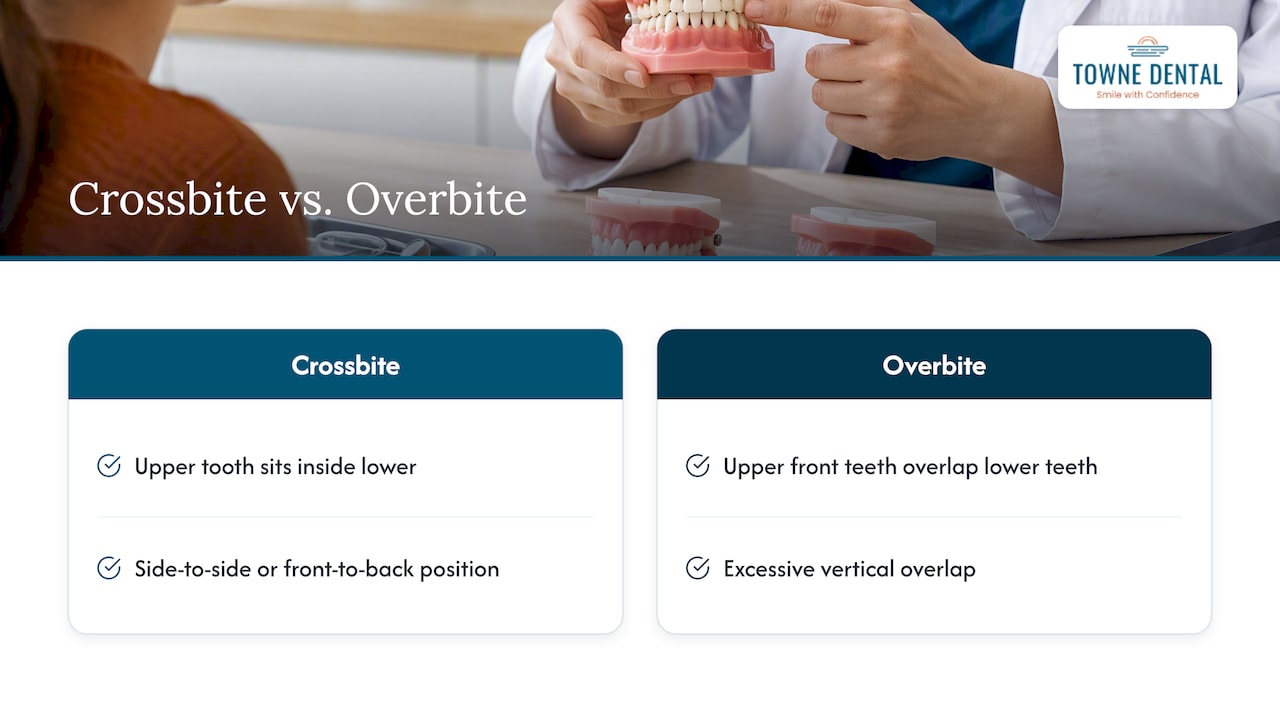
In a healthy bite, the upper teeth sit slightly outside the lower teeth, like the lid of a box. In a crossbite, one or more upper teeth sit inside the lower ones. A posterior crossbite involves the top back teeth biting inside the bottom back teeth. An anterior crossbite involves the front teeth, where an upper tooth bites behind a lower one.
An overbite is a different thing. In an overbite, the upper front teeth overlap the lower ones too far vertically. A crossbite is about side-to-side (or front-to-back) position, not how far the teeth overlap up and down. Some people have both.
The same review reports that posterior crossbite shows up in roughly 4% to 17% of children and adolescents, depending on the population studied. It is common, and it is very treatable.
Dental versus skeletal crossbite
Dentists separate crossbites into two broad types:
- Dental crossbite: one or a few teeth are tilted or positioned wrongly, but the jawbones are shaped normally.
- Skeletal crossbite: the upper jaw is too narrow compared with the lower jaw, so the whole arch is affected.
This distinction drives the treatment. Moving a tilted tooth is a braces job. Widening a narrow jaw is a different project, and it works best while the bones are still growing.
Causes of crossbite
Most crossbites come from a mix of genetics and habits. The common contributors are:
- Inherited jaw shape. A narrow upper jaw often runs in families.
- Prolonged pacifier use, thumb sucking or finger sucking. Constant sucking can narrow the upper arch over time.
- Delayed loss of baby teeth or crowding. Permanent teeth may erupt into the wrong position when there is no room.
- Mouth breathing. A tongue that rests low rather than against the palate can contribute to a narrow upper arch. This is a pattern clinicians watch for, not a diagnosis by itself.
- Missing or misplaced teeth. Teeth that drift after an extraction can end up in crossbite.
Pacifiers, thumb sucking and your child’s bite
Parents ask about this more than almost anything else, so here is the practical version.
The AAPD’s oral health policy on pacifiers notes that children who used a pacifier for 36 months or longer had a significantly higher incidence of anterior open bite than children who did not. An open bite is when the front teeth do not touch even with the back teeth closed. Sucking habits can also narrow the upper arch and contribute to posterior crossbite.
What that means day to day:
- Start easing off early. Many families begin limiting the pacifier in the first or second year, starting with daytime use.
- Aim to be done by age 3. Earlier is better. The longer the habit continues, the more the teeth and bone adapt to it.
- Don’t punish or shame. Positive reinforcement, a swap for a comfort object and consistency work better than pressure.
- Watch for habits that replace it. Thumb sucking can cause the same changes, and it is harder to take away than a pacifier.
- Have the bite checked if the habit continues past 3. Many bite changes from sucking improve once the habit stops, but a child who still has a crossbite after the habit ends should be seen.
If your child’s front teeth don’t meet or the upper teeth bite inside the lower ones, a pediatric dental exam will tell you whether it is likely to correct itself or needs an appliance.
Why treating a crossbite early matters
Crossbite treatment is not just cosmetic. According to the AAPD’s guidance on the developing dentition, correction normalizes the relationship between the teeth and the surrounding bone, helps prevent gum damage, and removes functional shifts that can lead to permanent asymmetric jaw development if the crossbite is left untreated in childhood.
A “functional shift” is when a child slides the jaw to one side to get the teeth to meet. Parents may notice the chin or the midline of the teeth looks off-center when the child bites down. That sideways slide is a reason not to wait and see.
Other consequences of an uncorrected crossbite can include uneven tooth wear, gum recession on the teeth that bite the wrong way, and chewing that favors one side.
Can a crossbite cause TMJ problems?
Possibly, but the link is not simple. A 2025 review of the literature describes crossbite as a recognized potential factor in temporomandibular disorders, while stressing that causality is complex and not everyone with a crossbite develops joint trouble. If you have jaw pain, clicking or headaches, a full exam of your teeth, jaw and muscles is the right first step. Don’t assume the bite is the only cause.
Crossbite treatment for children
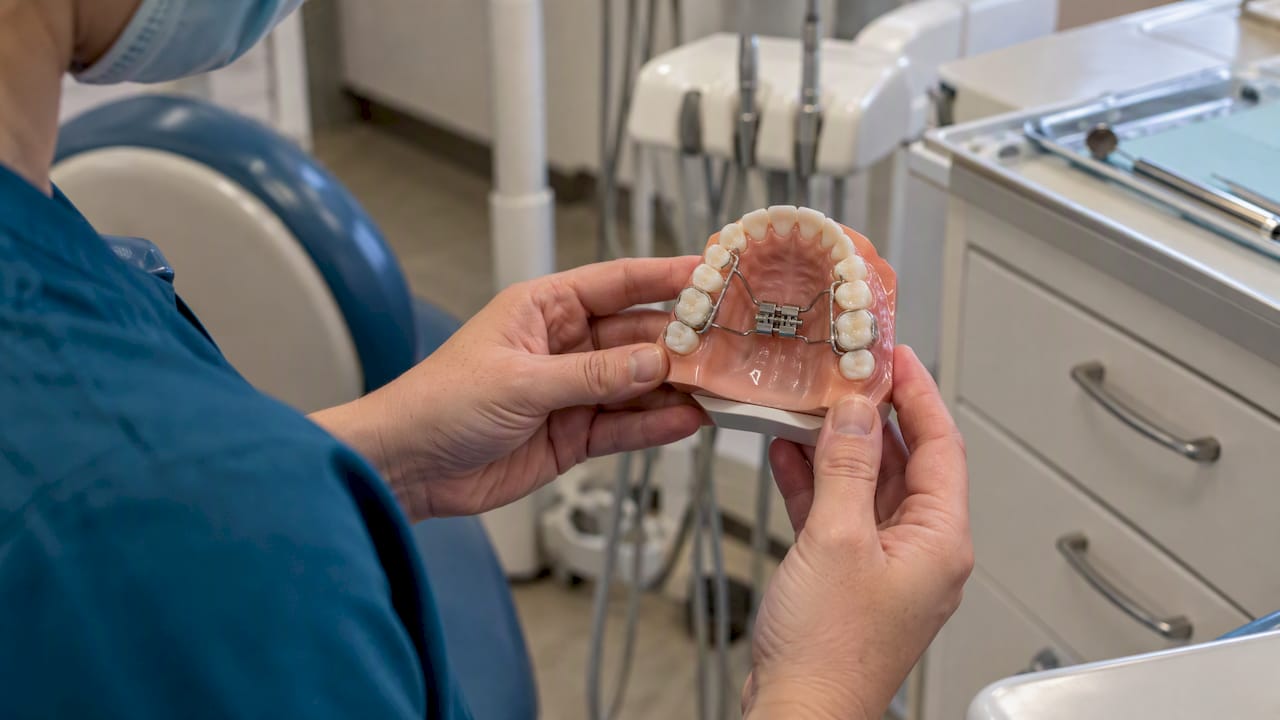
While a child is growing, the dentist can work with the bone, not just the teeth. The American Association of Orthodontists explains that palatal expanders apply gentle pressure as children’s jaws develop, helping the upper jaw grow in a way that prevents significant bite problems later.
Palatal expanders
The main appliance types for posterior crossbite are fixed expanders (such as the quad-helix or Hyrax) and removable expansion plates. The AAPD guidance notes that these widen the upper arch and correct the crossbite, and that quad-helix appliances were statistically more effective than expansion plates for increasing intermolar width and shortening treatment time in children.
What to expect with an expander:
- It sits in the roof of the mouth, attached to the back teeth or worn as a removable plate.
- Fixed expanders are typically adjusted at home or in the office on a set schedule.
- Speech and eating feel odd for the first few days, then most children adapt.
- After the arch is wide enough, the appliance usually stays in place for a retention period while the bone firms up.
When to start
A systematic review of early correction looked at functional unilateral posterior crossbites treated between ages 6 and 12, the mixed-dentition years when baby and permanent teeth are both present. That window is why a first orthodontic check around the early school years is common advice. Your child’s dentist will tell you whether to treat now or monitor.
If your child has a crossbite and needs X-rays to plan treatment, our guide to your child’s first dental X-rays explains when and why they are taken.
Will it stay corrected?
Usually, but not always. The AAPD guidance puts relapse at roughly 1 in 5 cases over the long term, even after a successful correction. A systematic review of long-term stability found that most studies measure relapse of the width gained, not relapse of the crossbite itself, which is why follow-up visits and retention matter.
Braces for crossbite in teens
Once the major growth years pass, braces become the workhorse. Brackets and wires move teeth into their correct positions, and elastics (small rubber bands) pull the upper and lower arches into line. Crossbite correction often depends on elastics, and results depend on wearing them as directed. Our guide to orthodontic elastics explains why you should wear them all day and never double up.
Braces can be metal or ceramic. Teens who care about appearance often choose clear or tooth-colored options. If a teen’s upper jaw is still narrow, an expander may come first, followed by braces to finish the alignment.
After braces come come retainers. Our post on retainers after braces covers the usual schedule: often full time for 4 to 6 months, then nights. Skipping this step is the quickest route to relapse.
Crossbite in adults
The good news first: the AAO says there is no age limit for orthodontic treatment. The difference is that adults are no longer growing, so the plan changes.
| Growing child | Adult | |
|---|---|---|
| Main goal | Guide jaw growth (moving bone) | Move teeth, or reposition the jaw surgically |
| Common tools | Expanders, then braces if needed | Braces, clear aligners, elastics, sometimes miniscrew expanders or surgery |
| Predictability of jaw widening | High | Lower, because the midpalatal suture has fused |
| Other dental issues | Fewer | Worn, missing or periodontally affected teeth are more common |
Braces and clear aligners
Mild dental crossbites in adults are often corrected with braces or clear aligners, sometimes with elastics. Clear aligners work well for some cases and less well for others, so the case needs an exam first. The AAO’s own advice is that the choice of appliance should be matched to your specific orthodontic problem. We offer braces and clear aligners so you can compare options at one visit.
When the jaw itself is narrow
Traditional rapid expanders become less predictable in late adolescents and adults. A systematic review of miniscrew-assisted rapid palatal expansion (MARPE) found it can produce meaningful skeletal widening without surgery in this age group, with an average dental width increase of about 6.55 mm. Severe skeletal crossbites in adults may still call for surgically assisted expansion or jaw surgery, which is a conversation for a specialist team.
Adults often need more than one specialist
Adult mouths come with history. The AAO notes that adults may need coordinated care among orthodontists, oral surgeons and periodontists because of worn or missing teeth or gum disease. Healthy gums come first, since teeth cannot be safely moved if the supporting tissue is inflamed.
Treatment options at a glance
| Option | Best suited for | How it works |
|---|---|---|
| Removable expansion plate | Young children with a narrow upper arch | Gradually widens the upper arch |
| Fixed expander (quad-helix, Hyrax) | Children in mixed dentition | Widens the upper arch; cannot be removed by the child |
| Braces | Teens and adults | Move teeth into proper position |
| Clear aligners | Selected mild cases in teens and adults | Series of custom trays shift teeth |
| Elastics | Added to braces | Pull arches into alignment |
| MARPE | Late teens and adults with narrow jaw | Miniscrews anchor the expander to the bone |
| Jaw surgery | Severe skeletal cases | Repositions the jaw |
The fastest option depends on the type of crossbite. A single tilted tooth moves faster than a skeletal width problem, so be wary of any promise of a universal timeline.
Caring for your mouth during and after treatment
Brackets, wires and expanders trap food and plaque. Brush after meals, floss with a threader or water flosser, and keep up cleanings. If you are choosing a rinse to use through treatment and retention, this mouthwash guide for post-orthodontic care is one reference to read before you decide. Ask your dentist which rinse suits your gums.
Our perspective on crossbite care
We see crossbite as a problem with a window of opportunity. For a child, a short conversation at a routine visit can spare years of complicated treatment later. For an adult, it is rarely too late, but it is worth treating as a whole-mouth project, not a single tooth.
Our approach is built on tailored treatment plans, a gentle experience for anxious patients, and a team that looks at the whole picture: general, pediatric, periodontal and surgical needs under one roof. If a child is nervous, or an adult has avoided the dentist for years, we plan the visit around comfort, and sedation dentistry is available when it makes sense.
We will tell you plainly if your crossbite can wait, if it needs treatment now, or if a specialist’s input is the next step.
— Towne Dental
Book a bite evaluation in Southwest Florida
If you or your child may have a crossbite, we can examine the bite and talk through the options. We serve families across Naples, Bonita Springs, Estero, Marco Island, Fort Myers, Cape Coral and Ave Maria. See our braces and clear aligner options, or browse all our services to see how pediatric, general and oral surgery care fit together.
FAQ
What is the fastest way to fix a crossbite?
There is no single fastest method, because speed depends on the cause. A tilted single tooth can move quickly with braces or aligners, while a narrow upper jaw in a child is usually treated with an expander. Starting early, while a child is still growing, tends to make treatment simpler.
When is it too late to fix a crossbite?
It is not too late at any age, because the AAO says orthodontic treatment has no age limit. After growth ends, the approach changes: braces, aligners, miniscrew-supported expansion or surgery for severe skeletal cases. Your gum health will matter for the plan.
Do braces fix a crossbite?
Often, yes. Braces with elastics can correct dental crossbites in teens and adults. If the upper jaw is too narrow, an expander may be needed first, or a miniscrew-supported expander in an adult.
Can a crossbite cause TMJ problems?
It can be one contributing factor, but research shows the relationship is complex. Not everyone with a crossbite develops joint problems, and jaw pain should get a full exam rather than an assumption.
When should my child stop using a pacifier?
The AAPD links pacifier use of 36 months or longer to a higher rate of anterior open bite, so the goal is to be finished by age 3, and sooner if possible. Start with daytime weaning and use positive reinforcement.
Sources
- Orthodontic treatment for posterior crossbites (PMC)
- AAPD: Management of the Developing Dentition
- AAPD: Oral Health Policy on Pacifiers
- Crossbite and temporomandibular disorders (PMC, 2025)
- AAO: What Are Palatal Expanders?
- Early orthodontic correction of functional unilateral posterior crossbite (PubMed)
- Long-term stability of posterior crossbite correction (PubMed)
- AAO: No Such Thing as Too Old for Orthodontic Treatment
- MARPE in late adolescents and adults (PMC)
- AAO: Adult Orthodontics