There is no set age for a child’s first dental X-rays. The dentist decides after examining your child’s mouth and reviewing their health history and cavity risk. Many children go years without needing any. Others need a single small image early on because their teeth are tightly packed or something looks wrong. If you are a parent in Southwest Florida wondering whether your toddler will be handed a sensor at the first visit, this guide explains what usually happens, why, and how to make it easy.
TL;DR
- X-rays are ordered by need, not by birthday. The American Academy of Pediatric Dentistry (AAPD) says the need for radiographs is patient-specific, not age-based.
- The first dental visit should happen within 6 months of the first tooth appearing, and no later than about 12 months of age. Stanford Medicine Children’s Health gives the same timeline. That visit is mostly a look, not a scan.
- Dentists often order the first images when back teeth start touching, because decay between them can’t be seen by eye.
- The dose is very low, and protective measures and child-sized settings apply. The exposure itself lasts a fraction of a second.
- Bring questions. A good dentist will tell you exactly what the X-ray is meant to answer.
Table of Contents
- Do babies and toddlers get X-rays at the first visit?
- When the first dental X-rays usually happen
- What the dentist is looking for
- Types of X-rays your child may see
- How safe are children’s dental X-rays?
- How long does it take?
- How to prepare your child
- Seeing the image can calm everyone down
- What about cost and insurance?
- Perspective: why we only take what answers a question
- Red flags that mean call the dentist sooner
- A short history: where dental X-rays began
- Local care for Southwest Florida families
- Questions to ask at the appointment
- FAQ
- Sources
Do babies and toddlers get X-rays at the first visit?
Usually not. The first visit is built around getting your child comfortable. According to Stanford’s fact sheet, it typically lasts 30 to 45 minutes and focuses on familiarizing your child with the office and assessing growth and development. The dentist counts teeth, checks the gums and bite, looks for early decay and talks with you about brushing, feeding and habits like thumb sucking.
Parents often expect an X-ray at that first appointment because it is common for adults. For infants and young children it is different. Baby teeth are small and often spaced apart, so the dentist can usually see everything needed with a good light and a gentle exam. Guidance summarized by the AAPD says dentists order radiographs for clinical need, such as when teeth are too close together to inspect for decay visually, rather than by age alone.
So if your one-year-old leaves without images, nothing was missed. It means the exam did not raise a question that an X-ray would answer.
When the first dental X-rays usually happen
Because the decision is individual, any age you read online is an average, not a rule. Still, a few patterns are common:
- Ages 2 to 4: Baby teeth are often still spaced out. Images may be taken earlier if there is a toothache, a fall or injury to the mouth, swelling, or a visible dark spot that may be deep decay.
- Around ages 4 to 6: Back baby teeth begin to touch. Cavities hide in those contacts, so this is when many children get their first set of small bite images.
- Around age 6 and after: The first permanent molars and front teeth start to come in. Dentists may want to see how adult teeth are developing and whether there is enough room.
- Pre-teens and teens: Images help plan braces or clear aligners, check wisdom teeth and track development.
The ADA and American Academy of Oral and Maxillofacial Radiology published patient selection recommendations stating that a thorough evaluation of history and clinical findings should come before any radiographic exam. In other words, the conversation and the exam come first.
What the dentist is looking for
Dental X-rays show parts of the mouth you can’t see directly. According to the Cleveland Clinic, they can reveal cavities (especially between teeth), bone loss, impacted teeth, abscesses and cysts. They also help with planning treatments like braces, implants or dentures.
In children, the main reasons are:
- Hidden cavities. Between-teeth decay is the classic one. It can grow for months with no visible sign.
- Tooth development. Images show whether permanent teeth are forming and positioned normally under the baby teeth.
- Injury. After a fall, an X-ray can show whether a root is damaged or a tooth was pushed out of position.
- Infection. A pimple-like bump on the gum or a persistent toothache can signal an abscess that only an image will confirm.
- Orthodontic planning. Before braces or aligners, the dentist needs to see roots and jaw growth.
Types of X-rays your child may see
| Type | What it shows | When it’s common in kids |
|---|---|---|
| Bitewing | The crowns of upper and lower back teeth, where they meet | Checking for decay between teeth |
| Periapical | One or two whole teeth, crown to root tip | Toothache, injury, suspected infection |
| Panoramic | The whole mouth, jaws and developing teeth in one wide image | Tracking adult teeth, planning orthodontics |
For most healthy children, the first images are bitewings, which are the smallest and simplest. Your child bites gently on a small tab or holds a sensor against the teeth while the machine is positioned outside the mouth.
How safe are children’s dental X-rays?
Dental X-rays use very low doses of radiation. Still, children are more sensitive to radiation than adults, and that is why dentists follow the ALARA principle: as low as reasonably achievable. The FDA’s pediatric X-ray guidance calls for adjusting exposure to the child’s size and clinical need. Digital receptors are part of how that is done.
A few things you can expect from a careful office:
- A lead apron or shield, and a thyroid collar when appropriate.
- Settings matched to a child’s smaller head and jaw.
- Only the images that answer a specific question.
- Reuse of recent images from a previous dentist, when available, instead of repeating them. The FDA’s selection guidance emphasizes the dentist’s professional judgment about how to best use imaging for each patient.
If you want a broader view of how doctors weigh different kinds of scans and why some carry more radiation than others, this plain-language guide to choosing between MRI, CT, ultrasound and X-ray is a helpful read. Note that it is written for a UK audience, and dental imaging is much smaller in scale than the scans it mostly discusses.
If your child is under a year old, has a medical condition, or you are pregnant: tell the dentist before any imaging. Pregnant parents who are holding a child in position should mention it so another adult can help. Questions about your child’s specific health history belong with your pediatrician and dentist together.
How long does it take?
Shorter than most parents fear. The Cleveland Clinic notes that exposure for each image is a fraction of a second. Most of the appointment time goes to positioning your child and placing the sensor. With digital imaging, the picture appears on a monitor within seconds.
For a child who cooperates, a few bitewings can take a few minutes. For a nervous child, a few minutes more of practice is time well spent.
How to prepare your child
The machine is not painful. What kids dislike is the unfamiliar: a sensor in the mouth, a gag feeling, holding still. These steps help.
- Show, don’t just tell. Ask the dental team to let your child touch the sensor and see the machine. Calling it a “camera for teeth” is accurate enough for young children.
- Practice at home. Have your child hold a flat, clean cardboard strip or spoon handle between their teeth and count to five.
- Choose the time of day. Book when your child is rested and fed. A tired child gags more and moves more.
- Stay in the room. Your calm tone matters. Hold your child’s hand or sit within reach.
- Breathe through the nose. Slow nose breathing helps with the gag reflex.
- Praise cooperation, not perfection. If the first try fails, a second attempt a few minutes later often works.
If your child has strong dental anxiety, say so when you book. Different offices handle this differently, and it is reasonable to ask which comfort options are available before a visit where images are expected.
Seeing the image can calm everyone down
One advantage of digital imaging is that the dentist can show the picture right away. The Cleveland Clinic notes that immediate images can support patient education, and for an anxious parent or older child, seeing exactly what the dentist sees makes the treatment plan feel less like a mystery. Ask to see it. A good clinician will point out the healthy areas as well as the problem ones.
What about cost and insurance?
We don’t publish fees for imaging, and costs vary with the type of image and the plan you have. Many dental plans cover bitewings at set intervals, but coverage details differ, and some plans impose waits before certain services are covered. If you are choosing or changing a plan, this explainer on dental waiting periods shows how those waits can work and what to check before enrolling. Always confirm with your insurer which images are covered and how often.
Perspective: why we only take what answers a question
At Towne Dental we treat X-rays as a tool, never a box to tick. Our approach to children’s care is built around two goals: finding problems early and keeping the visit gentle enough that your child comes back willingly.
That shapes how we think about imaging. We start with the exam and a conversation about your child’s habits, history and any worries. If an image will change what we do, we take it and show you why. If it won’t, we wait. A child who has a calm first experience is far more likely to sit well for the images they eventually need.
We also know that anxiety is not only a child’s issue. Many parents carry their own memories of dental visits. Part of our job is to make the next generation’s experience different, with clear explanations and no surprises. Our team offers general, pediatric and emergency dentistry along with sedation dentistry, so families can get what they need in one place and one relationship.
— Towne Dental
Red flags that mean call the dentist sooner
Don’t wait for the next checkup, and don’t assume an X-ray can wait, if you notice any of these:
- A toothache that keeps your child awake or doesn’t ease.
- Swelling of the gum, cheek or face, or a bump on the gum.
- A tooth knocked loose, chipped or pushed out of place after a fall.
- A tooth that has turned gray or dark.
- Fever with mouth pain.
Swelling in the face with fever, or trouble breathing or swallowing, is an emergency: go to an emergency room or call 911. For other urgent dental problems, we offer emergency dentistry and will tell you on the phone whether imaging is likely.
A short history: where dental X-rays began
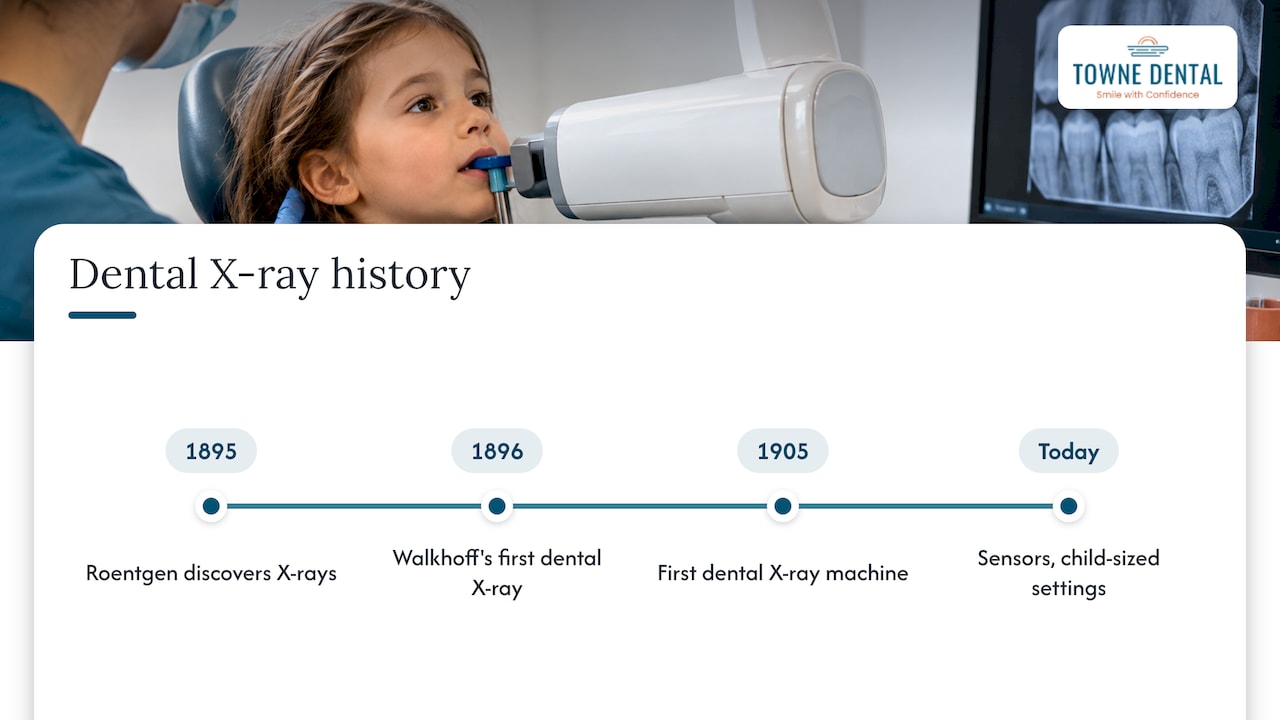
Parents sometimes ask where this technology came from. Wilhelm Roentgen discovered X-rays in late 1895, and German dentist Otto Walkhoff took the first dental radiograph of his own teeth in early 1896, according to a review in PubMed Central. The same source says Siemens made the first X-ray machine designed for dental use in 1905. Today’s digital sensors and child-sized settings are a long way from those early exposures, which is part of why the dose is now so low.
Local care for Southwest Florida families
If you live in Naples, Fort Myers, Cape Coral, Estero, Bonita Springs, Marco Island or Ave Maria, we can help you plan your child’s first visit. Our team provides pediatric dentistry and a full range of general care with a focus on gentle treatment tailored to each patient. When your child later needs more, from fillings and crowns to braces, clear aligners or oral surgery, the same team already knows them. Visit Towne Dental to learn more or to book.
Questions to ask at the appointment
You are your child’s advocate. These questions are reasonable, and a good office welcomes them:
- What question will this X-ray answer?
- What would you do differently depending on what it shows?
- Do you use digital sensors, and what protective gear do you use for children?
- Can you use images from our previous dentist?
- If we skip it now, when would you want to reconsider, and what signs should I watch for?
- How will you help my child through it if they are nervous?
FAQ
At what age should my child have a first dental appointment?
Experts recommend a first visit within 6 months of the first tooth coming in, and by about 12 months at the latest, according to Stanford Medicine Children’s Health. The visit is mostly an exam and a chance to ask questions. It usually does not include X-rays.
Are dental X-rays safe for kids?
They use very low doses, and clinicians follow the ALARA principle, meaning as little radiation as reasonably achievable, as described by the FDA. Children are more radiosensitive than adults, so settings are adjusted to their size and only needed images are taken. If you have concerns about your child’s health history, raise them with the dentist before the visit.
What can dental X-rays find that an exam can’t?
They reveal cavities between teeth, bone loss, impacted teeth, abscesses, cysts and the shape of roots and jawbone, according to the Cleveland Clinic. For children, the most common finding is early decay between back teeth. They also show how permanent teeth are developing.
Does my child need sedation or nitrous oxide for X-rays?
Most children do not need either for a few small images, and preparation and a calm approach are often enough. If your child is very anxious, has a strong gag reflex or struggles to stay still, ask the dentist about comfort options before the visit. Sedation decisions depend on your child’s age, health and the treatment planned, so the dentist should guide them.
How long does a dental X-ray take?
Each exposure lasts a fraction of a second, and digital images appear on screen within seconds, per the Cleveland Clinic. Most of the time goes to positioning, so a few images typically take only a few minutes.
Sources
- Prescribing Dental Radiographs for Infants, Children, Adolescents, and Individuals with Special Health Care Needs (AAPD, PDF)
- Prescribing dental radiographs: AAPD oral health policies
- A Child’s First Dental Visit Fact Sheet (Stanford Medicine Children’s Health)
- Dental X-rays: Purpose & Types (Cleveland Clinic)
- Pediatric X-ray Imaging (FDA)
- The Selection of Patients for Dental Radiographic Examinations (FDA)
- ADA and AAOMR patient selection for dental radiography and CBCT (JADA)
- Overview of dental imaging equipment industry in Taiwan (PMC)