Yes, you will need a retainer after braces to keep your teeth from drifting back out of alignment. Most patients wear a retainer full-time for the first few months, then shift to nights only, often for years or indefinitely. Your provider will recommend a fixed or removable option, such as a Hawley or an Essix retainer, based on your bite and habits.
TL;DR:
- A study found less relapse with fixed than Hawley or Essix retainers at six months; a review reported 29% failure or breakage.
- If a retainer feels tight or will not seat fully, do not force it; contact your orthodontist because your teeth may have shifted.
- Take removable retainers out for meals, clean them with cool water rather than toothpaste, and store them in a hard case when they are out.
- Clean bonded wires daily with floss threaders or interdental brushes, and bring your retainer to checkups so loose bonds or early movement can be caught.
- Removable retainers depend on consistent wear, while fixed retainers stay in place but require more careful cleaning around the wire.
Table of Contents
- Types of retainers: fixed, Hawley, and Essix explained
- How long and how often you should wear a retainer
- How to care for and maintain your retainer
- Fixed vs. removable retainers: what the evidence shows
- How Towne Dental supports your retention plan
- Getting used to your retainer: speech and comfort
- Daily habits that affect how well your retainer works
- What actually matters most after your braces come off
- Keeping your retainer on track with Towne Dental
- FAQ
- Sources
Types of retainers: fixed, Hawley, and Essix explained
Once your braces come off, you will typically choose between a fixed retainer and one of two removable styles. Each works differently, and the right one depends on your bite, your daily habits, and what your orthodontist thinks will hold your results best.
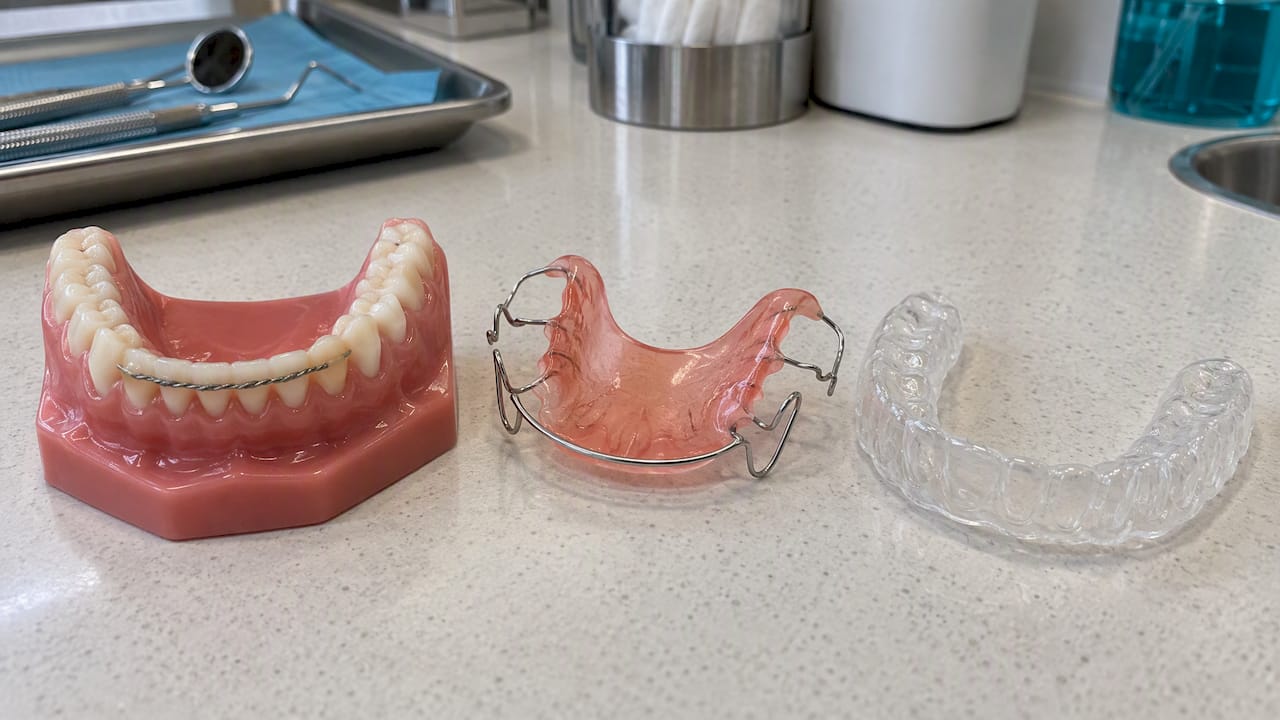
A fixed, or bonded, retainer is a thin wire glued to the back of your front teeth, usually the lower arch, and it stays in place around the clock without any effort from you. Because it cannot be removed for meals or forgotten at home, it tends to offer continuous support against relapse, though it does require more careful cleaning around the wire.
A Hawley retainer is a removable appliance made of a molded acrylic plate that sits against the roof of your mouth or along the inside of your lower teeth, with a visible metal wire wrapping across the front teeth. It is durable and adjustable, which is part of why it has remained a standard option for decades.
An Essix, or vacuum-formed, retainer is a clear plastic tray that looks similar to a clear aligner and fits snugly over your entire arch. Many patients prefer it for being nearly invisible, though it can trap moisture against teeth if not cleaned daily.
- Fixed retainers stay bonded in place and need floss threaders or interdental brushes for cleaning.
- Hawley retainers are removable, adjustable, and visible due to the metal wire.
- Essix retainers are clear, removable, and close-fitting but show wear over time.
Lab-made retainers like Hawley and Essix styles usually take a short turnaround after your final braces appointment, while a bonded retainer can often be placed the same day your braces are removed.
How long and how often you should wear a retainer
A common schedule after braces calls for full-time wear, removing the retainer only to eat and brush, for about four to six months. After that window, most people transition to wearing it only at night. The American Association of Orthodontists describes retention as an essential step that commonly follows this full-time-then-nightly pattern, and Cleveland Clinic guidance points to the same four-to-six-month full-time window before shifting to nights.
The early full-time period matters because the bone and ligament fibers around your teeth are still settling into their new positions right after braces come off. Teeth that move during active treatment are genuinely more prone to drifting back in those first months, so consistent wear during this window does real work.
A controlled study tracking retention outcomes found fixed retainers held teeth more stable at six months, with a mean anterior relapse lower than that of Hawley and Essix retainers, indicating better early stability. This data helps explain why many orthodontists lean toward nighttime wear being indefinite rather than a fixed end date, since any removable retainer allows more movement than a bonded one.
A realistic long-term schedule looks like this:
- Full-time wear (20 to 22 hours a day) for roughly four to six months after braces.
- Nightly wear only, often continuing for years or permanently, depending on your orthodontist’s recommendation.
- A brief return to more frequent wear if you notice looseness or skip several nights in a row.
If your retainer suddenly feels tight or you cannot seat it fully, that is usually a sign your teeth have already started shifting. AAO guidance advises against forcing it into place and recommends contacting your orthodontist for an evaluation instead.
How to care for and maintain your retainer
Keeping a retainer clean protects both your investment and your oral health, since plaque and bacteria build up on these appliances just as they do on natural teeth.
For removable retainers, brush gently with a soft toothbrush and lukewarm water every time you take it out, and avoid toothpaste, which can scratch the plastic or acrylic. Hot water will warp both Hawley and Essix retainers, so stick to room-temperature or cool water for rinsing and soaking.
- Rinse your retainer every time you remove it, before it dries out.
- Soak it a few times a week in a retainer-cleaning solution or diluted non-abrasive cleaner, never bleach.
- Skip abrasive toothpaste or scrubbing pads, which scratch and cloud clear plastic.
- Store it in its hard case any time it is out of your mouth.
Fixed retainers need a different routine. Because the wire sits behind your teeth, regular floss cannot pass through normally, so a floss threader or interdental brush is necessary to clean around and underneath it daily. Research on retention outcomes notes that bonded retainers shift more of the maintenance burden onto hygiene habits and periodic checks, since any missed plaque buildup along the wire raises the risk of decay or gum irritation at that spot.
Never wrap a removable retainer in a napkin, since it is easy to accidentally throw away, and keep it away from pets, who are drawn to the smell of saliva on the plastic. AAO patient-care guidance echoes both points.
Pro Tip: Keep a spare retainer case in your bag or car so a forgotten one at a restaurant doesn’t end up lost for good.
Fixed vs. removable retainers: what the evidence shows
Neither retainer type is flawless, and the right choice depends on what trade-off fits your life better: consistency or convenience.
A systematic review of retention studies found a notable risk of failure or breakage for lower fixed retainers bonded canine-to-canine over follow-up periods of six to 36 months. That review also found that bond failure was not strongly tied to how long the retainer had been in place, meaning a wire can detach early or stay solid for years with no clear pattern.
Fixed retainers remove the compliance question entirely since you cannot forget to wear them, and the relapse data above supports that advantage in the first six months. The trade-off is hygiene: cleaning around a bonded wire takes more effort, and a broken segment that goes unnoticed can let teeth drift quickly on just one side.
Removable retainers put more responsibility on you to wear them consistently, but they are easier to keep clean since you take them out to brush normally. Some research on retention protocols suggests removable retainers can show better gum health scores in certain studies, likely because there is no permanent wire trapping plaque against the gumline.
How Towne Dental supports your retention plan
We fit both fixed and removable retainers as part of our braces and orthodontics services, and we build a follow-up schedule around whichever option fits your bite and lifestyle. When a retainer cracks, loosens, or no longer seats properly, we handle repairs and replacements rather than leaving you to guess at next steps.
Patients are encouraged to bring their retainer to every check-up so fit can be verified and early signs of relapse caught before they become bigger problems. If something feels off between visits, whether it is a tight fit or a broken wire, reaching out promptly gives the best chance to correct course quickly.
Getting used to your retainer: speech and comfort
It is normal for a new retainer, especially a Hawley or Essix style, to feel bulky against your tongue or palate for the first few days. Many patients notice a temporary lisp or slightly slurred sounds, particularly with “s” and “th” sounds, since the appliance changes how your tongue contacts the roof of your mouth.
This adjustment period typically fades within a few days to about a week as your tongue and cheek muscles learn the new shape in your mouth. Reading out loud for a few minutes each day can speed up that adjustment, since it gives your mouth repeated practice forming sounds around the retainer.
Fixed retainers usually cause less speech disruption since they sit low behind the front teeth rather than covering the palate, though some patients notice their tongue bumping the wire at first. Mild soreness or pressure in the first day or two after a new retainer is fitted is common and generally fades as your teeth and gums adjust, though persistent pain or sores inside the cheek are worth mentioning at your next visit.
If a retainer still feels uncomfortable or speech problems persist beyond a couple of weeks, that is worth flagging rather than pushing through indefinitely, since an ill-fitting appliance may need an adjustment.
Daily habits that affect how well your retainer works
What you eat and how you handle your retainer day to day both influence how well it protects your results. Removable retainers should come out for meals, since chewing with them in can crack acrylic, warp plastic, or trap food particles against your teeth.
Chewing gum, biting fingernails, or grinding your teeth at night can all put extra stress on both fixed and removable retainers. Grinding in particular can crack an Essix tray over time or loosen the bond on a fixed wire, so mentioning this habit to your orthodontist is worth doing if you notice it.
Smoking and certain foods, like coffee or red wine, can stain a clear Essix retainer faster, since the plastic absorbs pigment the way natural teeth do, though staining does not affect how well the retainer holds your teeth in place. Sticky or hard foods are best avoided right after eating and before reinserting a removable retainer, since leftover residue gets trapped against your teeth.
Consistency matters more than any single habit. A retainer that sits in its case most nights because of inconsistent wear will not do the job a retainer worn as directed does, regardless of how well you clean it or how sturdy the material is.
What actually matters most after your braces come off
The conventional advice tends to treat retainers as an afterthought, a quick fitting after the “real” treatment ends. The evidence points the other way: the relapse data on fixed versus removable retainers shows that what happens in the first six months after braces often determines how stable your results stay for years.
Where the usual guidance falls short is in treating retainer wear as a short-term obligation rather than a long-term habit. Nighttime wear that continues indefinitely, not just for a prescribed number of months, is what prevents the slow drift that brings people back to their orthodontist years later wondering why their teeth moved despite “finishing” retention.
If you prioritize one thing, make it consistency during that first transition period and honesty with your provider the moment something feels different. A retainer that feels tight, a wire that feels loose, or a corner that’s gone soft are all small signals worth acting on quickly, before they become a bigger correction.
— Towne Dental
Keeping your retainer on track with Towne Dental
Protecting the results of your braces takes more effort than remembering to wear your retainer at night, and we make that easier with fittings, repairs, and check-ups built around your actual schedule, not a generic timeline.

- Fixed and removable retainers are fitted as part of orthodontic care, matched to your bite and daily habits.
- Repairs and replacements are handled when a retainer cracks, loosens, or stops fitting properly.
- Retainer fit is checked at regular visits so small issues get caught before teeth start to shift.
If your retainer needs a check, a repair, or you are due for a follow-up, schedule a visit through our orthodontics page and we will take it from there.
This article is general information, not a substitute for advice from a qualified doctor. Consult a qualified healthcare professional about your own circumstances before acting on anything here.
FAQ
Do I really need to wear a retainer forever?
Many orthodontists now recommend nighttime retainer wear indefinitely, since teeth can shift at any age even years after braces. The AAO notes that retention is considered an essential, often lifelong part of keeping your smile stable.
How long should I wear my retainer full-time after braces?
A common schedule calls for full-time wear, removing it only to eat and clean your teeth, for about four to six months after braces come off. Cleveland Clinic guidance follows this same window before transitioning to nights only.
What should I do if I lose or break my retainer?
Contact your orthodontist as soon as possible, since even a short gap without a retainer can allow teeth to begin shifting. Prompt contact lets your provider fit a temporary solution or start the process for a replacement before movement progresses.
Is a fixed retainer better than a removable one?
Neither type is universally better: a study on retention outcomes found fixed retainers showed less relapse at six months than Hawley or Essix retainers, but fixed retainers also carry a failure or breakage risk of around 29% over longer follow-up periods, according to a systematic review. The right choice depends on your hygiene habits, bite, and how your orthodontist weighs those trade-offs for your case.
Why does my retainer suddenly feel tight?
A tight-feeling retainer after a period of inconsistent wear usually means your teeth have already started to shift slightly. AAO guidance recommends not forcing it into place and instead contacting your orthodontist for an evaluation.
Sources
- Effects of fixed and removable orthodontic retainers: clinical data (PMC11001086)
- Retainers after orthodontic treatment — American Association of Orthodontists
- Teeth retainer: how it works, types & uses — Cleveland Clinic