An orthodontic emergency is a sudden problem with your braces, aligners or retainer that causes real pain, risks hurting your mouth or gets in the way of treatment. Most are uncomfortable but not dangerous: a broken bracket, a wire stabbing your cheek, a cracked aligner. You can usually manage them at home for a day or two, then call your orthodontic office. A few situations, like heavy bleeding, trouble breathing or a knocked-out permanent tooth, belong in an emergency room first.
This guide sorts the two groups, walks through the common braces problems step by step, and explains what to say when you call.
TL;DR
- Loose or broken brackets, poking wires, loose bands and lost or cracked aligners are urgent orthodontic problems, not life-threatening ones. Protect your mouth, then call your orthodontic office.
- Orthodontic wax, tweezers and clean nail clippers cover most home fixes until you are seen.
- Uncontrolled bleeding, breathing or swallowing trouble, a suspected broken jaw, or a knocked-out or badly displaced permanent tooth: call 911 or go to the nearest emergency department.
- If you swallowed or inhaled a piece and can’t find it, treat it as serious and call 911 if you have any breathing difficulty.
- Tell your orthodontist about any damage, even if it feels minor. Ignored breakage can lengthen treatment.
Table of Contents
- What counts as an orthodontic emergency
- Emergency room or orthodontist: how to decide
- Broken bracket: what to do
- Other common problems and the home fix
- Clear aligners and retainers
- When it really is a dental emergency
- Calling your orthodontist: what to say
- Can you go to a different orthodontist?
- Build a braces emergency kit
- Our perspective
- If you need help in Southwest Florida
- FAQ
- Sources
What counts as an orthodontic emergency
The American Association of Orthodontists (AAO) describes an orthodontic emergency as an unexpected problem with appliances that causes significant discomfort, interferes with treatment or risks harm to the teeth or mouth. Its examples include loose or broken brackets, poking wires, loose bands, and lost or cracked aligners or retainers.
That definition is wider than most people expect. It also means “emergency” here rarely means “drop everything.” Think in three tiers:
| Tier | Examples | What to do |
|---|---|---|
| Call 911 or go to the ER | Uncontrolled heavy bleeding, difficulty breathing or swallowing, suspected broken jaw, permanent tooth knocked out or severely displaced | Get emergency care first. Braces repair comes later. |
| Urgent, call your orthodontic office | Severe pain, swelling, a bracket or band that is loose and cutting your mouth, a wire you can’t make comfortable, a cracked aligner or lost retainer | Call the same day. Use home measures while you wait. |
| Minor, mention it at your next visit or by phone | A little rubbing, a slightly loose tie, a single missing rubber band | Wax, careful eating, and let the office know. |
The AAO is clear that true medical or dental emergencies call for a hospital emergency department or urgent dental clinic rather than your orthodontist, because the injury has to be stabilized before anything on the braces is repaired.
Emergency room or orthodontist: how to decide
Ask yourself three questions.
- Can you breathe and swallow normally, and is any bleeding under control? If not, call 911.
- Was there a blow to the face or jaw? A hit that leaves a tooth knocked out, pushed out of position or a jaw that won’t close properly needs emergency evaluation. Even if the braces are also broken, the injury comes first.
- Is it your appliance only? Wire, bracket, band, aligner or retainer trouble without a major injury is an orthodontic problem.
If you are a patient of record, the American Dental Association notes that the dentist is expected to be available to established patients when an emergency occurs, and that the practice assesses whether the situation needs immediate attention or can wait until the next business day. In practice, that is why many offices put after-hours instructions on their voicemail. Listen to it before you start searching for someone else.
Broken bracket: what to do
A bracket that has popped off is the most common call orthodontic offices get, and it is also the main thing people search for. Here is the sequence.
- Check whether it is still on the wire. A bracket that slid along the archwire can sometimes be nudged back toward its tooth with clean tweezers. Don’t force it.
- Keep the piece. If the bracket came off entirely, save it in a small bag or container and bring it along. Your orthodontist may be able to re-bond it.
- Cover sharp edges with wax. Roll a pea-sized piece of orthodontic wax between your fingers and press it over the bracket or wire that is irritating your lip or cheek.
- Rinse with warm salt water if the skin is scratched or sore. A common mix is about half a teaspoon of salt in a cup of warm water, swished gently.
- Switch to soft foods. Skip anything chewy, crunchy or sticky until it is repaired. Cutting food small and chewing on the other side reduces stress on the loose hardware.
- Call the office. Even if it doesn’t hurt, tell them.
That last step matters more than it feels. The AAO cautions that damaged, broken or missing brackets can affect your overall treatment, and that waiting until your next appointment is often not the best call. The office can decide whether you need to come in right away or whether it can be handled at your regular visit.
What to avoid
Don’t superglue a bracket back on. Don’t bend or cut a wire with household pliers. Don’t pull on a loose band. Each of these can damage enamel, cut soft tissue or turn a quick repair into a longer one.
Other common problems and the home fix
A poking or protruding wire
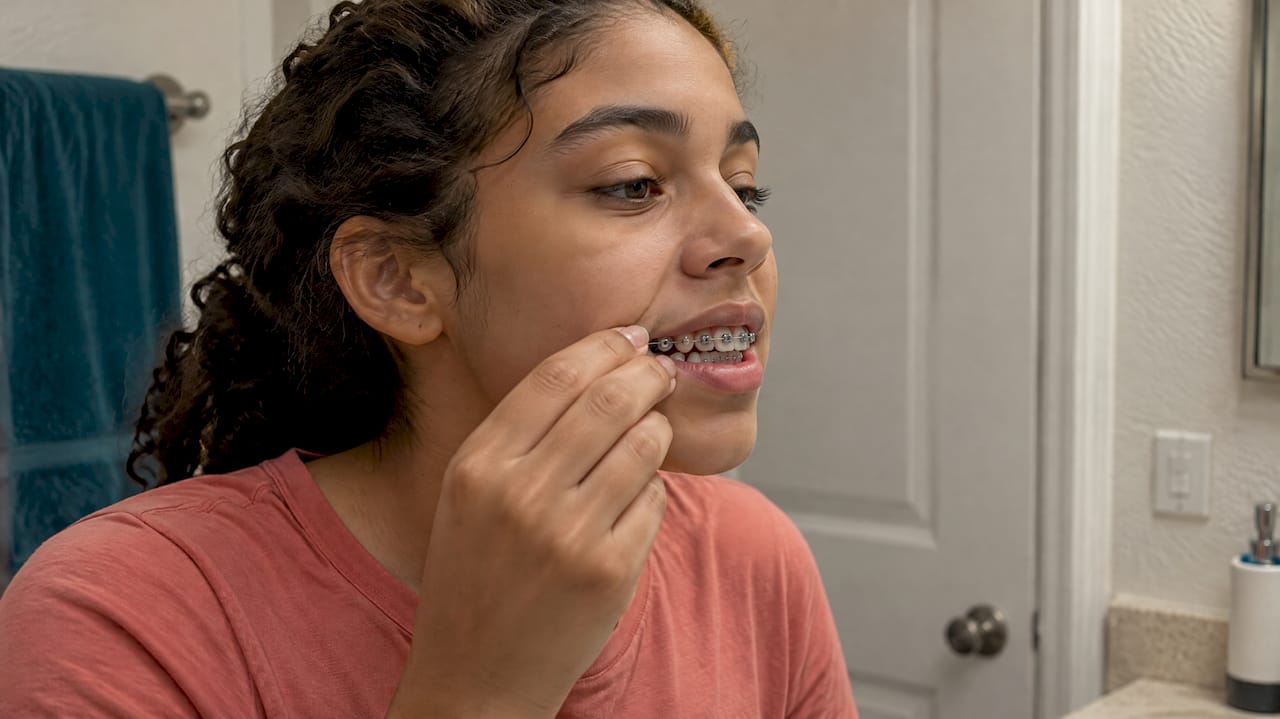
A wire end that jabs your cheek or tongue is usually the result of a tooth shifting or a wire sliding. Try pressing it flat with the eraser end of a pencil, or cover it with wax. If you can’t get it comfortable and the AAO’s basic home kit is within reach, a clean pair of nail clippers is the tool they mention for the rare case where a protruding end must be trimmed. Only do that if your orthodontist tells you to. Do not try to trim it if you might swallow the cut piece. Lie back slightly or hold a tissue or gauze beneath it.
A loose band or loose appliance
Bands wrap around molars. A loose one may spin or shift. Leave it in place unless it is about to fall out, avoid chewing on that side, and call. If it comes out, keep it.
Rubber bands (elastics)
If an elastic snaps, replace it with a new one from your kit. Running out is common, so ask the office for extras. Our guide on wearing orthodontic elastics all day and never doubling up explains why consistent wear matters and why wearing two does not speed things up.
Sore teeth after an adjustment
Soreness for a few days after tightening is normal and is not an emergency. Soft foods and a cold compress help. Severe pain, swelling of the gums or face, or pain that keeps worsening is different: call the office, and if you have facial swelling or fever, ask whether you need to be seen by a dentist urgently.
Mouth sores from braces
Wax on the offending spot plus warm salt water rinses usually calms things. Sores that don’t heal should be looked at.
Clear aligners and retainers
Braces aren’t the only appliance that fails.
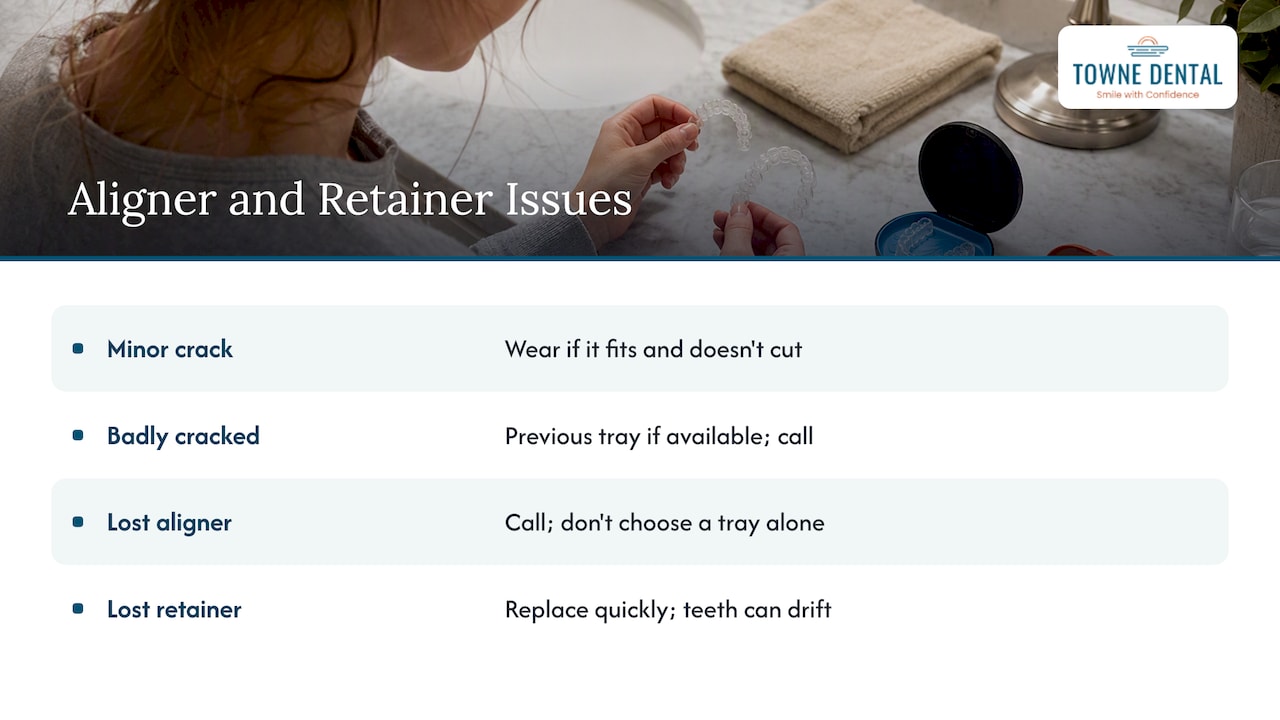
Cracked or broken aligner. If the damage is small and the aligner still fits and doesn’t cut your mouth, many orthodontists have you keep wearing it while they advise you. Don’t skip wear and hope for the best. If it is badly cracked, switch back to your previous tray if you still have it and call.
Lost aligner. Call right away. Depending on where you are in treatment, the office may have you move to the next tray or reorder. Don’t make that decision alone.
Lost or broken retainer. Teeth can drift when a retainer is left out, so don’t wait weeks. If you are in the early phase when it is meant to be worn most of the time, getting a replacement quickly counts. Our article on retainers after braces explains the usual full-time-then-nights pattern.
If you are replacing aligners or retainers and watching costs, it also helps to understand your plan’s limits. Gaps and waiting periods can change what dental coverage pays, and a guide to dental insurance coverage gaps covers the missing tooth clause and how it can affect timing if you change plans.
When it really is a dental emergency
Some situations have nothing to do with wires and everything to do with injury or infection. The ADA lists dental emergencies as potentially life threatening situations that need immediate treatment to stop ongoing bleeding, relieve severe pain or infection, such as uncontrolled bleeding and cellulitis, meaning a spreading soft tissue infection.
Go to the emergency room or call 911 if:
- Bleeding won’t stop after firm pressure.
- You are struggling to breathe or swallow, or swelling is spreading toward your eye or neck.
- You suspect a broken jaw.
- A permanent tooth is knocked out or badly displaced.
- You think you swallowed or inhaled a piece of appliance and can’t find it, especially with coughing, choking or breathing trouble.
For a knocked-out permanent tooth, handle it by the crown, not the root, and get to care immediately. A cracked tooth without trauma to the face is less urgent but still needs attention: see our overview of cracked tooth treatment, options and timing.
In a true medical event, an orthodontic team will put your general safety ahead of appliance repair. Research on this topic, including a survey of orthodontic practices, stresses that regular emergency training for doctor and staff is essential. It is a rare event in an orthodontic setting, but it is why “call 911 first” is the right order.
Calling your orthodontist: what to say
Many offices triage by phone or message before booking a visit. Research reviewed in a systematic review of teleorthodontics in emergencies looked at remote triage, which lets clinicians sort what can be managed at home from what needs an office visit. Help them by being specific:
- Which appliance (brackets, bands, aligners, retainer, elastics) and which tooth or area.
- What happened and when.
- Pain level, swelling, bleeding, or sores.
- What you have already done, such as wax or saving the piece.
- A photo, if the office accepts them. A clear picture of a loose bracket often settles the question.
The AAO notes that some problems are handled with what it calls a comfort appointment, a short visit to relieve irritation, when home measures aren’t enough. Expect the office to ask whether you can wait until your regular appointment or whether you should come in sooner.
Can you go to a different orthodontist?
You can, but it may not be simple. According to the AAO, appliances are often system-specific and not interchangeable, and an orthodontist who isn’t treating you may treat you as a transfer patient and isn’t obligated to accept you. That can complicate and lengthen treatment, so the AAO’s ideal is to stay with one practice from start to finish.
The practical answer: call your own office first, use its after-hours instructions, and use a different clinic only for genuine urgent relief such as pain, a cut or swelling. Then follow up with your own orthodontist.
Build a braces emergency kit
Most problems are easier when you have the basics within reach. The AAO’s list of items in a basic braces kit includes orthodontic wax, tweezers and clean nail clippers. Add to that:
- A small mirror and a flashlight or phone light.
- A travel case for aligners and a spare retainer case.
- Extra elastics, if you wear them.
- Dental floss and an interdental brush for cleaning around damaged hardware.
- Your orthodontic office’s phone number and its after-hours instructions saved in your phone.
- Salt for rinses and gauze for gentle pressure.
Keep a mini kit in your backpack, car or desk. If you travel around Southwest Florida or farther, tell your orthodontist about long trips so you know whom to call.
Our perspective
We see two mistakes. The first is panic: families rush to an emergency room over a poking wire that a bit of wax would have solved. The second is the opposite: a patient lets a broken bracket sit for weeks because it doesn’t hurt, and treatment drifts. Both come from not knowing where the line is, so our advice is simple. Protect your mouth, save any pieces, and call.
We also think comfort matters as much as mechanics. Many people dread dental problems, and a broken appliance at an awkward moment adds stress. At Towne Dental we build care around a gentler, lower-stress experience, and our services include braces and orthodontics, clear aligners, emergency dentistry and sedation dentistry for patients who are anxious. If an issue goes beyond your appliance, such as a cracked tooth or an injury, we can look at it with the rest of your dental health in mind.
— Towne Dental
If you need help in Southwest Florida
If you live in Naples, Bonita Springs, Estero, Fort Myers, Cape Coral, Marco Island or Ave Maria and you are dealing with a dental problem that can’t wait, our team offers emergency dentistry alongside clear aligners and other orthodontic care. Call us to talk through what’s happening and what the next step should be. If it is a life-threatening emergency, call 911 first.
FAQ
What qualifies as an orthodontic emergency?
Severe pain, swelling, trauma to the mouth, or significant damage to an appliance such as a broken bracket, loose band, poking wire or lost aligner or retainer. The AAO frames it as a problem that needs attention sooner than your next scheduled visit. Heavy bleeding or breathing trouble is a medical emergency instead.
What should I do if a bracket breaks at night or on a weekend?
Cover any sharp edge with wax, keep the piece, eat soft foods and listen to your orthodontic office’s after-hours voicemail. Call during business hours unless you have severe pain, swelling or bleeding. If it is a true emergency, go to an ER or call 911.
Can I wait until my next appointment?
Sometimes, but call anyway. Orthodontists warn that leaving broken or loose appliances alone can slow progress. Your office can tell you whether to come in earlier or wait.
What if I swallowed a piece of my braces?
Small pieces often pass without trouble, but call your orthodontist or doctor. If you can’t find the piece and think you may have inhaled it, or you are coughing, choking or short of breath, call 911 right away.
Sources
- What is an Orthodontic Emergency and How Do You Handle Them? (AAO)
- Navigating Broken Bracket Issues During Braces Treatment (AAO)
- Child Orthodontics FAQ (AAO)
- Emergency Treatment (American Dental Association)
- What Constitutes a Dental Emergency? (ADA)
- Management of medical emergencies in orthodontic practice (PMC)
- Utility of Teleorthodontics in Orthodontic Emergencies: A Systematic Review (PMC)