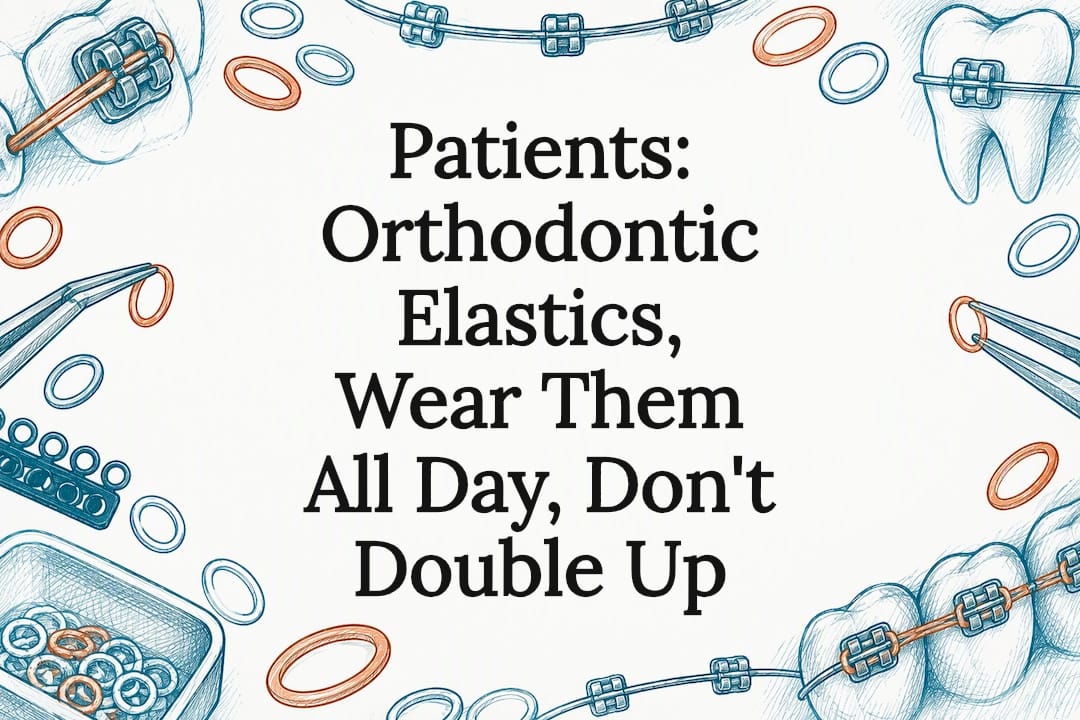
Orthodontic elastics are small, clinician-prescribed rubber bands that add targeted force to braces or aligners to correct bite relationships and achieve precise tooth movements. They supplement what wires and brackets can do on their own, pulling teeth and jaws into positions static hardware cannot reach. The two main goals are correcting how your upper and lower jaws meet and guiding specific teeth into their final positions. Wearing them exactly as prescribed, for the hours your orthodontist sets, determines how well and how quickly they work.
TL;DR:
- Most orthodontists prescribe elastics for most of each day, with removal limited to meals and brushing; replace snapped or stretched bands immediately.
- Your orthodontist selects each band’s force, size, and attachment points for your bite, so never substitute household rubber bands or double up.
- Contact your orthodontist promptly for severe or lasting pain, a loose tooth, swollen gums, or an elastic that disappears beneath the gumline.
- One randomized trial found that early elastic use shortened alignment and leveling time in Class II cases; missed wear can extend treatment by months.
Table of Contents
- What Are Orthodontic Elastics and How Do They Attach?
- How Do Elastics Move Teeth and Correct Your Bite?
- Common Elastic Configurations and What They Fix
- How Many Hours a Day Should You Wear Elastics?
- Is It Safe to Adjust or Double Up Your Elastics?
- Monitored Elastic Therapy at Towne Dental
- How Elastics Affect How Long Your Treatment Takes
- How to Tell If Your Elastics Are Working
- How Elastics Work Alongside Braces and Aligners
- Why Compliance Matters More Than the Elastic Itself
- Schedule an Orthodontic Consultation at Towne Dental
- FAQ
- Sources
What Are Orthodontic Elastics and How Do They Attach?
Orthodontic elastics are medical-grade bands made to withstand continuous stretching and the moisture of your mouth, which is why they bear no resemblance to the rubber bands in a kitchen drawer. According to the American Association of Orthodontists, elastics apply extra force that braces or aligners alone cannot generate, and that force has to be delivered through attachment points your orthodontist controls precisely.
Common attachment points include:
- Hooks built into brackets, where elastics connect directly to the metal or ceramic braces on your teeth.
- Bonded buttons, small attachments cemented onto a tooth surface when a bracket hook isn’t positioned correctly for the needed pull.
- Aligner attachments, tooth-colored bumps or slots added to clear aligners so elastics can anchor without braces.
Your orthodontist selects the elastic’s size and force level based on your specific bite correction, which is also why household rubber bands are never an acceptable substitute: they lack the calibrated tension and material safety of professional elastics.
How Do Elastics Move Teeth and Correct Your Bite?
Elastics work by applying continuous, directional force that teeth and the surrounding bone respond to over time. That steady pressure compresses the periodontal ligament on one side of a tooth and stretches it on the other, triggering bone remodeling that lets the tooth drift into a new position gradually. The same principle applies at a larger scale when elastics pull one jaw relative to the other to correct an overbite, underbite, or shifted midline.
It helps to separate two kinds of change elastics produce. One is tooth-level movement, where a single tooth’s root and crown shift position, often fine-tuning alignment that braces started. The other is intermaxillary change, where the elastic’s pull influences how the upper and lower jaws relate to each other, which is the mechanism behind most bite corrections.
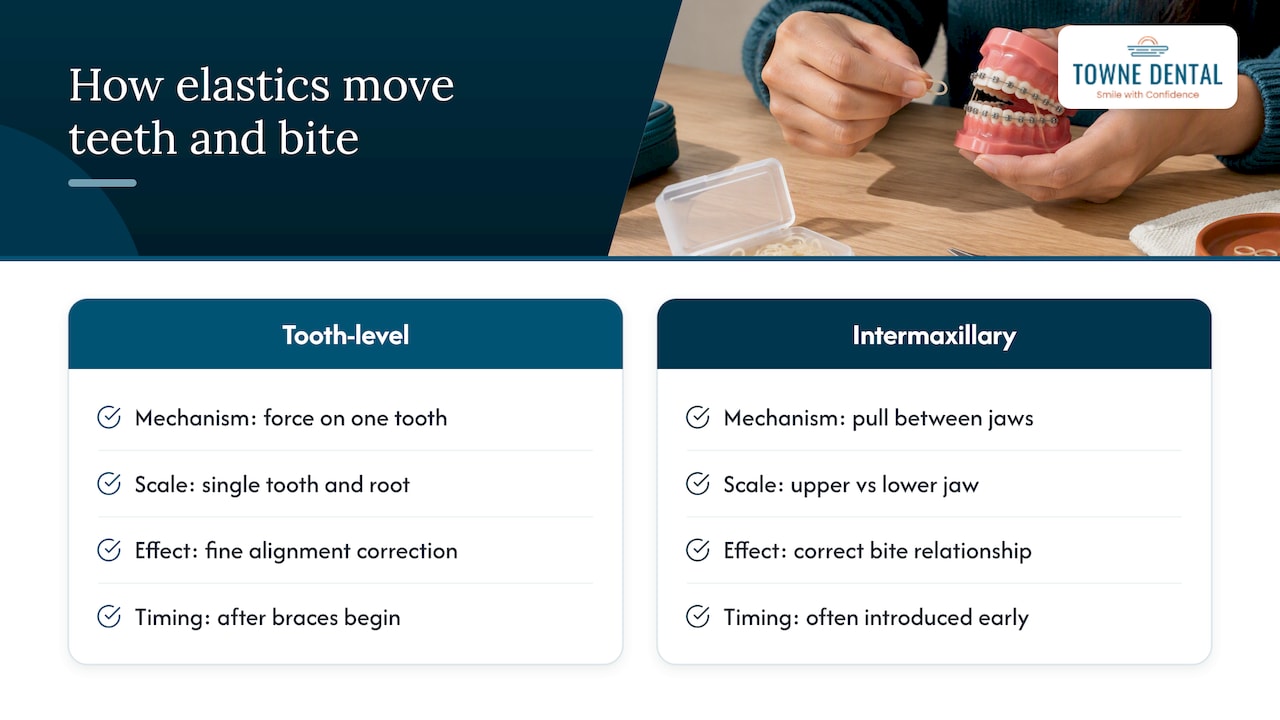
One randomized clinical trial found that early intermaxillary elastic use reduced total alignment and leveling time significantly compared to starting elastics later in treatment for Class II cases, according to a trial reported on PMC. That finding underscores why orthodontists often introduce elastics earlier rather than waiting until braces have done most of the visible work: the bite correction and the tooth movement progress together instead of in sequence.
Common Elastic Configurations and What They Fix
Your orthodontist chooses an elastic pattern based on the specific bite problem being corrected, and the configuration itself tells you a lot about what your treatment is targeting. Some of the most common setups include:
- Class II elastics, which typically run from the upper canine area back to the lower molar area to correct an overbite where the upper teeth sit too far forward.
- Class III elastics, which reverse that path to correct an underbite where the lower jaw protrudes relative to the upper.
- Triangle elastics, connecting three points, often used for localized rotation or minor bite adjustments.
- Vertical or open-bite elastics, which pull specific teeth up or down to close a gap where the front teeth don’t meet when biting.
- Box or cross-arch elastics, used to correct crossbites or asymmetries where one side of the jaw needs a different correction than the other.
The exact strength, size, and attachment points within any of these categories are customized to your bite, so two patients with Class II elastics may still be wearing bands of different force levels.
How Many Hours a Day Should You Wear Elastics?
Most orthodontists prescribe elastics for about a full day each day, removing them only to eat and brush. That near-continuous schedule matters because the tooth and jaw movement elastics produce depends on steady, uninterrupted force. Taking them out for long stretches resets the pressure and slows the correction you’re working toward.
Compliance is a documented challenge. A systematic review of removable orthodontic appliance wear found that objectively measured wear time is consistently lower than what patients self-report and lower than what’s prescribed, a pattern that shows up across different types of removable orthodontic devices, not just elastics. That gap is exactly why orthodontists emphasize building wear into your routine rather than treating it as something to remember separately.
A few practical habits make a real difference:
- Keep a spare set of elastics in your bag, car, and at your desk so a broken band never leaves you without a backup.
- Replace elastics immediately when they snap or lose elasticity, since worn-out bands stop delivering adequate force even if they’re still technically in place.
- Call your orthodontist’s office if you’re ever unsure which elastic configuration to use after a visit, rather than guessing.
Pilot research on behavioral “if-then” planning, cited in a small compliance study, suggests that linking elastic changes to existing habits, such as “if I brush my teeth, then I put in a fresh elastic,” can improve adherence, though results across studies are mixed.
Pro Tip: Attach elastic changes to something you already do daily, like your nighttime routine, so the habit runs on autopilot instead of willpower.
Is It Safe to Adjust or Double Up Your Elastics?
Elastics are safe when used exactly as prescribed, but they carry real risks when patients experiment with them on their own. The American Association of Orthodontists notes that doubling up elastics or increasing force beyond what’s prescribed does not speed up treatment and can cause harm, including potential damage to teeth and jaw. More force is not a shortcut: your orthodontist’s force plan already balances what your teeth and bone can safely handle.
The American Dental Association separately warns against any form of DIY orthodontics, including using household items as substitutes for prescribed appliances, because improper materials and placement can cause irreversible damage. Clinical case reports in dental literature document instances of elastics slipping below the gumline and causing significant tissue and bone loss when not managed under professional supervision.
Watch for these warning signs and contact your orthodontist promptly if any appear:
- Pain that is severe or doesn’t ease after the first few days of a new elastic.
- Gum tissue that looks swollen, discolored, or pulls away from a tooth.
- A tooth that feels loose rather than simply sore.
- An elastic you can no longer see or feel, which may have slipped under the gum.
Patients with latex sensitivities aren’t excluded from elastic therapy: non-latex elastic options exist, and your orthodontist can prescribe them as part of your treatment plan.
Monitored Elastic Therapy at Towne Dental
We provide braces and orthodontic care with elastic therapy supervised at every adjustment visit, so your configuration, force level, and wear schedule get checked and fine-tuned as your bite responds. We walk you through exactly how to place and replace your elastics before you leave the office, and we address soreness with practical guidance rather than leaving you to guess.
Regular checkups let us catch a configuration that isn’t working as expected before it costs you weeks of progress. If you’re dealing with persistent discomfort or a broken elastic between visits, our team can talk you through next steps so you’re never left wondering what to do.
How Elastics Affect How Long Your Treatment Takes
Elastics can shorten or extend your treatment timeline depending entirely on how consistently you wear them. When worn as prescribed, they let bite correction and tooth movement happen simultaneously instead of waiting for braces alone to finish aligning teeth before bite correction even starts. That overlap is part of why the randomized trial on early elastic use found a meaningful reduction in alignment and leveling time when elastics started earlier in treatment.
The reverse is also true: inconsistent wear is one of the most common reasons orthodontic treatment runs longer than originally estimated. Every hour an elastic sits out of your mouth is an hour the prescribed force isn’t acting on your teeth or jaw, and the correction has to restart that pressure from scratch once the elastic goes back in. Over weeks and months, scattered wear adds up to real delays, sometimes extending treatment by months beyond the original plan.
This is also why orthodontists recheck progress at nearly every adjustment appointment rather than simply handing you elastics and seeing you again in two months. Your bite’s response to the current elastic configuration tells your orthodontist whether to continue, adjust the pattern, or change the force level, and that feedback loop is what keeps your treatment timeline on track.
How to Tell If Your Elastics Are Working
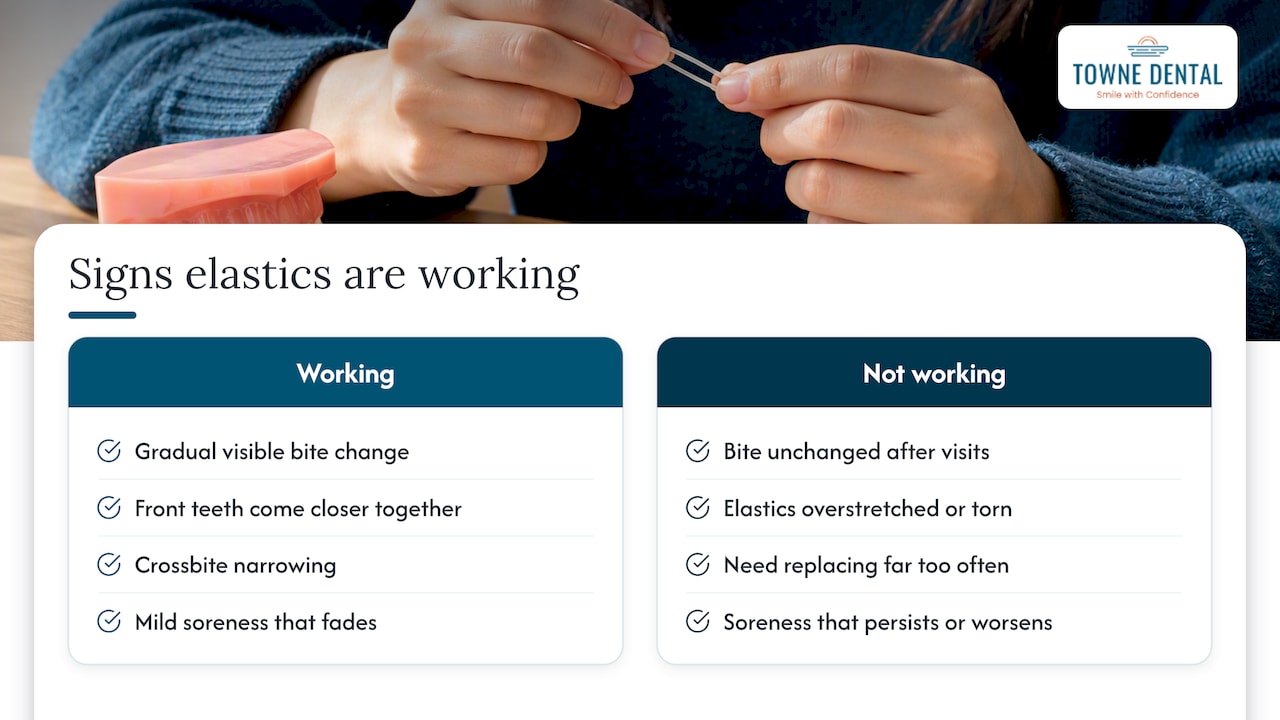
The clearest sign your elastics are working is gradual, visible change in how your teeth meet when you bite down. Over several weeks, you or your orthodontist may notice the front teeth coming closer together, a crossbite narrowing, or the midline of your upper and lower teeth aligning more closely. Mild soreness for the first few days after starting a new elastic or changing force levels is normal and generally fades as your mouth adjusts.
Signs your elastics may not be working as intended include a bite that looks unchanged after several consecutive visits, elastics that need replacing far more often than expected because they’re overstretched or torn, or soreness that persists well beyond the initial adjustment period. AAO patient guidance advises that consistent wear, not removal, is the fastest way to work through soreness, and that persistent or worsening pain should prompt a call to your orthodontist rather than a decision to stop wearing elastics on your own.
Your orthodontist is ultimately the one tracking real progress through photos, bite checks, and measurements at each visit, so don’t rely solely on how your bite feels day to day. If elastics are not producing visible change after a reasonable period, your orthodontist may adjust the configuration, force level, or wear schedule rather than keep the same plan running indefinitely. That kind of course correction is a normal part of treatment, not a sign that something has gone wrong.
How Elastics Work Alongside Braces and Aligners
Elastics don’t operate independently of your braces or aligners: they’re designed to work with whichever appliance is already moving your teeth. With traditional braces, elastics typically attach to hooks built into the brackets, letting the wires continue their slower, continuous tooth alignment while the elastics handle the bite-level correction between your upper and lower jaw. The two systems run at the same time rather than in sequence.
With clear aligners, the coordination looks a little different because there are no permanent brackets to hook onto. Instead, your orthodontist adds small tooth-colored attachments or precision cuts into the aligner tray itself, giving the elastic a stable point to pull against without disrupting the aligner’s fit. This lets elastic-based bite correction happen even though the appliance moving your teeth is removable rather than fixed.
In both cases, the elastic is doing a job the primary appliance can’t do alone: supplying directional, jaw-level force rather than the point-by-point tooth guidance that wires or aligner trays provide. That division of labor is exactly why skipping elastic wear doesn’t just slow down one part of treatment. It leaves the bite correction piece unaddressed while the alignment piece continues, which can create a mismatch your orthodontist then has to resolve later in treatment.
Why Compliance Matters More Than the Elastic Itself
The most overlooked part of elastic therapy isn’t the configuration your orthodontist chooses. It’s whether you actually wear the bands for the hours prescribed, day after day, for the full stretch of your treatment. Patients and even some general advice online focus heavily on which pattern fixes which bite problem, but the clinical trial data on timing suggests the bigger lever is simply starting consistent wear early and sticking with it.
Conventional advice often treats compliance as a matter of willpower, telling patients to just remember their elastics. That framing sets people up to fail. The behavioral research on if-then planning points to something more useful: treatment adherence improves when elastic changes are tied to an existing habit instead of relying on memory alone.
If you take one thing from everything above, it should be this: the force level and configuration your orthodontist prescribes are already calibrated correctly. Your job isn’t to optimize the science. It’s to build a routine reliable enough that wearing elastics becomes as automatic as brushing your teeth, because that consistency, more than any adjustment to the elastic pattern itself, is what determines how your treatment timeline actually plays out.
— Towne Dental
Schedule an Orthodontic Consultation at Towne Dental
If you’re starting orthodontic treatment or want a second opinion on your current elastic prescription, we invite you to schedule a consultation with our orthodontics team.
A visit includes a bite assessment, a treatment plan tailored to your correction needs, and an elastic prescription if your case calls for one, all supervised at each follow-up appointment so your progress stays on track.
This article is general information, not a substitute for advice from a qualified doctor. Consult a qualified healthcare professional about your own circumstances before acting on anything here.
FAQ
What do the animal designs on some elastics mean?
Novelty elastics with animal or character designs are typically a cosmetic option some orthodontic offices offer alongside standard clear or colored bands, with no difference in function or force. Your orthodontist can tell you whether novelty designs are available for your specific prescription.
How long should you wear elastics on your braces each day?
Most orthodontists prescribe elastics for most of the day each day, removing them only to eat and brush your teeth. Wearing them less than prescribed slows the bite correction and tooth movement elastics are meant to produce.
Can you remove elastics while eating?
Yes, elastics are meant to come out before meals and go back in immediately afterward, along with removal for brushing and flossing. Leaving them out longer than necessary reduces the continuous force that drives bite correction.
Do elastics move your teeth, your jaw, or both?
Elastics can do both, depending on the configuration your orthodontist prescribes. Some patterns move individual teeth into better positions, while others, particularly Class II and Class III setups, pull the upper and lower jaws into a corrected bite relationship.
Is it safe to double up elastics to speed up treatment?
No, doubling up elastics or using more force than prescribed does not speed up treatment and can cause harm, including root resorption and jaw joint strain, according to the American Association of Orthodontists. Always follow the exact configuration and force level your orthodontist prescribes.
Sources
- Orthodontic Elastics: Your Pathway to Perfect Alignment — American Association of Orthodontists
- Randomized clinical trial on early vs late intermaxillary elastic use (PMC)
- Systematic review on compliance with removable orthodontic appliances (PubMed)
- Home Oral Care | American Dental Association