Treatment for a cracked tooth depends on how deep the crack runs and where it sits. A surface crack may only need monitoring or bonding. A crack that reaches the nerve usually needs a root canal and a crown. A crack that splits the tooth below the gum line can mean extraction and a replacement such as an implant. The crack will not heal by itself, so the sooner a dentist looks at it, the more options you keep.
This guide covers how to recognize a crack, how dentists find one that can’t be seen, what each treatment involves, and how to protect the tooth until your appointment. It is written for patients in Southwest Florida, from Fort Myers and Cape Coral to Naples and Marco Island, and it is general information, not a diagnosis. Only an exam can tell you what your tooth needs.
TL;DR
- A cracked tooth does not heal on its own. Pain that comes and goes does not mean the crack is gone.
- Cracks are often invisible on X-rays, so diagnosis relies on your description, a bite test, light and sometimes dye.
- The best-supported treatment for a crack that reaches the nerve is a root canal followed by a crown, and the crown should not be delayed.
- “Cracked” does not automatically mean “lost.” Many teeth, even with deep cracks, are saved when treated correctly.
- Call a dentist the same day if you have severe pain, swelling, a fever or a piece of tooth has broken off.
Table of Contents
- How to tell if your tooth is cracked
- How dentists find a crack you can’t see
- Cracked tooth treatment options
- Why the crown can’t wait
- Cracked molar repair
- What to do before your appointment
- How long can you wait?
- Our perspective on treating cracked teeth
- Getting care in Southwest Florida
- Can a cracked tooth be prevented?
- Why the dentist you choose matters
- FAQ
- Sources
How to tell if your tooth is cracked
Cracks rarely announce themselves the way a chipped front tooth does. The American Association of Endodontists describes symptoms ranging from erratic pain when you chew to sudden pain when the tooth meets very hot or cold temperatures. The pain is often unpredictable. It may vanish for days or weeks, and that is exactly why people ignore it.
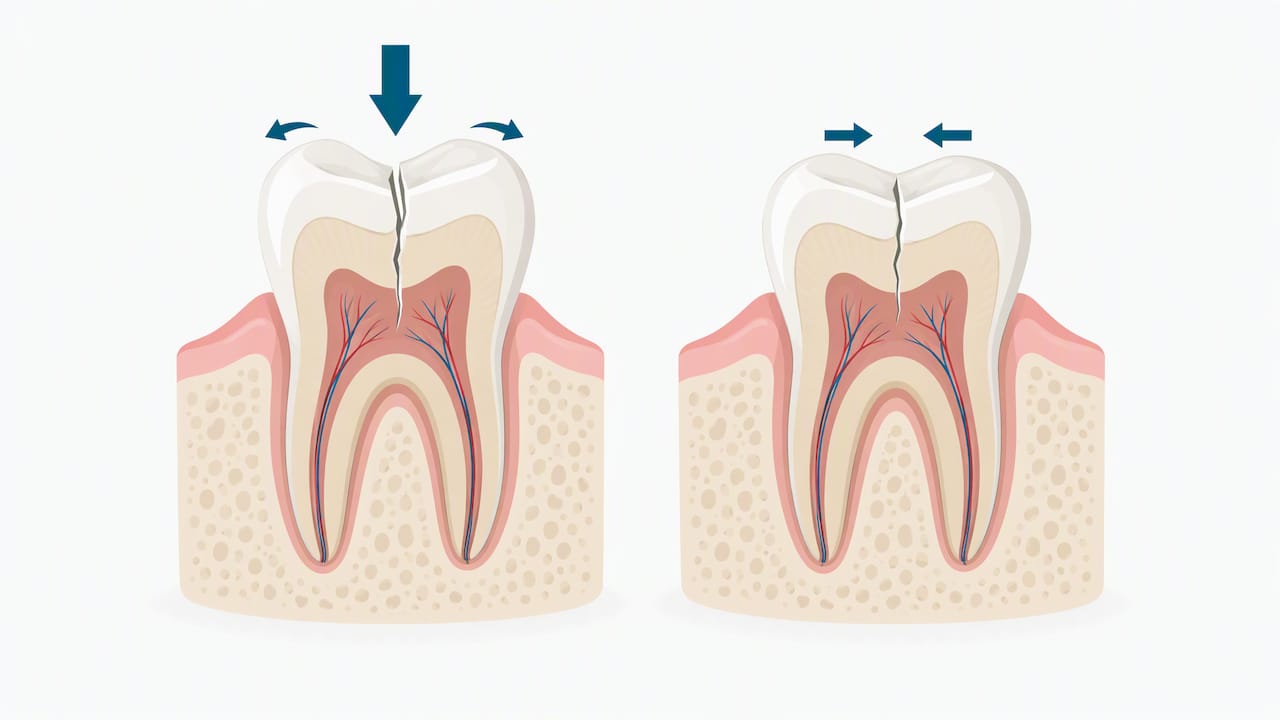
There is a mechanical reason for that pattern. As you bite, the cracked segments can flex slightly and then close again, which irritates the pulp, the tissue holding the tooth’s nerves and blood vessels. Over time that irritation can become irreversible.
How common are symptoms? In a study of 2,858 patients with a cracked back tooth, about 46% of the cracked teeth caused pain. Cold sensitivity (37%) and pain on biting (16%) were the most common complaints. That also means more than half of cracked teeth did not hurt, which is why dentists often find cracks during routine exams.
Signs worth acting on:
- Sharp pain when you bite down, especially when you release the bite
- Sensitivity to cold, heat or sweets that comes and goes
- Pain you can’t pinpoint to one tooth
- Swelling of the gum near one tooth
- A rough edge your tongue keeps finding
Craze lines versus true cracks
Many adults have fine vertical lines in the enamel, called craze lines. They sit in the outer layer, usually cause no pain, and are generally cosmetic. A true crack goes deeper and tends to hurt with biting or temperature. You can’t reliably judge the difference yourself, because both can look like a thin line under bathroom lighting. If a line is new, catches a fingernail, stains or comes with any sensitivity, have it checked.
What causes teeth to crack
The American Dental Association lists chewing hard items such as ice, nuts or hard candy, accidents that hit the mouth, grinding and clenching, and uneven chewing pressure among the common causes. Large old fillings can also leave a tooth with less structure to resist biting forces. If you grind your teeth at night, a custom nightguard is one of the more practical ways to protect the teeth you have.
How dentists find a crack you can’t see
Patients often expect an X-ray to settle it. Often it doesn’t. According to the ADA’s patient article, cracks are frequently invisible on standard X-rays and sometimes to the naked eye. Dentists combine several tools:
- Your history. When does it hurt: biting, releasing, cold, heat? Which side? Your answers are often the best clue.
- A bite test. You bite on a small instrument or tab one cusp at a time to reproduce the pain.
- Transillumination. A bright light shone through the tooth can show where the light stops at a crack.
- Dye staining. A dye such as methylene blue can settle into the crack and outline it.
- Gum probing. A narrow, deep pocket next to one tooth can point to a crack extending toward the root.
Before you go, jot down when the pain happens, what triggers it and how long it lasts. Five minutes of notes can shorten the hunt.
Cracked tooth treatment options
The AAE’s review of cracked tooth management says prognosis depends on three things: the location and extent of the crack, the timing of treatment, and the type of restoration. Here is how that plays out.
| Situation | Typical approach | Notes |
|---|---|---|
| Craze lines, no symptoms | Monitoring, polishing | Cosmetic options if the look bothers you |
| Small crack in a tooth with a healthy nerve | Bonding or a filling, sometimes a crown | Smaller cracks are where dentists’ recommendations vary most |
| Crack in a tooth with biting pain or a large filling | Crown (full coverage) | Holds the tooth together so it can’t flex |
| Crack reaching the nerve | Root canal, then a crown | Best-supported option for saving the tooth |
| Crack split below the gum or through the root | Extraction, then implant, bridge or denture | When the tooth can’t be restored |
Bonding and fillings
For a minor crack with a healthy nerve, a dentist may bond tooth-colored resin over it or replace a failing filling. This is a conservative step that can reduce sensitivity. Some cracked teeth are treated with direct restorations alone, but a narrative review of cracked tooth treatment discusses both monitoring and restoring as legitimate paths. Which is right depends on the crack and your symptoms.
Crowns
A crown caps the tooth like a sleeve. The AAE explains that the goal of treating a cracked tooth is to stop the crack from spreading, and full-coverage restorations do that by immobilizing the tooth. Think of the crown as a brace: it keeps the two sides from flexing when you bite, which is what produces the sharp pain.
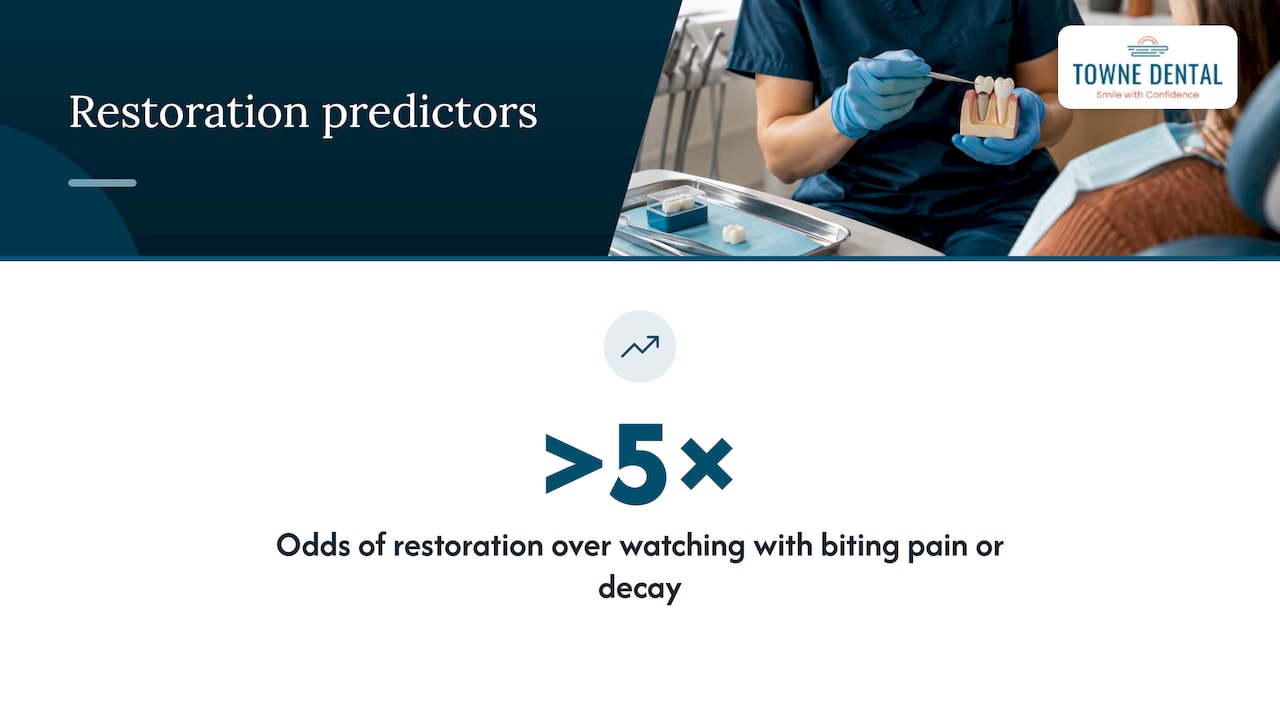
In the 2019 practice-network study above, biting pain and decay were the strongest predictors, with more than five-fold odds, that a dentist would recommend restoring a cracked tooth rather than watching it.
Root canal, then crown
When a crack lets bacteria reach the pulp, or the pulp is inflamed beyond recovery, a root canal removes the damaged tissue and seals the space. People often fear this step, but its purpose is to end the pain and save the tooth.
The evidence supports this pairing. A 2026 umbrella review of systematic reviews found root canal therapy followed by full cuspal coverage to be the most predictable approach, with survival rates of 84% to 96%. It also reports that teeth without full coverage were about 11.3 times more likely to be lost than crowned teeth.
When extraction is the honest answer
Some cracks run too deep. If the fracture splits the tooth through the root, or the remaining tooth can’t hold a restoration, extraction protects the surrounding bone and gums from infection. Even then, you have options. A dental implant, a bridge or a denture can replace the tooth. This is where an accurate diagnosis matters, since the AAE notes that even teeth with cracks extending into the root can survive at high rates in modern datasets when they are managed well.
Why the crown can’t wait
This is the most common mistake we see described in the literature: after a root canal, the pain disappears, so the crown feels optional. It isn’t. The tooth is still structurally compromised.
The AAE cites a landmark study in which 94% of root canal-treated cracked teeth that received a crown survived two years, against 20% of those left uncrowned. Place the crown promptly, and keep the follow-up appointment even when you feel fine.
Cracked molar repair
Back teeth crack most often because they take the heaviest chewing load. A cracked molar usually follows the path in the table above: a crown for a crack with a healthy nerve, a root canal plus crown if the nerve is involved. Molars have more roots and canals, which makes careful diagnosis more important. If a molar hurts only when you release the bite, mention it, because that detail often points to a crack.
What to do before your appointment
These steps are comfort measures, not treatment. They don’t fix the crack.
- Rinse gently with warm salt water to keep the area clean.
- Hold a cold pack against the outside of your cheek for swelling.
- Avoid chewing on that side and skip very hot, cold or hard foods.
- If you take an over-the-counter pain reliever, follow the label and your own doctor’s guidance, especially if you have other health conditions or take other medications.
- Save any fragments and bring them with you.
Don’t try to glue the tooth, and don’t test it by biting on something hard.
When to call the same day
Severe or throbbing pain, facial swelling, a fever, a bad taste or a pimple-like bump on the gum can mean infection. Swelling that affects your breathing or swallowing needs emergency care, so go to an emergency room. A tooth that has broken in half, or a crack from a blow to the face, also warrants a same-day call.
How long can you wait?
There is no safe timeline. A crack doesn’t heal, and the AAE notes that waiting lets it open and close with every bite, risking irreversible damage to the pulp. The AAE also says that when a crack is treatable, early restorative treatment is generally recommended to prevent pulp damage and structural failure. A tooth that needs only a crown today can need a root canal and a crown in six months.
Our perspective on treating cracked teeth
At Towne Dental, we see a cracked tooth as a timing problem as much as a technical one. The patients who have the easiest road are those who come in when the first twinge appears, not after weeks of avoiding one side of the mouth.
A few things we hold to:
- Diagnose before you drill. Because cracks hide, we want your story first, then the exam. Not every crack needs the same level of treatment, and we won’t recommend more than your tooth requires.
- Treat the whole picture. Our office offers general dentistry, endodontics, crowns, oral surgery and implants under one roof, so a plan that moves from root canal to crown, or from extraction to replacement, doesn’t have to be handed off across town.
- Make it comfortable. Many people delay a cracked tooth because they dread the chair. We offer sedation dentistry and a gentle approach for anxious patients.
- If a tooth can’t be saved, replace it well. We use the Yomi® robotic system for assisted dental implants, which supports precise, less invasive placement.
We would rather see you for a quick check that turns out to be minor than meet you after a crack has split the tooth.
— Towne Dental
Getting care in Southwest Florida
If you think you have a cracked tooth, we can evaluate it and explain your options before any treatment starts. Our emergency dentistry and general services cover urgent pain, and our general dentistry page explains crowns, fillings, bridges and dentures. If a tooth can’t be saved, read about dental implants and tooth extraction. We see patients from Fort Myers, Cape Coral, Estero, Bonita Springs, Naples, Marco Island and Ave Maria. Ask about insurance and payment options when you call, since we don’t publish set fees for these treatments.
Can a cracked tooth be prevented?
Not always, but you can lower the odds:
- Skip ice chewing and hard candy, and don’t open packages with your teeth.
- Wear a mouthguard for contact sports.
- If you clench or grind, ask about a nightguard.
- Have large or old fillings checked at routine cleanings, since a weakened tooth is more likely to split.
- Don’t postpone a crown that a dentist has recommended.
The ADA also lists uneven chewing pressure and stress on a tooth as contributors, so an uneven bite is worth mentioning at your next exam.
Why the dentist you choose matters
The National Dental Practice-Based Research Network found wide variation in how dentists treat cracks. Dentists agree on crowning teeth that have had a root canal, but recommendations for smaller cracks differ. A second opinion is reasonable if you’re told to extract a tooth that still looks restorable. Ask how the crack was diagnosed, how deep it appears to be, and what happens if you wait.
FAQ
Can a cracked tooth heal on its own?
No. Unlike bone, tooth structure doesn’t knit back together, and the crack can grow with chewing. Pain may fade for a while, but that doesn’t mean the crack has closed. A dentist should check any tooth you suspect is cracked.
Does a cracked tooth always need a crown?
Not always. A very small crack in a healthy tooth may only need bonding or watching. Teeth with biting pain, large fillings or a root canal generally benefit from a crown. Your dentist will weigh the location and depth of the crack, your symptoms and your bite.
Is a root canal or a crown better for a cracked tooth?
They do different jobs. A root canal treats the nerve when it is inflamed or infected, and a crown protects the tooth from splitting further. If the crack reaches the nerve you usually need both, and the research shows better survival when the crown follows the root canal promptly.
How much does it cost to fix a cracked tooth?
It varies widely, from a simple filling to a root canal, crown or implant, and your insurance changes the out-of-pocket amount. We don’t publish set prices, because we can only quote after an exam. Call our office and we can walk you through the likely steps and cover costs and coverage.
Can a cracked tooth be saved if the crack is deep?
Often, yes. Modern data show survival rates of 82% to 96% for teeth with deeper cracks treated with a root canal and a well-fitted crown. A crack that splits the root is the main case where extraction becomes the better choice.
Sources
- Cracked Teeth, American Association of Endodontists (patient page)
- Cracked Teeth: To Treat or Not to Treat?, American Association of Endodontists
- Cracking the Cracked Tooth Code, American Association of Endodontists
- Do you have a cracked tooth?, The Journal of the American Dental Association
- Recommended treatment of cracked teeth: National Dental Practice-Based Research Network
- Saving the split: An umbrella review on cracked tooth syndrome
- Treatment of cracked teeth: A comprehensive narrative review