A tooth abscess is always worth treating quickly, but it does not always mean the emergency room. Go to the ER if the infection is affecting your breathing, swallowing or your whole body: trouble breathing, trouble swallowing, a swollen eye, swelling spreading under the jaw or down the neck, a fever with chills, confusion, or a racing heart. If your pain is intense but the swelling is local and you feel otherwise well, call a dentist the same day. Only a dentist can remove the source of the infection.
Below, we explain how to tell the two situations apart, what to do while you wait for care, what treatment really involves, and why antibiotics alone rarely fix the problem.
TL;DR
- Go to the ER or call 911 for trouble breathing or swallowing, inability to open your mouth, drooling, a swollen eye, swelling under the jaw or neck, high fever, confusion, or a fast heartbeat.
- Call a dentist today for severe tooth pain, a pimple-like bump on the gum, a bad taste, or swelling limited to the area around one tooth.
- An abscess does not heal on its own. The cure is removing the source: a root canal, drainage or extraction.
- Antibiotics are an add-on, not the fix, and are mainly for signs of body-wide illness.
- If it is not improving within 48 hours of treatment, go back right away.
Table of Contents
- What a tooth abscess actually is
- When to go to the ER for a tooth abscess
- When a dentist is the right call
- How fast can an abscess progress?
- What to do while you wait for care
- What treatment really involves
- Is the pain a different problem?
- Our perspective
- Emergency dental care in Southwest Florida
- After the abscess is treated
- Frequently asked questions
- Sources
What a tooth abscess actually is
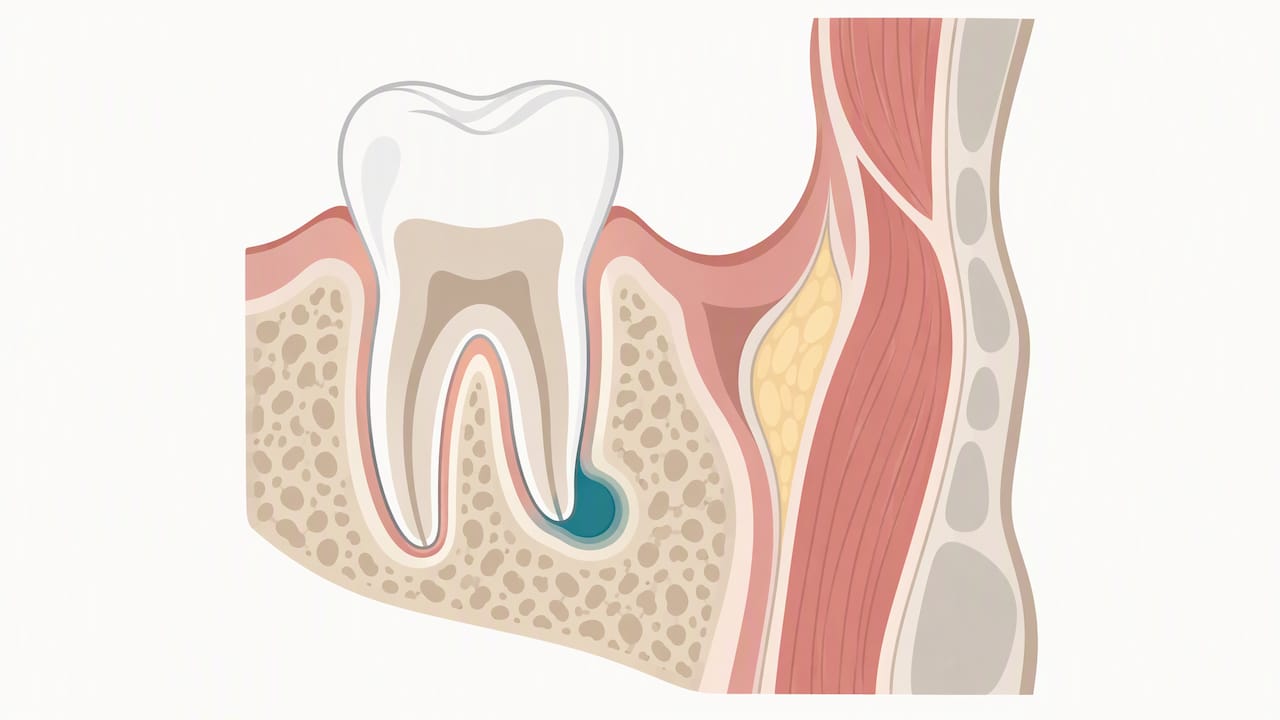
An abscess is a pocket of pus caused by a bacterial infection. Usually the bacteria reach the inside of the tooth through deep decay, a crack or a previous dental problem, kill the nerve, and spill out around the root tip. Dental references use the terms apical abscess, dentoalveolar abscess and odontogenic abscess more or less interchangeably for this collection of pus at the root. A different kind, a periodontal abscess, forms in the gum next to a tooth, often when deep gum pockets trap bacteria. If you have been told you have gum pockets, our guide to gum pockets treatment explains why that matters.
The key point is that the infection sits right next to the spaces of your face and neck. That is why a problem in a single tooth can turn into a medical emergency.
When to go to the ER for a tooth abscess
Most dental abscesses can be handled in a dental office. Clinicians who study these infections point out that, because of their closeness to the airway, they can still be dangerous, and that an emergency department visit is warranted when the infection causes systemic illness or threatens the airway.
Go to the nearest ER, or call 911 if you cannot get there safely, if you have a tooth abscess and any of the following:
- Trouble breathing or a feeling that your throat is closing.
- Trouble swallowing, drooling, or a muffled “hot potato” voice.
- Being unable to open your mouth normally (trismus).
- Swelling of the face, an eye, or below the jawline or neck. Hospital guidance lists facial swelling, swelling of the eye and swelling under the jaw as reasons to go straight to the ER.
- Fever, shivering or feeling very cold, especially alongside worsening pain.
- Confusion or disorientation, a fast heartbeat or weak pulse.
The last two groups matter because of sepsis. The CDC describes sepsis as the body’s extreme response to an infection and a life-threatening medical emergency. Its warning signs include confusion, extreme pain or discomfort, fever, shivering or feeling very cold, a high heart rate or weak pulse, and difficulty breathing. A dental infection can be the starting point.
The airway symptoms are the ones people most often underestimate. Trouble swallowing, drooling or being unable to open your jaw are not signs of “a bad toothache.” They suggest the infection is moving toward the airway, and waiting for a dental appointment is the wrong call.
What happens in the ER
Expect an exam, vital signs, and probably blood work or imaging if the infection looks deep. If you have severe systemic signs, surgical guidance describes a stay that may include 24 to 48 hours of intravenous antibiotics, fluids and observation. In extreme cases, that can mean hospital admission or surgery to protect the airway. Some ER providers can drain an abscess depending on where it is, but many ERs do not have a dentist on call. You will often need a dental or oral surgery visit afterward to deal with the tooth itself.
When a dentist is the right call
For localized pain without signs of whole-body illness, the dentist is the primary and most effective provider for urgent, definitive care, as the same emergency medicine review notes. Call a dental office the same day if you have:
- Severe, throbbing tooth pain, sometimes radiating to the ear or jaw.
- Pain when biting or a tooth that feels “high.”
- Sensitivity to hot and cold that lingers.
- A pimple-like bump on the gum, or a sudden salty, foul taste if it drains.
- Moderate swelling right around the tooth.
When you call, say the word “abscess” or “swelling.” Tell the office about fever, difficulty swallowing and any medical conditions. That lets the staff decide how fast to see you.
A quick comparison
| Situation | Where to go |
|---|---|
| Trouble breathing, swallowing or opening the mouth | ER or 911 now |
| Swelling of the eye, jaw or neck | ER now |
| Fever with chills, confusion, racing heart | ER now |
| Severe pain, bump on the gum, local swelling, you feel otherwise well | Dentist the same day |
| Dull ache, mild sensitivity, no swelling | Dentist within a few days |
| Abscess that burst and drained, pain much better | Dentist still needed, soon |
A burst abscess is not a cure. Relief is real, because pressure drops, but the source of infection is still there and can flare again.
How fast can an abscess progress?
People often ask how long they can wait. There is no safe number, because infections move at different speeds. A review of odontogenic infections describes a typical course in three stages: soft, mildly tender swelling in the first one to three days; hard, red, severely sore swelling at around two to five days; and a pus-filled abscess at roughly five to seven days. These are general timelines, not a schedule you can count on. The same review stresses seeking care as soon as swelling or intense pain appears, because early drainage can decompress the spaces and improve outcomes.
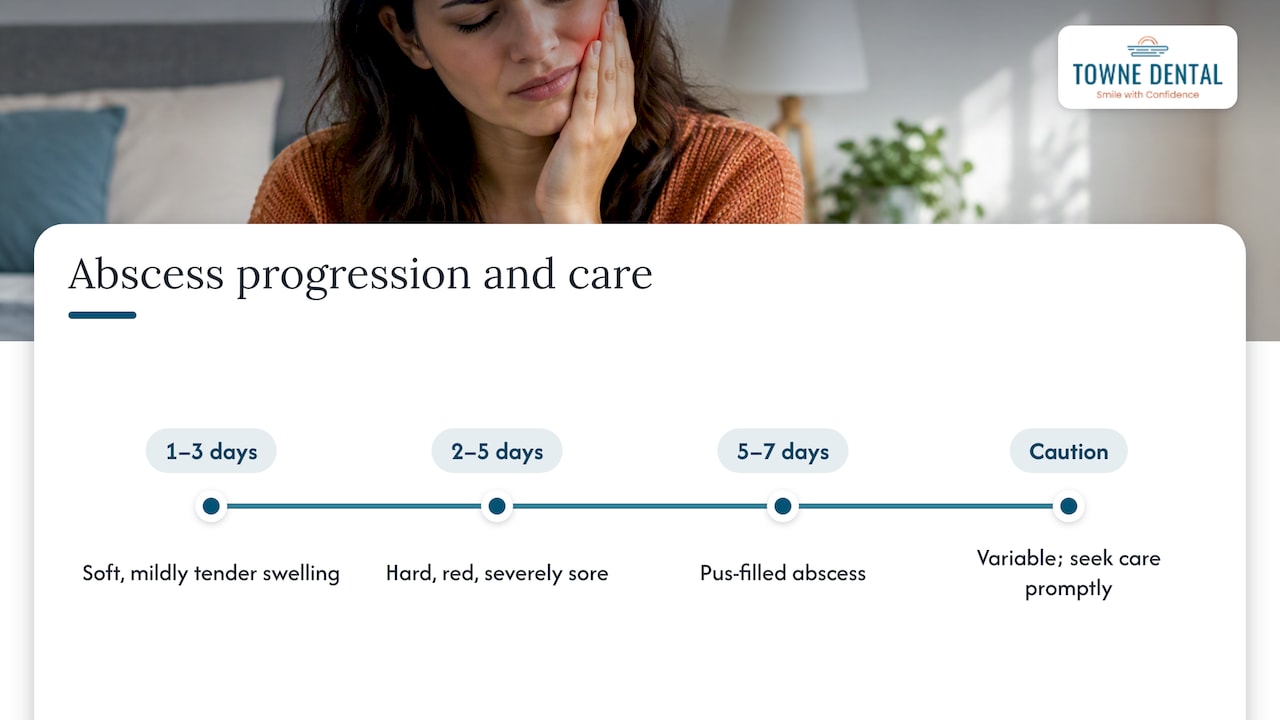
If your swelling is growing hour by hour, that is faster than the textbook and a reason to treat it as urgent.
What to do while you wait for care
These steps ease symptoms. They do not treat the infection, and none of them replaces being seen.
- Take over-the-counter pain relief as labeled. The ADA guidance pairs definitive dental treatment with over-the-counter pain relievers such as acetaminophen or ibuprofen. Check the label and ask your doctor or pharmacist if you have kidney, stomach, liver or blood-thinner concerns.
- Rinse gently with warm salt water. It can soothe the gum and help clean the area.
- Use a cold compress on the outside of your cheek, in short intervals.
- Sleep with your head raised to reduce throbbing.
- Do not put aspirin on the gum, and do not poke, squeeze or try to drain the abscess yourself.
- Do not apply heat to the face. It can encourage swelling to spread.
- Watch for red flags. If any ER symptom above appears, stop waiting and go.
If you already have an old antibiotic prescription in the cabinet, do not self-treat. Guessing at the drug, dose and length is exactly the kind of use the CDC and ADA are trying to reduce.
What treatment really involves
Here is what many people do not expect: antibiotics are not the first-line answer for most dental abscesses. The 2019 ADA guideline on urgent dental pain and swelling, endorsed by the American College of Emergency Physicians, recommends that dentists prioritize definitive, conservative dental treatment for immunocompetent adults, and reserve antibiotics for cases with systemic involvement such as fever or malaise. A CDC checklist for dentists repeats this advice.
The reason is simple. Antibiotics circulate in the blood, and a dead tooth with a pus pocket has little blood supply. The medicine may not reach the site well, so the infection returns when the course ends. The cure is to eliminate the source. Depending on the tooth, that means one of these:
- Root canal therapy. The dentist cleans out the infected pulp, disinfects the canals and seals the tooth. This saves the natural tooth when enough healthy structure remains.
- Incision and drainage. For a swelling that is ready, a small opening lets the pus out and relieves pressure.
- Tooth extraction. When the tooth cannot be saved, removing it removes the source. Afterward, our guide to what to eat after a tooth extraction covers the first days of healing.
- Gum treatment for periodontal abscesses, which targets the pocket beside the tooth.
When a patient does have fever or other signs of systemic involvement, the ADA guidance lists amoxicillin or penicillin V potassium for a short course of 3 to 7 days. Which drug, if any, is a decision for the treating clinician, particularly if you have a penicillin allergy or a weakened immune system.
The 48-hour check
One habit protects people: reassess after 48 hours. If swelling, pain or fever are not clearly getting better after drainage or after starting antibiotics, the treatment is not working and care needs to escalate. Being on antibiotics does not mean you are safe. Call your dentist back the same day, or go to the ER if any red flag appears.
Is the pain a different problem?
Not every severe toothache is an abscess. A cracked tooth can cause sharp pain when biting, and a crack can eventually let bacteria into the pulp. If the pain comes and goes with chewing and you see no swelling, read about cracked tooth treatment options and timing. Either way, the answer is the same: get examined. A dentist can tell the difference with an exam and an X-ray, and you should not diagnose it by feel.
Our perspective
We see the same pattern again and again: the pain gets bad, the patient takes pain relievers, waits a weekend, and calls only when the face is swollen. We would rather you call early. A tooth that can be saved with a root canal on Monday can become an extraction, or an ER visit, by Thursday.
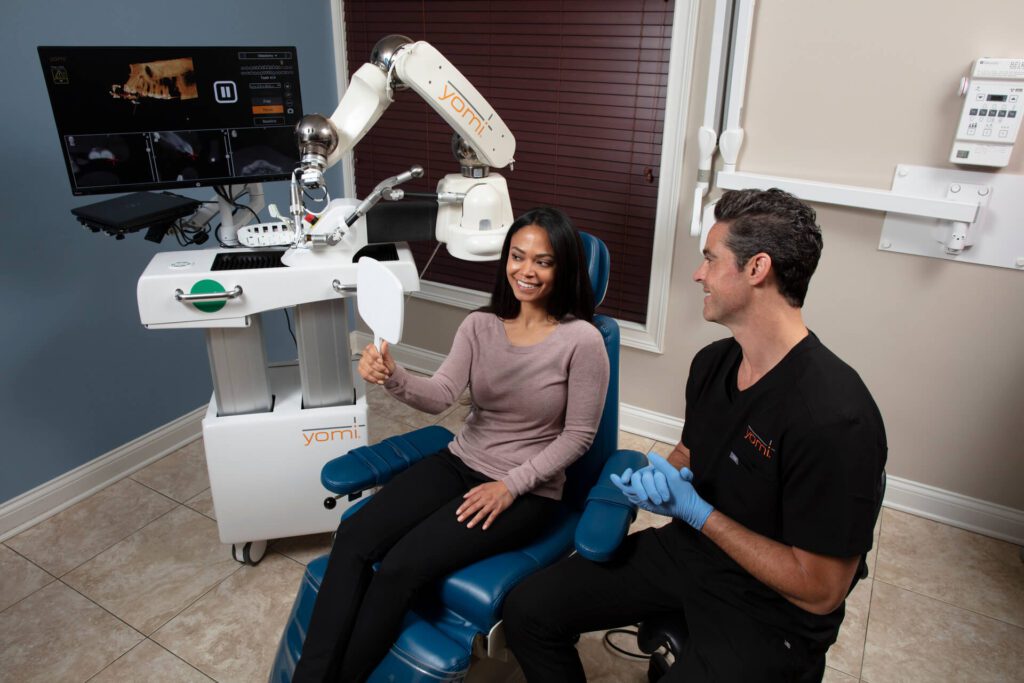
We also know that fear is often the real delay. People put off calling because they dread the chair. That is why our approach to emergency care is built around comfort: we explain what we are going to do, treat the source of the problem, and offer sedation dentistry for patients who are anxious about procedures. If a tooth cannot be saved, we can talk through replacing it afterward, including implants placed with Yomi® robotic guidance for precision and a less invasive procedure.
Our advice is simple. If you have trouble breathing or swallowing, a swollen eye, neck swelling or a high fever, go to the ER first. For everything else that looks like an abscess, call a dentist the same day. Do not wait for it to burst.
— Towne Dental
Emergency dental care in Southwest Florida
If you live in Naples, Fort Myers, Cape Coral, Bonita Springs, Estero, Marco Island or Ave Maria, Towne Dental offers emergency dentistry alongside general dentistry, endodontics, oral surgery and sedation dentistry, so an abscess can be evaluated and treated at one practice. Call the office when symptoms start, tell the team about swelling and fever, and ask for the earliest available urgent visit. If your symptoms match the ER list above, do not call us first: go to the nearest emergency room.
To see the full list of what we treat, including extractions and implants, visit our website.
After the abscess is treated
Getting through the infection is the first half. The second half keeps it from coming back.
- Finish what you are given. If you were prescribed antibiotics, take them as directed. Do not stop early because you feel better, and do not save leftovers.
- Restore the tooth. A tooth that has had a root canal usually needs a crown to protect it from fracture.
- Plan for missing teeth. If a tooth was removed, options include a bridge, a denture or an implant. Leaving a gap can let neighboring teeth drift.
- Treat the cause. Deep decay, a cracked tooth or gum disease are what let bacteria in. Fix them, and keep your cleanings on schedule.
- Know your triggers. Any return of swelling, a gum bump or a bad taste means a call to the dentist right away.
Frequently asked questions
What happens if you go to the ER for a tooth abscess?
The ER team will check your vital signs, examine your mouth and neck, and may order imaging or blood tests. They treat the immediate danger, which can include pain control, IV antibiotics and, in serious cases, drainage or airway protection. They generally cannot complete a root canal or tooth repair, so you will need a dentist afterward.
What are the first signs of sepsis from a tooth abscess?
Watch for fever, shivering or feeling very cold, confusion, a fast heart rate or weak pulse, difficulty breathing, and pain that feels extreme. The CDC treats sepsis as a medical emergency. If you notice these signs with a dental infection, go to the ER or call 911.
How long can you wait with a tooth abscess?
You should not wait. Get a dental appointment the same day if you can, since the infection does not clear without removing its source. Swelling that spreads, fever, or any trouble breathing or swallowing means going to the ER now.
How long before a tooth abscess bursts?
There is no reliable timeline. One review describes abscess formation at around five to seven days in a typical infection, but individual cases vary widely. Rupture brings relief, but it does not cure the infection, so you still need dental treatment.
Can I treat an abscess with antibiotics alone?
Usually not. Current ADA guidance says definitive dental treatment comes first, with antibiotics reserved for signs such as fever or malaise. Antibiotics alone may quiet symptoms for a while, but the infection often returns.
Sources
- Oral Facial Infection of Dental Origin: A Guide for the Medical Practitioner, StatPearls
- Review article: Maxillofacial emergencies: oral pain and odontogenic infections
- Can You Go to the ER for Dental Emergencies? Baptist Health
- About Sepsis, CDC
- Management of acute dental problems: an aide-mémoire for referrals to oral and maxillofacial surgery
- Management of odontogenic infections and sepsis: an update
- Dental Infection Antibiotics Guidelines for Pain and Swelling, American Dental Association
- Checklist for Antibiotic Prescribing in Dentistry, CDC