Bleeding gums during pregnancy are common, usually harmless in themselves, and worth getting checked. Rising hormone levels make your gums react more strongly to the plaque already on your teeth, so they swell and bleed when you brush or floss. The fix is almost always more careful cleaning at home plus a professional cleaning and exam, both of which are safe at any stage of pregnancy.
Below, we walk through why it happens, what you can do tonight, what your dentist can safely do, and the signs that mean you should not wait.
TL;DR
- Bleeding gums affect up to 75% of pregnant people, mostly because hormones make gums more sensitive to plaque.
- Keep brushing twice a day with fluoride toothpaste and flossing once a day. Bleeding that comes from inflammation improves when you clean the area well, not when you avoid it.
- Cleanings, X-rays with shielding, and local anesthesia are safe at any point in pregnancy. Tell your dentist you are pregnant.
- Call a dentist promptly for heavy bleeding, pus, a painful lump, loose teeth, or facial swelling. Infections should not wait for the baby to arrive.
Table of Contents
- Why your gums bleed when you’re pregnant
- Is it normal, or is it something more?
- What to do at home starting tonight
- Can you get a dental cleaning while pregnant?
- Does gum disease affect the pregnancy?
- Safe dental treatments during pregnancy
- A word on fluoride varnish
- Paying for care and insurance questions
- Our perspective: gentle care, started early
- Book a gum check with Towne Dental
- When to call right away
- FAQ
- Sources
Why your gums bleed when you’re pregnant
Your gums have always had a reaction to plaque, the sticky film of bacteria that builds up along the gumline. During pregnancy, the reaction gets louder. The American Dental Association explains that hormonal changes, especially higher progesterone, increase gum sensitivity to plaque and bacteria. The same amount of plaque that caused no trouble before can now leave gums red, puffy, tender and quick to bleed.
This is called pregnancy gingivitis. Gingivitis is the mild, early stage of gum disease, and the JADA patient guide on pregnancy lists it alongside gum overgrowths and periodontal disease as ways hormones can affect your gums.
A few features help you recognize it:
- Gums look bright red or darker than usual, and feel puffy or tender.
- Blood shows up on the brush, the floss, or in the sink after rinsing.
- Bad breath or a bad taste that brushing doesn’t clear for long.
- It often starts in the first trimester and tends to be most noticeable in the second and third. Many people find it settles after delivery, though that is not a reason to skip care in the meantime.
Morning sickness can add to the problem. If brushing makes you gag, you may start skipping the back teeth or shortening the routine, and plaque builds up fast in exactly the places that bleed.
Is it normal, or is it something more?
Bleeding that is mild, appears when you brush or floss, and affects several areas is the classic pattern of pregnancy gingivitis. It is common, and it is reversible with good hygiene and professional cleaning.
Some signs point to something that needs a dentist soon rather than eventually:
| What you notice | What it may mean | What to do |
|---|---|---|
| Gums bleed a little when brushing or flossing, look red and puffy | Pregnancy gingivitis | Improve home care, book a cleaning and exam |
| A soft, red or purple lump on the gum that bleeds easily | A pregnancy-related gum overgrowth (often called a pregnancy tumor, though it is not cancer) | Have it examined. Many shrink after delivery, but some need removal if they interfere with eating or cleaning |
| Gums pulling away from teeth, persistent bad breath, teeth that feel loose | Possible periodontitis, a more advanced gum disease | See a dentist for a periodontal evaluation |
| Bleeding that is heavy or won’t stop, or pus along the gumline | Infection or another problem | Call a dentist the same day |
| Facial swelling, fever, severe tooth pain | Possible abscess | Urgent care. Do not wait |
The ADA’s guidance on gum changes in pregnancy notes that gingivitis can progress. The JADA overview describes periodontal disease as one of the conditions hormones can aggravate, which is why a gum check early in pregnancy is worthwhile even if you feel fine.
What to do at home starting tonight
The goal is to remove plaque from along the gumline every day, gently but thoroughly. Bleeding gums feel like a reason to be careful, and you should be gentle, but backing away from them lets the inflammation continue.
- Brush twice a day with fluoride toothpaste. ACOG and the ADA both recommend twice-daily brushing with fluoride toothpaste and daily flossing during pregnancy.
- Use a soft brush and short, small strokes. Angle the bristles toward the gumline. Scrubbing hard doesn’t clean better and can make tender gums worse.
- Floss once a day. Expect some bleeding for the first several days. If it is plaque-related, it should lessen within one to two weeks of consistent cleaning. If it doesn’t, tell your dentist.
- Try a smaller-headed brush if gagging is the issue. ACOG’s guidance mentions this for patients whose gag reflex makes daily hygiene hard.
- Don’t brush right after vomiting. Stomach acid softens enamel, and brushing immediately scrubs it in. Rinse first with a mix of 1 cup of water and 1 teaspoon of baking soda, then brush later, per ACOG’s guidance.
- Cut back on frequent sugary snacks and drinks. Cravings are real, but constant sipping and snacking feeds the bacteria that inflame your gums and cause cavities.
If you are considering a medicated mouth rinse, ask your dentist or obstetrician which one fits your situation first, since ingredients vary from product to product.
Can you get a dental cleaning while pregnant?
Yes, and it is one of the most useful things you can do for bleeding gums. A professional cleaning removes hardened plaque (tartar) that a toothbrush can’t, and that deposit is often what keeps gums inflamed.
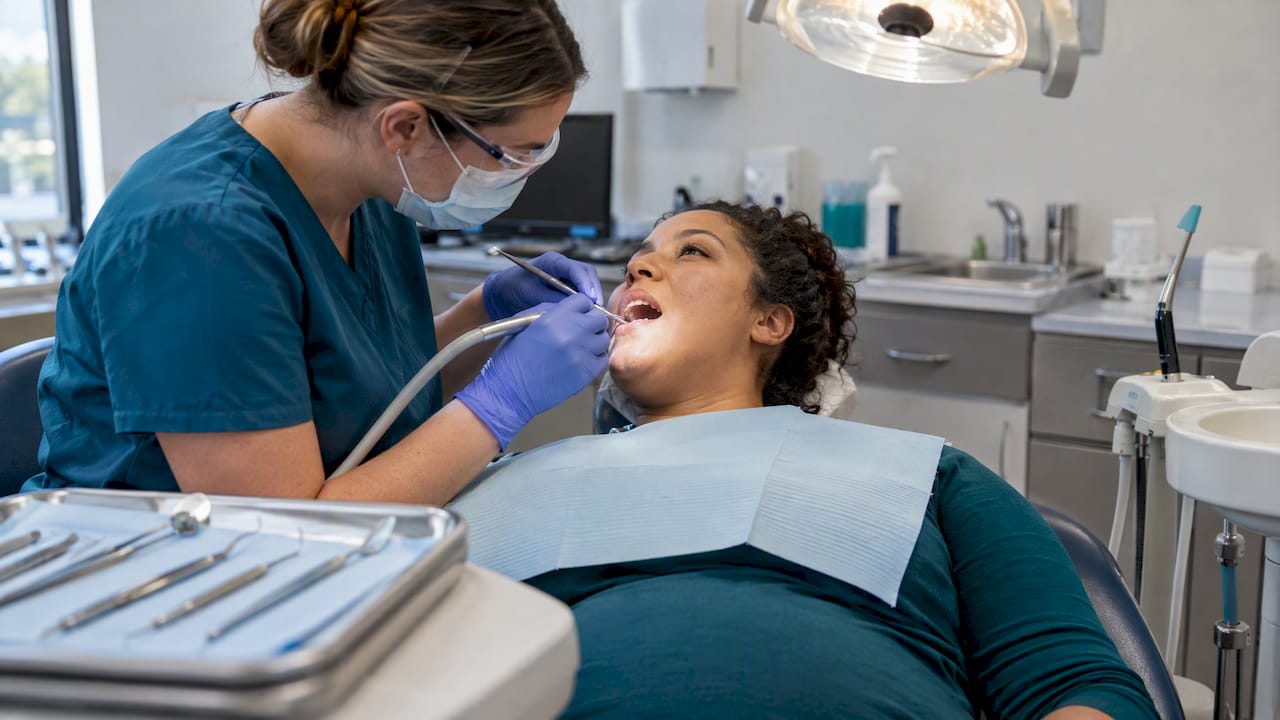
The ADA states that oral health care, including dental X-rays and local anesthesia, is safe at any point during pregnancy. The ADA and ACOG also agree that delaying necessary treatment can cause more complex, painful and costly problems later. ACOG recommends that pregnant patients have routine checkups and tell their dental provider they are pregnant so positioning and treatment planning can be adjusted.
Which trimester is best?
Preventive and restorative care is safe throughout pregnancy. Many people find the second trimester the most comfortable for longer appointments, because morning sickness has often eased and lying back is not yet hard. That is a convenience, not a rule. If you are in your first or third trimester and your gums are bleeding or something hurts, book the visit.
What a visit looks like
- You tell the team how far along you are, any medications or prenatal vitamins, and any nausea or reflux.
- Your dentist checks your gums, measures pocket depths around the teeth, and looks for any gum overgrowths.
- X-rays are taken only if needed, with standard shielding.
- Cleaning is done with attention to comfort. In late pregnancy, a pillow or a slight tilt to your left side can make reclining easier.
- You leave with a plan: how often to come back and what to adjust at home.
Some people need a deeper cleaning below the gumline if gum disease has moved past gingivitis. This is called scaling and root planing, and it can be done during pregnancy.
Does gum disease affect the pregnancy?
Gingivitis on its own is a local gum problem. The questions researchers ask are about periodontitis, the more serious disease that damages the tissue and bone supporting the teeth.
A 2019 systematic review and meta-analysis found that women with periodontitis had a higher risk of preterm birth, with an odds ratio of about 2. That is an association, though, not proof that gum disease caused the preterm births. When researchers tested whether treating gum disease during pregnancy lowers preterm birth, a meta-analysis of randomized trials did not find a clear reduction, and ACOG notes that trials have not consistently shown one.
What does that mean for you? Two things are true at once:
- Nobody can promise that cleaning your gums will change a birth outcome, and we won’t.
- Treating gum disease is safe, it relieves your own symptoms, and it prevents infection and tooth loss. That is reason enough.
There is also a benefit for your baby later on. ACOG’s guidance notes that good maternal oral health may reduce the transmission of cavity-causing bacteria to the infant, which is one more reason to get ahead of plaque now.
Safe dental treatments during pregnancy
Many patients worry that anything beyond a cleaning is off limits. Professional guidance says otherwise. The ADA and ACOG agree that fillings, extractions and root canals are safe and important at any stage of pregnancy, and that infections, abscesses and trauma should not be postponed to a later trimester.
| Treatment | Generally okay during pregnancy? | Note |
|---|---|---|
| Cleaning and exam | Yes | Recommended, especially with bleeding gums |
| X-rays | Yes, when needed | Done with shielding |
| Local anesthesia | Yes | Tell your dentist about your pregnancy and any medications |
| Fillings | Yes | Treating decay early avoids bigger problems |
| Root canal or extraction | Yes | Infection should not wait |
| Teeth whitening and elective cosmetic work | Usually postponed | Not urgent, so most people wait until after delivery |
| Orthodontic or implant planning | Can usually wait | Discuss timing with your dentist |
If anxiety is what keeps you away from the dentist, say so when you book. Our team can talk through gentler options for comfort, and we offer sedation dentistry for patients who need extra support. Whether any sedation option is appropriate during pregnancy is a decision for your dentist and your obstetrician together.
A word on fluoride varnish
People searching for this topic often ask about fluoride varnish, and the question usually comes from one of two directions: parents asking about it for kids, and expecting mothers asking whether fluoride is safe.
For you, the practical piece is the fluoride toothpaste in your daily routine, which ACOG recommends during pregnancy. For your children, fluoride varnish is a professional treatment a dentist or pediatric provider paints on the teeth at checkups, and it is generally discussed as an option alongside fluoride toothpaste and regular exams. Varnish is applied as a concentrated coating at the office, while gels and foams are typically held in a tray, so the two differ in how they are delivered. Whether your child would benefit, and how often, depends on their cavity risk, age and diet. Ask the dentist at your child’s next visit rather than deciding from a search result. Our pediatric dentistry team can go over it with you.
Paying for care and insurance questions
A new pregnancy often comes with a new insurance situation: a job change, a marketplace plan, a plan that starts mid-year. If you are choosing coverage or wondering why a plan won’t cover a treatment right away, it helps to understand how dental waiting periods work before you schedule anything beyond a basic cleaning. Call your insurer and ask which services are covered, what the waiting periods are, and whether a cleaning counts as preventive.
We don’t publish fixed prices, because the right treatment depends on what we find at your exam. Our team can explain costs and what your plan is likely to cover before you commit.
Our perspective: gentle care, started early
We see pregnant patients who have put off a dental visit because they were unsure it was allowed, or because they were nervous. We would rather you come in with bleeding gums and a question than wait and call us with a swollen face.
Here is how we think about it. Bleeding gums in pregnancy are a signal that plaque needs to come off, and the most helpful response is a calm, thorough exam and cleaning, plus a plan you can follow at home. We build treatment plans around the individual patient, and for expecting mothers that means paying attention to comfort, positioning, nausea and timing.
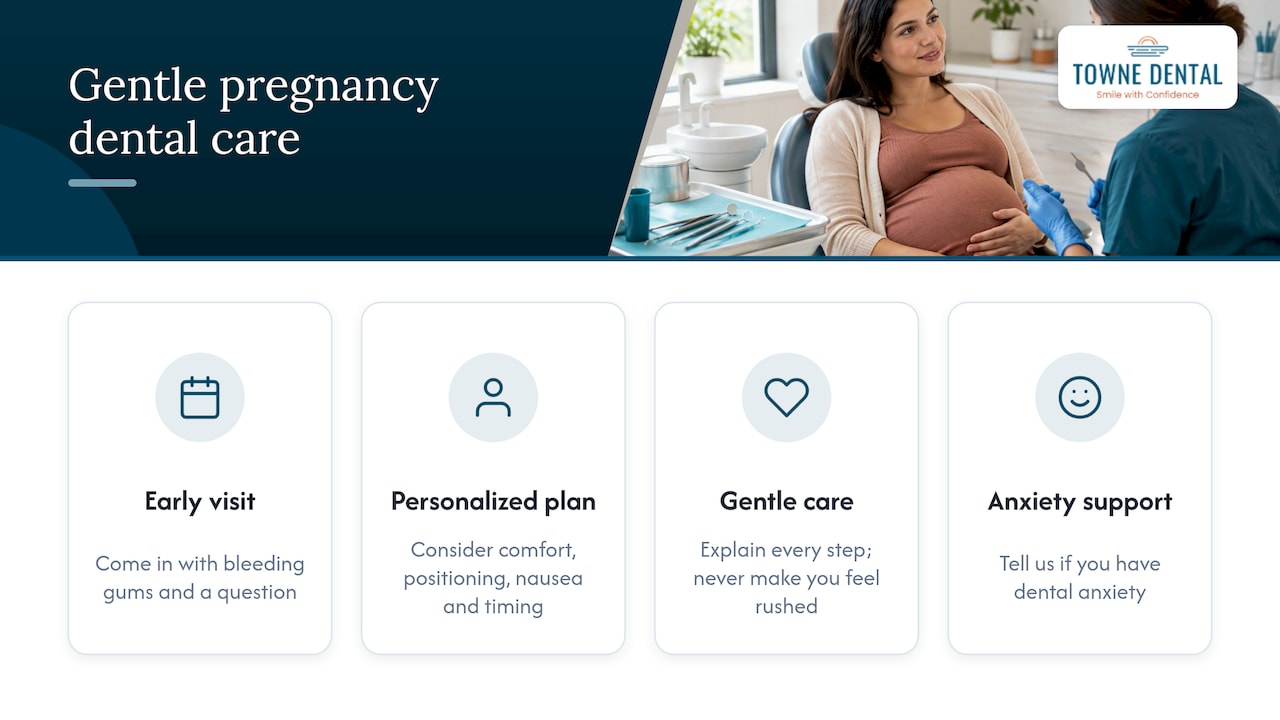
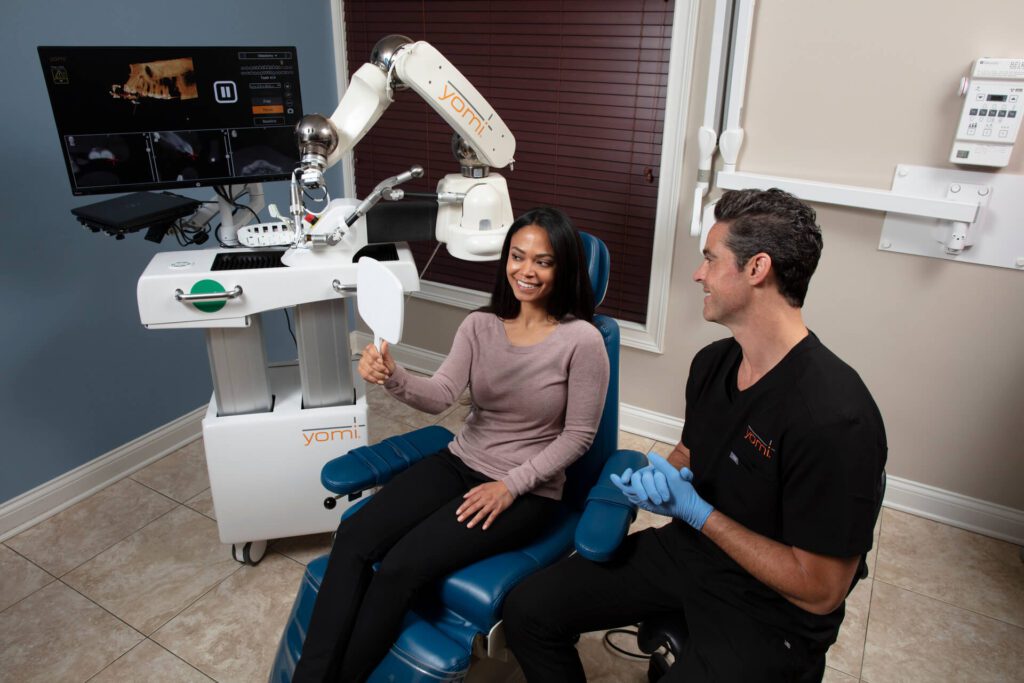
Our practice leans on modern technology to keep care precise and less invasive. That is most visible in our implant work with the Yomi® robotic system, which is usually a conversation for after delivery rather than during pregnancy. But the same philosophy applies to a simple cleaning: be careful, explain every step, and never make you feel rushed.
If you have a history of dental anxiety, tell us. A gentler, lower-stress visit is something we design for, not something extra.
— Towne Dental
Book a gum check with Towne Dental
If you are in Fort Myers, Naples, Cape Coral, Bonita Springs, Estero, Marco Island, Ave Maria or elsewhere in Lee or Collier County, we can see you for a cleaning, gum exam and a plan for the rest of your pregnancy. Learn more about our general dentistry services, including teeth cleaning and fillings, or see everything we offer. If something hurts or is swollen, our emergency dentistry services exist for exactly that, so call us rather than waiting for a routine slot.
When to call right away
Don’t wait for your next routine appointment if you have:
- Bleeding that is heavy or does not stop
- Pus, a bad taste that won’t go away, or a pimple-like bump on the gum
- Swelling of the face or jaw, or swelling that makes it hard to swallow or breathe (go to an emergency room if breathing is affected)
- Severe or throbbing tooth pain, or a fever with tooth pain
- Teeth that feel loose
- A gum lump that bleeds repeatedly or interferes with eating
For anything about your pregnancy itself, such as bleeding from somewhere other than your mouth, contact your obstetrician. Dental and prenatal providers are encouraged to work together, and your dentist can coordinate with your OB if needed.
FAQ
Are bleeding gums normal during pregnancy?
Yes. The ADA reports that up to 75% of pregnant people have bleeding gums, mainly because hormonal changes make gums more reactive to plaque. Normal does not mean ignore it. Mention it to your dentist, who can check whether it is simple gingivitis or something more advanced.
Can I get a dental cleaning while pregnant?
Yes. Cleanings are safe in every trimester, and the ADA advises that routine dental care, including X-rays and local anesthesia, can be done at any point. A cleaning is one of the most effective ways to calm bleeding gums. Let your dentist know how far along you are.
Will my gums go back to normal after the baby arrives?
For many people, pregnancy gingivitis improves once hormones settle after delivery, especially if plaque has been well controlled. If gum disease has progressed to periodontitis, it will not resolve by itself and needs treatment. Schedule a follow-up exam after delivery to check.
Is fluoride varnish safe for kids?
Fluoride varnish is a routine professional treatment at pediatric and dental checkups, applied by a trained provider in a small amount. Whether your child needs it, and how often, depends on their cavity risk and age, so ask their dentist or pediatrician at the next visit.
Should I avoid brushing if my gums bleed?
No. Keep brushing gently twice a day and flossing daily, because plaque removal is what reduces the inflammation. Use a soft brush and light pressure. If bleeding is not improving after one to two weeks of steady cleaning, see your dentist.
Sources
- Bleeding gums in pregnancy, American Dental Association
- Pregnancy, American Dental Association
- Oral Health Care During Pregnancy and Through the Lifespan, ACOG
- Keeping a healthy smile during pregnancy, JADA
- Maternal periodontitis and preterm birth: systematic review and meta-analysis, PubMed
- Obstetric outcomes after treatment of periodontal disease during pregnancy, PMC