Yes, adults can get dental sealants, and for the right teeth they are one of the gentlest ways to prevent a cavity. A sealant is a thin plastic coating painted onto the chewing surface of a back tooth. It fills the deep grooves where food and bacteria collect. Whether it makes sense for you depends on your teeth, not your birthday: deep grooves, no existing fillings on that tooth and a history of decay in similar spots all point toward yes.
Below we cover who is a good candidate, what the appointment involves, how long sealants last, whether they are safe, how they compare with fluoride varnish and what to ask your dentist.
TL;DR
- Sealants are not only for children. Adults with deep, unfilled grooves on their molars or premolars can benefit, and an exam is the only way to know which teeth qualify.
- Placement is quick and noninvasive: clean, etch, rinse, dry, paint on the sealant and harden it with a blue light. Most adults need no numbing.
- According to the CDC, sealants prevent about 80% of cavities over two years in back teeth, and they can protect for several years with regular checkups.
- The ADA says sealants are safe, and the trace BPA exposure involved is far below everyday exposure.
- Sealants and fluoride varnish do different jobs. Sealants block the grooves, varnish strengthens enamel, and dentists sometimes use both.
Table of Contents
- Why back teeth need extra protection
- Are sealants really only for kids?
- Which adults are good candidates
- What happens at the appointment
- How long sealants last and how to keep them working
- Are sealants safe? The BPA question
- Sealants and fluoride varnish: different tools
- Sealant, filling or crown: how the choices compare
- What do sealants cost for adults?
- Our perspective at Towne Dental
- Getting sealants in Southwest Florida
- Questions to ask your dentist
- FAQ
- Sources
Why back teeth need extra protection
The chewing surfaces of molars and premolars are not smooth. They have pits and fissures, narrow grooves that can be too tight for a toothbrush bristle to reach. The American Association for Dental, Oral, and Craniofacial Research notes that these complex surfaces readily trap biofilm and debris and are harder to clean, which makes them more prone to decay than smooth surfaces.
The CDC reports that sealants prevent 80% of cavities over two years in the back teeth, where 9 in 10 cavities occur. That statistic is the heart of the case for sealants, and nothing about it expires at age 18.
Are sealants really only for kids?
No. Sealants became associated with children because new permanent molars come in during childhood, and school programs target those teeth. But the mouth keeps making new risks as we age. The ADA’s consumer site MouthHealthy points to factors such as gum recession, gum disease and older fillings that leave adults prone to new decay in hard-to-clean areas.
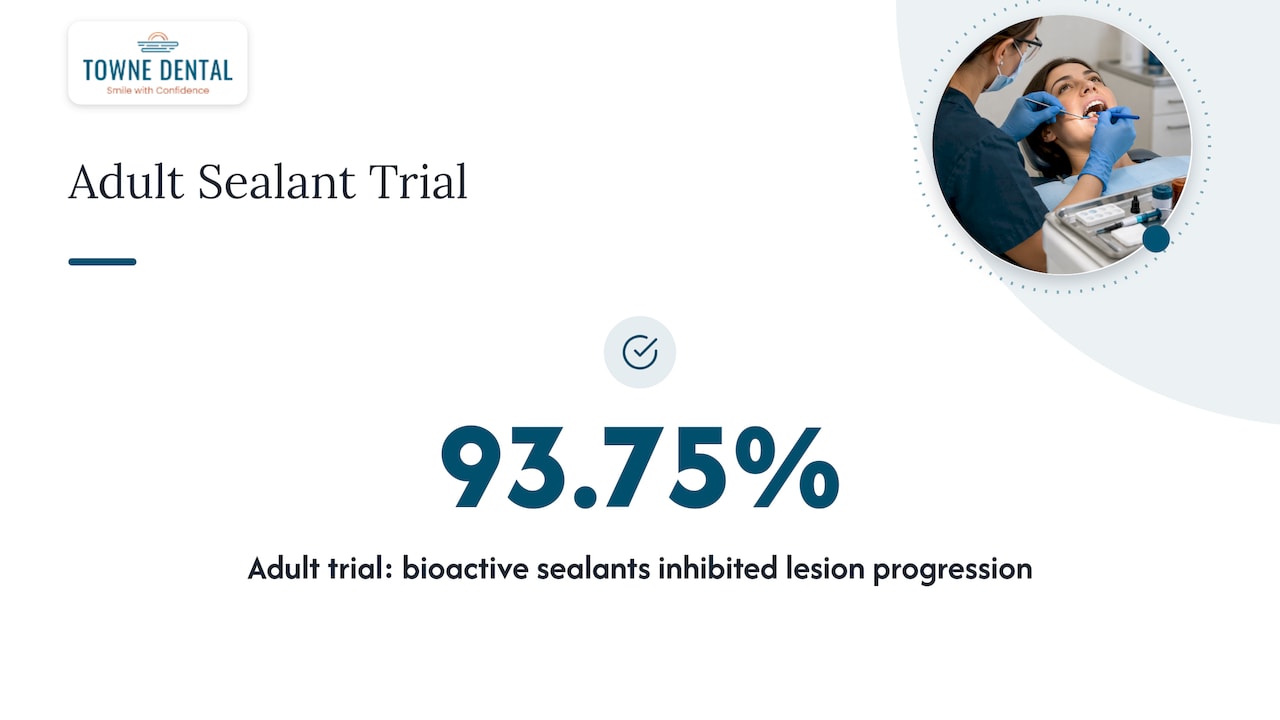
The clinical evidence has caught up with that reality. A 2025 randomized clinical trial in adults found a 93.75% success rate for bioactive sealants in inhibiting the progression of noncavitated occlusal lesions over 24 months. That is one trial with a specific material, not a promise for every tooth, but it shows sealants can do real work in adult mouths.
The ADA-endorsed guideline work points the same way. A 2024 JADA review of nonrestorative treatments supports sealants, with or without fluoride varnish, as a priority for noncavitated occlusal lesions. In plain terms, early decay on a chewing surface that has not yet formed a hole can often be sealed and monitored instead of drilled.
Which adults are good candidates
Your dentist decides tooth by tooth. These situations tend to make the conversation worthwhile:
- Deep grooves and no cavities yet. If you have steep, narrow fissures on molars that have never needed a filling, a sealant keeps it that way.
- Early, shallow spots on a chewing surface. A sealant can act as a physical barrier over a noncavitated lesion so that it is watched and not drilled.
- Dry mouth. Medications, medical conditions and aging can reduce saliva, and saliva is a natural defense against decay. Ask your dentist whether sealants fit your risk level.
- Recent cavity history. If you have had several fillings in the last few years, protecting the untouched back teeth is a sensible next step.
- Braces or aligners past or present. Brackets and attachments make cleaning harder, and teeth can come out of treatment with new vulnerable spots.
Sealants are not for every tooth. A tooth that already has a filling on its chewing surface, or one with a cavity that has broken through the enamel, needs a different treatment. Smooth surfaces between teeth are not sealed either. If you are unsure how your existing dental work is holding up, our guide to when old fillings should be repaired or replaced explains how that decision is made.
What happens at the appointment
The ADA describes sealant placement as quick, painless and noninvasive. Here is the usual sequence:
- Cleaning. The tooth is polished so the surface is free of plaque and debris.
- Etching. A mild acidic gel roughens the enamel slightly so the sealant bonds well.
- Rinse and dry. The gel is rinsed off and the tooth is dried and kept dry.
- Application. The liquid sealant is painted into the grooves.
- Curing. A special blue light hardens the plastic in seconds.
- Bite check. The dentist confirms your bite feels normal and the coating is smooth.
Because no drilling is involved, adults typically do not need numbing for sealants. If a dental visit makes your stomach drop, that is worth knowing: the procedure is among the lowest-stress things we do. If anxiety is a bigger barrier than the procedure itself, reading about fear of the dentist in adults can help you plan for the visit, and you can always tell us about it so we can adjust the pace.
Why a dry tooth matters
A sealant only bonds well on a dry surface. Saliva control can be harder in some adults, for example with certain oral conditions or sensitivities. In those cases the JADA review describes how dentists may choose hydrophilic materials such as glass ionomer sealants, which tolerate moisture better than traditional resin. Material choice is something to raise with your dentist, who can match it to your teeth.
How long sealants last and how to keep them working
The CDC says sealants protect against cavities for many years, and that regular dental checkups are how wear or chipping gets caught. There is no guarantee of a fixed number of years. Adults who grind their teeth, chew ice or bite hard candy will wear a sealant faster than someone who does not.
A few habits stretch the life of a sealant:
- Brush twice a day with fluoride toothpaste and clean between teeth daily.
- Do not use your teeth to crack nuts, ice or packaging.
- Keep your cleaning and exam schedule so the dentist can check the coating.
- Tell us if a tooth feels rough or a sealant edge catches floss.
If a sealant chips, it can usually be repaired or reapplied. A sealant that wears away does not harm the tooth underneath. It just stops protecting it.
If you clench or grind, mention it. A cracked or worn tooth is a separate problem from a sealed one, and our article on cracked tooth treatment explains what that looks like and what the options are.
Are sealants safe? The BPA question
The most common worry about resin sealants is bisphenol A (BPA). The ADA’s BPA page says that a small, transient increase in BPA can be detected in urine and saliva after treatment, and that the amounts are far lower than exposure from ordinary sources such as air or handling a receipt. Simple steps reduce even that: rinsing the mouth after placement and having the dentist wipe the sealant surface.
The ADA’s position is that there is no basis for health concerns about BPA from dental sealants. If you are pregnant, or have any specific health concern, tell your dentist and your physician, and they can discuss materials with you.
Sealants and fluoride varnish: different tools
Sealants and fluoride varnish are often mentioned together, so it helps to separate them.
| Dental sealant | Fluoride varnish | |
|---|---|---|
| What it is | Plastic or glass ionomer coating | Concentrated fluoride painted on the tooth |
| Main job | Blocks grooves from plaque and food | Helps strengthen enamel |
| Where it goes | Chewing surfaces of back teeth | Can cover the surfaces of the teeth |
| Who decides | Your dentist, tooth by tooth | Your dentist, based on risk |
The 2024 JADA review lists fluorides and sealants among the products that studies support for arresting early decay lesions, and the guideline work refers to sealants with or without fluoride varnish. So the two are partners, not rivals. A sealant physically covers the groove. Varnish works on the enamel chemistry across the tooth.
On the questions we hear most:
- Is fluoride varnish safe? It is a routine professional treatment, and your dentist chooses the amount based on your age and risk. Tell us about any allergies or health conditions first.
- What are the benefits? Varnish supports enamel and is part of nonrestorative decay management, as the JADA review describes.
- How often? There is no single schedule for everyone. Frequency depends on your cavity risk, so your dentist sets it at your exam.
- What about kids? Children’s needs differ from adults’, and our pediatric team can advise on both sealants and varnish.
Sealant, filling or crown: how the choices compare
The real value of a sealant is what it helps you avoid. Once decay breaks through the enamel, you need a filling. If a filling gets large or the tooth weakens, a crown may follow. Each step removes more natural tooth structure and each restoration can eventually need replacing.
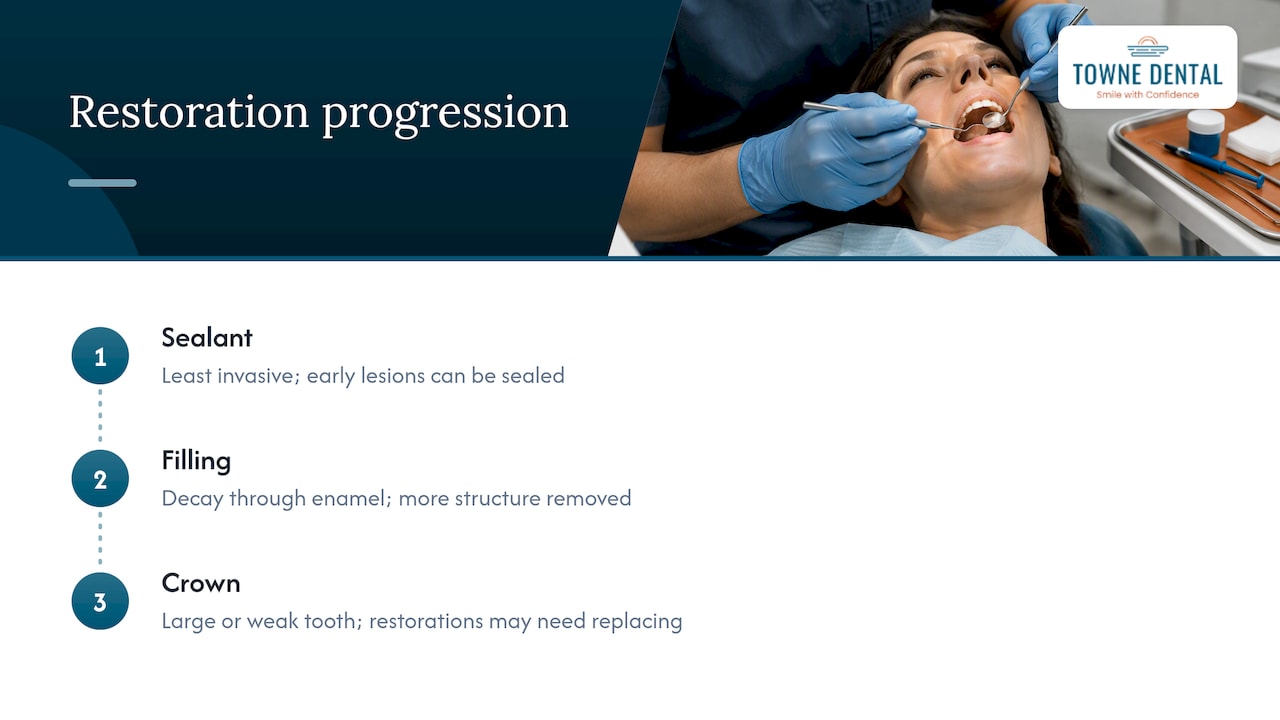
A sealant is the least invasive rung on that ladder. The JADA guideline material describes sealing early lesions as a way to buy time and avoid more invasive restorations later. That is why dentists prefer to find a problem early and seal it than drill it.
There is a limit. A sealant cannot fix decay that has already formed a cavity. It also does nothing for gum problems. If your gums bleed or you have deep pockets, that is the first thing to deal with, and our guide to gum pocket treatment explains what to expect.
What do sealants cost for adults?
We do not publish a price for sealants, and costs vary by number of teeth and the material used. Coverage varies a lot too. Many dental plans are written around children for sealants, so adults often find limits on age or tooth type. The most reliable approach is to ask your plan before the visit and to ask our team for an estimate once we have examined your teeth. That way you know the figure for your own mouth, not an average from the internet.
Our perspective at Towne Dental
We see sealants as part of a bigger idea: keep natural teeth intact for as long as possible. Most of our patients who come in anxious about the drill are relieved to learn that prevention is often the quiet, comfortable route. Our approach is built around gentle, personalized care, and that starts with looking closely at each tooth instead of applying a blanket rule.
We would not seal every adult molar, and we do not think you should expect that. We look at groove depth, existing fillings, how well you can clean the area, your history and your habits. Sometimes the answer is a sealant. Sometimes it is a fluoride treatment and a watchful eye. Sometimes it is a filling, because the decay has gone too far. We would rather tell you which one applies than sell you the same thing every time.
For patients who are nervous, we also offer sedation dentistry, so the comfort question does not need to keep you from the chair. The decision should rest on your teeth and your goals.
— Towne Dental
Getting sealants in Southwest Florida
If you live in Naples, Fort Myers, Cape Coral, Bonita Springs, Estero, Marco Island or elsewhere in Collier or Lee County, our team can check whether your back teeth are good candidates during a routine exam and cleaning. Sealants fall under our general dentistry services, alongside fillings, crowns and teeth cleaning, so a single visit can cover your exam, your options and a plan. You can start from our main page to find the office nearest you and book.
Bring a list of your medications, mention any dry mouth, grinding or sensitivity, and tell us what worries you most. That gives us what we need to recommend the right option.
Questions to ask your dentist
A short list makes the appointment more productive:
- Which of my teeth have grooves deep enough to benefit?
- Do any of my molars show early, noncavitated spots that could be sealed and monitored?
- Which material do you recommend for me, resin or glass ionomer, and why?
- How will you check the sealants at my future visits?
- Would fluoride varnish also make sense for my risk level?
- What will my plan cover, and what is my out-of-pocket cost?
FAQ
Can sealants be done on adult teeth?
Yes. Sealants work on any tooth with a suitable chewing surface, and adults qualify when their molars or premolars have deep grooves and no filling on that surface. A clinical trial published in 2025 studied them in adults specifically. Your dentist will confirm which teeth qualify after an exam.
Why can’t some adults get sealants?
Usually because the tooth is not a fit. A tooth that already has a filling on the chewing surface, or one with a cavity that has broken through the enamel, needs a different treatment. Insurance plans may also limit sealant coverage by age, which can make it feel like adults are excluded.
How long do sealants last in adults?
The CDC says sealants protect teeth for many years, though the exact time varies. Grinding, chewing hard objects and missed checkups shorten it. Your dentist checks the coating at regular visits and repairs it if it chips.
Is a sealant painful?
No. The ADA describes the procedure as quick, painless and noninvasive, since nothing is drilled. Most adults feel only the cleaning, a slightly sour taste from the etching gel and the light.
Are sealants safe given the BPA concern?
The ADA says there is no basis for health concerns about BPA from dental sealants. Any exposure is small and brief, and rinsing after placement lowers it further. If you have a specific health concern, raise it with your dentist before treatment.
Sources
- Dental Sealants, American Dental Association
- Bisphenol A, American Dental Association
- Tooth decay, MouthHealthy (ADA)
- About Dental Sealants, CDC
- Dental Sealant Facts, CDC
- Sealants, AADOCR
- Evidence-based approaches to nonrestorative treatments, JADA 2024
- 24-month efficacy of bioactive versus fluoride sealant in adults, PMC