Dental implants can’t get cavities, but the gum and bone around them can still get infected. Good maintenance has two parts. At home, you clean every surface twice a day with soft, implant-safe tools. In the dental chair, you keep regular professional visits, usually every 3 to 6 months depending on your risk. This guide covers both, plus the mistakes that quietly damage implants.
TL;DR
- Brush twice a day with a soft brush, and clean between teeth daily with an interdental brush, implant floss or a water flosser.
- Plan on professional maintenance visits every 3 to 6 months, set by your personal risk, such as gum disease history, smoking or diabetes.
- Bleeding, redness or swelling around an implant is a reason to call, not to wait. Early gum inflammation can be reversed. Bone loss cannot.
- Metal scalers, abrasive pastes and long-term chlorhexidine rinses can damage implants. Ask your dentist what is safe for yours.
- Check your insurance: implant-specific maintenance is often capped differently from routine cleanings.
Table of Contents
- Why implants still need care
- Your daily routine at home
- What happens at a professional maintenance visit
- How often should you go?
- Warning signs to act on
- Common mistakes
- Caring for implants when someone else helps you
- Our perspective on implant care
- Insurance and maintenance visits
- Maintenance with Towne Dental
- FAQ
- Sources
Why implants still need care
An implant is a titanium (or sometimes zirconia) post in the jawbone with a crown, bridge or denture attached. The post can’t decay. But bacteria still collect on the crown and at the gumline, and the tissue around an implant is a little less forgiving than the tissue around a natural tooth.
The American Academy of Periodontology describes peri-implant diseases as inflammatory conditions of the soft and hard tissues around implants. Bacteria build up at the base of the implant, below the gumline, and over time irritate the surrounding tissue. There are two stages:
- Peri-implant mucositis: inflammation of the gum only. Bleeding, redness and swelling. It is reversible with better cleaning and professional care.
- Peri-implantitis: the inflammation reaches the bone and bone starts to be lost. This is the main threat to implant longevity, and mucositis is its usual precursor.
That is the whole logic of maintenance: catch the first stage early so the second never happens. A systematic review and meta-analysis in Clinical Oral Implants Research examined exactly this question, whether supportive care after placement improves implant survival and lowers the rate of peri-implant disease.
Adherence matters as much as technique. Clinicians report that patients who skip professional recall visits and daily home care show significantly higher rates of peri-implant disease and implant loss than patients who follow the schedule.
Your daily routine at home
A good routine takes about five minutes. Consistency beats intensity.
Step 1: Brush twice a day, gently
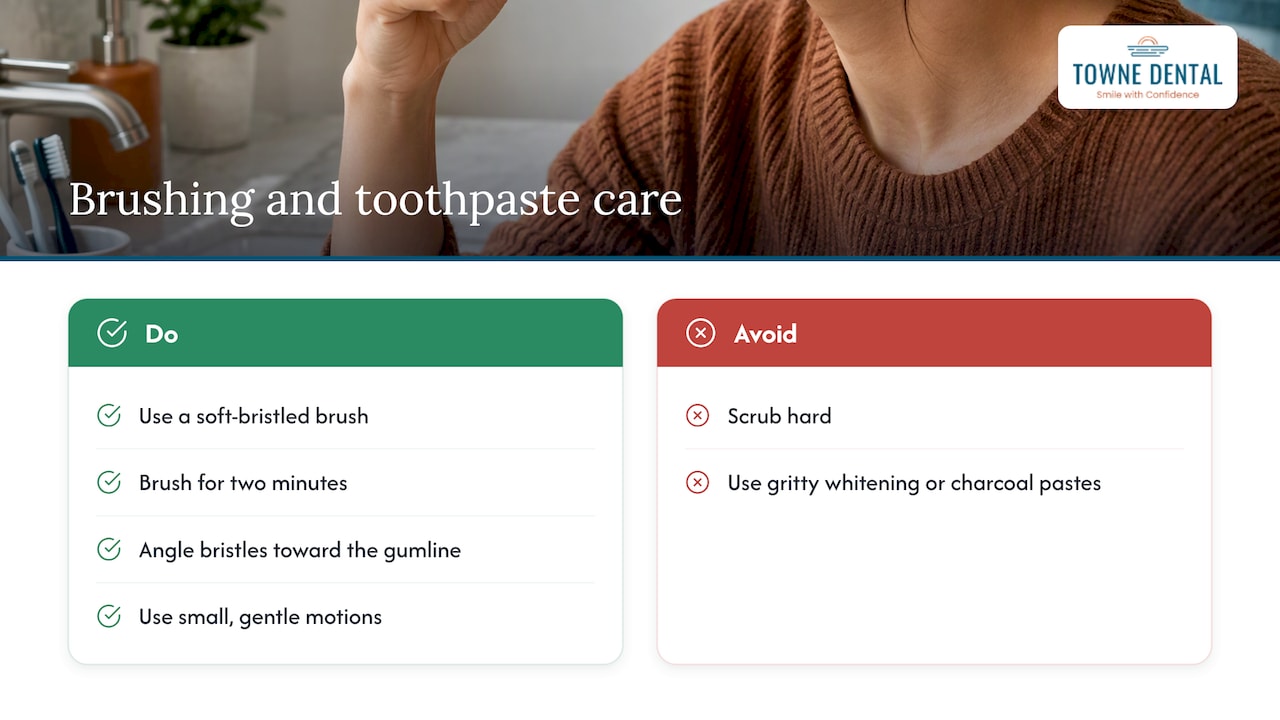
Use a soft-bristled brush, manual or electric, for two minutes. Angle the bristles toward the gumline and use small, gentle motions. Scrubbing hard does not clean better. It irritates the gum and can recede the tissue, exposing the edge of the crown or the implant collar. Brush the inside surfaces and the chewing surfaces of implant crowns just as carefully as the front.
Pick a low-abrasive toothpaste. Gritty whitening or charcoal pastes can scuff the polished surfaces of crowns and abutments, and a rough surface holds more plaque. If you are unsure about your toothpaste, bring it to your next visit and we will tell you.
Step 2: Clean between and under, every day
This is the step most people skip, and it is where plaque hides. Your options:
| Tool | Best for | Notes |
|---|---|---|
| Interdental brushes (plastic-coated wire) | Spaces between implant crowns, and under bridges | Choose a size that fits snugly without forcing it. Metal wire can scratch. |
| Implant or bridge floss (stiff end, spongy middle) | Single crowns and bridges | Threads under the bridge, and the spongy section wipes the surfaces. |
| Water flosser | Full-arch bridges, hard-to-reach areas, people with limited dexterity | Start on a low setting and aim at the gumline. |
| Single-tuft brush | Back of the last implant, tight corners | Useful where a regular brush can’t reach. |
Periodontists often suggest these tool types, for example in this guide to cleaning around implants, which lists plastic-coated interdental brushes, implant floss and water flossers as the safe options. Regular string floss can shred around the restoration or miss areas entirely.
Step 3: Handle a full-arch bridge differently
If you have a fixed full-arch prosthesis (sometimes called an all-on-four or hybrid), a toothbrush alone is not enough. The American College of Prosthodontists says that home care must include interdental brushes or water flossers that reach the underside of the prosthesis, because plaque accumulating there is the leading cause of peri-implant disease. Ask for a hands-on demonstration at your visit. Seeing the angle once is worth ten diagrams.
Step 4: Be careful with mouthrinse
An alcohol-free antimicrobial or fluoride rinse can be a useful extra, but it never replaces mechanical cleaning. One specific warning: chlorhexidine is meant for short-term use after surgery. Used daily for the long term, it can stain abutments and may alter the biofilm around the implant. Use it only if your dentist prescribes it, and only for the stated period.
Step 5: Protect against grinding and trauma
Implants have no ligament to cushion biting forces the way natural teeth do. If you clench or grind at night, tell us. A custom nightguard protects crowns and the porcelain on bridges from chipping and overload. Also avoid using your teeth to open packages or crack ice.
What happens at a professional maintenance visit
A maintenance visit is not a standard cleaning with a different name. It has a few specific parts:
- Review of your health history. Changes in medications, diabetes control and smoking all affect the tissue around implants.
- Soft tissue check. The clinician looks for redness, swelling and bleeding on probing. These are the early warning signs of inflammation.
- Gentle probing and measurements. Baseline probing depths are ideally recorded within two weeks of the final restoration so future readings have something to be compared against.
- Bite and stability check. Is the crown solid, are the screws tight, is the bite even?
- X-rays when indicated. Radiographs monitor the bone level around each implant. The schedule depends on your stability: if bone is steady, images may be needed only occasionally, but any sign of change calls for earlier imaging.
- Professional cleaning with implant-safe instruments. See the next section.
- Home care coaching. Adjusting your tools and technique based on what the clinician actually sees.
A clinical update on implant maintenance in PubMed Central notes that a typical visit for implant patients can last about an hour. Expect your maintenance appointment to be a bit longer than an ordinary cleaning, especially with bridges or full-arch work.
Why the instruments matter
Implant surfaces can be scratched. Standard metal scalers can scratch titanium or zirconia, leaving microscopic grooves where bacteria hold on, which can speed up peri-implantitis. The safe choices are titanium-grade curettes, plastic instruments, or glycine-based air polishing. If you ever move or have a cleaning elsewhere, it is reasonable to ask which instruments will be used on your implants.
How often should you go?
There is no single number. The 2025 AO/AAP consensus describes lifelong professional maintenance, with recall every 3 to 6 months based on individual risk. The same report lists the main risk factors: a history of periodontitis, smoking, uncontrolled diabetes and poor plaque control.
| Your situation | Typical starting point |
|---|---|
| Healthy gums, no smoking, stable diabetes or none, tidy home care | Closer to 6 months |
| Past gum disease, diabetes, or a smoker | Closer to 3 months |
| Full-arch fixed bridge | Often tighter, with periodic bridge removal for deep cleaning, as your dentist decides |
| Any bleeding, swelling or bad taste around an implant | Come in now, not at the next recall |
These are starting points, not rules. Your dentist adjusts the interval to what the tissue shows. If your gums stay calm for a couple of years, the interval may lengthen. If inflammation appears, it shortens.
Warning signs to act on
Call your dentist promptly if you notice any of these:
- Bleeding when you brush or floss around an implant
- Red, puffy or tender gum around the crown
- A bad taste or pus near an implant
- A crown or bridge that feels loose or shifts when you bite
- Gum that has pulled back so metal or a dark edge shows
- Pain on biting, which is not normal for a healed implant
Peri-implant disease is often painless early on, which is why bleeding is the sign to take seriously. If you have swelling with fever, or a loose implant with significant pain, treat it as urgent and call the same day.
Common mistakes
- Skipping the implant area because it “can’t decay.” The tissue around it can still become infected.
- Using a hard brush or a heavy hand. Gum recession around implants is difficult to fix.
- Using a metal pick or a regular scaler at home. Scratches create bacterial hiding spots.
- Staying on chlorhexidine rinse for months. It is for short-term use only.
- Skipping maintenance visits because nothing hurts. Pain arrives late.
- Ignoring smoking. It is one of the key risk factors for peri-implant disease.
Caring for implants when someone else helps you
If you or a parent has limited hand strength, arthritis or memory loss, daily cleaning can slip. That is when small habits matter: an electric brush with a larger handle, a water flosser that is easier to hold than floss, and a set routine at the same time every day. Caregivers can follow practical steps like those in this guide to oral care for seniors to keep daily care consistent. Tell us at the next visit what is hard, and we will adjust the tools to fit.
Our perspective on implant care
Most implant problems we worry about are not surgical. They are slow, quiet and preventable, and they come from a gap between a good placement and a care routine that fades after the first year.
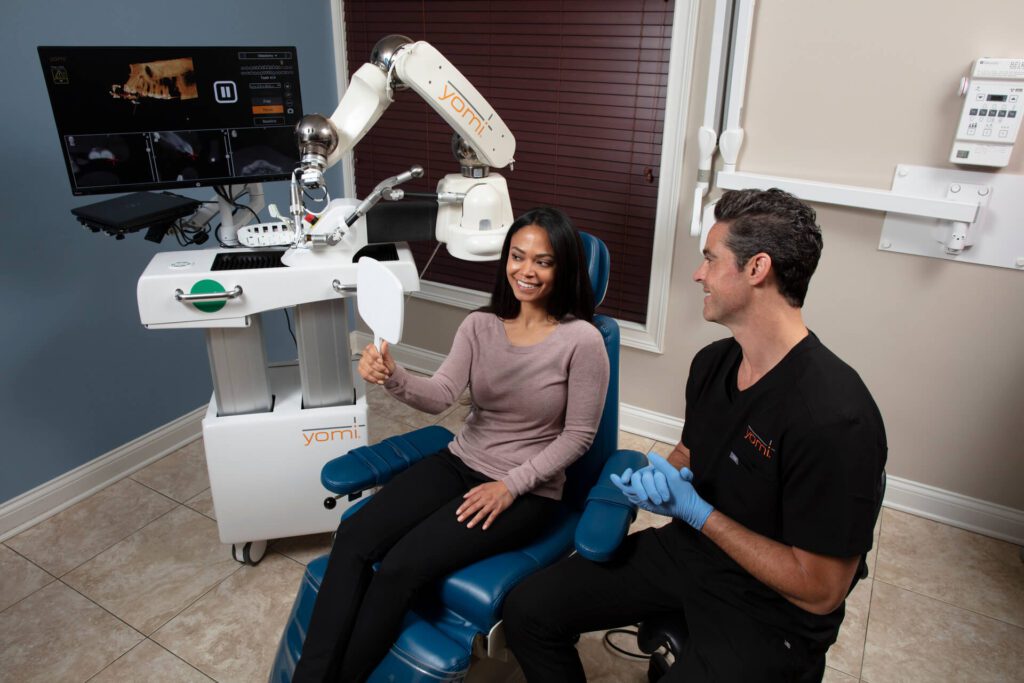
We see maintenance as part of the treatment, not an add-on. That starts with placement. We use the Yomi® robotic system for assisted implant surgery, which gives guided precision in positioning. Implant specialists note that precise placement can make long-term maintenance easier, because an implant in the right position is easier to reach and clean. Robot guidance doesn’t replace home care, but it gives you a better starting point.
We also know that anxiety keeps some people away from the dental chair, and that is exactly the group who most need regular visits. Our approach is to keep maintenance appointments gentle and unhurried, with sedation options available when a patient needs them, and to explain what we are doing at each step. We tailor the recall interval and the home-care tools to each patient, rather than handing everyone the same sheet.
If you take one thing from this guide: clean daily, keep your visits, and call us early when something looks off.
— Towne Dental
Insurance and maintenance visits
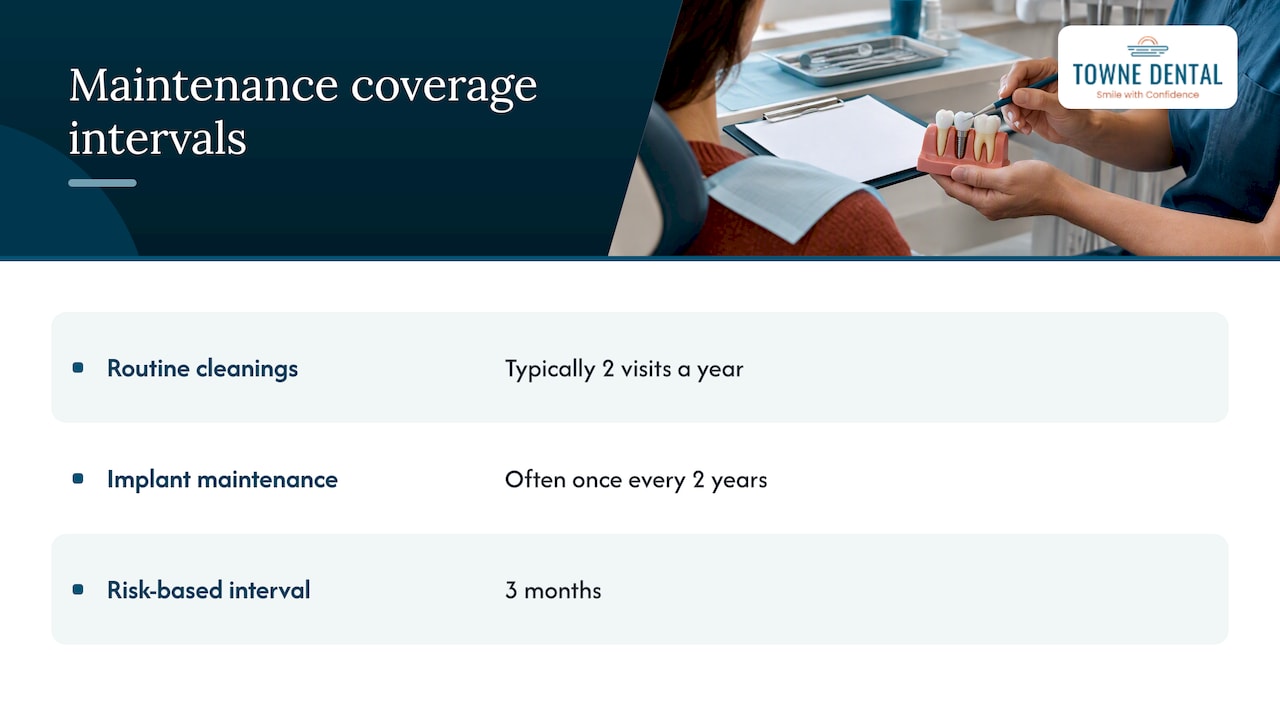
Coverage varies a lot by plan, so check yours before you assume. As one example, a 2026 Kaiser Permanente employer plan sheet shows that routine cleanings are typically limited to two visits a year, while implant maintenance involving removal and reinsertion of the prosthesis is often limited to once every two years. That is one plan, not a universal rule, but it shows why a risk-based 3 month interval can run ahead of what a plan pays for.
Call your insurer and ask three questions: how many cleanings per year are covered, whether implant maintenance is covered separately, and whether the benefit differs for periodontal maintenance. Our team can help you read your benefits. We do not publish fixed prices for maintenance, so ask us for an estimate for your own situation.
Maintenance with Towne Dental
If you have implants placed here or elsewhere in Southwest Florida, we can help you keep them healthy. We see patients in the Fort Myers, Naples, Bonita Springs, Estero, Marco Island, Cape Coral and Ave Maria area. Read about our dental implants and oral surgery services, or see our general dentistry page for cleanings, crowns and bridges. If you are considering a first implant, our Yomi® robot-assisted implants are a good place to start the conversation.
FAQ
How do I clean dental implants at home?
Brush twice a day with a soft brush and a low-abrasive toothpaste. Then clean between and under the crowns once a day with plastic-coated interdental brushes, implant floss or a water flosser. If you have a full-arch bridge, the underside needs a water flosser or interdental brush, since a toothbrush can’t reach it.
How often do dental implants need professional cleaning?
Most people need a visit every 3 to 6 months. The shorter interval fits people with gum disease history, diabetes or smoking. Your dentist will set the schedule after looking at the tissue and the X-rays.
Can I use a Waterpik or water flosser on implants?
Yes, in most cases, and it is especially helpful under bridges and full-arch prostheses. Begin on a low pressure setting and aim along the gumline. If your gums bleed or feel sore after a week of regular use, mention it at your next visit.
Can dental implants get infected years later?
Yes. Peri-implant disease can develop at any time if plaque builds up around the implant, which is why maintenance is lifelong. The early stage, mucositis, is reversible. Bone loss from peri-implantitis is much harder to treat, so report bleeding or swelling early.
Is implant hygiene different from caring for natural teeth?
The basics are the same, but the tools and professional instruments are more selective. Implant surfaces can be scratched by metal instruments, and the gum around an implant can be more vulnerable to inflammation. Soft brushes, plastic-coated tools and implant-safe instruments are the standard.
Sources
- AO/AAP consensus on peri-implant diseases and conditions, Journal of Periodontology, 2025
- Position Statement: Maintenance of Full-Arch Implant Restorations, American College of Prosthodontists
- Maintenance of peri-implant health in general dental practice, PubMed Central
- Peri-implant diseases, American Academy of Periodontology
- Patient adherence and peri-implant disease, PubMed Central
- The effect of supportive care in preventing peri-implant diseases and implant loss, Clinical Oral Implants Research
- Implant Maintenance Protocols for Dental Hygienists, RDH Magazine
- Oral hygiene and dental implant maintenance, Implant Practice US
- Neocis, maker of the Yomi system
- 2026 Dental Implant Services, Kaiser Permanente
- How to Clean Around Dental Implants, Dr. Scharf