Ridge preservation, also called socket preservation, is a bone grafting procedure done at the time of a tooth extraction. The dentist or oral surgeon fills the empty socket with graft material so the jawbone keeps more of its width and height. If you plan to replace the tooth with an implant, it can keep that option simpler later. It limits bone loss but does not stop it completely, and not every extraction needs it.
Below, we explain why the jaw changes after a tooth is removed, who tends to benefit, how the procedure works, what healing looks like and how it affects your implant timeline.
TL;DR
- Ridge preservation, socket preservation and alveolar ridge preservation are closely related terms for placing graft material in the socket at extraction to reduce bone loss.
- The jaw loses width and height after an extraction, and the changes are faster in the first months. Preservation limits this loss but does not prevent it.
- It is most useful when you want an implant later but cannot have one placed the same day, or when the bone wall around the tooth is thin or damaged.
- If a graft is placed, implant placement is generally considered ideal about six to nine months after extraction.
- The decision is made before the tooth comes out, so ask about it at your extraction consultation.
Table of Contents
- What ridge preservation actually is
- Why the jaw changes after a tooth is removed
- Who tends to benefit most
- How socket preservation is performed
- What to expect during healing
- How preservation affects your implant timeline
- Cost and insurance
- Questions to ask before your extraction
- Plan your extraction and implant with our team
- FAQ
- Sources
What ridge preservation actually is
The alveolar ridge is the part of the jawbone that holds your teeth. When a tooth is removed, it leaves a socket in that ridge. Ridge preservation is any procedure done at or after the extraction to reduce the shrinkage of that ridge. One review defines it as a procedure designed to minimize external resorption of the ridge after the tooth is gone, but the most common version is simple: clean the socket, fill it with graft material and protect it while it heals.
You will see several names for the same idea. Researchers note that socket preservation and ridge preservation are often used as synonyms for procedures performed at the time of extraction, and both sit under the broader heading of alveolar ridge preservation, which aims to support the hard and soft tissue for a future implant.
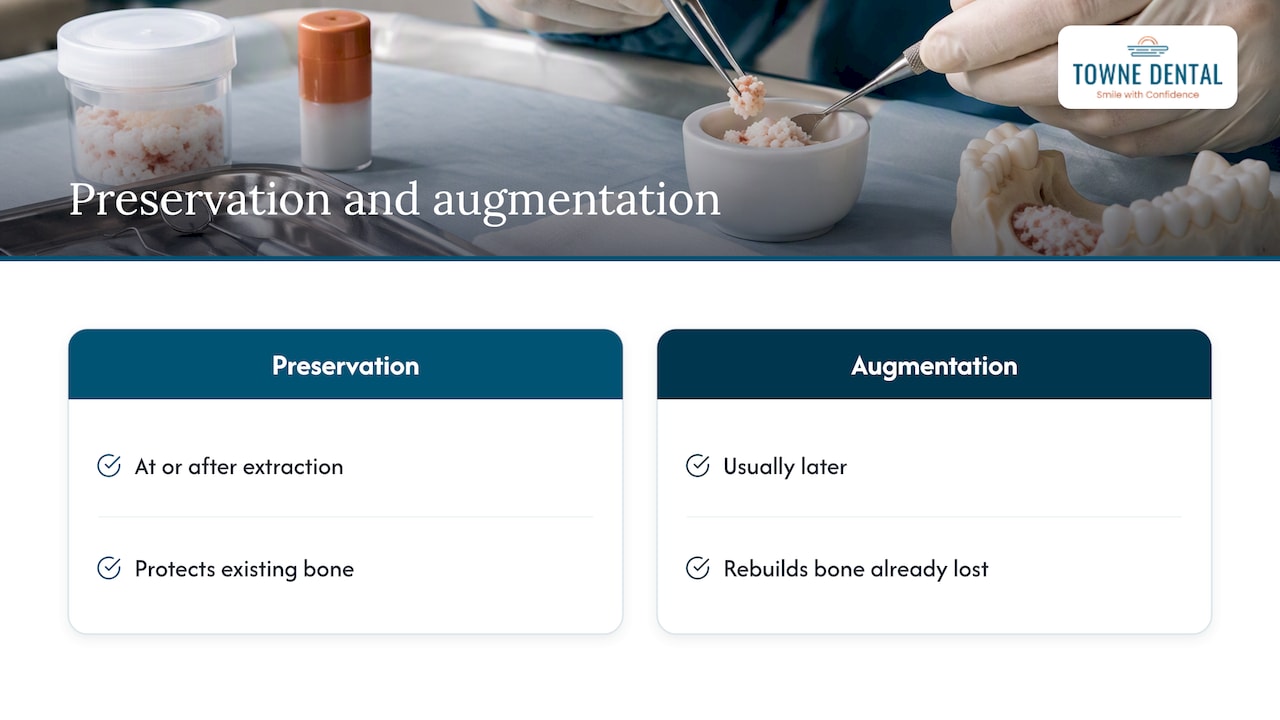
Ridge augmentation is a different, usually later step. Preservation protects the bone you have at the moment of extraction. Augmentation rebuilds bone that has already been lost. If you want to see what that second procedure looks like, our article on ridge augmentation for implant patients walks through a case.
Why the jaw changes after a tooth is removed
Bone stays strong when it is used. A tooth transmits chewing forces through the ligament around its root to the surrounding bone. Remove the tooth and that stimulation stops. Research describes how extraction interrupts the stimulation of the periodontium and sets off inflammatory remodeling and bone resorption.
The same review states that bone loss after extraction is inevitable and reduces both ridge width and height, with changes more pronounced in the first three months. It also says resorption is greater in the first six months but continues throughout life.
In practical terms, that means:
- The ridge gets narrower, often from the cheek side first, because the outer bone wall can be very thin.
- The ridge can lose height, leaving less bone for an implant to anchor in.
- The gum contour can flatten, which matters for the look of a front tooth replacement and for how a bridge or crown sits.
This is why the first few months matter. A socket left to heal on its own is already remodeling while you are still deciding what to do about the missing tooth.
Who tends to benefit most
Not everyone needs a graft at extraction. A dentist weighs the tooth’s location, the condition of the surrounding bone, your plans for replacement and your overall health. These are the situations where preservation is most often considered.
You want an implant but cannot have it placed right away
A bone replacement graft is generally recommended when a tooth is removed and a patient needs a future implant but cannot receive an immediate one, or when the existing ridge shape is critical for the final restoration, according to a clinical review in Decisions in Dentistry. Academic reviewers add that preservation should be considered when implant placement is delayed because the implant cannot be stable enough on the day, bone growth is incomplete, or economic factors are involved.
Some patients are good candidates for placing an implant the same day as the extraction. If that could be you, see who really qualifies for immediate implant placement. When it is not possible, preservation is the bridge between the extraction and the implant.
The bone wall around the tooth is thin or damaged
The same clinical review says grafting is especially indicated when the cheek-side bone wall is thin or damaged, to prevent excessive resorption. A 2022 U.S. study found that a thin facial bone (less than 1 mm) was linked to a greater need for extra bone augmentation, and that ridge preservation reduced that need compared with letting the socket heal unassisted.
Infection, a fractured root or a long-standing gum problem can all leave that wall compromised. Your dentist can see this on a 3D scan before extraction.
A front tooth where appearance matters
The ridge shape under the gum shapes how a replacement tooth emerges. Keeping the contour helps a crown or bridge look natural and can reduce the need for gum or bone reshaping later. Your dentist will tell you whether your smile line makes this a priority.
You are not sure about replacement yet
Some patients extract a tooth and are not ready to decide on an implant, bridge or denture. Preservation keeps the options open while you decide. Even if you eventually choose a bridge, a smoother ridge can help with fit.
How socket preservation is performed
The procedure is built into the extraction visit, so there is no separate surgery. The usual sequence looks like this:
- Gentle extraction. The tooth is removed with as little trauma to the surrounding bone as possible, since the thin walls are what you are trying to protect.
- Cleaning the socket. Infected tissue and debris are removed so the graft heals in a clean site.
- Placing graft material. The socket is filled. According to the Cochrane review on this topic, the material can be human, animal or artificial bone, and the dentist may cover it with a barrier to keep gum tissue from growing into the socket.
- Closing and protecting the site. The graft is held in place with a membrane, sutures or a sealing technique, depending on the case.
- Healing. Your body gradually replaces the graft with its own bone over the following months.
Graft materials and techniques
A 2019 systematic review and meta-analysis identified nine different preservation approaches, including bovine bone particles, donor bone particles, synthetic materials and socket sealing, and found that preservation reduced the dimensional loss of the ridge compared with extraction alone.
Blood-derived products, often called biologics, are another option. A 2022 systematic review found that biologics produced results generally similar to conventional protocols, and that products made from your own blood enhanced new bone formation and reduced early wound opening.
There is no single winning material. Research summaries state that no technique or biomaterial has been shown to be superior to the others. One study reported less loss of ridge width with bovine graft covered by an absorbable collagen membrane than with the graft alone or with unassisted healing, as described in the Decisions in Dentistry review. What matters most is matching the technique to your socket: how many walls are intact, how thin the bone is, and whether there is infection.
What to expect during healing
A socket graft is done at the same time as the extraction, so recovery feels much like a standard extraction with a few extra instructions. Clinical trials in the Cochrane review reported mixed experiences: some participants had pain and swelling, and delayed healing was reported in one person.
That is consistent with what most patients describe: soreness and swelling for a few days that responds to the pain relief your dentist recommends. Practical points to follow:
- Avoid disturbing the site with your tongue, fingers or a toothbrush near the graft in the first days.
- Skip straws and avoid smoking, since suction and smoke can disturb the clot and slow healing.
- Eat soft, cool foods at first. Our guide to what to eat and avoid each day after an extraction gives a day-by-day list.
- Rinse only as directed. Our day-by-day dry socket prevention guide covers the first two weeks.
- Know the warning signs: pain that gets worse after the third day, a bad taste, or visible bone can signal dry socket. See our list of dry socket symptoms and call the office promptly if you notice them. Fever, spreading swelling or pus need a same-day call, and if you cannot reach us, urgent care or an emergency room.
If you have diabetes, take blood thinners, smoke or have had radiation to the jaw, tell your dentist before the procedure. These affect healing and bleeding, and your dentist may coordinate with your physician.
Graft healing happens in stages beneath the gum. For a closer look, see our bone graft healing timeline.
How preservation affects your implant timeline
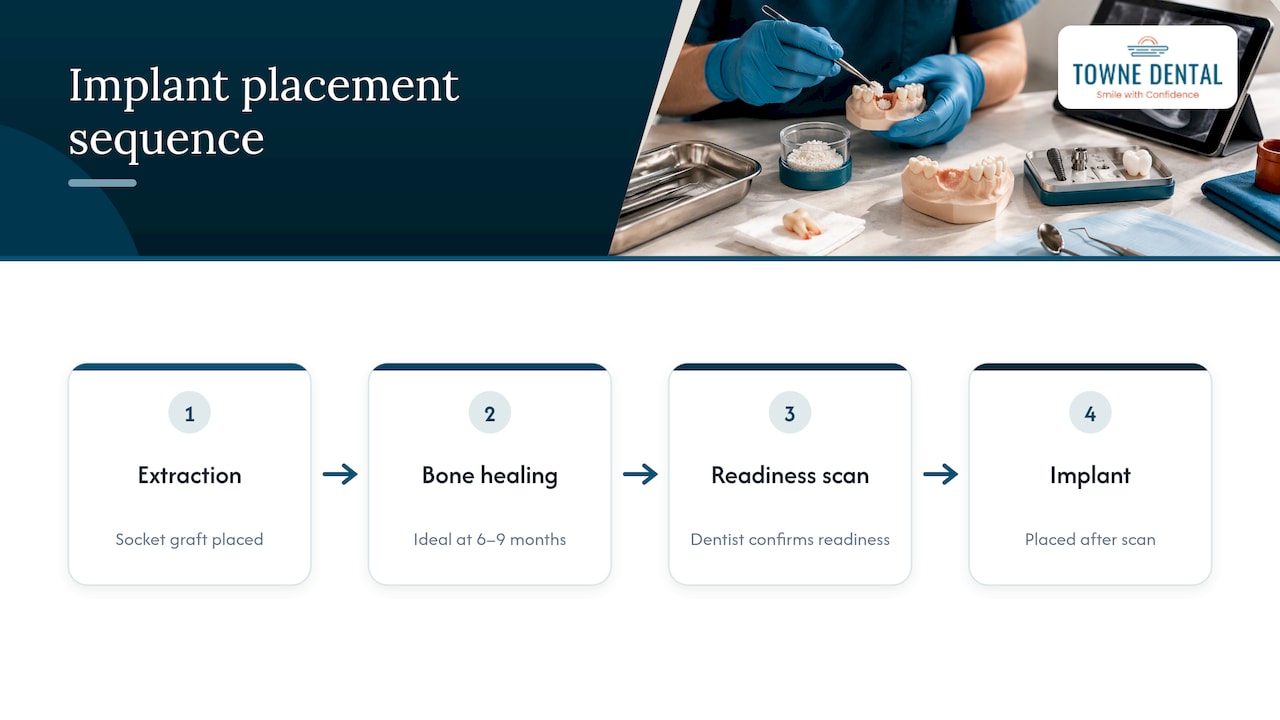
This is the question most patients really have. If a bone substitute is placed in the socket, implant placement is considered ideal six to nine months after extraction to allow good bone regeneration. Your own timing will vary with the graft material, the size of the socket and how you heal. Your dentist confirms readiness with a scan before placing the implant.
The benefit is that preservation may reduce the need for additional bone augmentation at implant placement and help achieve prosthetically driven implant therapy, meaning the implant goes where the crown needs it rather than where the bone happens to be.
The evidence is not uniform. The Cochrane review notes that preservation may prevent bone loss, but studies are mixed on whether it actually removes the need for added bone before an implant. Even so, the extra graft done at the extraction is generally a smaller step than rebuilding a collapsed ridge later. Preservation limits resorption without stopping it, because bone loss continues over a lifetime. For the full sequence from consultation to final crown, read our dental implant timeline.
If bone has already thinned and you are worried it is too late, grafting is not the only route. Our guide to dental implants without bone covers options for patients who have already lost volume.
Cost and insurance
We do not publish a fixed fee for socket grafting, because it depends on the number of sites, the graft material and whether a membrane is needed. Your estimate is given at your consultation.
For insurance, dental offices report this procedure with a specific code. The American Dental Association’s current coding guide lists CDT code D7953 for a bone replacement graft for ridge preservation, reported per site, and it does not include obtaining graft material from another site. Coverage varies widely by plan: some plans cover grafting, others treat it as part of the implant, and many apply waiting periods or annual maximums. Reading about dental implants insurance coverage can help you know what to ask your carrier before you schedule. Our team can also help you check your benefits before treatment.
Questions to ask before your extraction
Because the graft is placed during the extraction itself, the conversation needs to happen first. Bring these questions:
- Based on my scan, how thick is the bone wall around this tooth?
- Do you recommend a graft, and which material and membrane would you use?
- Could an implant be placed the same day instead?
- When would the implant be placed if we graft, and how will we confirm the site is ready?
- What will I do for the first two weeks, and whom do I call if something feels wrong?
- How will my insurance be billed for the graft?
Our perspective on ridge preservation
When we plan a tooth removal at Towne Dental, we are already thinking about the tooth that will replace it. Once a tooth is gone, the bone starts changing, so the best time to protect it is the day of the extraction, not months later.
That is why we look at the bone before we remove a tooth. Careful planning lets us decide whether a graft, a same-day implant or a different approach fits you. Our oral surgery services include tooth extraction, bone grafting and dental implants, so the person planning the extraction is looking at the whole path to your replacement tooth.
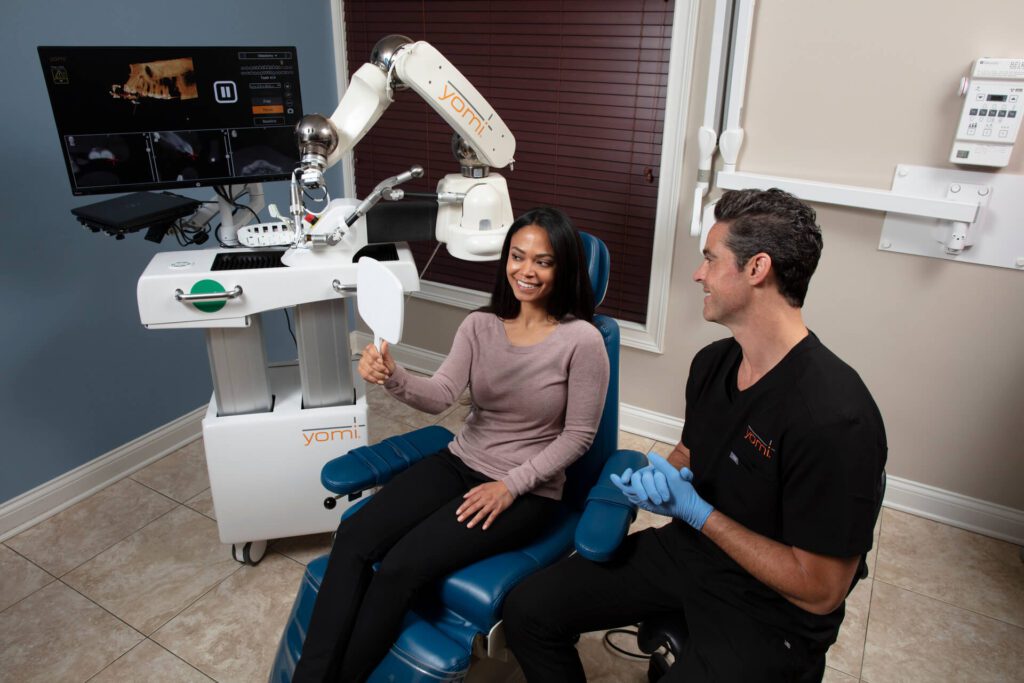
Our implant approach uses the Yomi® robot for assisted implant placement, designed to support precision and less invasive procedures. A well-preserved ridge gives that precision more to work with. We also know many patients dread extractions, which is why we offer sedation dentistry options and design visits to feel gentler and less stressful.
We believe an informed patient decides best. We will explain what we see, what each option involves and what it means for your timeline, and we will tailor the plan to you.
Towne Dental
Plan your extraction and implant with our team
If you live in Naples, Fort Myers, Cape Coral, Bonita Springs, Estero, Marco Island or nearby, our team can examine the tooth, review your bone and talk through preserving the ridge before an extraction. We offer oral surgery in Naples, FL, including extractions, bone grafting and dental implants, along with Yomi® robot-assisted implants for patients ready to replace a tooth.

If a tooth is causing pain right now, see our emergency dentistry page. Otherwise, you can book a consultation through our main site and bring the questions above.
FAQ
Is socket preservation the same as ridge preservation?
In most conversations, yes. Researchers note the terms are often used as synonyms for procedures done at the time of extraction. Both fall under the broader term alveolar ridge preservation. Ridge augmentation, by contrast, usually refers to rebuilding bone that has already been lost.
How painful is a dental bone graft at extraction?
Most patients describe soreness and swelling similar to a standard extraction, and the area is numbed during the procedure. Clinical studies reviewed by Cochrane reported some pain and swelling in some participants. Pain that gets worse after the first few days is not normal, so call the office.
How long does bone loss continue after an extraction?
It is fastest early on: changes are more pronounced in the first three months, and resorption is greater in the first six months but continues throughout life, according to a published review. Preservation can limit this loss but does not prevent it.
Do I always need a graft if I want an implant?
No. Some patients can have an implant placed the same day, and others have enough bone that the socket heals well without help. Your dentist decides from your scan, the bone wall thickness and your timeline. Ask about it before the tooth comes out, since the graft is placed during the extraction.
Sources
- Socket Preservation and Guided Bone Regeneration (PMC)
- Alveolar ridge preservation: A review of concepts and controversies (PMC)
- Alveolar ridge preservation reduces the need for ancillary bone augmentation (PMC)
- Alveolar Ridge and Socket Preservation Techniques for Implant Therapy (Decisions in Dentistry)
- What works best to preserve the jaw bone after tooth extraction (Cochrane)
- Effect of alveolar ridge preservation interventions (PubMed)
- Efficacy of biologics for alveolar ridge preservation (PMC)
- Ridge preservation after tooth extraction: what do we know (PubMed)
- ADA Guide to Graft Material Collection Procedure Reporting