Most patients complete a single-tooth dental implant in 4–8 months. Add a bone graft and that window stretches to 6–12 months or longer. Full-arch cases, like All-on-4 or full-mouth rehabilitation, can run 6–18 months depending on how much surgery is involved and whether immediate loading is possible. The Mayo Clinic notes that the process takes many months largely because bone healing, called osseointegration, cannot be rushed, and that some steps can only be combined in select cases.
Three stage drivers determine where your case falls in that range:
- Imaging and treatment planning (typically 1–2 visits before any surgery)
- Surgery and osseointegration (the longest window, often 3–6 months)
- Restoration (abutment, impression, and final crown, usually 4–8 weeks at the end)
AAOMS and the NIDCR both recognize implant therapy as a standard approach to tooth replacement, and Towne Dental’s treatment plans are built around these same clinical benchmarks.
Key Takeaways
Most dental implant cases take 4–8 months without grafting and 6–12 months or more when bone augmentation is required, with osseointegration being the single longest phase in nearly every case.
| Point | Details |
|---|---|
| Simple case total time | Single-tooth implants with no graft typically complete in 4–6 months. |
| Grafting adds significant time | Socket grafts add 2–4 months; sinus lifts can add 4–9 months before implant placement. |
| Osseointegration drives the schedule | Lower jaw sites often integrate in 3–4 months; upper jaw and grafted sites need 4–6 months or more. |
| Patient factors matter | Smoking, diabetes control, and oral hygiene directly affect how quickly each stage clears. |
| Towne Dental’s approach | Robot-assisted placement and in-house oral surgery help keep each phase on schedule with fewer corrective visits. |
Table of Contents
- What does the dental implant timeline look like step by step?
- Which extra procedures add the most time to your treatment?
- Immediate placement vs. delayed placement: which is faster?
- How does osseointegration actually work, and how long does it take?
- What factors speed up or slow down your healing?
- Three realistic case timelines to map your situation
- How guided and robot-assisted workflows can affect your timeline
- Towne Dental’s perspective on managing your implant timeline
- Towne Dental offers every phase of the implant process under one roof
- Sources
- FAQ
What does the dental implant timeline look like step by step?
Each phase below has a realistic duration. Knowing what happens at each visit helps you plan around work, travel, and recovery.
Step 1: Initial consultation and imaging (Weeks 1–2)
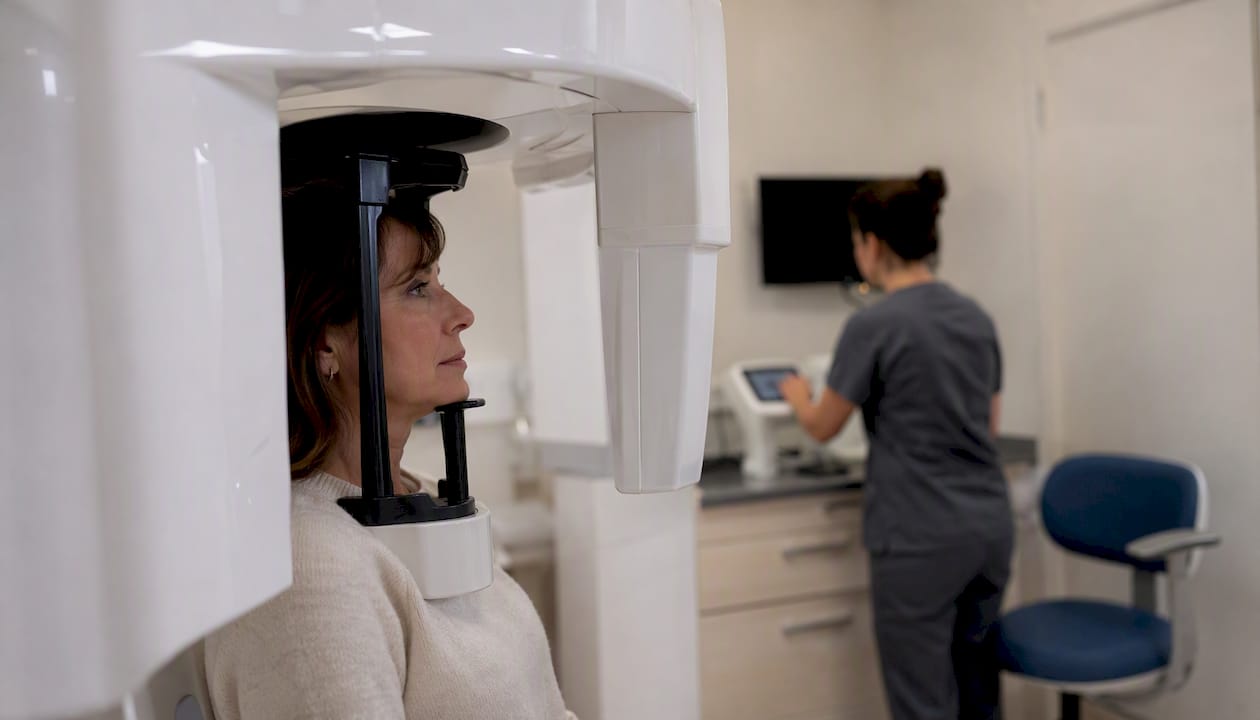
Your dentist reviews your medical history, takes a cone-beam CT (CBCT) scan, and evaluates bone volume, gum health, and adjacent teeth. This visit also screens for conditions that could complicate healing, like uncontrolled diabetes or active gum disease. Treatment planning typically wraps up within one to two weeks of this appointment.
Step 2: Pre-treatment and tooth extraction (Weeks 2–8, if needed)
If the tooth is still present, extraction comes first. Healing before implant placement depends on the protocol your surgeon chooses:
- Immediate placement (Type I): Implant placed the same day as extraction, when bone and tissue conditions allow.
- Early placement (Type II/III): Soft tissue closes first (4–8 weeks), then the implant is placed.
- Delayed placement (Type IV): Full bone healing, typically 3–6 months post-extraction, before surgery.
Step 3: Bone grafting, if required (adds 2–9 months)
Not every patient needs a graft, but when bone volume is insufficient, grafting happens before or at the time of implant placement. Socket preservation grafts placed at extraction typically integrate in 2–4 months. More involved procedures, like a lateral window sinus lift, require 4–9 months of healing before the implant can be placed. Minor augmentation done simultaneously with implant placement adds less time overall.
Step 4: Implant placement surgery (Day of surgery + 1–2 weeks recovery)
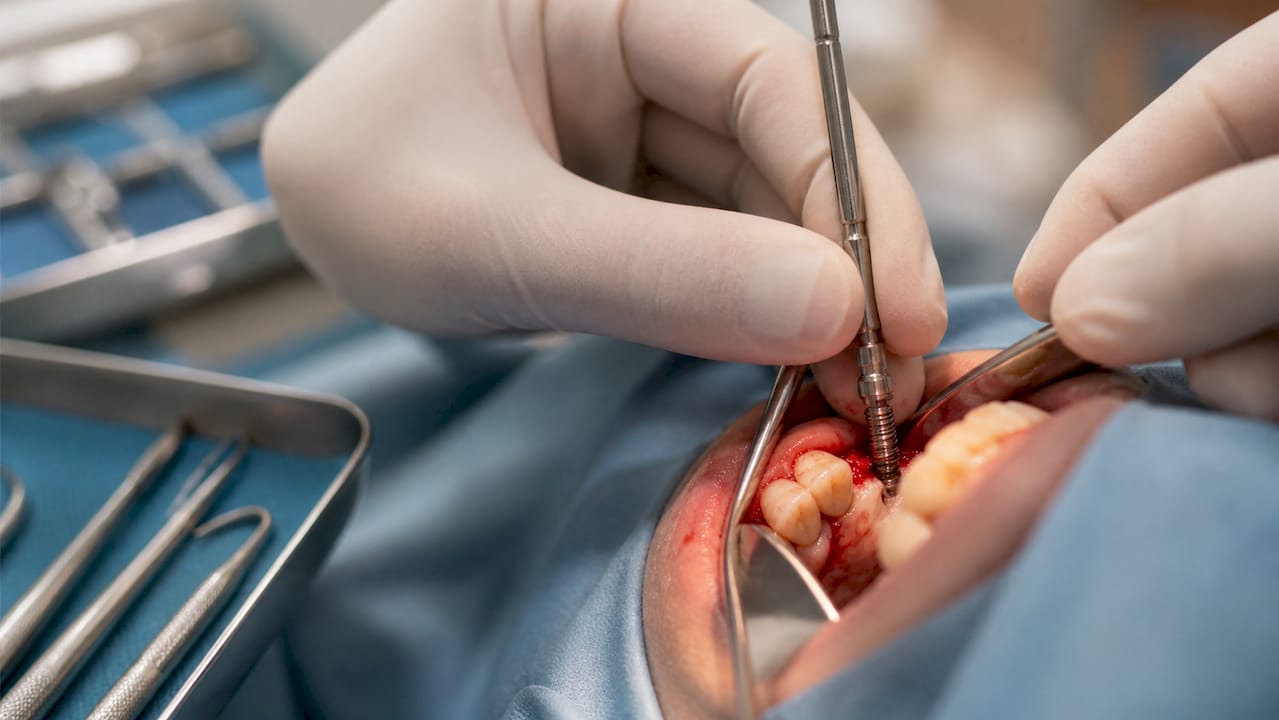
The titanium post is placed into the jawbone under local anesthesia, with sedation available. In a one-stage procedure, a healing cap sits above the gumline from day one. In a two-stage procedure, the implant is buried under the gum and uncovered at a second visit roughly 2–6 weeks after osseointegration is confirmed. Most patients return to normal activity within a few days, though soreness and minor swelling are common for 1–2 weeks.
Step 5: Osseointegration (several months)
Bone grows directly onto the implant surface over the following months. The AAOMS describes this healing process as individualized, requiring regular follow-ups to assess stability before any final restoration is placed. The American Dental Assistants Association notes that approximately 4 months is a commonly cited integration window for many posterior single implants, though upper jaw sites and grafted sites often need longer.
Step 6: Abutment placement and soft-tissue maturation (2–6 weeks)
Once osseointegration is confirmed, the abutment (the connector between implant and crown) is attached. Gum tissue needs 2–6 weeks to mature around it before a final impression is taken.
Step 7: Final restoration (2–4 weeks after impression)
A digital scan or traditional impression captures the exact position of the implant. The lab fabricates the crown, bridge, or overdenture, and the final restoration is seated at the last appointment. Digital scanning can speed lab turnaround, though traditional implant-level impression techniques remain widely used for high-accuracy restorations.
| Stage | Typical Duration | Visits |
|---|---|---|
| Consultation and imaging | 1–2 weeks | 1–2 |
| Extraction (if needed) | Day of + 1–2 weeks recovery | 1 |
| Bone graft (if needed) | 2–9 months healing | 1–2 |
| Implant placement | Day of surgery | 1 |
| Osseointegration | 3–6 months | 2–3 check-ins |
| Abutment + soft tissue | 2–6 weeks | 1 |
| Final crown/restoration | 2–4 weeks after impression | 1–2 |
Which extra procedures add the most time to your treatment?
Bone grafting is the single biggest timeline extender. Here is what each common adjunctive procedure typically adds:
- Socket preservation graft (placed at extraction): 2–4 months before implant placement
- Particulate bone graft (minor augmentation at implant placement): minimal added time, often done simultaneously
- Block graft (larger defect): 4–6 months of healing before implant surgery
- Lateral window sinus lift: 4–9 months depending on the amount of bone generated
- Crestal sinus lift (osteotome technique, smaller gain): often done at implant placement, less added time
- Guided bone regeneration (GBR): 4–6 months depending on membrane type and defect size
Timing the graft matters. A socket preservation graft placed at extraction avoids a separate surgical appointment later and can shorten the overall plan by folding two procedures into one visit. Staging the graft after the site has already healed adds another surgical recovery window.
One scenario that catches patients off guard: a failed graft or post-surgical infection can reset the clock. Re-treatment typically requires roughly 3 months of healing before a new attempt, per Mayo Clinic guidance on bone graft integration. That is why pre-operative bone quality assessment and infection control are worth getting right the first time.
Immediate placement vs. delayed placement: which is faster?
Immediate implant placement (Type I, same day as extraction) sounds like the obvious shortcut. The reality is more nuanced.
Potential advantages of immediate placement:
- Fewer surgical appointments
- Shorter total treatment time in straightforward cases
- Possible same-day provisional crown for esthetics
Trade-offs to weigh:
- Higher risk of mid-facial gum recession in esthetic zones
- Requires preserved buccal (outer) bone wall at the extraction socket
- Demands precise 3D planning and high primary implant stability
- Not appropriate when active infection is present
A scoping review published in the Journal of Clinical Medicine found comparable implant survival rates between immediate and delayed protocols overall, but noted that immediate placement carries a higher risk of mid-facial recession while delayed placement tends to yield more predictable soft-tissue healing. For front teeth, that esthetic trade-off matters.
AAOMS clarifies that even when a provisional crown is placed the same day for appearance, it is typically not used for chewing. True immediate loading (functional bite forces on the implant from day one) requires high primary stability and sufficient bone volume. Without those conditions, loading too early raises failure risk.
Eligibility checklist for immediate placement:
- Intact buccal bone wall at the extraction site
- No active infection or significant bone loss
- Adequate bone volume for primary stability
- Non-smoker or well-controlled risk profile
- Favorable tooth position (posterior sites are generally lower esthetic risk)
How does osseointegration actually work, and how long does it take?
Osseointegration is the direct structural bond between living bone and the implant surface. Bone cells migrate onto the titanium, deposit new matrix, and gradually anchor the post so firmly that it functions like a natural root. The AAOMS emphasizes that this process is highly individualized.
Typical windows by site:
- Lower jaw (mandible): 3–4 months, often faster due to denser bone
- Upper jaw (maxilla): 4–6 months, softer bone takes longer to mineralize
- Grafted sites: 4–9 months depending on graft type and volume
Clinicians confirm stability through a combination of radiographic bone contact (no visible gap around the implant on X-ray), absence of mobility when tested, and healthy surrounding soft tissue. No single test is definitive on its own.
A standard follow-up schedule looks like this:
- 1 week post-surgery: Suture check, early healing assessment
- 2 weeks: Soft tissue closure confirmed
- 3 months: Radiographic check, initial stability assessment
- Prosthetic stage: Final stability confirmation before abutment placement
Pro Tip: Ask your surgeon specifically whether your implant site is in the upper or lower jaw and whether any grafting was done. Those two factors alone will tell you whether to plan for a 4-month or a 6-plus-month osseointegration window.
What factors speed up or slow down your healing?
Patient factors
- Smoking: Reduces blood flow to healing tissue and is one of the strongest predictors of implant failure and delayed osseointegration
- Diabetes: Poorly controlled blood sugar slows tissue repair; well-managed diabetes is generally not a contraindication
- Bisphosphonate medications: Used for osteoporosis; can impair bone remodeling and require pre-treatment evaluation
- Oral hygiene: Bacterial load around the implant site directly affects soft-tissue healing
- Nutrition: Adequate protein, calcium, and vitamin D support bone regeneration
- Age and bone density: Older patients with lower bone density may integrate more slowly, though age alone is rarely a disqualifier
Treatment factors
- Implant diameter and length relative to available bone
- Location (posterior mandible heals faster than posterior maxilla)
- Need for simultaneous augmentation
- Immediate loading attempts without confirmed primary stability
Red flags that require prompt contact with your clinic
- Pain that increases after the first week rather than improving
- Swelling accompanied by fever
- Any visible implant mobility
- Persistent drainage or unusual taste from the surgical site
- Numbness that does not resolve within a few weeks
Pro Tip: Pre-op optimization makes a measurable difference. Quitting smoking at least 8 weeks before surgery, stabilizing blood glucose, and reviewing your medication list with your dentist before the procedure are the three steps most likely to keep your dental implant recovery on schedule.
Three realistic case timelines to map your situation
Example A: Simple single-tooth replacement, no graft needed
- Consultation and CBCT scan (Week 1)
- Implant placement surgery (Week 2–4)
- Osseointegration (Months 1–4)
- Abutment placement (Month 4–5)
- Soft-tissue maturation (2–4 weeks)
- Final crown seated (Month 5–6)
Total: approximately 4–6 months
Example B: Extraction plus socket graft, then implant
- Extraction and socket preservation graft placed same day (Week 1)
- Graft integration and site healing (Months 1–4)
- Implant placement (Month 4–5)
- Osseointegration (Months 5–9)
- Abutment and final crown (Months 9–11)
Total: approximately 9–12 months
Example C: Full-arch rehabilitation (All-on-X style)
Full-arch cases involve multiple implants and often combine extractions, grafting, and either immediate or staged loading. Immediate-load protocols can place a provisional full arch the same day as surgery, with the final prosthesis following after osseointegration. Staged protocols add 3–6 months before the final restoration. For a deeper look at how full-arch timelines are structured, the All-on-Four complete guide covers both approaches in detail.
Total: approximately 6–18 months depending on bone volume, number of grafts, and loading protocol.
A common patient question: When can I eat normally? With immediate provisional restorations, soft foods are typically allowed within days, but full chewing function on the final prosthesis usually resumes after osseointegration is confirmed, often 3–6 months post-surgery.
How guided and robot-assisted workflows can affect your timeline
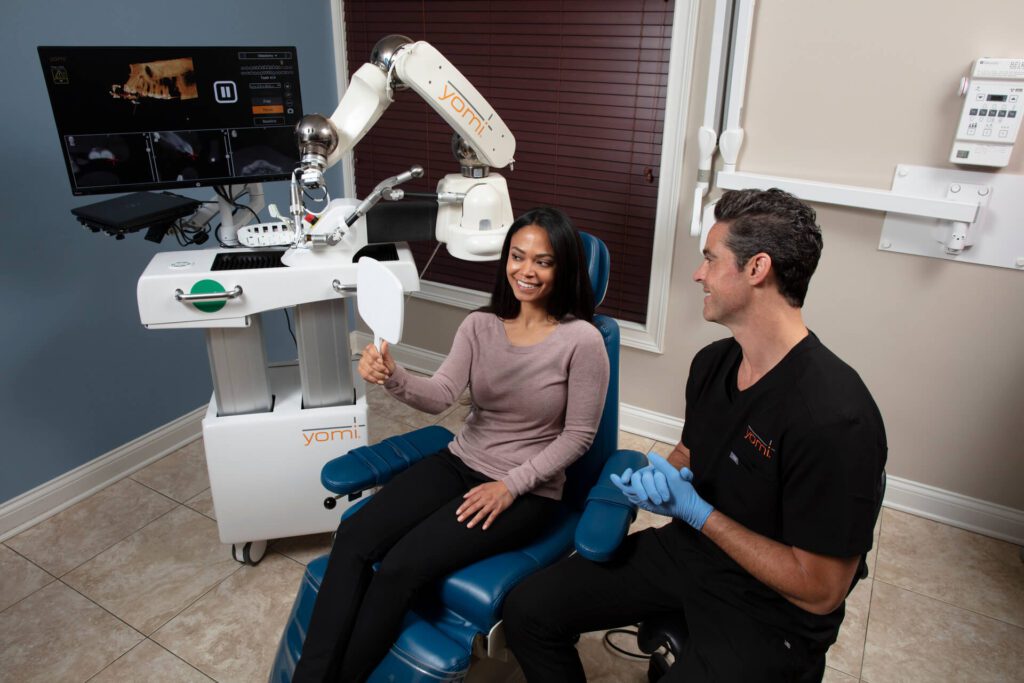
Guided implant surgery uses a pre-fabricated surgical guide, created from your CBCT scan, to direct the drill to the exact planned position. Yomi® robot-assisted placement takes this further: the robotic arm provides real-time haptic feedback during surgery, so the surgeon can adjust depth and angle dynamically rather than relying solely on a static guide.
The practical effect on your timeline: Precise placement reduces the likelihood of intra-operative adjustments, bone damage from misdirected drilling, and post-operative complications that delay restoration. In select cases, the accuracy of robot-assisted placement supports same-day provisionalization because the implant lands exactly where the prosthetic plan requires it. Fewer corrective visits means fewer weeks added between stages.
For patients who want to understand the mechanics behind this approach, the robotic dental implants overview explains how Yomi® works and what the precision data looks like in practice.
Pro Tip: When evaluating any implant provider, ask specifically: “Do you use a surgical guide or robot-assisted placement, and will my prosthetic plan be designed before surgery?” A yes to both means your implant position is optimized for the final crown before the first drill touches bone.
Towne Dental’s perspective on managing your implant timeline
At Towne Dental, the most common source of timeline surprises is not the surgery itself. It is the gap between what a patient expects at the consultation and what the healing biology actually requires. Shared decision-making at the planning stage, where the surgeon walks through each phase with realistic month estimates, is what keeps patients on schedule rather than frustrated.
The patient responsibilities that most consistently shorten delays:
- Following pre-operative instructions precisely (fasting, medication adjustments, antibiotic protocols)
- Attending every follow-up appointment, even when healing feels uneventful
- Maintaining meticulous oral hygiene around the implant site throughout osseointegration
- Reporting any unusual symptoms promptly rather than waiting for the next scheduled visit
Every treatment plan at Towne Dental is individualized. Bone volume, systemic health, and the number of teeth being replaced all shape the schedule. The goal is a timeline that is honest from day one, not one that gets revised after the first complication.
Towne Dental offers every phase of the implant process under one roof
From CBCT imaging and oral surgery (extractions, bone grafting, sinus lifts) through Yomi® robot-assisted implant placement and final crown fabrication, Towne Dental handles the complete treatment arc without referrals to outside specialists. That continuity matters for timeline management: your surgeon and restorative dentist are coordinating in the same practice, not trading records across offices.

To get a realistic timeline estimate for your specific case, book a consultation at Towne Dental. Bring your current medication list and any recent dental X-rays. The team will complete a CBCT scan at that first visit and give you a stage-by-stage schedule before any treatment begins. See all available services or call to schedule directly.
Sources
- Dental implant surgery – Mayo Clinic
- From Biological Mechanisms to Clinical Outcomes: A Scoping Review Comparing Immediate and Delayed Dental Implant Placement Protocols
- Dental Implants: A Comprehensive Review | American Dental Assistants Association
- National Institute of Dental and Craniofacial Research (NIDCR)
Bring any printed materials from these sources to your consultation. Your clinician can apply the general guidance to your specific bone volume, health history, and tooth position.
This article is general information, not a substitute for advice from a qualified doctor. Consult a qualified healthcare professional about your own circumstances before acting on anything here.
FAQ
How long does the full dental implant process take?
Most single-tooth cases without grafting take 4–8 months from consultation to final crown. Cases involving bone grafts or sinus lifts typically run 6–12 months or longer.
What is osseointegration and how long does it take?
Osseointegration is the process of bone fusing directly to the implant surface. It typically takes 3–4 months in the lower jaw and 4–6 months in the upper jaw or at grafted sites.
Can a dental implant be placed the same day as extraction?
Yes, in select cases. Immediate placement requires intact surrounding bone, no active infection, and high primary implant stability. Not every extraction site qualifies, and a same-day provisional crown is usually for appearance only, not chewing.
What slows down dental implant healing the most?
Smoking is the single strongest controllable factor. Poorly managed diabetes, inadequate oral hygiene, and certain medications like bisphosphonates also delay osseointegration and soft-tissue healing.
How many appointments does the implant process require?
Most straightforward cases involve 5–8 appointments across the full timeline: consultation, surgery, two to three osseointegration check-ins, abutment placement, and final crown seating. Grafting or complications add visits.