A single dental implant — post, abutment, and crown combined — typically runs between $3,000 and $6,000 in the United States, with a national average near $4,507. That range reflects a straightforward case in an average-cost market; what you actually pay depends heavily on where you live, your bone health, and how many teeth need replacing.
Quick cost snapshot:
- Single implant (post + abutment + crown): $3,000–$6,000; national average approximately $4,507
- All-on-4 per arch: roughly $15,000–$35,000
- Full-mouth treatment: $40,000–$90,000+
Implants are not cheap, but they are the only tooth-replacement option that preserves jawbone and functions like a natural tooth. For most healthy candidates, the long-term math works in their favor.
Table of Contents
- How much does a dental implant cost, component by component?
- What hidden costs do patients often miss?
- What factors change how much you pay?
- What do full-arch and full-mouth implant solutions cost?
- How can insurance, FSA/HSA, and financing lower your out-of-pocket cost?
- What is the typical timeline from consult to final crown?
- Are dental implants worth the investment?
- Key Takeaways
- Why the cheapest implant quote is rarely the whole story
- Towne Dental offers transparent implant pricing and Yomi-assisted surgery
- Useful sources
- FAQ
How much does a dental implant cost, component by component?
Every implant quote should break down into at least three restorative pieces plus the surgical fee. When a provider gives you one lump number, ask them to itemize it — here is what you are looking at.
The three core components
- Implant fixture (post): The titanium or zirconia screw placed into the jawbone. CDT code D6010. Typical range: $1,500–$2,500.
- Abutment (connector): The piece that links the post to the crown. CDT code D6057 for a custom abutment. Typical range: $400–$900. Stock abutments cost less; custom abutments cost more and are used when anatomy demands a precise fit.
- Crown (final tooth): The visible porcelain or zirconia restoration. Typical range: $1,000–$2,500. Lab-fabricated crowns from premium ceramics sit at the high end.
Beyond those three, most quotes also include a surgical placement fee and a planning fee, which may be bundled or listed separately.
| Component | Typical U.S. Range | CDT Code |
|---|---|---|
| Implant fixture (post) | $1,500–$2,500 | D6010 |
| Abutment | $400–$900 | D6057 (custom) |
| Crown | $1,000–$2,500 | varies by material |
| Surgical placement fee | $500–$1,500 | — |
| Consult + imaging | $150–$500 | D0330 (CBCT) |
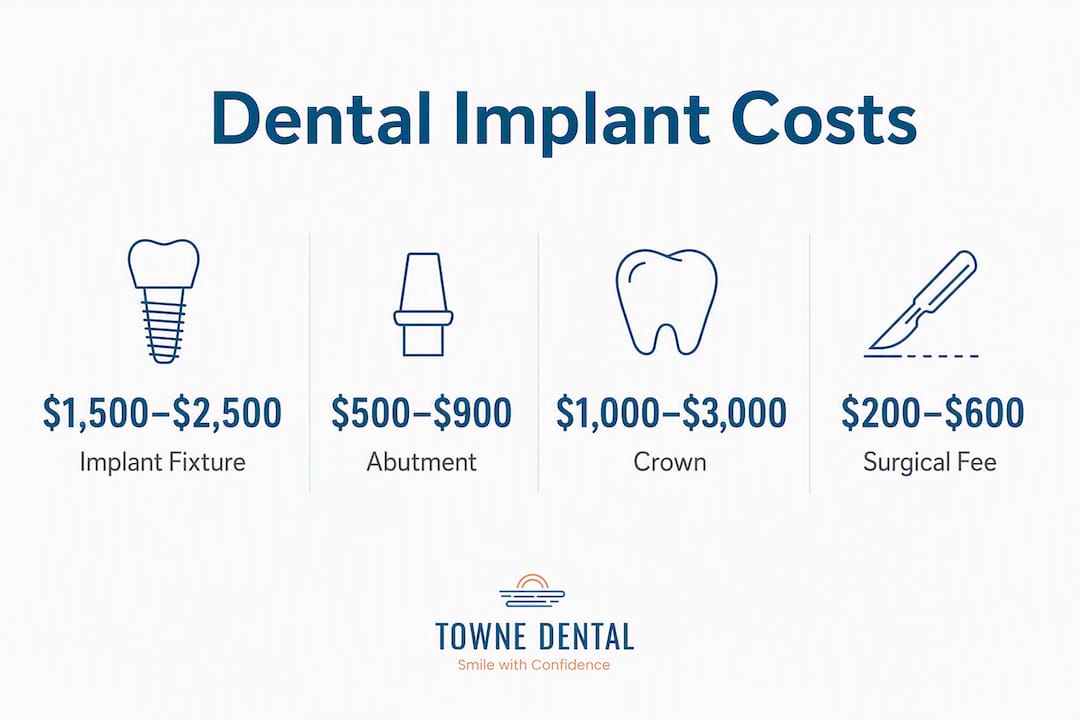
Costs climb when a patient needs a custom abutment instead of a stock one, when the crown material is premium zirconia, or when the practice uses guided surgical templates that require additional lab work.
What hidden costs do patients often miss?
The component prices above assume a clean, straightforward case. Most patients are not straightforward cases. Here is what commonly gets added to the bill after the initial quote.
- CBCT/3D cone-beam imaging: Standard 2D X-rays are not enough for implant planning. A cone-beam CT scan (CDT D0330) typically adds $150–$500 and is almost always necessary.
- Tooth extraction: If the failing tooth is still in place, removal adds $150–$300 for a simple extraction, more for a surgical one.
- Bone grafting: More than half of all implant cases require some bone grafting. Costs range from roughly $550 for a minor socket graft to over $5,000 for a major block graft. If you have been missing a tooth for years, expect this line item. For a deeper look at what happens when bone is insufficient, the dental implants without bone guide explains your options.
- Sinus lift: Required when placing implants in the upper back jaw where the sinus cavity sits too low. Adds $1,500–$3,000 or more.
- Sedation or anesthesia: IV sedation typically runs $250–$900 depending on duration. Local anesthesia is usually included; anything beyond that is extra.
- Temporary restoration: A flipper or temporary crown keeps the space filled during healing. Budget $300–$600.
- Follow-up imaging and check visits: Some practices include these; others bill separately.
Pro Tip: Ask for a full itemized quote with CDT codes before you commit. Legitimate offices will list every code — D6010, D6057, D0330, and any graft codes — so you can cross-check allowed amounts through your insurer’s predetermination process or FAIR Health Consumer. If a quote is one line item with no codes, that is a red flag.
A second-opinion treatment-plan review is one of the most cost-effective steps you can take before signing anything. It can surface unnecessary grafts or redundant imaging that inflate the total.
What factors change how much you pay?
Geography
Where you live is one of the biggest levers on price. State-level averages range from about $3,759 in Alabama to $5,733 in California. High-cost metro markets like New York City and San Francisco commonly run 40–60% above rural areas for identical work. A patient in rural Mississippi and a patient in Manhattan are not shopping the same market.

Provider type
Counterintuitively, specialists often charge less than general dentists for implants. One analysis found specialist median costs are often notably lower than those of general dentists for implant procedures, likely because high-volume specialists have more efficient workflows and stronger lab relationships. That does not mean every specialist is cheaper, but it is worth getting quotes from both.
Clinical complexity
Bone quality is the single biggest clinical variable. A patient with dense, adequate bone in a straightforward position pays far less than one who needs a sinus lift, multiple extractions, and staged grafting. Infection, prior failed implants, and anatomical challenges all add time and cost.
Materials and implant brand
Titanium remains the standard and is well-supported by decades of clinical data. Zirconia implants are metal-free and increasingly popular, but they typically cost more and have a shorter long-term track record. For the abutment, stock options cost less; custom-milled abutments add $200–$400 but may be clinically necessary for ideal crown fit.
Technology at the practice level
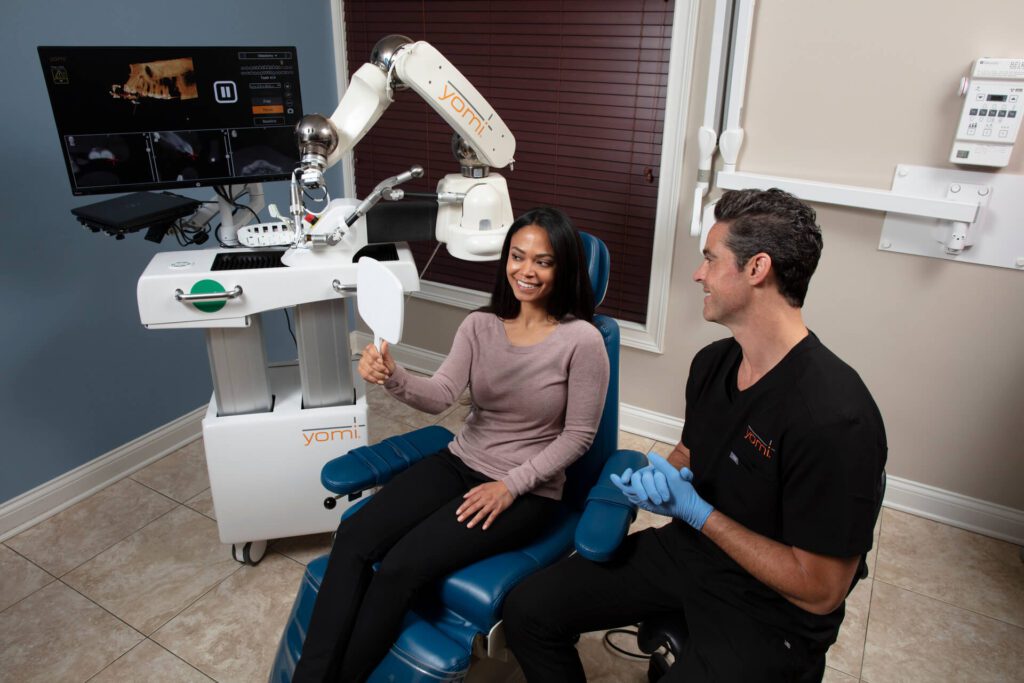
Practices using guided surgery or robotic assistance — such as the Yomi® robotic system — invest more in planning infrastructure, which can affect fees. The tradeoff is more precise placement, reduced surgical trauma, and faster recovery. Robotic-assisted implant surgery is worth understanding if you are comparing practices on more than price alone.

What do full-arch and full-mouth implant solutions cost?
When multiple teeth are missing or a full arch needs replacing, single implants per tooth become impractical. Full-arch solutions consolidate the work onto fewer posts.
- All-on-4: Four implants support a full fixed arch. Per-arch cost typically runs $15,000–$35,000; full-mouth (both arches) can reach $40,000–$90,000+. The wide range reflects material choices (acrylic vs. zirconia prosthetics), geographic market, and whether extractions or grafting are needed. The All-on-4 with zirconia guide covers material differences in detail.
- All-on-6: Six implants per arch provide additional stability, particularly for patients with lower bone density. Costs run higher than All-on-4 per arch, reflecting the extra surgical and restorative work.
- Implant-supported overdentures: A removable denture that snaps onto two to four implants. Less expensive than a fixed arch, with lower per-arch costs, but requires daily removal for cleaning.
- Full-mouth individual implants: Replacing every tooth with its own implant is the most expensive route and rarely the recommended one for patients who have lost most of their teeth.
Full-arch solutions often reduce the per-tooth cost compared to individual implants, but the upfront investment is substantial. Patients who need extensive extractions or bone grafting before placement should budget for those procedures on top of the arch cost.
How can insurance, FSA/HSA, and financing lower your out-of-pocket cost?
What dental insurance actually covers
Most dental plans either exclude implants outright or classify them as a “major service” subject to a 50% co-pay after a waiting period. The real problem is the annual maximum. Annual caps commonly run from about one to a few thousand dollars, which barely covers the crown on a single implant, let alone the post and abutment. Even a plan that pays 50% of major services hits its ceiling fast.
Example scenario: a $4,500 implant with a plan that covers 50% of major services and has a $1,500 annual maximum. The plan pays $1,500; you pay $3,000. That is the realistic math for most patients with standard employer dental coverage.
Waiting periods (commonly 12 months for major services) and in-network vs. out-of-network allowed amounts add further complexity. Always request a predetermination from your insurer before treatment starts — it is not a guarantee of payment, but it tells you what the plan will and will not cover.
FSA and HSA
Flexible Spending Accounts and Health Savings Accounts let you pay for implants with pre-tax dollars, effectively reducing your cost by your marginal tax rate. HSA funds roll over year to year, making them a useful savings vehicle for planned implant work.
Financing options
- In-office payment plans: Many practices offer interest-free installments for 6–18 months.
- Third-party medical financing: Companies like CareCredit and Lending Club Patient Solutions offer longer-term plans, though interest rates on extended terms can be significant. Read the terms carefully.
- Dental discount plans: Not insurance, but membership-based fee schedules that reduce costs at participating offices, typically 10–30% off listed fees.
The two-year strategy
Splitting staged implant treatment across two calendar years is a reliable tactic for multi-stage cases. Schedule the surgical placement in December and the crown delivery in January, and you can access two annual benefit maxima instead of one. On a $1,500 annual cap, that is a $3,000 insurance contribution toward a $4,500 case.
What is the typical timeline from consult to final crown?
- Initial consultation and imaging (Week 1–2): Exam, X-rays, CBCT scan, and treatment planning. This is where add-on costs like bone grafts get identified.
- Extractions, if needed (Week 2–4): Failing teeth come out. Some cases allow immediate implant placement at the same appointment; others require healing time first.
- Bone grafting, if needed (adds 3–6 months): Grafts need time to integrate before an implant can be placed. A sinus lift can add a similar delay.
- Implant placement surgery (Day 1 of implant timeline): The fixture goes into the bone. A temporary restoration may be placed the same day in select cases.
- Osseointegration and healing (3–6 months): The implant fuses with the jawbone. This is the longest phase and cannot be rushed. Smoking, uncontrolled diabetes, and certain medications can extend this window or cause failure.
- Abutment placement (after osseointegration): A short appointment to attach the connector piece. Some implant systems combine this with the crown delivery.
- Crown delivery (final appointment): The permanent restoration is placed and adjusted. Total treatment time from consult to final crown: typically 5–9 months for a straightforward case, 12–18 months when grafting is involved.
Immediate-loading protocols (“teeth in a day”) exist for select candidates with adequate bone, but they are not universally appropriate and carry specific clinical requirements.
Are dental implants worth the investment?
For most healthy patients, yes. Implants are the only tooth-replacement option that stimulates the jawbone and prevents the bone resorption that follows tooth loss. Bridges and dentures restore appearance and some function, but they do not address the underlying bone loss. Over a 20-year horizon, the total cost of maintaining a bridge (which typically needs replacement every 10–15 years) often approaches or exceeds the cost of an implant placed once.
The American Academy of Implant Dentistry notes that implants are highly customized and that final cost depends on diagnostics, bone quality, and restorative needs — which is exactly why two patients with the same missing tooth can receive very different quotes.
Clinical risk factors that affect outcomes and costs
Active smoking increases implant failure rates 2–3 times compared to non-smokers. Uncontrolled diabetes slows osseointegration and raises infection risk. Bisphosphonate medications (used for osteoporosis) can impair bone healing and may require a drug holiday before surgery. These are not disqualifying conditions for most patients, but they require honest disclosure and may mean additional monitoring, longer healing phases, or higher remedial costs if complications arise.
Common complications include peri-implantitis (infection around the implant), crown fracture, and, in rare cases, implant failure requiring removal and replacement. Remedial costs for a failed implant can run $1,000–$3,000 or more, depending on what needs to be redone.
Pro Tip: Ask your provider two specific questions before signing a treatment plan: (1) What does the practice warranty cover, and for how long? (2) What does the implant manufacturer warranty cover? These are separate. A practice warranty typically covers the restorative work; the manufacturer warranty covers the fixture itself. Understanding both protects you from unexpected costs down the road. More detail on implant warranty policies is worth reviewing before you commit.
Key Takeaways
A single dental implant in the U.S. has a national average cost near four to five thousand dollars, but actual out-of-pocket costs depend on location, bone health, insurance coverage, and financing strategies like the two-year benefit split.
| Point | Details |
|---|---|
| National average cost | A complete single implant averages $4,507; the typical range is $3,000–$6,000 depending on location and complexity. |
| Always request itemized quotes | Ask for CDT-coded line items (D6010, D6057, D0330) so you can verify charges and run a predetermination with your insurer. |
| Insurance rarely covers the full cost | Annual maximums typically leave most patients paying substantial out-of-pocket costs even with coverage. |
| Use the two-year strategy | Scheduling placement and crown delivery across two calendar years lets you access two annual benefit maxima. |
| Towne Dental approach | Towne Dental provides itemized, CDT-coded treatment plans with Yomi® robotic-assisted placement for predictable outcomes and transparent pricing. |
Why the cheapest implant quote is rarely the whole story
The conventional wisdom on dental implant pricing goes like this: shop around, find the lowest quote, and you have found the best deal. That logic works for commodity purchases. It does not work for a surgical procedure where the outcome depends on bone quality, surgical precision, and long-term follow-up.
The 29% cost gap between specialists and general dentists is real, but it does not mean specialists are cutting corners to get there. It usually reflects volume efficiency, better lab relationships, and more predictable workflows. A high-volume implant specialist who places 200 implants a year has a fundamentally different risk profile than a general dentist who places 20.
The add-on cost problem is where patients most often get burned. A practice that quotes $2,500 for an implant and then adds $3,000 in grafting, imaging, and sedation has not given you a low price. They have given you a low anchor number. The only way to compare quotes honestly is to compare complete, itemized treatment plans for the same clinical scenario. That means getting a CBCT scan done first, having a full diagnosis in hand, and then asking two or three providers to quote against the same set of findings.
The long-term value case for implants is genuinely strong. A bridge requires grinding down two healthy adjacent teeth and typically needs replacement after 10–15 years. A well-placed implant in a healthy patient can last decades. The upfront cost is higher, but the total cost of ownership over a lifetime often is not. That is the comparison worth making, not the sticker price on day one.
Towne Dental offers transparent implant pricing and Yomi-assisted surgery
Patients researching implant costs in Southwest Florida have a specific advantage at Towne Dental: the clinic uses the Yomi® robotic system for implant placement, which means computer-guided precision on every case rather than freehand estimation. That translates to more predictable outcomes, less surgical trauma, and faster recovery for most patients.
Every treatment plan at Towne Dental comes with itemized CDT-coded line items so you know exactly what you are paying for before a single appointment is scheduled. The team covers the full scope of implant-related care in-house, including oral surgery, periodontics, bone grafting, and final restorations, which means fewer referrals, fewer coordination gaps, and a single point of contact for your entire case. Financing options are available to help spread costs across manageable payments. To get a complete, itemized estimate for your specific situation, schedule a consultation through Towne Dental’s services page.
Useful sources
- State of U.S. Dental Costs 2026 — Real Dental Costs: State-by-state average implant costs with city-level data. The most granular public price index available for U.S. implant pricing.
- How Much Do Dental Implants Cost? — Dentistry Today: National range and average with component-level context; useful for cross-checking quotes.
- Full Price Breakdown by Component and State — ToothCheck: CDT code guidance and per-component ranges; recommended for patients reviewing itemized quotes.
- Dental Implant Cost by State — CostPrism: Insurance coverage limits, clinical risk factors, and state-level pricing context.
- AAID — How Much Do Dental Implants Cost?: Clinical perspective from the American Academy of Implant Dentistry on cost variables and candidacy.
- Does Dental Insurance Cover Implants? — HealthInsurance.org: Plain-language explanation of how dental plans handle implant coverage and annual maximums.
- HHS — Where Can I Find Low-Cost Dental Care?: Federal resource listing community health centers and federally qualified health centers that offer sliding-scale dental fees.
FAQ
How much does a single dental implant cost in the U.S.?
A complete single implant — post, abutment, and crown — typically costs $3,000–$6,000, with a national average of approximately $4,507. State averages range from about $3,759 in Alabama to $5,733 in California.
Will dental insurance pay for implants?
Most plans either exclude implants or cover them as a major service subject to annual maximums of $1,000–$2,500, which rarely covers the full cost of even one implant. Always request a predetermination before treatment starts.
Which state has the cheapest dental implants?
Based on current state-level data, Alabama has the lowest average implant cost at approximately $3,759, while California is among the highest at $5,733. Rural areas within any state tend to run below their state average.
How long do dental implants last?
A well-placed implant in a healthy patient can last decades, with many lasting a lifetime. Success rates are lower for smokers, patients with uncontrolled diabetes, and those on bisphosphonate medications, all of which can affect osseointegration and long-term stability.
Is a dental implant worth the money?
For most healthy patients, yes. Implants preserve jawbone, function like natural teeth, and avoid the structural compromises of bridges or dentures. Over a 15–20 year horizon, the total cost often compares favorably to alternatives that require periodic replacement.