Immediate implant placement puts a titanium implant into the socket the same day a tooth comes out, cutting a two-surgery process down to one and shortening total treatment time by months. It works well, with survival rates matching delayed protocols, but only in carefully screened cases with intact bone walls and a clinician who can verify enough mechanical stability to justify skipping the healing wait.
TL;DR:
- Proper case selection requires CBCT imaging to confirm sufficient bone volume and intact socket walls, avoiding cases with active infection or damaged bone.
- Achieving high primary stability with torque and ISQ values is essential before proceeding with immediate loading, limiting it to suitable cases.
- In esthetic zones, connective tissue grafts combined with provisional crowns help prevent gum recession and preserve gum contours.
- Immediate placement can cut treatment time by several months and reduce surgeries, but it increases risks if bone or tissue conditions are inadequate.
- A thorough diagnostic workup is crucial, as pushing for immediate placement without verifying bone and stability can lead to higher failure or complications.
Table of Contents
- What Is Immediate Implant Placement, and What Does It Actually Save You?
- The Selection Checklist: What Your Dentist Is Actually Looking For
- From Consultation to Temporary Crown: What the Procedure Involves
- What Can Go Wrong, and How Experienced Dentists Reduce the Risk
- Recovery Week by Week: What to Expect After Surgery
- Immediate, Early, or Delayed: Why Timing Isn’t One-Size-Fits-All
- What an Experienced Implant Provider Should Bring to Your Case
- Bottom Line: Is Immediate Placement Right for You?
- Why Standard Treatment Advice Undersells the Selection Problem
- Ready to Find Out If You’re a Candidate?
- Sources
- FAQ
What Is Immediate Implant Placement, and What Does It Actually Save You?
Immediate implant placement, sometimes called Type 1 placement in the clinical literature, means the implant goes into the socket immediately after extraction rather than after weeks or months of healing. There’s no second surgical appointment to open the gum and place the implant later. That’s the whole appeal in one sentence, and it’s a real one.
The practical benefits show up in three places patients actually feel:
- Fewer surgeries. One surgical event instead of two means less time in the chair, less cumulative anesthesia, and one recovery period instead of two.
- Shorter overall treatment. Skipping the multi-month socket-healing phase before implant placement can shave several months off a case that would otherwise stretch past a year.
- Better provisional esthetics in the right cases. Because the implant sits in its final position from day one, a temporary crown can sometimes be shaped and placed immediately, preserving gum contour that’s harder to rebuild once it collapses.
When performed on carefully selected patients by clinicians with the skill to confirm proper anchorage, survival rates for immediate implants run roughly 95% to 98%, statistically comparable to delayed placement. That figure matters because it tells you the trade-off isn’t really about implant survival. It’s about case selection. Get the candidacy criteria wrong and you’re not risking a slightly lower success rate. You’re risking a different set of complications entirely, which is exactly what the next section covers.
The Selection Checklist: What Your Dentist Is Actually Looking For
Not every extraction site is a candidate for immediate placement, and the criteria are stricter than most patients expect walking into a consultation.
- A 3D scan comes first. Cone-beam CT imaging lets your dentist measure socket walls, buccal bone thickness, and how much bone remains beyond the root apex, none of which a flat X-ray or a visual exam can reliably show.
- The socket walls need to be intact. If the tooth was lost to trauma, a vertical root fracture, or advanced decay that ate through the buccal plate, immediate placement usually isn’t an option; the implant has nothing solid to sit against.
- There has to be enough bone beyond the root tip. The implant gets its initial grip from bone beyond and around the socket, not from the socket itself, so apical and palatal bone volume is a hard requirement.
- Active infection rules it out. A draining abscess or acute periapical infection at the extraction site is one of the clearest contraindications the EAO position paper lists.
- Systemic and lifestyle factors count too. Uncontrolled diabetes, certain autoimmune conditions, and heavy smoking all raise the risk of poor healing and implant failure.
- Clinician experience is part of the criteria, not a footnote. The ITI consensus statements classify immediate placement with immediate restoration as an advanced protocol that demands the surgeon be able to verify true mechanical stability, not just estimate it.
Pro Tip: Ask your dentist to show you the CBCT scan and point out the buccal bone thickness directly. If they can’t articulate a specific number in millimeters, that’s a sign the case hasn’t been fully worked up yet.
From Consultation to Temporary Crown: What the Procedure Involves
Here’s what actually happens across the visits, in order.
- Diagnostic consultation and CBCT planning. Your dentist images the tooth and surrounding bone, sometimes building a digital surgical guide that maps the exact implant angle and depth before you’re ever in the chair.
- Atraumatic extraction. The tooth comes out with techniques designed to preserve the socket walls rather than lever against them, since a fractured buccal plate can eliminate the immediate-placement option mid-procedure.
- Implant insertion into apical bone. The implant is seated to engage bone beyond the socket, and the surgeon checks insertion torque and, often, resonance frequency (ISQ) readings to confirm it’s mechanically stable enough to load.
- Gap grafting. Almost always, there’s a gap between the implant and the socket walls. Bone graft material fills that space to support healing and reduce future ridge collapse.
- Soft tissue management. In visible areas, a connective tissue graft is often added to thicken the gum and protect against future recession, particularly for patients with thin gum tissue.
- Provisional restoration, if criteria are met. A temporary crown may go on the same day only if torque and stability numbers hit the threshold; otherwise the implant heals unloaded under a healing cap or a removable temporary.
What determines immediate loading versus waiting:
- Insertion torque and ISQ values above established thresholds
- No signs of infection at the time of placement
- Adequate keratinized tissue and a provisional design that avoids direct chewing contact
Follow-up typically happens at one week, one month, and three months, with your dentist watching for tissue healing, any implant mobility, and how the gum margin is settling around the crown.
What Can Go Wrong, and How Experienced Dentists Reduce the Risk
The biggest esthetic risk with immediate implants is midfacial recession, where the gum line on the front (facial) side of the implant shifts downward as the socket remodels. This happens because tooth extraction triggers bone remodeling that immediate placement slows but does not fully stop, and patients with thin, delicate gum tissue (thin biotype) are considerably more prone to it than those with thicker, more robust tissue.
Other risk factors that raise failure rates:
- Insufficient primary stability. If the implant doesn’t achieve solid mechanical lock at placement, it’s at higher risk of failing before it can integrate.
- Undetected or developing infection. Even low-grade infection at the extraction site compromises healing.
- Occlusal overload. A temporary crown placed too high, catching bite forces it isn’t ready for, can loosen an implant before it has fully integrated.
Dentists manage these risks with specific techniques rather than hoping the biology cooperates. Gap grafting, connective tissue grafts, and carefully shaped provisional crowns all work together to hold the gum contour in place while the bone remodels underneath it. In esthetic zones especially, pairing immediate placement with a connective tissue graft and a purposefully under-contoured provisional crown is one of the more reliable ways to protect against a visible gum line drop. None of this eliminates the risk. It manages it.
Recovery Week by Week: What to Expect After Surgery
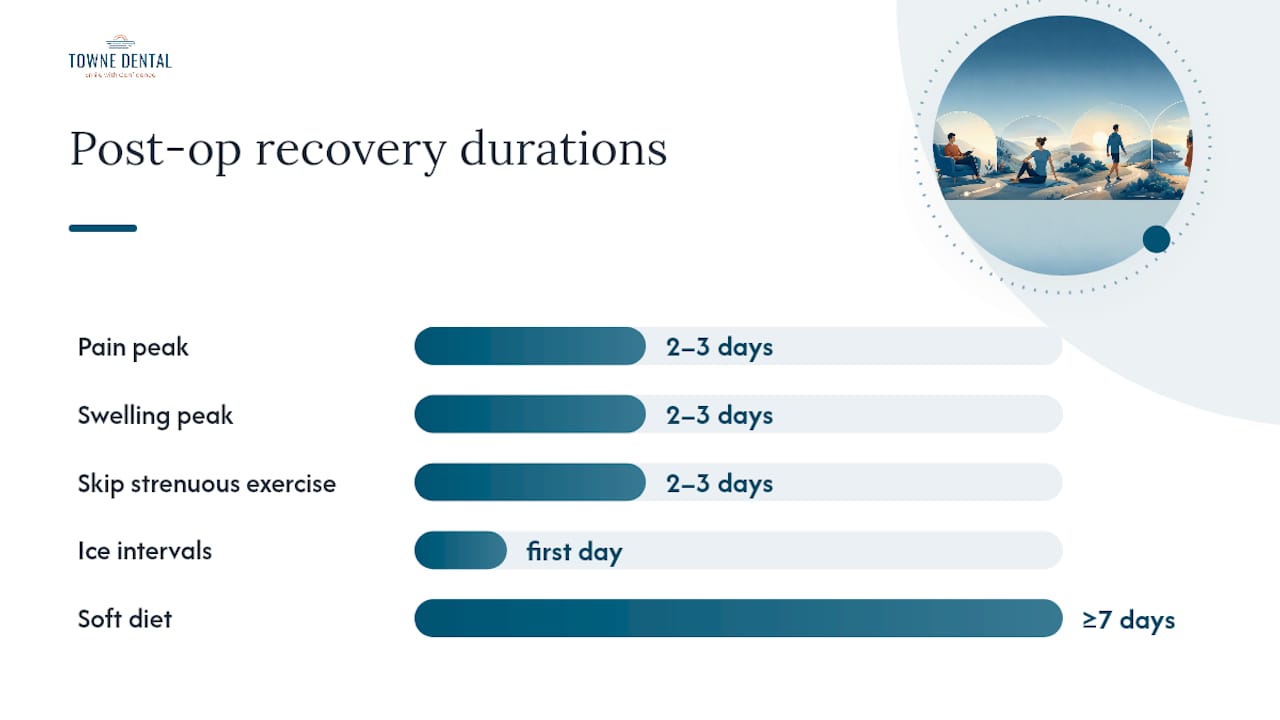
Pain after immediate implant placement is usually moderate and peaks in the first 48 to 72 hours, similar to a surgical extraction, and typically responds well to over-the-counter ibuprofen or a short course of a prescribed analgesic. Swelling tends to build for the first two to three days before it starts improving.
What to expect and do during healing:
- Rinse gently with warm salt water starting the day after surgery; avoid vigorous swishing or spitting that could dislodge the graft material.
- Stick to a soft diet (yogurt, eggs, soup, mashed vegetables) for at least a week, and chew on the opposite side if a temporary crown is in place.
- Skip strenuous exercise for 48 to 72 hours, since elevated blood pressure can increase bleeding and swelling at the site.
- Brush other teeth normally, but hold off brushing directly over the surgical site until your dentist says it’s healed enough.
Pro Tip: Ice the outside of your cheek in 15-minute intervals for the first day. It does more to control swelling than most people expect, and it’s easy to skip when you’re distracted by discomfort.
Call your dentist promptly if you notice bleeding that won’t stop with gentle pressure, fever, pain that gets worse instead of better after day three, or any sense that the implant or temporary crown feels loose. Those aren’t symptoms to wait out.
Immediate, Early, or Delayed: Why Timing Isn’t One-Size-Fits-All
Immediate placement is one option among four recognized timing protocols, and the classification system exists precisely because not every case fits the immediate model.
- Type 1 (immediate): Implant placed the same day as extraction. Best for intact sockets with no active infection.
- Type 2 (early, 4 to 8 weeks): Allows soft tissue to heal over the socket first. Often chosen when there’s a small infection that needs to clear before intervening.
- Type 3 (early, 12 to 16 weeks): Allows partial bone healing. Common when the socket has some bone loss that needs to regenerate before placement.
- Type 4 (delayed, six months or more): Full bone healing first, sometimes after a separate grafting procedure. Used for sites with significant bone loss or prior infection.
A patient with a fractured molar and a clean socket is a reasonable immediate candidate. A patient with a longstanding periapical abscess almost never is, no matter how much they’d prefer to skip the wait.
What an Experienced Implant Provider Should Bring to Your Case
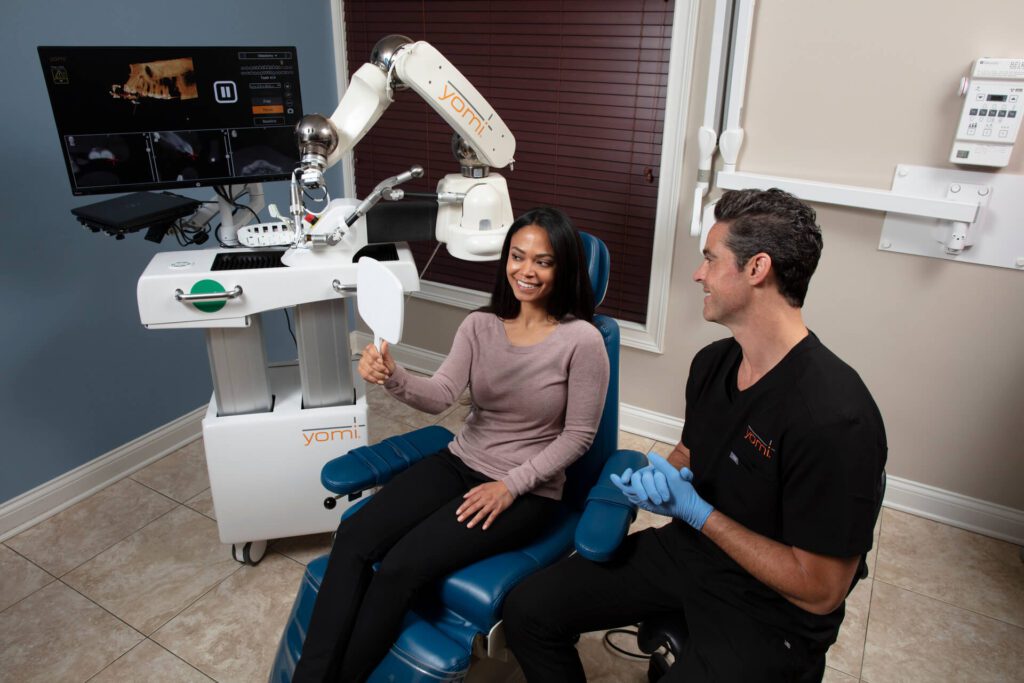
Immediate placement leaves little room for guesswork, which is exactly where technology and hands-on surgical experience earn their keep. At Towne Dental, treatment planning starts with CBCT imaging and digital guides, the same diagnostic standard the EAO position paper points to for assessing socket walls and bone volume before anyone touches a drill. For select cases, the team also uses Yomi robotic-assisted surgery to guide implant angle and depth with more precision than freehand placement allows.
| What matters for immediate placement | Why it matters |
|---|---|
| CBCT-based diagnosis | Confirms bone volume and socket integrity before committing to same-day placement |
| Guided or robotic-assisted surgery | Improves accuracy of implant angle, depth, and apical bone engagement |
| Soft tissue grafting expertise | Reduces the risk of visible gum recession in esthetic zones |
| Case-by-case loading decisions | Immediate crown placement only when torque and stability criteria are actually met |
Soft tissue grafting and provisional shaping matter as much as the surgery itself in visible areas, since a poorly managed gum line is the complication patients notice most. Full clinician credentials, individual case outcomes, and patient-reported results are best discussed directly during a consultation with the oral surgery team.
Bottom Line: Is Immediate Placement Right for You?
Immediate implant placement rewards the right candidate with fewer surgeries and a faster path to a finished smile. It punishes the wrong candidate with a higher chance of recession, grafting complications, or a failed integration. The difference between those two outcomes comes down to bone volume, absence of infection, and whether your dentist can verify real primary stability rather than assume it.
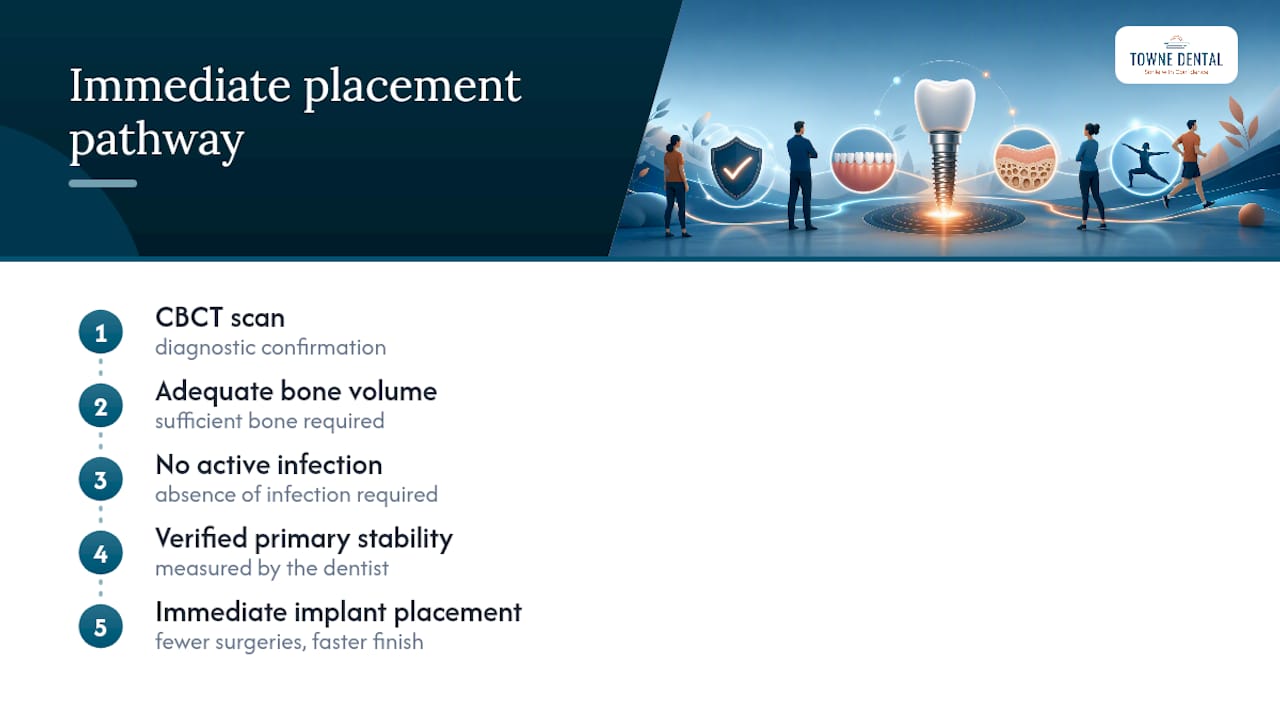
If you’ve recently lost a tooth or know an extraction is coming, the next real step isn’t researching further. It’s a diagnostic consultation with a CBCT scan, which is the effective way to know which category your case actually falls into.
Why Standard Treatment Advice Undersells the Selection Problem
Most patient-facing content on immediate implants leads with the convenience angle: one surgery, less time, less hassle. That’s true, but it buries the part that actually determines outcomes. The real skill in immediate placement isn’t the concept, it’s the judgment call on a specific socket, on a specific day, with a specific patient’s bone density and biotype in front of you.
The conventional advice tends to treat immediate placement as a preference, something you request the way you’d request a numbing gel over a shot. It isn’t. It’s a clinical decision gated by measurable criteria: bone thickness in millimeters, torque values, ISQ readings. A patient who insists on immediate placement against a dentist’s recommendation isn’t getting a faster version of the same result. They’re often getting a worse one.
What patients should prioritize first isn’t speed. It’s finding a provider willing to say no when the anatomy says no, and yes only when the numbers back it up.
— Towne Dental
Ready to Find Out If You’re a Candidate?
The only way to know if immediate implant placement fits your case is a proper diagnostic workup, which should start every implant consultation. Instead of guessing from a panoramic X-ray, CBCT imaging and, for eligible cases, robotic-assisted guidance confirm bone volume and plan implant position before any decision gets made about timing.
If your case calls for grafting first, or if you’re a strong candidate for same-day placement, you’ll know which path you’re on before you leave the consultation, not months into treatment. Patients weighing implants against other tooth-replacement options can also explore the practice’s oral surgery services directly, or review what to expect at each stage of a typical implant timeline. The next step is simple: schedule a CBCT consultation and get a real answer instead of a guess.
This article is general information, not a substitute for advice from a qualified doctor. Consult a qualified healthcare professional about your own circumstances before acting on anything here.
Sources
- Immediate implant placement: clinical considerations
- EAO Position Paper: Immediate Implant Placement: Managing Hard and Soft Tissue Stability from Diagnosis to Prosthetic Treatment
- Timing of Dental Implant Placement: The Past, the Present, the Future
- Implant Placement and Loading Protocols – Consensus Statements – ITI
FAQ
Is immediate implant placement better than waiting?
It’s not universally better, it’s situational. In well-selected cases with intact bone and no infection, immediate placement offers faster treatment with survival rates comparable to delayed protocols, but poor candidates face higher complication risk if they push forward anyway.
What are the requirements for immediate implant placement?
Candidates need intact socket walls, adequate apical and palatal bone confirmed by CBCT imaging, no active infection at the site, and a clinician able to verify sufficient primary stability at placement.
What are the downsides of immediate implant placement?
The main risks are midfacial gum recession, especially in patients with thin gum tissue, and a higher failure risk if primary stability, infection control, or bite forces on a temporary crown aren’t managed properly.
How painful is implant placement surgery?
Most patients describe moderate discomfort similar to a surgical tooth extraction, peaking in the first two to three days and generally well controlled with over-the-counter or short-course prescribed pain medication.