A routine dental cleaning is a short, non-surgical visit in which a hygienist or dentist checks your mouth, scrapes plaque and tartar off your teeth, polishes them and often finishes with flossing and fluoride. Most visits take 30 to 60 minutes, and the cleaning itself should not be painful. Below, we walk through every step in the order it usually happens, explain which parts vary from office to office, and show how a routine cleaning differs from a deep cleaning.
TL;DR
- A standard cleaning has four core parts: a look at your teeth and gums, scaling to remove plaque and tartar, polishing, and a finish such as flossing or fluoride.
- Most cleanings take 30 to 60 minutes. You may hear scraping and feel vibration, but it should not hurt.
- A routine cleaning is for healthy gums. If you have gum disease, you may need scaling and root planing, a deeper treatment that can take more than one visit.
- Cleanings are considered safe during pregnancy, and dental care is part of a healthy pregnancy. Tell your dental team you are expecting.
- If anxiety keeps you away, say so when you book. Gentle techniques and sedation options exist.
Table of Contents
- What a dental cleaning is meant to do
- The dental cleaning procedure, step by step
- How long does a cleaning take?
- Does a dental cleaning hurt?
- Does teeth cleaning remove stains?
- Possible downsides of a cleaning
- Is teeth cleaning safe during pregnancy?
- Routine cleaning vs. deep cleaning
- How often should you get your teeth cleaned?
- How to prepare for your appointment
- Our perspective on the dental cleaning
- Book a cleaning at Towne Dental
- FAQ
- Sources
What a dental cleaning is meant to do
A routine professional cleaning, which dentists call a prophylaxis, is designed for people with healthy teeth and gums. Its job is to remove bacteria, plaque and tartar from the surfaces of your teeth.
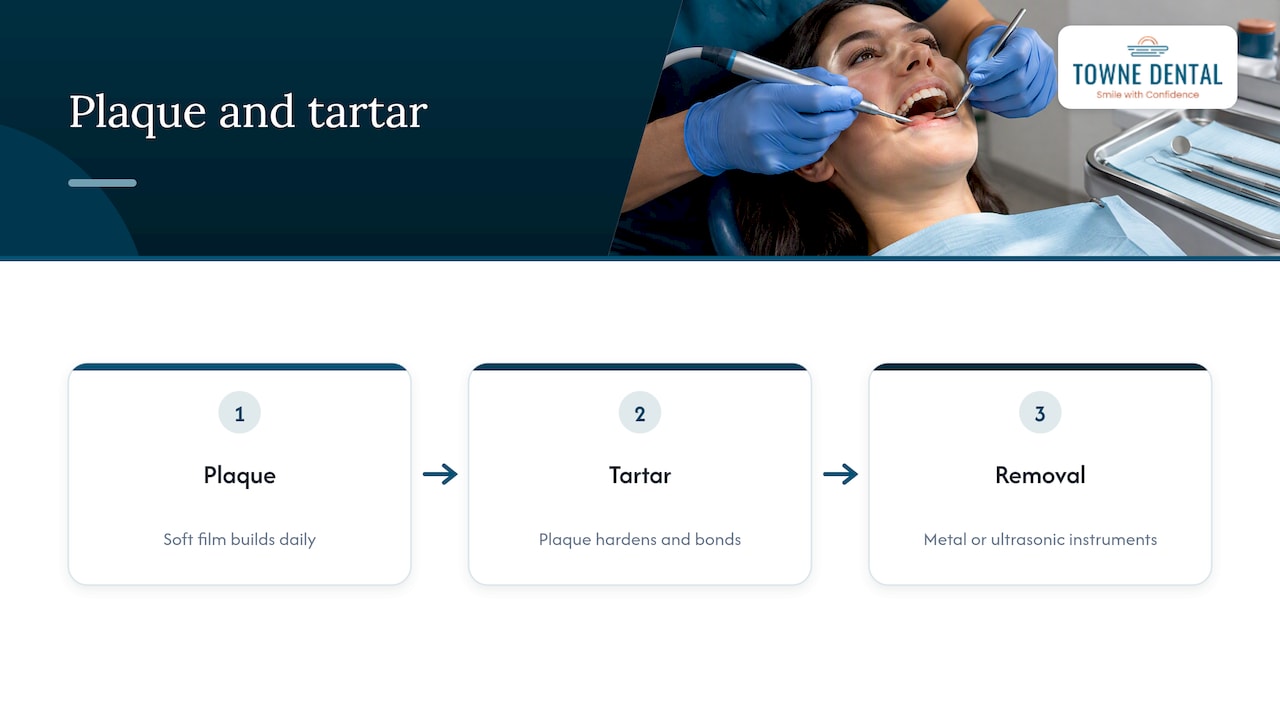
Plaque is the soft, sticky film that builds up every day. If it stays, it hardens into tartar (also called calculus). Tartar bonds to the tooth, so brushing and flossing at home cannot remove it. Only metal or ultrasonic instruments can. That is the real reason a cleaning is a separate visit rather than something you can replace with a better toothbrush.
Tartar tends to collect in the same places: behind the lower front teeth, along the gumline and on the back surfaces of the upper molars. Those are the areas where your hygienist will spend the most time.
The dental cleaning procedure, step by step
Offices differ in the details. Individual procedures can vary, and steps such as X-rays or oral hygiene instructions are not done at every visit. The sequence below is the typical one.
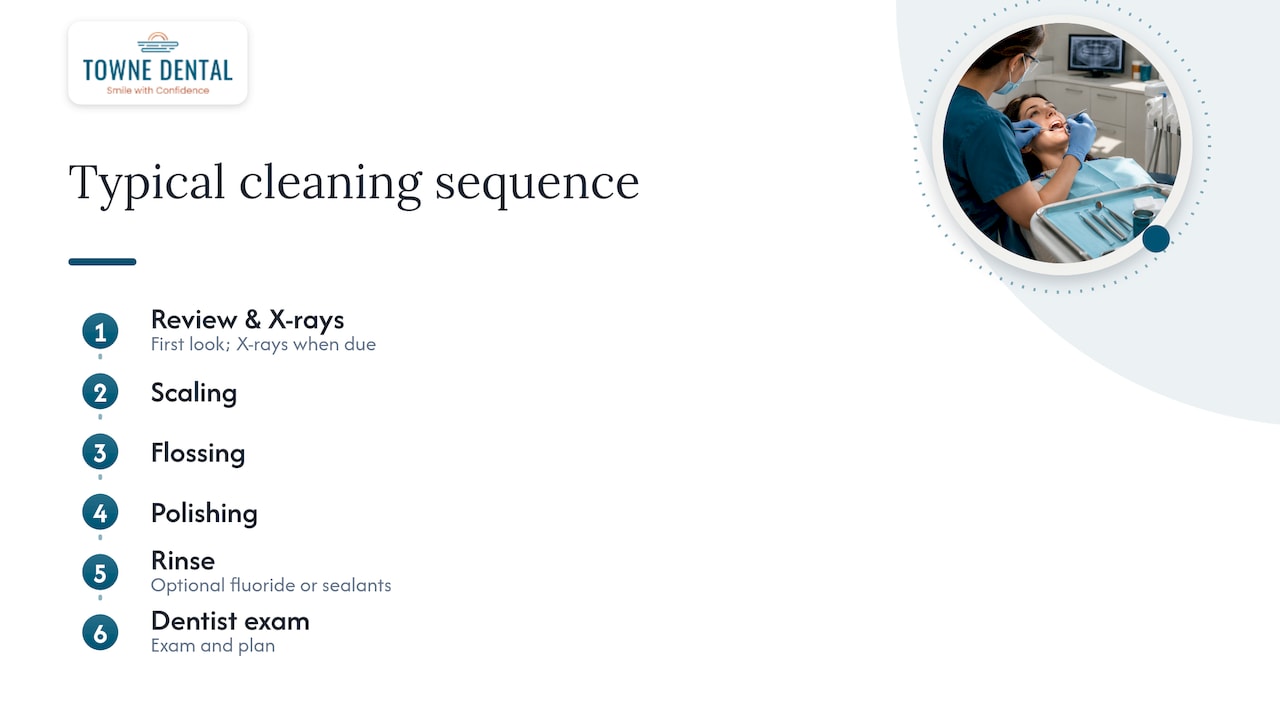
1. Review and a first look
You start with a quick conversation. Expect questions about changes in your health, new medications, bleeding when you brush, sensitivity and anything that has bothered you since your last visit. This is the moment to mention that you are pregnant, that you have a heart condition or diabetes, or that you get nervous in the chair.
The hygienist or dentist then looks over your teeth and gums, often with a small mirror, checking for inflammation, cavities and worn areas. Some offices measure the depth of the space between each tooth and the gum with a thin probe. Those numbers are an early way to spot gum disease.
2. X-rays, when they are due
X-rays are not part of every cleaning. Dentists and hygienists may use X-rays to detect hidden problems such as decay between teeth or bone loss that you cannot see in the mirror. How often you need them depends on your history and risk of cavities, which is why your last set matters. If you are bringing a child, our guide to a child’s first dental X-rays explains when and why they are taken.
3. Scaling: removing plaque and tartar
Scaling is the heart of the visit. The hygienist uses a hand scaler, an ultrasonic scaler or both to lift tartar and plaque from the tooth surface and from just below the gumline.
This is the part people notice most. You may hear scraping sounds and feel the vibrating tip of an ultrasonic scaler, which also sprays a little water. A small suction tube keeps your mouth clear. Pressure and noise are normal. Sharp pain is not, so raise your hand if something hurts.
4. Flossing between the teeth
Professional cleaning steps may include flossing between the teeth. The hygienist works the floss down to the gumline on each side of every tooth, which clears out leftover polish and any debris loosened during scaling. It is also a quick way to see which gum areas bleed, and bleeding tells the dental team where inflammation is hiding.
5. Polishing
After scaling, the teeth are polished with a soft rubber cup and a special toothpaste (prophy paste). Polishing smooths the enamel surface so plaque has a harder time sticking, and it lifts away surface stains from coffee, tea, red wine or tobacco. The paste has a slightly gritty texture, and flavors range from mint to bubble gum.
6. Rinse and fluoride or sealants
You rinse to clear the paste and debris. The dentist or hygienist may then offer a fluoride treatment or dental sealants. Fluoride is painted on as a gel, foam or varnish to strengthen enamel. Sealants are thin protective coatings placed on the chewing surfaces of back teeth. They are common for kids, but they can help some adults too, and our article on sealants for adults covers who benefits.
7. The exam and your plan
The dentist typically performs the exam, either before or after the cleaning, and reviews X-rays and the hygienist’s notes. You then hear what was found: healthy gums, a cavity to treat, or a sign that you need closer monitoring. Many offices finish with home-care coaching, such as how to angle your brush at the gumline or which interdental cleaner suits the space between your teeth.
How long does a cleaning take?
Most dental cleanings take 30 to 60 minutes, and special cleanings can take longer. Here is what usually changes the time:
| Factor | Effect on the visit |
|---|---|
| Heavy tartar or stain | More time spent scaling |
| New X-rays and an exam | Adds time to the visit |
| Bleeding or tender gums | Slower, gentler work and possibly a second visit |
| First visit to a new office | Longer history and a full set of records |
| Anxiety or sensitivity | Breaks and numbing gel can add minutes |
If you are booking a lunch-hour appointment, ask for the full length of the visit, including the exam, rather than just the cleaning.
Does a dental cleaning hurt?
It should not. The procedure is not supposed to be painful, though the sound and vibration can be unpleasant. Some people feel a pinch where the gums are inflamed or sensitive teeth react to cold water or air.
Here is what helps:
- Tell the hygienist early. They can slow down, use a different instrument or numb a small area with topical gel.
- Agree on a signal. A raised hand means stop, and a good hygienist will stop.
- Ask about the timing. If you have not had a cleaning in a few years, a long first session can feel rough. Splitting it into two shorter visits is a reasonable request.
- Bring headphones. Music takes the edge off the scraping sound for many people.
- Ask about sedation. If fear is what has kept you away from the dentist, sedation dentistry is a legitimate option rather than a last resort.
Does teeth cleaning remove stains?
Yes, to a point. Scaling and polishing remove surface stains, the brown or yellow film left by coffee, tea, red wine and tobacco, so teeth often look brighter right after a cleaning. A cleaning does not change the natural shade of your enamel or lighten stains inside the tooth, such as discoloration from certain medications or an old injury. For that, you would look at professional whitening or veneers, both of which fall under cosmetic dentistry.
Possible downsides of a cleaning
For most people, the downsides are mild and short-lived:
- Temporary sensitivity. Teeth that had heavy tartar can feel more sensitive to cold for a few days once the buildup is gone.
- Gum tenderness or light bleeding. Gums that were inflamed can bleed during and after the cleaning. This usually settles as the gums get healthier with good home care.
- Jaw soreness. Keeping your mouth open for 30 to 60 minutes can leave your jaw tired. Ask for a bite block or a break if you have jaw problems.
- Gaps that look bigger. Once tartar is gone, spaces between teeth may feel more open to your tongue. Nothing has been removed from the tooth. The buildup that filled the space is gone.
If pain is severe or bleeding does not stop, call your dental office rather than waiting for your next visit.
Is teeth cleaning safe during pregnancy?
Yes. The American Dental Association states that oral health care during pregnancy, including dental X-rays when needed, is safe. Hormonal changes can make gums swollen and prone to bleeding, so keeping up with cleanings matters more, not less. Tell your hygienist how far along you are so they can position you comfortably, and plan non-urgent work around how you feel. Our article on bleeding gums during pregnancy covers the causes and when to call your dentist or your OB provider.
Routine cleaning vs. deep cleaning
A routine cleaning is preventive. A deep cleaning is treatment for gum disease. The difference is where the instruments go and why.
| Routine cleaning (prophylaxis) | Deep cleaning (scaling and root planing) | |
|---|---|---|
| Who it is for | People with healthy gums | People with gum disease and deepened gum pockets |
| What it targets | Plaque and tartar on the visible tooth surface and just below the gumline | Plaque and tartar above and below the gumline, plus rough root surfaces |
| Numbing | Usually none | May need a local anesthetic |
| Visits | One | May take more than one |
| Afterward | Fresh, smooth teeth | Tenderness and sensitivity for a short time |
According to the American Dental Association, scaling and root planing removes plaque and tartar above and below the gumline and smooths the tooth roots so gums can reattach to the teeth. It may need a local anesthetic, and afterward you may have pain for a day or two, sensitivity for up to a week, and swollen, tender or bleeding gums. If bleeding or swelling is severe, or sensitivity lingers beyond that, call the office that treated you.
Gum pockets that do not tighten after a deep cleaning may need further care. We explain the options in our guide to gum pockets treatment.
When heavier cleaning is needed first
Sometimes tartar is so thick that the dentist cannot see the teeth well enough to examine them. In that case, a procedure called gross debridement removes the heavy buildup first, so a proper exam and a regular cleaning can follow. Needing one does not mean you did something unforgivable. It usually means a long gap between visits.
How often should you get your teeth cleaned?
Twice a year is the common schedule, but it is a starting point. People with gum disease, a history of frequent cavities, dry mouth, diabetes or who smoke are often advised to come in more often, sometimes every three or four months. People with very healthy gums and low cavity risk may be told that a longer interval is fine. Your dentist sets the interval based on your gum measurements, your X-rays and how quickly tartar builds up on your teeth.
If you wear implants, you still need regular professional care. Our dental implant maintenance guide explains what changes with implants and how often to be checked.
How to prepare for your appointment
- Brush and floss as usual. You do not need to scrub harder beforehand. Hygienists would rather see the real picture.
- Write down your questions. Sensitivity, bleeding, bad breath, a spot that feels rough.
- Update your health history. New medications, pregnancy, diabetes and heart conditions all matter.
- Bring your insurance information. Many plans cover preventive cleanings, but coverage details differ, so confirm your benefits with your plan.
- Avoid very hot or cold drinks right after. If your teeth are sensitive, give them a few hours.
- Keep up the habit at home. Brush twice a day, clean between your teeth daily and treat the cleaning as a reset, not a substitute.
Our perspective on the dental cleaning
We see the cleaning as the most useful 45 minutes in preventive dentistry, and also the most misunderstood. Patients often arrive expecting a lecture or discomfort. What we want them to leave with is information: where their gums stand, where plaque keeps coming back and what to change at home.
We also know that anxiety is the main reason people skip cleanings, and that skipped cleanings are how small problems become root canals, extractions and implants. That is why our approach is to be gentle, explain each step before we do it and tailor care to the patient in the chair. Someone with healthy gums needs a straightforward prophylaxis. Someone with bleeding gums needs a plan. And someone who has avoided the dentist for years needs patience first.
The cleaning is also the best time to catch what you cannot feel: early gum disease, a cavity between teeth or a worn filling. Finding it early usually means simpler, less invasive treatment. Our article on replacing old fillings shows how we think about repairing before replacing.
— Towne Dental
Book a cleaning at Towne Dental
If it has been a while since your last visit, or you have been putting it off because dental appointments make you tense, we can help. Our general dentistry team provides teeth cleaning along with exams, fillings, crowns and more, and we offer periodontics and gum care if your gums need more than a routine visit. We also offer relaxing sedation dentistry for patients who find the chair stressful.

We serve patients across Collier and Lee counties, including Naples, Fort Myers, Cape Coral, Bonita Springs, Estero and Marco Island. To start, call or request an appointment through our services page and tell us anything that would make the visit easier.
FAQ
Does a dental cleaning hurt?
It should not be painful. You may hear scraping and feel the vibration of an ultrasonic scaler, and sensitive or inflamed gums can feel tender. Tell your hygienist when something hurts, because they can adjust their technique, numb a small area or take a break.
How long does a dental cleaning take?
Most take 30 to 60 minutes, and special cleanings can take longer. The visit runs longer when you need X-rays, an exam or a lot of tartar removed.
What is the difference between a cleaning and a deep cleaning?
A routine cleaning removes plaque and tartar from healthy mouths. A deep cleaning, called scaling and root planing, treats gum disease by cleaning above and below the gumline and smoothing the roots. It may need a local anesthetic and more than one visit.
Can I get my teeth cleaned while pregnant?
Yes. The American Dental Association says dental care during pregnancy is safe. Let your dental team know you are pregnant so they can keep you comfortable and, if needed, time any non-urgent work.
Will a cleaning remove stains from my teeth?
It removes surface stains from coffee, tea, wine and tobacco through scaling and polishing. It will not change the natural color of your teeth or stains inside the tooth. If you want a whiter shade, ask about professional whitening.
Sources
- What Happens During a Dental Cleaning? (Cleveland Clinic)
- Teeth Cleaning Process and Benefits (Cigna Healthcare)
- Dental cleaning guide: what to expect, types and more (Delta Dental)
- Scaling and Root Planing for Gum Disease (ADA MouthHealthy)
- Pregnancy and oral health (American Dental Association)