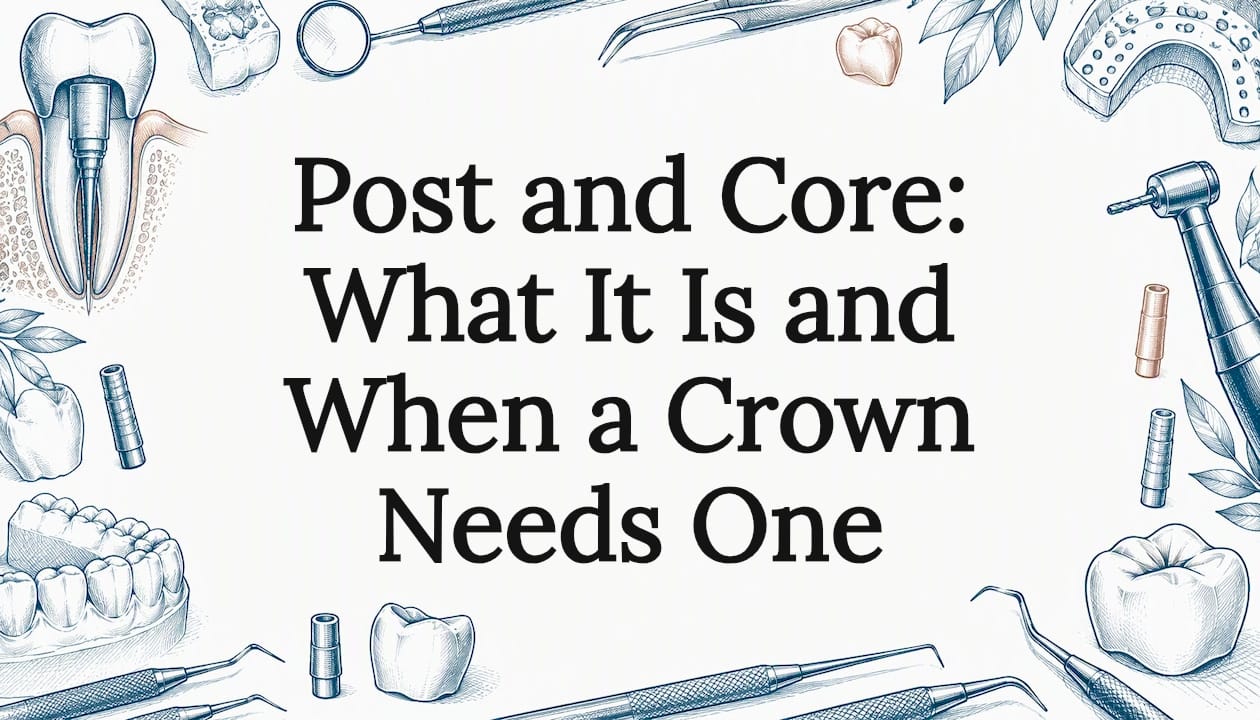
A post and core is the foundation under a crown on a tooth that has had a root canal and lost too much of its natural structure. The post is a small rod that sits inside the root. The core is the filling material built up around it, and it gives the crown something solid to hold on to. Not every root canal tooth needs one, and the difference matters for your comfort, your wallet and how long the tooth lasts.
This guide explains what a post and core is, when a dentist recommends it, what happens in the chair, what it costs, and how it compares to pulling the tooth and placing an implant.
TL;DR
- A post and core connects a root canal treated tooth to its crown when there isn’t enough healthy tooth left above the gum to hold the crown.
- Many teeth, especially molars, can be rebuilt without a post, because the chamber and canals can hold the core.
- The procedure is done under local anesthesia on a tooth that has already had a root canal, so most people feel pressure rather than pain.
- A post and core is billed separately from the crown, and the amount of healthy tooth left above the gum is the main factor in whether it lasts.
- If the tooth is too cracked or broken to rebuild, an implant is usually the better path.
Table of Contents
- What a post and core actually is
- Why a root canal tooth needs protection at all
- When a post is needed, and when it isn’t
- What happens during the procedure
- Post materials: what they’re made of
- How painful is it, and how long does it take?
- What does a post and core cost?
- Risks and limits you should know about
- Post and core or implant?
- Our perspective
- Getting a root canal tooth restored in Southwest Florida
- FAQ
- Sources
What a post and core actually is
Think of a fence post. The crown is the visible cap, but a cap needs something underneath to grip. When a tooth has decayed, cracked or been drilled out for a root canal, the part above the gum can be too small to do that.
The restoration has two parts:
- The post. A metal or fiber pin is cemented into the tooth after space is made in the root filling.
- The core. Tooth-colored filling material is built up on the post, and the crown is then made to fit over it.
An endodontic professional newsletter from the American Association of Endodontists puts the logic in a chain: the purpose of a post is to retain the core. The root holds the post, the post holds the core, and the core holds the crown. If any link is weak, the whole restoration is at risk.
A post does not strengthen the root. This is the most common misunderstanding. Its only job is retention, which is why a dentist who can avoid a post usually will.
Why a root canal tooth needs protection at all
A tooth that has had a root canal is no longer alive inside, and it is often already weakened by the decay or large filling that made the root canal necessary. According to WebMD’s overview of root canals, a treated tooth may need a crown, a crown and post, or another restoration to protect it, keep it from breaking and return it to full function.
That is why a crown is the usual final step. If you’ve just finished a root canal and a temporary filling is in place, the crown is not an upsell. It is what protects the tooth from the bite forces it will face for years. You can read more about our crowns and other general dentistry restorations on our site.
Root canal treatment itself has a strong track record: WebMD reports a success rate above 95%, and many treated teeth can last a lifetime. The restoration on top is what protects that investment.
When a post is needed, and when it isn’t
The deciding factor is how much healthy tooth remains above the gum line after decay and old filling material are removed.
A post is usually considered when:
- Extensive tooth structure has been lost and other features of the tooth cannot hold the core. The AAE newsletter describes this as the main reason to place a post.
- The tooth is a front tooth or premolar with a single narrow canal and little space inside the crown portion to anchor a core.
- Only a thin shell of tooth remains after the old filling and decay are removed.
A post is often unnecessary when:
- The tooth is a molar. The same source notes that molars may not need posts, because the pulp chamber and canals can usually retain the core.
- Enough healthy tooth walls remain to support a core made only of filling material.
In practice, we decide this after the root canal is complete and the old restoration has been removed, because that’s when we can see what’s left. It’s normal for the answer to change once decay is cleaned out. A tooth that looked restorable on an X-ray can turn out to have less structure than expected, and the reverse is also true.
If your tooth cracked rather than decayed, the picture is different again. Our guide to cracked tooth treatment explains how the depth and direction of a crack decide what can be saved.
What happens during the procedure
The details vary from tooth to tooth, but the sequence is consistent.
- Exam and X-rays. We confirm the root canal filling is sound and there’s no sign of infection. A post goes in only on a tooth that is healing normally and has a well-sealed root filling.
- Numbing. Even though the nerve has been removed, the surrounding gum and tissues are numbed so you stay comfortable.
- Cleaning out the tooth. Old filling material and decay are removed so the dentist is working with solid structure only.
- Making space for the post. A small portion of the root canal filling is removed from the upper part of the canal. The goal is to remove as little tooth as possible, since excess dentin removal is the main route to root fracture.
- Placing the post. The post is tried in, checked on an X-ray, and cemented.
- Building the core. Tooth-colored material is built up around the post and shaped like a prepared tooth.
- Preparing for the crown. The tooth is shaped, an impression or digital scan is taken, and a temporary crown is placed while the final one is made.
The final crown is then cemented at a follow-up visit. Whether the core and crown prep happen the same day or on separate visits depends on the tooth and how it’s healing, and we explain the plan before we begin.
Post materials: what they’re made of
The AAE newsletter lists ceramic, composite, fiber-reinforced and metal posts as the available options, and recommends passive posts in most cases. A passive post is cemented in place rather than screwed into the root, which puts less stress on the root walls.
| Material | What to know |
|---|---|
| Fiber-reinforced | Tooth-colored and flexes slightly, closer to the way natural tooth behaves. Often chosen when appearance matters, such as a front tooth. |
| Metal | Very rigid. A long-standing option, but a rigid post in a thin root is a reason for caution. |
| Ceramic | Tooth-colored and rigid. Chosen mainly for appearance. |
| Composite | Tooth-colored material, sometimes used in combination with other components. |
The right choice depends on the tooth’s position, the thickness of the root, how you bite, and the crown material going over it. A good dentist can explain why they picked one rather than just telling you which one it is.
How painful is it, and how long does it take?
Most people are surprised by how uneventful it is. The tooth has already had its nerve removed, and local anesthetic handles the surrounding tissue. Penn Dental Medicine describes root canal therapy as virtually painless with modern techniques and anesthesia, though the tooth and surrounding area can feel sensitive for a few days. A post and core on an already treated tooth follows the same pattern: pressure, vibration and noise, then mild tenderness afterward.
Treat these as signals to call us rather than wait out:
- Pain that builds instead of fading after the first few days
- Swelling in the gum or face
- A bite that feels high or uneven
- A temporary crown that comes off
If you’re an anxious patient, tell us when you book. We offer sedation dentistry for people who dread the chair, and a gentle pace matters more than speed.
As for how long it takes, that depends on whether the core is placed the same day as the root canal or at a separate visit, and whether the crown is made in the office or at a lab. We give you the schedule at your exam rather than a generic number.
What does a post and core cost?
Here is what we can say honestly. We don’t publish a fixed fee for this procedure because the cost depends on the tooth, the type of post and the work needed beforehand, so we quote it after an exam and tell you what your insurance may cover before you commit.
For a reference point from outside our practice, one published dental plan fee schedule effective August 1, 2024 lists post and core/pin buildup at $188 for the Phoenix and Tucson areas. That is one plan’s negotiated rate in a different state, not a Florida cash price, so use it only as a sense of scale.
Two points matter more than any number:
- It is a separate line item from the crown. A dental cost guide notes that a post and core for root canal teeth is billed as its own procedure fee, apart from the crown. Ask for both in your estimate.
- Total cost includes the root canal and crown. The full path for a root canal tooth is typically the root canal, the post and core if needed, and the crown. Ask for the whole sequence in writing so nothing surprises you.
If you have dental insurance, many plans cover buildups and crowns at different percentages and with waiting periods or annual maximums. We can check your benefits before treatment starts.
Risks and limits you should know about
A post and core is a well-established procedure, but it isn’t risk-free, and anyone who tells you otherwise is skipping the part that matters.
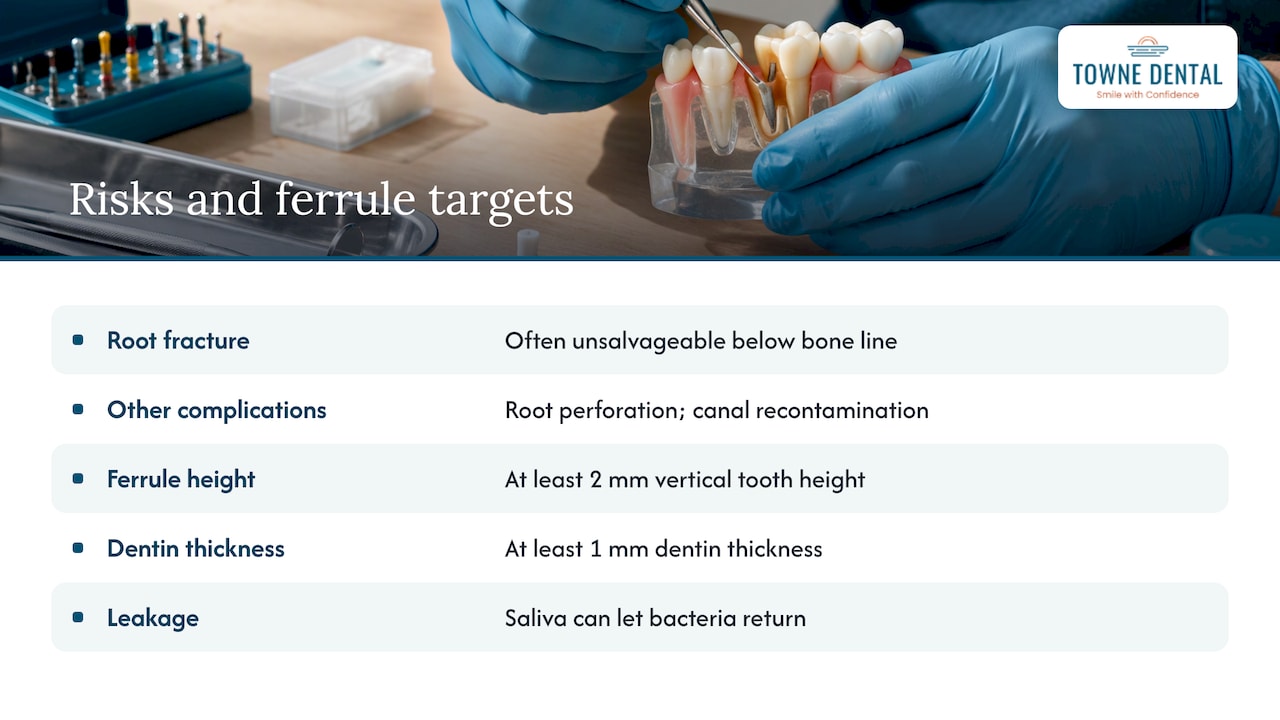
Root fracture. This is the main concern. The AAE lists root fracture, root perforation and recontamination of the root canal system as potential complications, with fracture tied to removing too much dentin during preparation. A fracture below the bone line often means the tooth can’t be saved.
Not enough tooth above the gum. The same source describes a ferrule, a collar of tooth the crown wraps around, as highly desirable when a post is used: at least 2 mm of vertical tooth height and 1 mm of dentin thickness. If that isn’t there, the dentist may need to reshape the gum or bone, or move the tooth upward with orthodontics, before a crown will hold. If it still can’t be achieved, the long-term outlook is poorer.
Leakage. If saliva reaches the sealed root canal, bacteria can return. A good seal at the crown margin and a well-fitted crown are part of preventing that.
The practical takeaway: the best post and core is the one that removes the least tooth, has a ferrule to work with, and is covered by a well-fitting crown promptly. Delay is its own risk. A tooth left with a temporary filling for months can fracture or leak.
Post and core or implant?
This is the question behind many searches, and it’s a fair one. The answer starts with whether the tooth can be saved.
Penn Dental Medicine says root canal therapy is recommended when a tooth can be saved, while extraction is done when the tooth is too damaged, for example when a crack extends below the gum and leaves too little structure to be stable after repair.
A workable way to think about it:
| Situation | Usually points to |
|---|---|
| Healthy root, enough tooth above the gum, no deep crack | Root canal, post and core if needed, crown |
| Thin root, little ferrule that can’t be corrected | Discuss extraction and replacement |
| Vertical crack below the gum line | Extraction and replacement |
| Repeated failure of earlier treatment | Compare options carefully |
Saving a natural tooth has real advantages: you keep your own root and ligament, and treatment is often faster than implant healing. But a tooth that is heavily compromised can cost more over time through repeated repairs. An implant can be the better long-term investment in that case.
If extraction is the answer, we do both steps in-house. Our oral surgery team handles extractions and implants, and what you eat in the first days matters, so our tooth extraction food guide is worth a read beforehand. Afterward, our dental implant maintenance guide covers daily and yearly care.
Our perspective
We approach post and core the same way we approach most restorative decisions: keep as much of your natural tooth as is sensible, and be candid when it isn’t enough.
A few principles guide us:
- Don’t place a post by default. If a tooth can be rebuilt without one, we prefer that, because every bit of dentin we remove is gone for good.
- Decide with the tooth open. We make the final call once decay and old filling are out and we can see what’s actually left.
- Say so when implants make more sense. We offer Yomi® robot-assisted implants, which use robotic guidance for precise, less invasive placement. We don’t steer patients toward an implant, or away from one. We steer them toward the option that gives that specific tooth the best odds.
- Make it comfortable. Many of our patients are nervous about dental work. A slower pace, clear explanations and sedation options are part of the treatment, not extras.
The most useful thing you can do is get the crown done soon after the root canal and keep up regular checkups so a small problem under a crown is caught early.
— Towne Dental
Getting a root canal tooth restored in Southwest Florida
If you’ve had a root canal and haven’t had the tooth crowned, or you’ve been told you need a post and core and want a second opinion, we can examine the tooth, explain what’s left of it and give you a plan for the whole sequence. We see patients from Naples, Bonita Springs, Estero, Fort Myers, Cape Coral and Marco Island. Start with our root canal and endodontic care and other services, or see everything we offer on our services page. If you have a broken tooth or pain now, tell us when you call, because emergency problems are seen sooner.
If an older filling is the concern rather than a root canal tooth, our guide on replacing old fillings explains when repair is enough.
FAQ
Does every root canal tooth need a post and core?
No. A post is used when a lot of tooth structure is gone and nothing else can retain the core. Molars often don’t need one because the chamber and canals can hold the core. Your dentist decides after removing old filling and decay.
Is a post and core the same as a crown?
No. The post and core is the foundation, and the crown is the cap that goes over it. They are separate procedures, and a post and core is typically billed as its own fee apart from the crown.
Can a post and core fail?
Yes. The main failure is root fracture, which is linked to removing too much dentin during preparation, along with perforation and recontamination of the canal. A good ferrule and a well-sealed crown lower that risk. If the root fractures, the tooth usually has to be extracted.
Is it better to get a post and core or an implant?
If the tooth can be saved with enough healthy structure and a sound root, keeping it is usually preferred. If a crack runs below the gum or too little tooth remains, an implant is often the better choice. We can show you the X-rays and walk through both.
How long should I wait to get the crown after a root canal?
As soon as your dentist advises. A root canal tooth is more brittle, and the American Dental Association-based guidance summarized by one dental resource says a crown is recommended after a root canal to prevent fracture of the non-vital tooth. Leaving it with only a temporary filling for long raises the risk of breakage.
Sources
- Crowns, Leeds Teaching Hospitals NHS Trust
- Endodontics: Colleagues for Excellence, American Association of Endodontists
- Root Canals overview, WebMD
- Root Canal vs Extraction, Penn Dental Medicine
- American Dental Plan Benefits Fee Schedules
- Dental Crown Cost in New York, 2026 Average Prices
- Dental Crowns in 2026 guide