How a child’s cavity is treated depends on how far the decay has gone, how active it is, which tooth is affected and how your child handles the visit. Early spots may only need fluoride and sealants. Small established cavities usually get a white filling. Deep or painful ones may need a crown or a baby root canal. Silver diamine fluoride (SDF) sits in between: a painless liquid that can stop some cavities without drilling.
This guide walks through each option in the order a dentist thinks about them, so you know what to ask at the appointment.
TL;DR
- Treatment is matched to the stage of the cavity: the earlier it is caught, the gentler the fix.
- Early decay can sometimes be managed with fluoride, cleaning and sealants. Most established cavities need a filling or crown.
- SDF can arrest suitable cavities without a drill or numbing, but it leaves permanent black staining on the decayed area and needs follow-up.
- Spontaneous pain, night pain, swelling or suspected infection means calling a dentist promptly, not waiting for the next checkup.
- Anxious children have options, from a slower, gentler visit to sedation.
Table of Contents
- How a dentist decides what your child needs
- Stage 1: early decay
- Stage 2: a small cavity that has broken through
- Silver diamine fluoride vs. a filling
- Stage 3: when a cavity is too large for a filling
- Stage 4: decay near or in the nerve
- Why waiting usually makes it harder
- What to expect after treatment
- Helping an anxious child through treatment
- Perspective: why we start with comfort
- Preventing the next cavity
- Booking a children’s cavity visit in Southwest Florida
- FAQ
- Sources
How a dentist decides what your child needs
There is no single kids cavity treatment. The dentist first looks at the tooth, usually on clean, dry teeth, and classifies the lesion by how it looks and how deep it is. The American Dental Association describes a visual scale: lower scores mean intact enamel, middle scores mean early or shallow breakdown, and the highest scores mean late, deep cavities. Bitewing X-rays can reveal decay between teeth that the eye cannot see, and the dentist also weighs your child’s overall cavity risk.
Guidance from Scotland’s dental guidance body, SDCEP, lists what a clinician should consider for each child: how extensive and active the lesion is, whether there is pain or infection, how long until the baby tooth is expected to fall out, medical history, cooperation, and whether the family can keep up with preventive follow-up. That last point matters more than most parents expect. A treatment that works beautifully for a child who comes back every few months may be the wrong choice for a family that cannot.
The same guidance favors the least invasive approach that is realistic for that tooth and that child. In practice that means a dentist is weighing several things at once:
- How deep the cavity is and whether it is still active
- Whether your child has pain or signs of infection
- How long the baby tooth needs to last
- How many teeth are affected
- How nervous your child is
If you would like a pediatric exam to find out where your child stands, our pediatric dentistry team can go through the findings with you.
Stage 1: early decay
A white or chalky spot near the gumline, before the enamel has broken down, is the best time to act. Johns Hopkins Medicine notes that early decay can be managed with plaque removal, cleansing, remineralization, supplemental fluoride and sealants. No drilling is involved.
This stage is where home habits and professional care work together:
- Professional fluoride. A varnish painted on the teeth in a few minutes. Our guide to fluoride treatment at the dentist explains what the visit looks like.
- Sealants. A thin protective coating over the grooves of back teeth, where food and bacteria collect. See our page on dental sealants for families for how they work and who benefits.
- Better brushing. Twice a day for two minutes with fluoride toothpaste, which we cover in the prevention section below.
The catch: the spot has to be watched. A white spot that is not changing at checkups is a success. One that is growing needs a different plan.
Stage 2: a small cavity that has broken through
Once the surface has collapsed into a hole, the tooth cannot rebuild itself. Johns Hopkins says most established cavities need the decayed tooth structure removed and replaced with a restoration, and that a direct filling is generally placed in a single visit.
What that visit usually involves:
- The dentist numbs the area, often after a numbing gel on the gum so the injection is barely felt.
- The decayed part of the tooth is removed.
- A tooth-colored filling is placed and hardened with a light.
- The bite is checked and polished.
Most children handle this well when the dentist explains each step in simple words and lets them hold a mirror or hear the “water whistle” before the real work starts. The numbness lasts a couple of hours, and young children sometimes bite their cheek or lip while it wears off, so keep an eye on them and offer soft foods until feeling returns.
Fillings in baby teeth are worth doing even though the teeth fall out. Those teeth hold space for adult teeth, help your child chew and speak, and an untreated cavity can grow into a painful infection. For general filling and restorative care for the whole family, see our general dentistry page.
Silver diamine fluoride vs. a filling
This is the comparison many parents search for, so here it is plainly.
Silver diamine fluoride is a liquid painted onto a cavity to stop it from progressing. The American Academy of Pediatrics describes it as quick and generally painless, with no need for drilling, local anesthetic, sedation or general anesthesia. That makes it attractive for very young children, anxious children and children with complex medical needs. The ADA’s clinical guideline recommends 38% SDF applied twice a year over weekly 5% sodium fluoride varnish for arresting advanced cavitated lesions on the chewing and smooth surfaces of baby teeth.
| Silver diamine fluoride | Filling | |
|---|---|---|
| What it does | Arrests an active cavity | Removes decay and rebuilds the tooth |
| Drilling or numbing | Not needed | Usually both |
| Time in the chair | A few minutes | Longer, often one visit |
| Appearance | Decayed area turns permanently black | Tooth-colored material |
| Follow-up | Monitoring and possible reapplication | Routine checkups |
| Best fit | Suitable active cavities in very young, anxious or medically complex children | Established cavities where the tooth structure can be restored |
What parents should know about SDF
The AAP family guidance is clear about the trade-offs, and you should hear them before agreeing:
- The treated cavity stains permanently black. Gums or lips may stain temporarily, and a metallic taste can linger briefly.
- It is not appropriate with a silver allergy, mouth sores, spontaneous or prolonged pain, swelling or infection.
- It may need to be reapplied, and some teeth later get a filling, crown or extraction anyway.
The American Academy of Pediatric Dentistry frames SDF as a way to arrest decay, not a cosmetic restoration. It requires lesion monitoring, control of the risk factors that caused the cavity, and possible retreatment. The application itself follows careful steps: clean away gross debris, dry the lesion, apply only to the affected surface, let it dry for at least a minute and remove the excess to limit absorption.
If the black spot would bother your child on a visible front tooth, say so. Staining is a good reason to consider a filling instead. For more questions to bring to the appointment, read our article on silver diamine fluoride and what parents should ask.
Stage 3: when a cavity is too large for a filling
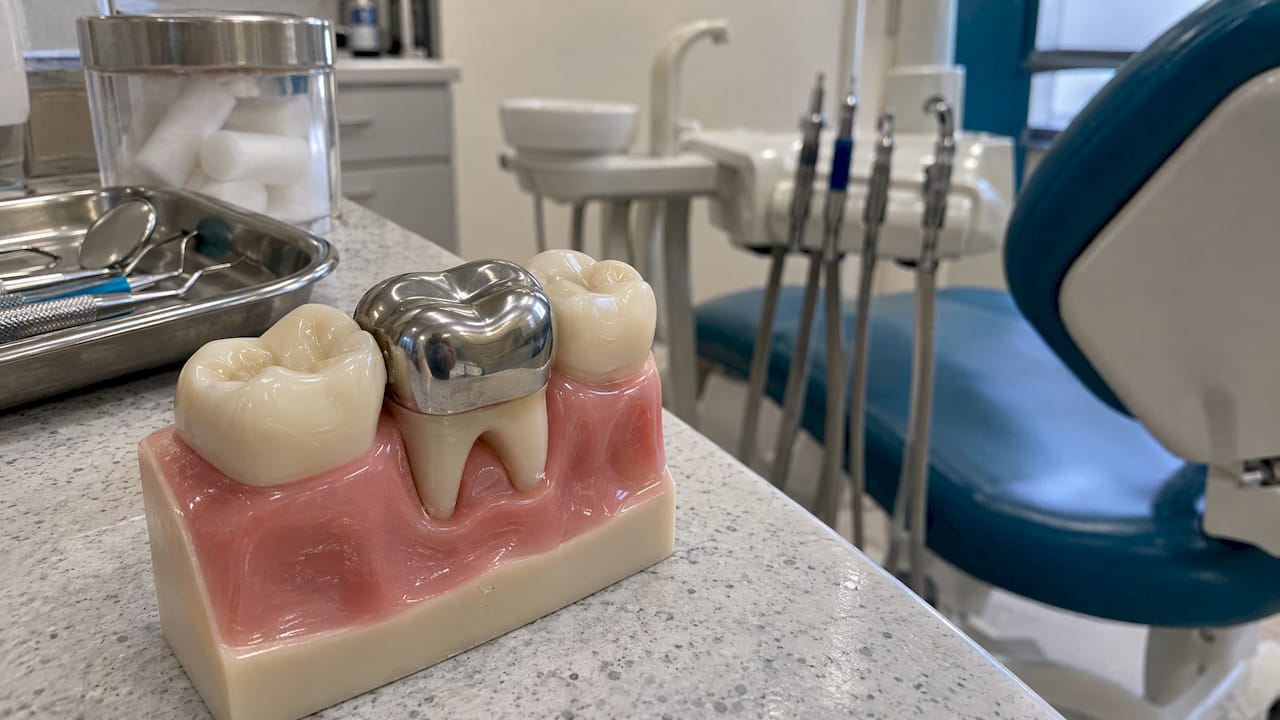
When decay has destroyed a big part of the tooth, a filling may not hold. Large cavities weaken the walls of the tooth, and the filling can break or the tooth can crack. In that case the dentist may recommend a crown, a cap that covers the whole tooth. Johns Hopkins notes that indirect restorations such as crowns may take two or more visits, though the exact number depends on the type of crown used.
A crown protects a tooth that has lost a lot of structure, which is especially useful for baby molars that need to last several more years. If you are curious about how crowns differ from other tooth-saving restorations, our crown vs. onlay guide explains the logic, even though it was written with adult teeth in mind.
Stage 4: decay near or in the nerve
A cavity that gets close to the pulp, the soft center of the tooth, is where treatment becomes more involved. SDCEP notes that care becomes more invasive when decay reaches the pulp with no clear band of healthy dentine between them.
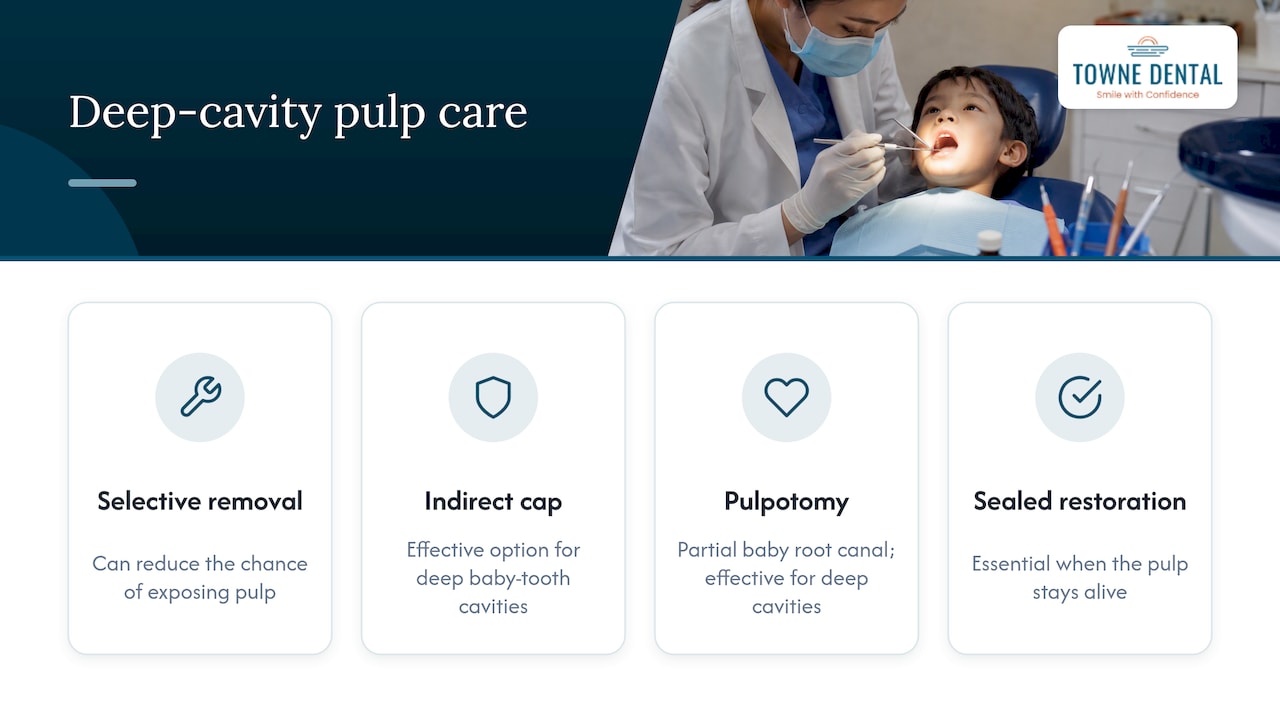
Here the dentist’s goal is to keep the tooth alive and comfortable when possible. The European Academy of Paediatric Dentistry’s best practice guidance recommends selective or stepwise removal of decay instead of complete removal for deep lesions when appropriate, because it can reduce the chance of exposing the pulp. It also reports that indirect pulp capping and pulpotomy, a partial baby root canal, are effective options for deep cavities in baby teeth. The same guidance stresses that a restoration with a good seal over the top is essential when the pulp stays alive.
If the nerve is badly infected, the tooth may need a full root canal, or in some cases an extraction. Our endodontics team handles root canal care when a tooth needs more than a standard filling.
Why waiting usually makes it harder
Baby teeth have thinner enamel than adult teeth, so decay can move toward the nerve faster than parents expect. A cavity that could have been a small filling or an SDF application can become a crown, a pulpotomy or an extraction in a matter of months. Waiting also means a child who may have a toothache, which makes the next visit scarier. A cavity seldom hurts until it is already deep, so regular checkups catch what you cannot see. Our post on dental checkups for children explains why that rhythm matters.
It also helps to understand the difference between preventive and restorative visits. Preventative vs. restorative care breaks down what each one covers.
What to expect after treatment
After a filling, expect numbness for a couple of hours. Some mild sensitivity to cold for a few days is common. Call the dentist if the bite feels high or the discomfort is growing rather than fading.
After SDF, the American Academy of Pediatrics’ HealthyChildren site says children can eat and drink, with a 30-minute wait if fluoride varnish was also applied. Follow your clinician’s instructions on brushing. Follow-up matters, because SDF may not stop the cavity from getting worse, and the dentist needs to confirm that the decay has arrested.
When to call right away
The same source lists the signs that need urgent dental attention:
- Spontaneous pain, or pain that wakes your child at night
- Pain that lasts more than 60 seconds after eating or brushing
- Swelling of the face or gums
- Suspected infection, even if there is no pain
If any of these show up on a weekend or after hours, our emergency dentistry page explains how to reach us.
Helping an anxious child through treatment
A fearful child can turn a simple filling into a hard morning. A few things help in any dental office:
- Tell your child the truth in simple words: the dentist will clean the tooth and fix it, and you will be nearby.
- Avoid words like shot, drill and hurt. Let the dentist describe the steps in child-friendly terms.
- Book a time of day when your child is rested and fed.
- Stay calm yourself. Children read a parent’s face.
SDCEP names cooperation and treatment anxiety among the factors in choosing a treatment, so a dentist should take your child’s comfort seriously when planning. For some children, a gentler approach such as SDF is the right first step. For others, sedation may be the better route. We offer sedation dentistry for patients who need extra help relaxing, and we will talk through whether it is appropriate for your child.
Perspective: why we start with comfort
We see the same pattern often: a parent waits because they are afraid the visit will be traumatic, and the cavity grows. We would rather have you in early, when the fix is small.
Our approach to pediatric care starts with a gentle first visit, plain explanations for your child and a treatment plan built around that child, not a template. We are committed to technology and techniques that make care more precise and less invasive, which is the same thinking behind the Yomi® robotic system we use for adult implants.
For kids, that philosophy shows up differently: we talk through every option with you, from prevention to fillings to crowns, so you can choose with confidence. A calm first experience tends to shape how a child feels about the dentist for years.
Towne Dental
Preventing the next cavity
Once a child has had one cavity, the chance of another goes up unless something changes. Johns Hopkins gives a practical checklist:
- Brush twice a day for two minutes with fluoride toothpaste: a rice-sized smear before age 3 and a pea-sized amount from age 3.
- Floss daily once your child is past age 2.
- Limit sticky, sugary foods and drinks.
- Put only water in a bedtime bottle.
- Avoid sharing utensils, and do not clean a pacifier with your own saliva.
- Ask about fluoride supplements, sealants and fluoride varnish.
- Keep routine dental visits every six months.
Sealants are an easy win once the permanent molars come in, since they cover the deep grooves where decay starts. Adults sometimes wonder if they can get them too, and the answer is covered in our guide to sealants for adults.
Booking a children’s cavity visit in Southwest Florida
If you suspect a cavity, or a checkup turned one up, we can examine your child, explain what we see in plain words and lay out the options from least to most invasive. Our team serves families across Naples, Bonita Springs, Estero, Marco Island, Fort Myers and Cape Coral. Start with our pediatric dentistry page, or see everything we offer on our services page.

Prices vary by treatment and by insurance, so contact the office for what applies to your child.
FAQ
Can a cavity in a baby tooth be left alone?
It is rarely a good idea. Baby teeth hold space for adult teeth and a growing cavity can lead to pain or infection. Some early or arrested spots can be monitored, but only a dentist can tell which ones, so have it examined.
Is silver diamine fluoride better than a filling?
Neither is better for every child. SDF is quick and needs no drill or numbing, so it suits some young or anxious children, but it stains the cavity black and may need reapplication. A filling restores the tooth’s shape and color. Your dentist will recommend one based on the tooth and your child.
Does a child’s cavity treatment hurt?
SDF is generally painless. For fillings, the dentist numbs the area first, so your child should feel pressure rather than pain. Tell the dentist if your child is nervous, and ask about sedation if anxiety is severe.
What does a cavity in a child look like?
Early decay can appear as a white, chalky spot near the gumline. Later it turns brown or black and may form a visible hole. Many cavities show no sign at home, which is why regular exams and X-rays matter.
Can a cavity go away on its own?
Early enamel changes can sometimes be reversed with fluoride, good cleaning and sealants, according to Johns Hopkins. Once the enamel has broken into a hole, the tooth needs treatment because it cannot rebuild itself.
Sources
- Caries Risk Assessment and Management, American Dental Association
- Prevention and Management of Dental Caries in Children, SDCEP
- Tooth Decay (Caries or Cavities) in Children, Johns Hopkins Medicine
- Best clinical practice guidance for treating deep carious lesions, EAPD
- Silver Diamine Fluoride (SDF) FAQ for Families, American Academy of Pediatrics
- Nonrestorative Treatments for Carious Lesions on Primary Teeth, ADA chairside guide
- Use of Silver Diamine Fluoride for Dental Caries Management in Children, AAPD
- Silver Diamine Fluoride to Stop Tooth Decay, HealthyChildren.org