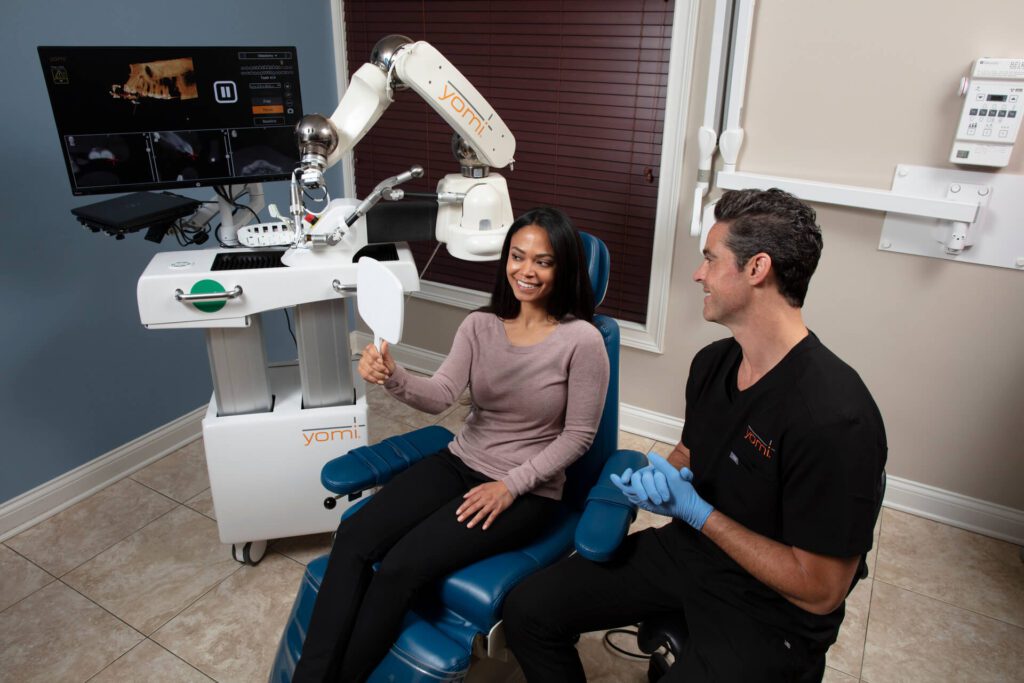
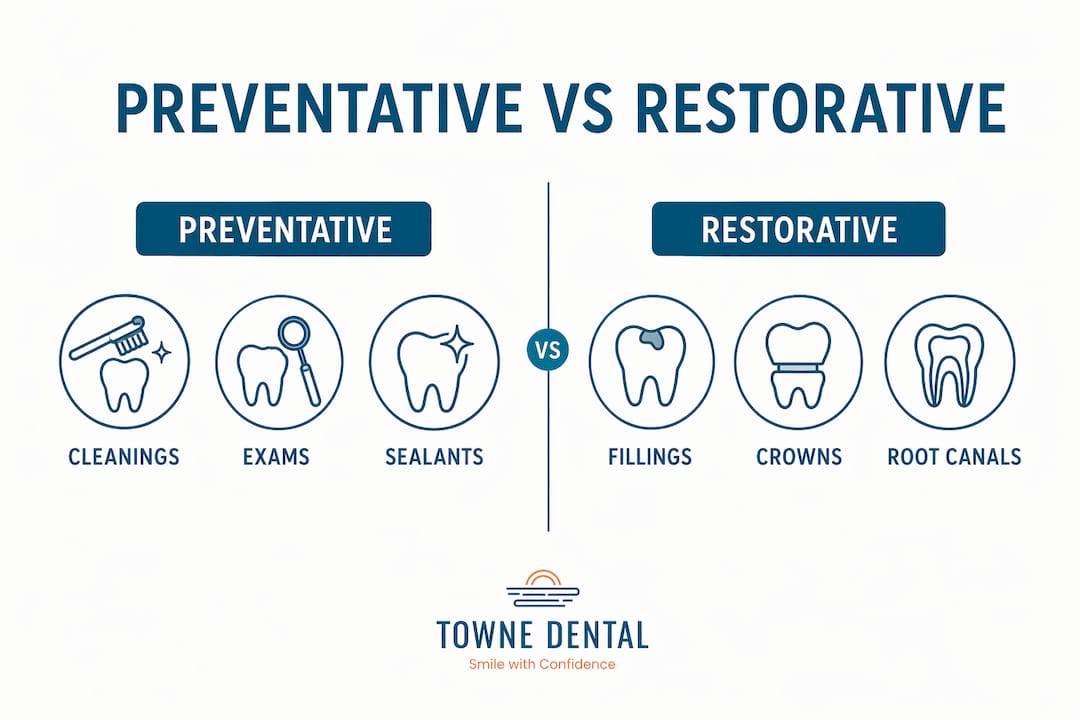
Preventative dentistry stops problems before they start; restorative dentistry repairs damage that has already occurred. If you’re in Estero and want a single clinic that handles both, Towne Dental covers the full spectrum, from routine cleanings and sealants to Yomi® robot-assisted implants. The American Dental Association consistently prioritizes nonrestorative measures when clinically appropriate, and the data backs that up.
At a glance:
-
Preventative care: exams, cleanings, fluoride, sealants, risk monitoring
-
Restorative care: fillings, crowns, bridges, root canals, implants, dentures
-
Bottom line: prevention preserves your natural teeth; restoration returns function and appearance after damage occurs
-
A short local clinic comparison follows below
Table of Contents
- What is preventative dentistry, and how often do you need it?
- What does restorative dentistry involve, and what does it cost?
- Why prevention genuinely reduces your need for restorative care
- How dentists decide between preventive management and restorative treatment
- Estero-area clinics: how do they compare for prevention and restorative care?
- How to choose a dentist for preventive or restorative needs
- Why Towne Dental is a strong choice for both preventative and restorative care
- Key Takeaways
- Ready to book a preventive exam or restorative consult at Towne Dental?
- FAQ
What is preventative dentistry, and how often do you need it?
Preventative (or preventive) dentistry covers everything designed to keep healthy teeth healthy. The core services are professional cleanings, comprehensive exams, fluoride treatments, and dental sealants, backed by daily home care like brushing and flossing.
Common preventative services:
- Professional cleaning: removes tartar that brushing can’t reach, reducing gum inflammation
- Fluoride treatment: strengthens enamel and can reverse early mineral loss
- Dental sealants: thin coatings applied to the pits and fissures of back teeth to block bacteria
- Oral cancer screening: visual and tactile exam at each checkup
- X-rays: detect decay and bone changes before they become visible
How often you need each service depends on your personal risk level. Low-risk adults typically need a cleaning and exam every six months; high-risk patients (those prone to cavities, gum disease, or dry mouth) may benefit from visits every three to four months.
| Patient risk | Exam/cleaning cadence | Fluoride varnish | Sealants |
|---|---|---|---|
| Low | Every 6 months | Annually | As needed (children/teens) |
| Moderate | Every 4–6 months | Every 6 months | Recommended |
| High | Every 3–4 months | Every 3–6 months | Strongly recommended |
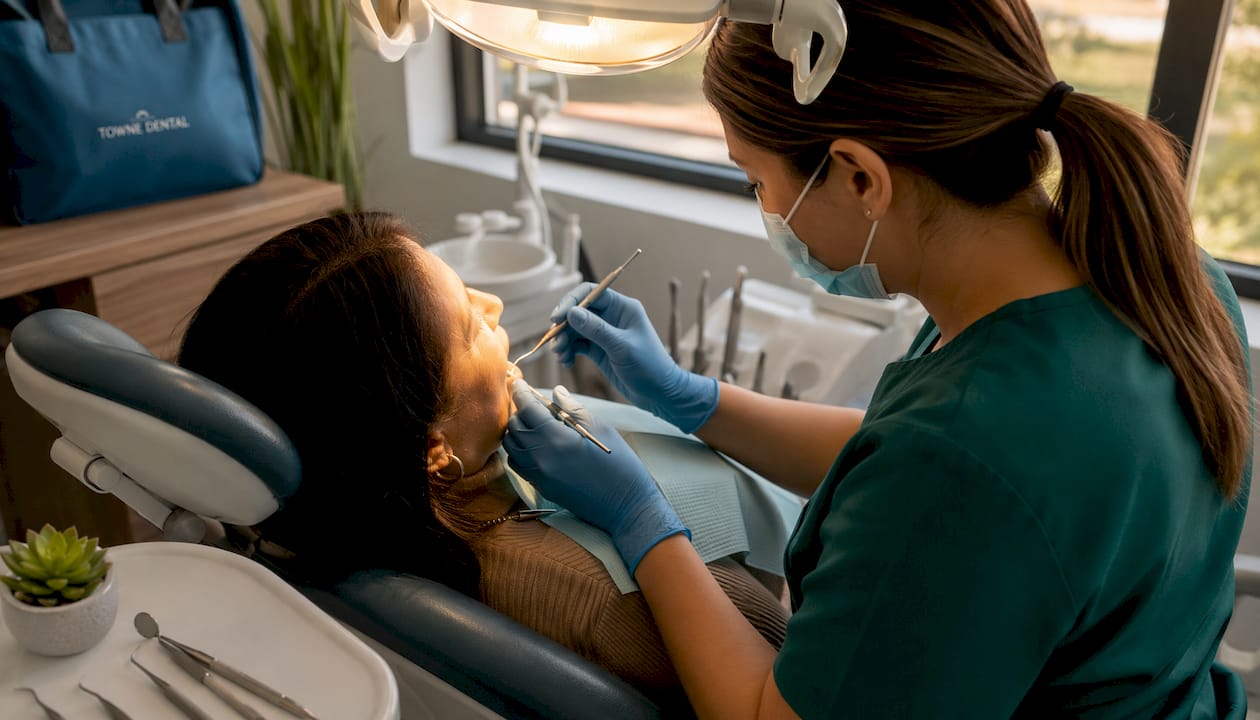
Pro Tip: Ask your dentist about silver diamine fluoride (SDF) or resin infiltration if you have an early cavity that hasn’t broken through the enamel surface. The ADA’s nonrestorative treatment guideline ranks these options for specific lesion types — you may be able to avoid a filling entirely.
Regular dental checkups for children are especially important because sealants and fluoride work best when applied early.
What does restorative dentistry involve, and what does it cost?
Restorative dentistry repairs, replaces, or stabilizes teeth that have been damaged by decay, fracture, infection, or tooth loss. The ADA’s clinical practice guideline on restorative treatments informs which materials and techniques are appropriate for each situation.
Common restorative procedures:
- Fillings — single visit; low relative cost; used for cavities that have broken through enamel
- Crowns — typically two visits (or one with CAD/CAM); medium-to-high cost; covers a damaged or weakened tooth
- Root canal therapy — one to two visits; medium cost; removes infected pulp to save the tooth
- Bridges — two to three visits; medium-to-high cost; replaces one or more missing teeth anchored to adjacent teeth
- Dental implants — multiple visits over several months; highest relative cost; titanium post replaces the tooth root with a crown on top
- Dentures (full or partial) — several visits; medium cost; replaces multiple or all missing teeth
Timeline expectations: a simple filling can be completed in one appointment. A crown typically takes two visits spread over two to three weeks. An implant, from consultation to final crown, usually spans four to twelve months depending on whether bone grafting is needed.
Cost shapes: fillings sit at the low end; crowns and bridges in the middle; implants and full-mouth restorations at the high end. Costs vary by material, complexity, geographic market, and insurance coverage. Always ask for a written treatment estimate before proceeding.
Worth knowing: composite resin restorations have shown a cumulative survival rate of 91.7% at six years and 81.6% at twelve years, making modern tooth-colored fillings a durable option for most patients.
Why prevention genuinely reduces your need for restorative care
Prevention isn’t just good advice. The numbers show a clear shift: diagnostic and preventive services grew from 63.7% to 75.3% of all dental procedures between 2001 and 2018, while restorative procedures dropped from 21.6% to 11.9% over the same period. That’s not coincidence.
Every cavity caught at the early, noncavitated stage is a filling you don’t need. Every filling avoided is a crown you may never need. Preserving natural tooth structure also means less chair time, lower lifetime cost, and a tooth that stays stronger longer. The benefits of preventative treatment extend even to surgical situations, where early intervention can prevent the need for more complex procedures later.
How dentists decide between preventive management and restorative treatment
The decision isn’t binary. Dentists use a staged diagnostic process to determine the least invasive option that will actually work.
The typical clinical pathway:
- Risk assessment — review of diet, hygiene habits, medical history, and saliva quality
- Imaging — bitewing X-rays to detect interproximal and sub-surface decay
- Lesion staging — using systems like ICDAS to classify whether a lesion is noncavitated or cavitated
- Nonrestorative options first — for noncavitated lesions, the ADA recommends sealants, 38% silver diamine fluoride, or fluoride varnish depending on lesion type
- Restorative treatment — indicated when a lesion is cavitated, symptomatic, or nonrestorative options have failed
Red flags that mean restorative care is needed now:
- Spontaneous or lingering tooth pain
- Visible hole or dark cavity in the tooth
- Swelling, abscess, or pus near a tooth
- Significant tooth fracture or broken cusp
- Tooth mobility from bone loss
If any of these are present, skip the watchful-waiting stage. Delaying restorative care when these signs appear tends to make the treatment more complex and costly.
Estero-area clinics: how do they compare for prevention and restorative care?
The table below compares verified Estero-area dental practices based on Google Places data, published services, and technology listings. Selection was based on Google Places verification, patient ratings, and publicly listed services.
| Clinic | Core services | Specialties noted | Emergency/same-day | Technology | Location | Google reviews |
|---|---|---|---|---|---|---|
| Towne Dental Naples | General, preventive, cosmetic, restorative, emergency | Implants, oral surgery, endodontics, ortho, perio, peds, sedation | Yes | Yomi® robot-assisted implants | Naples/Estero area | 4.9★ |
| Brown & Nawrocki Restorative and Cosmetic Dentistry | Restorative, cosmetic | Cosmetic focus | Not listed | Not listed | Estero area | 4.8★ (342) |
| High Tides Dental Care | General dentistry | General/preventive | Not listed | Not listed | Estero area | 4.7★ (296) |
| New Roots Dentistry | General, restorative | Family dentistry | Not listed | Not listed | Estero area | 4.8★ (201) |
| Blossom Dental and Facial Aesthetics | Restorative, cosmetic, facial aesthetics | Cosmetic/aesthetic focus | Not listed | Not listed | Estero area | 4.7★ (156) |
| Smillie Dental | General dentistry | Routine care | Not listed | Not listed | Estero area | 5★ (64) |
| Cypress Dental of Ormond Beach | General dentistry | General care | Not listed | Not listed | Ormond Beach area | 5★ (15) |
| Revive Dentistry | General, restorative, preventive | General care | Not listed | Not listed | Estero area | 5★ (10) |
How we chose these clinics: each practice was verified through Google Places, confirmed to have a published listing with patient reviews, and selected based on publicly available service information. No paid placement was involved.
Towne Dental stands out for patients who need both prevention and complex restorative work under one roof. Its Yomi® robot-assisted implant technology is the only explicitly listed advanced technology among these practices. Brown & Nawrocki and Blossom Dental suit patients whose primary focus is cosmetic-restorative work. High Tides and New Roots are solid neighborhood options for routine preventive care and general restorations.
How to choose a dentist for preventive or restorative needs
Choose on capability, communication, and evidence-based approach. A dentist who explains your options clearly, presents nonrestorative alternatives before drilling, and gives you a written treatment plan is a good sign.
Questions to ask when you call:
- Do you offer risk-based caries management, or just routine cleanings?
- What nonrestorative options do you use for early cavities (SDF, sealants, fluoride varnish)?
- Do you accept my insurance, and do you offer financing?
- Is sedation available for anxious patients?
- Can I get a same-day appointment for a dental emergency?
Red flags to watch for:
- Vague answers about materials (“we use whatever works”)
- No mention of nonrestorative options before recommending a filling or crown
- Pressure to approve extensive treatment at the first visit without diagnostic imaging
- No written estimate provided before treatment begins
When you call to schedule, ask for a new-patient comprehensive exam rather than just a cleaning. Bring your insurance card, a list of current medications, and any recent X-rays from a previous dentist.
Why Towne Dental is a strong choice for both preventative and restorative care
Towne Dental offers general and specialized dental services covering the full range from preventive exams to advanced surgical restorations. The clinic’s use of Yomi® robot-assisted implant technology means implant placement is more precise and less invasive than conventional freehand surgery.
Services available at Towne Dental:
- Preventive: exams, professional cleanings, fluoride, sealants, nightguards
- Restorative: fillings, crowns, bridges, implants with Yomi® technology, dentures
- Specialty: endodontics, oral surgery, orthodontics, periodontics, pediatric dentistry
- Sedation dentistry for patients with dental anxiety
- Emergency dentistry for urgent needs
[Insert author’s dental qualifications and professional experience.]
[Insert patient testimonials or case studies from Towne Dental.]
Key Takeaways
Preventative care stops damage before it starts; restorative care repairs it once it exists — and catching problems early is almost always less expensive and less invasive than treating them later.
| Point | Details |
|---|---|
| Prevention vs. restoration | Preventive care stops decay before it starts; restorative care repairs existing damage. |
| Prevention shifts utilization | Preventive/diagnostic procedures grew from 63.7% to 75.3% of all dental visits between 2001 and 2018. |
| Nonrestorative options exist | For noncavitated lesions, the ADA recommends SDF, sealants, or fluoride varnish before drilling. |
| Choose on capability | Ask about nonrestorative options, materials, sedation, and emergency access before committing to a clinic. |
| Towne Dental | Covers both prevention and advanced restorative care locally, including Yomi® robot-assisted implants and sedation dentistry. |
A note from the practice
We believe the best restorative work is the kind you never need. Prevention is where we start with every patient, and when restorative care is necessary, we make sure you understand every option before we begin. If you have questions about where you stand, we’re happy to talk through it at a consult.
Ready to book a preventive exam or restorative consult at Towne Dental?
Towne Dental gives Estero-area patients something most local clinics can’t: a single practice where a routine cleaning and a robot-assisted implant can both happen without a referral. That means fewer appointments scattered across multiple offices and one consistent care team who knows your history.
Book a preventive exam or restorative consultation directly through Towne Dental’s services page. If you have an urgent issue, emergency dental care is also available. Bring your insurance card, a medication list, and any recent X-rays. Towne Dental works with most major insurance plans and offers financing options for larger restorative cases.
Useful sources and local clinic profiles
The following sources support the clinical claims and local comparisons in this article:
- ADA Evidence-Based Guideline: Nonrestorative Treatments for Carious Lesions — supports SDF, sealants, and fluoride varnish recommendations
- ADA Evidence-Based Guideline: Restorative Treatments for Caries Lesions — informs material and technique choices for restorations
- ADA HPI Brief: Demand for Restorative Dental Care Varies by Patient Age — source for the 75.3%/11.9% utilization shift figures
- ADA Caries Risk Assessment and Management — supports ICDAS staging and risk-based care framework
- ADA: Materials for Direct Restorations — source for composite survival rate data
- Towne Dental Naples (clinic profile) — verified local provider with Yomi® technology listing
- Local clinic profiles verified via Google Places: Brown & Nawrocki, High Tides Dental Care, New Roots Dentistry, Blossom Dental and Facial Aesthetics, Smillie Dental, Cypress Dental of Ormond Beach, Revive Dentistry
For a broader look at prevention economics, this dental prevention cost analysis from Italy offers useful context on prevention versus restorative financial trade-offs, though figures reflect the Italian market and should not be applied directly to U.S. costs.
FAQ
What is the difference between preventive care and restorative care?
Preventive care (exams, cleanings, fluoride, sealants) keeps healthy teeth healthy and stops decay before it starts. Restorative care (fillings, crowns, implants, root canals) repairs teeth that have already been damaged.
What is the 3-3-3 rule in dentistry?
The 3-3-3 rule is a brushing guideline: brush three times a day, for three minutes each session, and wait three minutes after eating before brushing to let enamel reharden after acid exposure.
Is restorative dentistry worth it?
Yes. Restorative treatment stops disease progression, relieves pain, and restores function and appearance. Delaying necessary restorative care typically leads to more complex and costly treatment later.
What is the 50-40-30 rule in dentistry?
The 50-40-30 rule is an aesthetic design guideline used in cosmetic and restorative planning. It describes the approximate contact area proportions between upper front teeth that create a balanced, natural-looking smile. It’s a planning aid, not a rigid law, and works across veneers, crowns, bonding, and implant-supported restorations.