An implant-supported bridge replaces several missing teeth in a row by anchoring a fixed prosthesis to two or more dental implants instead of grinding down your neighboring natural teeth. It’s the standard recommendation when you’ve lost consecutive teeth, want a permanent (non-removable) fix, and want to keep the healthy teeth on either side untouched. Expect a surgical process that unfolds over several months, not a single visit.
TL;DR:
- Implants supporting bridges rely on sufficient jawbone and good health, with grafting and medical condition control influencing treatment timing and success.
- The process involves months of planning, surgery, osseointegration, and final placement, with immediate loading possible in suitable cases.
- Implant-supported bridges preserve natural teeth and bone, offering better chewing performance and longer-lasting results compared to traditional or removable options.
- Costs vary based on implant numbers, grafting needs, and materials, with upfront expenses typically higher but lasting benefits often outweighing traditional bridges.
- Proper oral hygiene and regular professional care can extend the lifespan of both the implant fixtures and the prosthetic bridge.
Table of Contents
- What Is an Implant-Supported Bridge and How Does It Differ From Other Options?
- Who Is a Candidate for an Implant Bridge Procedure?
- How the Implant Bridge Procedure Works, Step by Step
- Why Dentists Favor Implant-Supported Bridges for Multiple Missing Teeth
- What Does an Implant-Supported Bridge Cost?
- What Are the Risks and Complications of Implant Bridges?
- How Long Do Implant Bridges Last and How Do You Care for Them?
- Towne Dental’s Approach to Implant-Supported Bridges
- How Should You Prepare Before Implant Bridge Surgery?
- What Should You Expect During Recovery After Implant Placement?
- Will an Implant Bridge Change How You Speak or Eat?
- Clinician Perspective: When an Implant Bridge Is the Right Call
- Ready to Talk to Towne Dental About an Implant Bridge?
- Sources
- FAQ
What Is an Implant-Supported Bridge and How Does It Differ From Other Options?
An implant-supported bridge is a span of artificial teeth fused together and mounted onto dental implants rather than relying on adjacent natural teeth for support. The implants act as replacement roots, embedded in the jawbone, and the visible prosthesis attaches to them either with a screw or dental cement.
Configuration depends on the gap. Two implants commonly support a 3-unit bridge, replacing three teeth. Longer spans, four, five, or six missing teeth in a row, often need three or more implants and more detailed planning to distribute chewing forces evenly. When the loss extends across most of the jaw, the case shifts toward full-arch approaches rather than a segmented bridge.
Materials matter too. Zirconia has become the go-to choice for its strength and tooth-like appearance, while porcelain-fused-to-metal (PFM) remains a durable, lower-cost alternative in some cases.
Compared with other fixed and removable options, the differences are stark:
- Traditional tooth-supported bridge: requires shaving down healthy adjacent teeth to hold crowns; doesn’t stimulate the jawbone underneath the gap.
- Removable partial denture: no surgery, but it comes out for cleaning, can shift while chewing, and provides no bone stimulation.
- Implant-supported bridge: preserves neighboring teeth, transmits chewing force into the bone like natural roots would, and stays fixed in place.
Who Is a Candidate for an Implant Bridge Procedure?
Candidacy comes down to three broad checkpoints: gum health, bone volume, and how well any medical conditions are controlled. Most healthy adults with consecutive missing teeth qualify, but a few factors change the picture.
- Gum and bone baseline. You need healthy gum tissue and enough jawbone for anchoring implants securely. Thin or resorbed bone doesn’t automatically disqualify you, but it usually adds a preparatory step.
- Systemic health. Conditions like uncontrolled diabetes or autoimmune disorders can slow healing and need to be stabilized before surgery.
- Smoking status. Smoking measurably slows bone healing around implants and raises failure risk, which is why many practices ask patients to cut back or quit before and after placement.
- Medications. Bisphosphonates (often prescribed for osteoporosis) and immunosuppressants can complicate healing, so your dentist will review your prescription list closely before recommending surgery.
- Bone grafting needs. If a CT scan shows insufficient bone height or width, a graft or sinus lift is often recommended first, which adds healing time before implants go in. A bone graft healing timeline typically runs several months on its own.
- Case complexity. Longer spans, prior grafting, or complicated bite issues often bring in a prosthodontist working alongside the surgeon rather than one general dentist handling the whole case.
How the Implant Bridge Procedure Works, Step by Step
The process is genuinely multi-stage, and knowing the sequence helps you set realistic expectations before you commit.
- Diagnostics and planning. A clinical exam, a CBCT scan (3D imaging that maps bone density and nerve position), and an intraoral scan feed into digital treatment planning, sometimes producing a surgical guide that maps exact implant positions.
- Surgical placement. Implants go into the jawbone under local anesthesia or sedation, depending on complexity and patient anxiety. In select cases, a temporary restoration can be placed the same day (immediate loading); research shows immediate loading performs comparably to waiting, for many implant types, when case selection is right.
- Osseointegration. This is the healing window where bone fuses to the implant surface, typically taking several months and varying by jaw location, bone quality, and whether grafting was involved. A temporary restoration usually keeps you from going without teeth during this stretch.
- Follow-up imaging. Your dentist checks integration progress with periodic imaging before moving forward.
- Final prosthetic phase. Once integration is confirmed, precise impressions or digital scans capture the bite, the lab fabricates the final bridge, and you go through try-ins and occlusal adjustments before the piece is secured with screws or cement.
Pro Tip: Ask your clinic upfront whether they use digital scanning for impressions instead of traditional putty trays. It’s faster, more comfortable, and often more accurate for multi-unit cases.
Total timeline usually runs from a few months to close to a year, with grafting, smoking, or uncontrolled medical conditions among the biggest factors that stretch it out. A detailed implant timeline breakdown can help you map appointments against your own schedule.
Why Dentists Favor Implant-Supported Bridges for Multiple Missing Teeth
The core appeal is straightforward: this approach solves the gap without sacrificing anything healthy around it.
- Preserves adjacent teeth. No enamel gets shaved down on the teeth flanking the gap, unlike a traditional bridge that requires crown preparation on both sides.
- Preserves bone. Implants transmit chewing force directly into the jaw, which helps maintain bone volume that would otherwise shrink after tooth loss.
- Better chewing performance. A fixed prosthesis anchored to bone handles harder foods with more confidence than a removable partial, which can shift mid-bite.
- Longer functional lifespan. Well-maintained implant-supported restorations report high survival rates over 10 years, reducing the odds you’ll face a full redo down the road.
Pro Tip: If avoiding damage to your natural teeth is a priority, ask your dentist directly whether an implant bridge or a traditional bridge would preserve more of your original tooth structure in your specific case.
What Does an Implant-Supported Bridge Cost?
Cost varies widely depending on how many implants you need, whether grafting is required, and what materials go into the final prosthesis. As a general pattern, implant-supported bridges cost more upfront than traditional bridges but often work out more economical over 15 to 20 years, since they don’t require the same cycle of replacements or repairs to adjacent teeth.
Several line items drive the final number:
- Number of implants placed to support the span.
- Bone grafting or sinus lift, if bone volume is insufficient.
- CBCT imaging for surgical planning.
- Specialist fees if a prosthodontist or oral surgeon is involved.
- Implant brand and material choice, including whether the final bridge is zirconia or porcelain-fused-to-metal.
Dental insurance frequently covers part of the prosthetic crown or bridge portion but excludes the implant itself, so check your plan’s specific exclusions before assuming coverage. Many practices offer in-house financing or work with third-party lenders to spread payments over time. Reviewing your options for dental implant insurance before your consult can save a lot of back-and-forth. Whatever the estimate, ask for a written, itemized treatment plan and ask directly whether phased payments are available, a detailed cost breakdown makes that comparison easier.
What Are the Risks and Complications of Implant Bridges?
No surgical procedure is risk-free, and implant bridges carry a handful of complications worth knowing about before you sign off on treatment.
- Implant failure, where the implant doesn’t fully integrate with bone or loosens later.
- Peri-implantitis, an inflammatory condition around the implant similar to gum disease, usually linked to plaque buildup.
- Prosthetic loosening or fracture, particularly under heavy bite forces or with poor occlusal adjustment.
Smoking, inconsistent oral hygiene, and uncontrolled systemic disease raise the odds of each of these. Most problems respond to nonsurgical therapy (deep cleaning, antimicrobial treatment) or minor revision, but persistent infection or a failed implant sometimes requires removal and reimplantation after healing. Watch for red flags: persistent swelling, pain that worsens rather than improves, a loose-feeling bridge, or visible gum recession around an implant. Any of those warrants a prompt call to your dentist rather than a wait-and-see approach.
How Long Do Implant Bridges Last and How Do You Care for Them?
Daily hygiene under an implant bridge matters more than most patients expect, because plaque can accumulate beneath the prosthesis where a toothbrush alone can’t reach. A water flosser, interdental brushes, or floss threaders designed for bridgework should become part of your daily routine, paired with professional cleanings on the schedule your dentist recommends.

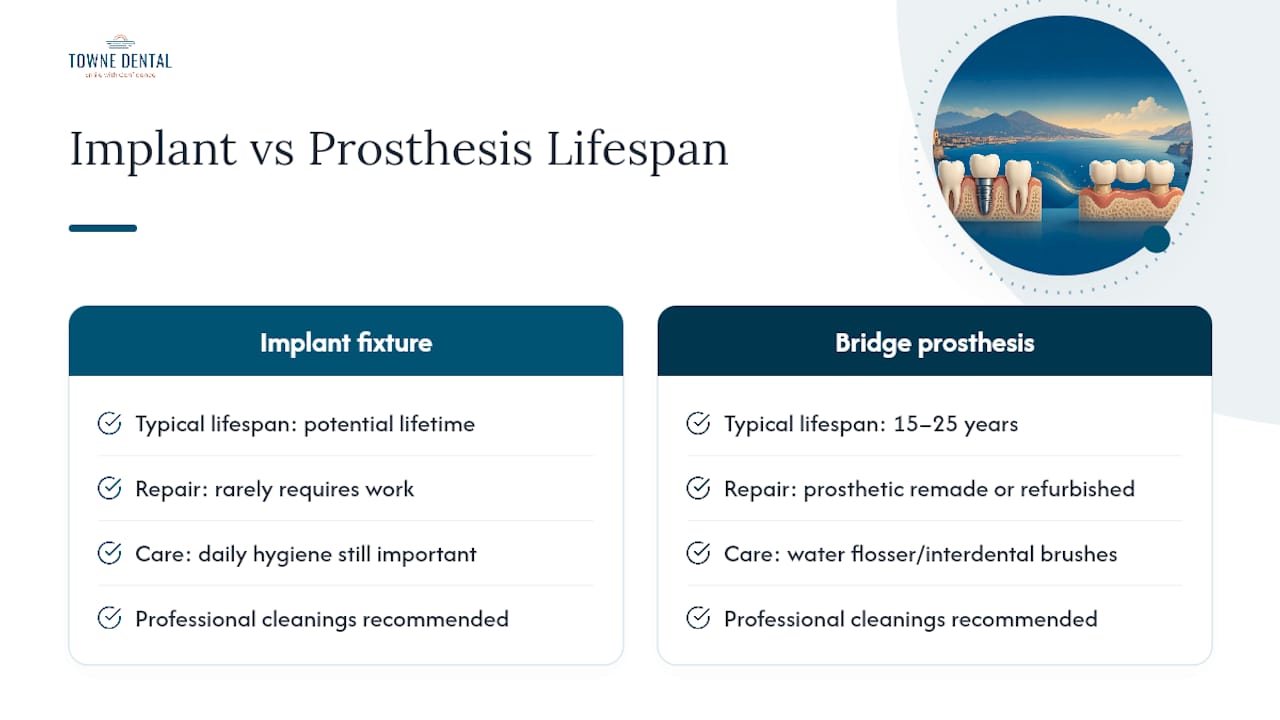
Longevity breaks down into two separate clocks. The implant fixture itself, the titanium post in the bone, can last a lifetime with proper care. The visible bridge prosthesis has a shorter practical lifespan, commonly needing refurbishment or replacement somewhere between 15 and 25 years depending on material and wear patterns. Repair usually means remaking the prosthetic portion rather than touching the implant underneath, unless there’s an underlying bone or infection issue.
Pro Tip: A dental implant warranty can cover part of a prosthetic remake if problems show up earlier than expected. Ask about warranty terms before treatment starts, not after.
Towne Dental’s Approach to Implant-Supported Bridges
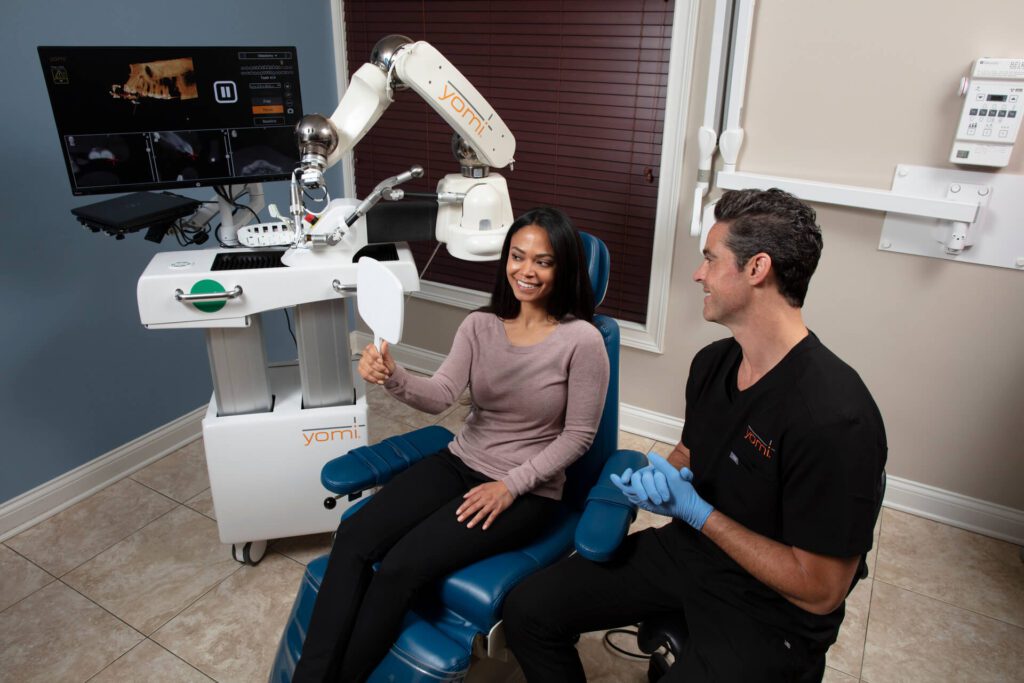
A dental clinic coordinates surgical and prosthodontic care for implant bridge cases, using digital planning to map implant position before any drilling happens. For patients who qualify, the practice offers Yomi® Robot-assisted implant placement, a robotic guidance system built to increase precision and reduce invasiveness during surgery. A consultation typically includes a CBCT review, an honest conversation about candidacy, and a phased treatment estimate so you know the sequence and cost before committing to anything.
How Should You Prepare Before Implant Bridge Surgery?
Preparation starts weeks before the surgical date, not the morning of. Your dentist will review your full medication list, including blood thinners, which sometimes need temporary adjustment under your physician’s guidance, and any bisphosphonates or immunosuppressants that affect healing.
If you smoke, cutting back or quitting in the weeks leading up to surgery meaningfully improves your odds of successful integration. Most practices also ask patients to arrange a ride home if sedation is planned, since anesthesia effects can linger for several hours.
On the practical side, expect instructions to eat a light meal beforehand (unless you’re under general sedation, in which case fasting rules apply), wear comfortable clothing, and avoid alcohol for at least 24 hours prior. Bring a current list of medications, any recent medical imaging, and your insurance information to the pre-op appointment so nothing holds up scheduling.
If a bone graft is part of your plan, that healing period happens on its own separate timeline before implant placement can even begin, so factor that into your overall preparation window rather than assuming everything happens back to back. Ask your dental team specifically what to expect the night before and morning of surgery. Clinics vary on fasting rules, medication pauses, and sedation protocols, and getting those details in writing prevents last-minute confusion.
What Should You Expect During Recovery After Implant Placement?
The first 48 to 72 hours after implant surgery bring the most noticeable swelling and tenderness, generally manageable with over-the-counter pain relievers or a short course of prescription medication if your dentist recommends one. Ice packs applied in short intervals during the first day help control swelling more than heat does at this stage.
Soft foods, think yogurt, scrambled eggs, mashed potatoes, are the standard recommendation for the first several days, gradually reintroducing firmer textures as comfort allows. Avoid the surgical site when brushing initially, but keep the rest of your mouth clean as usual; your dentist may prescribe an antimicrobial rinse to reduce infection risk around the healing implant.
Mild discomfort and minor bleeding are normal in the first day or two. What isn’t normal: pain that intensifies rather than fades after day three, fever, pus or foul discharge near the implant site, or numbness that persists beyond the expected duration of local anesthesia. Any of those signs means calling your dentist promptly rather than waiting for a scheduled follow-up.
Most patients return to normal activity within a few days, though strenuous exercise is usually restricted for a week or so to avoid disrupting the healing site. Follow-up visits during the osseointegration period let your dentist confirm healing is on track before moving to the final prosthetic phase.
Will an Implant Bridge Change How You Speak or Eat?
Most patients notice an adjustment period of a week or two after receiving a temporary restoration, particularly with certain consonant sounds if the bridge replaces front teeth. This typically resolves quickly as your tongue and lips adapt to the new shape in your mouth, and it’s far less pronounced than the speech changes some people experience with removable dentures, which can shift or click during conversation.
Eating tends to improve dramatically once the final bridge is in place. Because the prosthesis is fixed to bone rather than resting on gum tissue or clipped to adjacent teeth, chewing force feels closer to natural teeth than what a removable partial denture allows. Foods that felt risky with a loose partial, corn on the cob, firm apples, chewy bread, generally become manageable again once healing is complete and the final restoration is fitted.
During the temporary phase, before the permanent bridge is placed, your dentist may recommend softer foods and caution around very hard or sticky items to protect the healing implant site. That restriction lifts once the final restoration is secured and your bite has been checked and adjusted.
Clinician Perspective: When an Implant Bridge Is the Right Call
Consecutive tooth loss where a patient wants a fixed, permanent solution and doesn’t want to touch healthy neighboring teeth points clearly toward an implant-supported bridge. It costs more and asks more of you upfront, surgery, healing time, a real financial commitment, but for patients thinking in decades rather than years, that trade-off usually favors the implant route. The right choice still depends on your bone, your health history, and honestly, what you’re willing to go through to get there.
— Towne Dental
Ready to Talk to Towne Dental About an Implant Bridge?
If you’re weighing an implant-supported bridge against a traditional bridge or a removable partial, the next real step is a consultation that looks at your actual bone structure and health history, not a generic estimate. Towne Dental combines digital treatment planning with Yomi® Robot-assisted implant placement, giving patients a more precise, less invasive surgical experience than freehand placement alone typically allows.

Bring any recent dental imaging, your current medication list, and your insurance card to your consultation so the team can build an accurate, phased treatment estimate on the spot. The visit typically includes a CBCT scan review and a straightforward conversation about whether grafting, an implant bridge, or another restorative option fits your case best, explore the full range of restorative and implant services before you come in. Request an itemized plan before committing to anything, and ask specifically about phased payment options if cost is a concern. Schedule your consultation to find out where you stand.
Sources
- Dental Bridges: Types & Who Needs Them
- Implant-Supported Bridge Guide
- An implant-supported bridge step by step | MDO Prosthetics
- Dental Implants vs. Bridges vs. Dentures: Full Comparison – Blog by Dr.Shreya Rajkumar
This article is general information, not a substitute for advice from a qualified doctor. Consult a qualified healthcare professional about your own circumstances before acting on anything here.
FAQ
How Much Does an Implant Bridge Cost?
Cost depends heavily on how many implants you need, whether bone grafting is required, and what material the final prosthesis uses, so figures vary widely from patient to patient. Towne Dental provides itemized treatment estimates during a consultation rather than publishing flat rates, since every case involves different variables.
Can Towne Dental Do an Implant-Supported Bridge?
Yes. Towne Dental offers implant planning and placement, including Yomi® Robot-assisted implant surgery, along with coordinated prosthodontic restoration for multi-unit bridge cases.
Why Do Dentists Prefer an Implant Bridge Over a Traditional Bridge?
An implant bridge avoids grinding down healthy adjacent teeth, which a traditional bridge requires to anchor its crowns. It also transmits chewing force into the jawbone, helping preserve bone volume that would otherwise shrink after tooth loss.
What Are the Problems With Dental Implant Bridges?
The main risks are implant failure, peri-implantitis (inflammation around the implant), and occasional prosthetic loosening or fracture under heavy bite force. Most issues are preventable with good hygiene and are manageable with nonsurgical therapy when caught early.
How Long Do Implant Bridges Last?
The implant fixture can last a lifetime with proper care, while the visible bridge prosthesis typically needs refurbishment or replacement between 15 and 25 years depending on material and wear. Regular cleaning and professional maintenance visits are the biggest factors in reaching the longer end of that range.