Smokers can get dental implants, but smoking roughly doubles the risk of implant failure and raises the odds of infection and bone loss around the implant. Research on heavy smokers, those over 20 cigarettes a day, shows the risk climbs even higher. The single best move if you smoke and want implants: book a consult, tell your dentist your full smoking history, and ask about a cessation plan built around your surgery date.
TL;DR:
- Heavy smokers, those over 20 cigarettes daily, face a risk of implant failure up to 4 times higher than non-smokers, especially if they continue smoking around the time of surgery.
- Reduced blood flow, impaired bone cell activity, and suppressed immune response caused by smoking delay healing and increase chances of infection and bone loss around implants.
- Dentists consider smoking history, gum health, bone volume, and medical conditions when planning implants, often recommending quitting or staged treatment for higher-risk cases.
- Quitting at least two weeks before surgery and abstaining for the first 72 hours post-op significantly improve healing; longer abstinence is advised for grafting or complex procedures.
- Vaping and smokeless tobacco carry similar risks to smoking due to nicotine-induced blood vessel constriction and tissue irritation, making full cessation preferable for implant success.
Table of Contents
- Smoking and Implants: What the Evidence Actually Shows
- Why Smoking Slows Healing Around an Implant
- Will a Dentist Place Implants If You Smoke?
- How Long Before and After Surgery Should You Avoid Smoking?
- How to Quit Before Implant Surgery: Support That Actually Works
- Signs of Implant Trouble and How Smokers Should Handle Aftercare
- Impact of Vaping and Smokeless Tobacco on Implant Outcomes
- Implant Care and Hygiene: What Changes If You Smoke
- Do Smokers Need Different Implant Materials or Designs?
- Long-Term Survival: How Smokers’ Implants Hold Up Over Years
- Practice Perspective: Balancing Risk, Patient Goals, and Realistic Expectations
- How Towne Dental Approaches Implant Care for Smokers
- Sources
- FAQ
Smoking and Implants: What the Evidence Actually Shows
The numbers are consistent across multiple large reviews, and none of them are subtle. A pooled analysis of implant outcomes found smokers face about a 140% higher risk of implant failure compared with non-smokers, along with roughly 0.58 mm more marginal bone loss around the implant site, according to a systematic review and meta-analysis on smoking and dental implants. That bone loss might sound small on paper, but around an implant, half a millimeter is the difference between a stable fixture and one that starts to loosen.
A separate meta-analysis found a similar pattern: implant failure risk rose to roughly RR 2.23 in smokers, and postoperative infection risk came in near double that of non-smokers, based on a study on smoking’s impact on implant failure and infection.
Statistic Callout: Heavy smokers, those lighting up more than 20 cigarettes a day, carry an implant-based relative risk of failure of 2.45 and a patient-based relative risk of 4.00 compared with non-smokers, according to a systematic review on smoking levels and implant failure. Risk scales with how much you smoke, not just whether you smoke.
A few caveats matter here. These reviews pool studies with real variation in smoking intensity, follow-up length, and implant systems. Patients with untreated periodontitis, poorly controlled diabetes, or bone grafts stacked on top of smoking see compounded risk, not just additive risk. That’s why “smokers fail more” is true on average but the range within that average is wide.
- Implant failure risk: roughly 2 to 2.5 times higher in smokers than non-smokers
- Marginal bone loss: about 0.58 mm greater around implants in smokers
- Postoperative infection: close to double the risk versus non-smokers
- Heavy smoking (20+ cigarettes/day): risk climbs to RR 2.45 (implant level) and RR 4.00 (patient level)
Why Smoking Slows Healing Around an Implant
Osseointegration, the process where bone physically fuses to the implant surface, depends on steady blood flow and active bone cell growth. Nicotine constricts blood vessels and carbon monoxide from smoke lowers how much oxygen your blood actually carries to gum and jawbone tissue. Less oxygen at the surgical site means slower, weaker healing at exactly the moment your implant needs the opposite.
Smoking also blunts angiogenesis, the formation of new blood vessels, and interferes with osteoblast function, the cells responsible for laying down new bone. On top of that, tobacco smoke suppresses immune response locally, which is part of why infection rates run higher in smokers after implant surgery.
Put together, these mechanisms explain the clinical picture: delayed or incomplete osseointegration, more marginal bone loss over time, and a meaningfully higher rate of peri-implantitis, the gum infection around implants that mirrors periodontitis around natural teeth.
- Reduced blood flow and oxygen delivery slow tissue and bone healing
- Impaired angiogenesis means fewer new blood vessels forming at the surgical site
- Weakened osteoblast activity slows bone fusion to the implant
- Suppressed local immunity raises infection and peri-implantitis risk
Pro Tip: If you can’t quit entirely before surgery, cutting down in the weeks leading up to it still helps blood flow recover somewhat. Every reduction moves the odds in your favor, even if it’s not a full quit.
Will a Dentist Place Implants If You Smoke?
Smoking alone rarely disqualifies you outright. Dentists weigh it alongside a broader risk picture, and most will still proceed with proper planning and informed consent. What changes is how carefully they plan the case and how directly they’ll discuss risk with you.
During a consult, expect your dentist to review:
- Smoking history — how many cigarettes or pouches per day, and for how many years (pack-years matter more than “I smoke sometimes”)
- Periodontal health — active gum disease compounds implant risk sharply
- Bone volume — smokers with thin ridges may need grafting first, which adds its own healing timeline
- Medical conditions — uncontrolled diabetes alongside smoking is a well-documented double risk factor for implant failure
- Current medications — some affect bone metabolism or healing independent of smoking status
From there, your dentist typically has a few paths: proceed with clear informed consent, ask you to quit or cut back before scheduling surgery, stage the treatment with grafting and longer healing windows, or discuss alternative restorations like a fixed bridge if implant risk looks too high for your specific case. Bring your actual cigarette count, not an estimate, and ask directly what your individual failure risk looks like given your health history.
How Long Before and After Surgery Should You Avoid Smoking?
Timing windows vary by case complexity, but the pattern dental teams generally follow starts well before the surgery date, not the morning of. Quitting at least two weeks ahead of placement gives blood flow and tissue oxygenation a real chance to recover before the drill even touches bone.
The postoperative window matters even more. The first 72 hours are when a stable blood clot forms at the surgical site, and disrupting that with nicotine’s vasoconstriction can undo the early healing before it starts. For straightforward single-implant cases, dentists often ask for several weeks of abstinence. For cases involving bone grafts or sinus lifts, that window commonly stretches longer, since graft failure and smoking-driven healing problems can compound each other.
- Quit at least two weeks before surgery to restore healthier blood flow
- Avoid smoking entirely for the first 72 hours after surgery, when clot formation is critical
- Extend abstinence several weeks longer for grafted or sinus-lift cases
- If full cessation isn’t realistic yet, delay your first cigarette as long as possible and never smoke while the surgical wound is still open
How to Quit Before Implant Surgery: Support That Actually Works
Cessation isn’t a willpower contest. The most effective approach combines counseling with medication, and dental practices are well positioned to start that conversation because they see you before surgery anyway.
- Ask about the 5As — Ask, Advise, Assess, Assist, Arrange is the brief intervention framework the American Dental Association recommends dental teams use, and it takes just a few minutes at a routine visit
- Discuss first-line cessation aids — nicotine replacement therapy, varenicline, and bupropion all have real evidence behind them, and combining medication with counseling outperforms either alone
- Request a QuitLine referral — 1-800-QUIT-NOW connects you with free coaching, and your dental team can make that referral directly
- Time your quit date around your surgery — aligning cessation with your implant timeline gives you a concrete deadline instead of an open-ended goal
Pro Tip: Tell your dentist you’re planning implants before you even schedule surgery. Practices that build cessation support into the treatment plan from day one see better follow-through than patients who try to quit cold on their own the week before.
Signs of Implant Trouble and How Smokers Should Handle Aftercare
Normal healing involves some swelling and mild discomfort for the first few days, tapering off steadily. If pain, swelling, or bleeding is getting worse instead of better by day four or five, that’s outside the normal curve.
Call your dentist promptly if you notice pus or discharge, an implant that feels loose or shifts when you bite, fever that doesn’t resolve, or swelling that keeps expanding rather than subsiding. Because smoking dulls local immune response, infections can progress faster and with fewer early warning signs in smokers, so don’t wait out symptoms hoping they’ll resolve.
- Brush and floss around the implant site gently but consistently from day one
- Stick to soft, non-irritating foods until your dentist clears you for normal chewing
- Take prescribed antibiotics or anti-inflammatories exactly as directed, full course
- Keep every follow-up visit, since radiographic checks catch bone loss before you’d ever feel it
Impact of Vaping and Smokeless Tobacco on Implant Outcomes
E-cigarettes and smokeless tobacco don’t get you off the hook. Evidence on smoke-free nicotine products and implant outcomes is still limited, but what exists doesn’t support treating vaping or chewing tobacco as a safe substitute. Major dental and public health guidance points out there’s no proven-safe form of nicotine or tobacco use for implant healing, according to a systematic review on tobacco and smoke-free products as implant risk factors.
Vaping still delivers nicotine, and nicotine is the primary driver of the blood vessel constriction that slows osseointegration, regardless of whether it arrives via combustion or an aerosol. Heat-not-burn products carry the same open question mark. The research base simply hasn’t caught up to confirm or rule out reduced risk, which means dental teams reasonably treat these products with the same caution as cigarettes until better data exists.
Smokeless tobacco, dip and chew, introduces a different mechanical problem on top of the chemical one: direct, sustained contact between tobacco and gum tissue at the placement site, which raises local irritation and gum recession risk independent of the nicotine itself.
The practical takeaway: if you’re switching from cigarettes to vaping thinking it protects your implant investment, the evidence doesn’t back that assumption up. Full cessation, not substitution, remains the goal your dental team should walk you toward.
Implant Care and Hygiene: What Changes If You Smoke
Smokers need a tighter maintenance routine than non-smokers, not because the implant itself is different, but because the tissue around it is working with less blood flow and a weaker local immune response from the start.
Daily hygiene around an implant matters for everyone, but for smokers it’s the primary lever you control between checkups. Non-smokers can sometimes get away with slightly looser habits and still avoid peri-implantitis. Smokers generally can’t, since their baseline risk for gum inflammation around the implant is already elevated.
Practical differences worth building into your routine:
More frequent professional cleanings. Where a non-smoker might do fine on a standard six-month schedule, many dentists recommend smokers come in every three to four months for the first year or two after placement, so early bone loss or inflammation gets caught on x-rays before it becomes symptomatic.
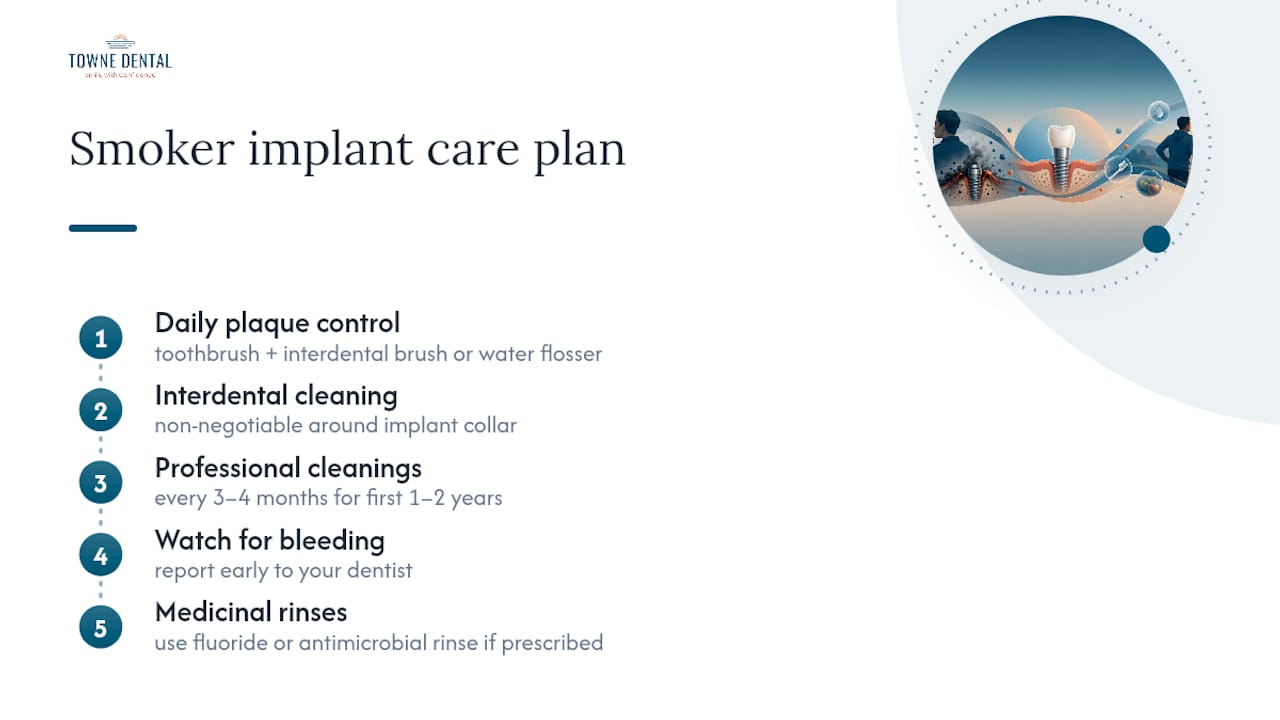
Interdental cleaning is non-negotiable. A water flosser or interdental brush around the implant collar removes plaque a toothbrush alone misses, and that plaque control matters more when your tissue is already compromised.
Watch for bleeding on brushing. In a non-smoker, occasional light bleeding might just mean brushing too hard. In a smoker, it’s worth flagging to your dentist sooner, since nicotine’s effect on blood vessels can mask early inflammation until it’s more advanced.
Stay consistent with fluoride or antimicrobial rinses if prescribed. These aren’t cosmetic extras for smokers, they’re part of managing a genuinely higher baseline risk.
Do Smokers Need Different Implant Materials or Designs?
The implant material itself, typically titanium or zirconia, doesn’t change based on smoking status. Both materials integrate with bone through the same biological process, and neither is inherently more “smoker-resistant” than the other.
What often changes is the treatment plan around the implant. Dentists may favor implants with certain surface treatments designed to promote faster bone attachment, since smokers are working with a slower baseline healing rate. Roughened or treated implant surfaces that encourage bone cells to attach more readily can help offset some of the healing disadvantage, though they don’t eliminate it.
Case staging shifts more than material choice does. A smoker with adequate bone might get the same implant a non-smoker would, but on a longer timeline: extended healing before the crown gets attached, more conservative loading protocols, and closer radiographic monitoring along the way. For smokers who need bone grafting first, because smoking itself can reduce bone density over time, that staging becomes even more deliberate. Clinicians often insist on longer abstinence windows specifically for grafted cases, since graft failure risk and smoking-driven healing problems can compound each other.
The honest summary: your dentist is far more likely to adjust your timeline and monitoring schedule than to hand you a fundamentally different implant.
Long-Term Survival: How Smokers’ Implants Hold Up Over Years
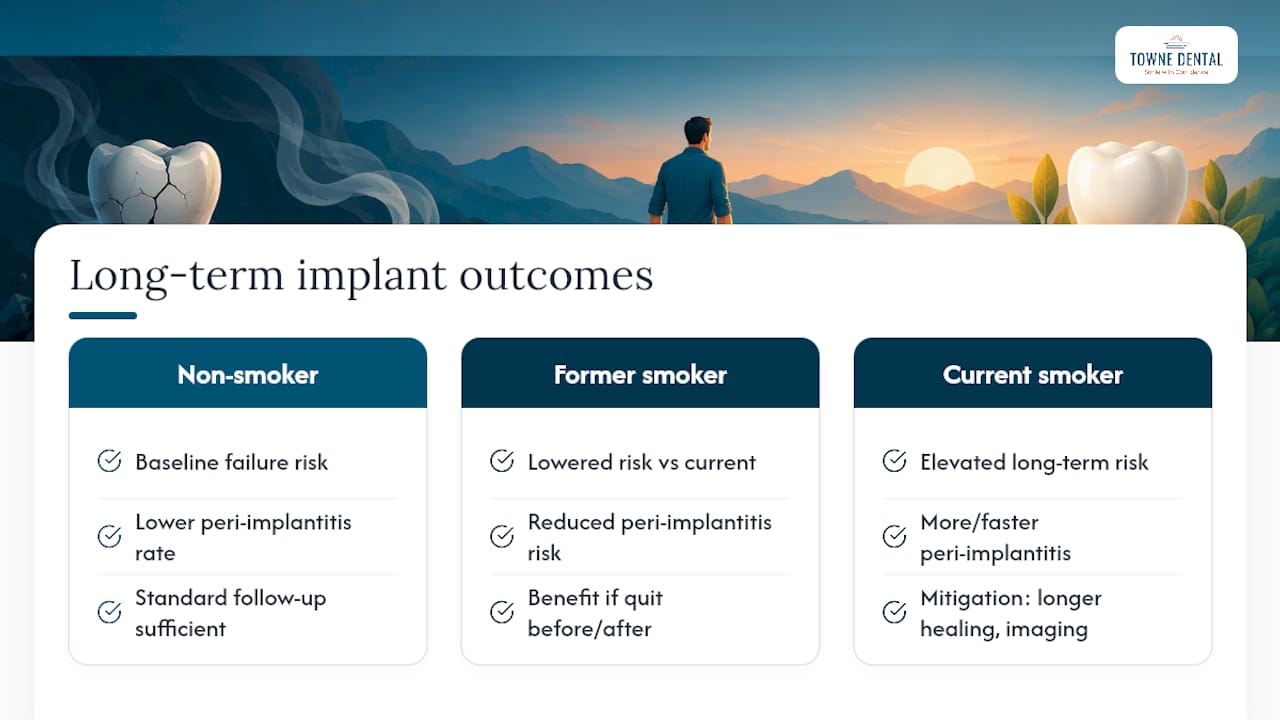
Short-term healing risk gets most of the attention, but the long-term picture matters just as much for anyone weighing this decision. Implants that successfully integrate in smokers don’t automatically face doom down the road, but the odds of complications later stay elevated compared with non-smokers across the years that follow.
Peri-implantitis, the slow, often symptom-quiet gum infection around implants, tends to show up more and progress faster in smokers over a five to ten year horizon. That’s consistent with the marginal bone loss differences seen in early studies, since bone that starts thinner has less buffer against inflammation years later.
There’s genuinely good news buried in the data, though. Former smokers who quit, even years before or shortly after implant placement, show meaningfully better peri-implantitis outcomes than current smokers, according to the same meta-analysis on smoking and dental implants. Quitting isn’t a lost cause just because the implant is already in. And when full cessation doesn’t happen, staging the restoration with a longer healing period before loading, paired with closer follow-up and regular imaging, can mitigate some of the added long-term risk, even if it can’t erase it entirely.
The realistic long-term prognosis for a smoker with a well-placed, well-maintained implant is still generally favorable. It’s just not identical to a non-smoker’s odds, and pretending otherwise doesn’t serve anyone.
Practice Perspective: Balancing Risk, Patient Goals, and Realistic Expectations
Implants change people’s lives, restoring the ability to chew comfortably and smile without hesitation. That doesn’t disappear because someone smokes. What should disappear is the vague, hedge-everything conversation that leaves patients guessing at their actual risk. Every smoker deserves a direct number, a real timeline, and a genuine plan for cutting back or quitting before their surgery date, not a lecture that stops at “you probably shouldn’t.”
— Towne Dental
How Towne Dental Approaches Implant Care for Smokers
We don’t turn patients away for smoking. We plan around it. Every implant consult includes a full review of your smoking history, medical background, and bone health, because a smoker with well-controlled risk factors and a smoker with untreated gum disease and diabetes need genuinely different treatment plans.

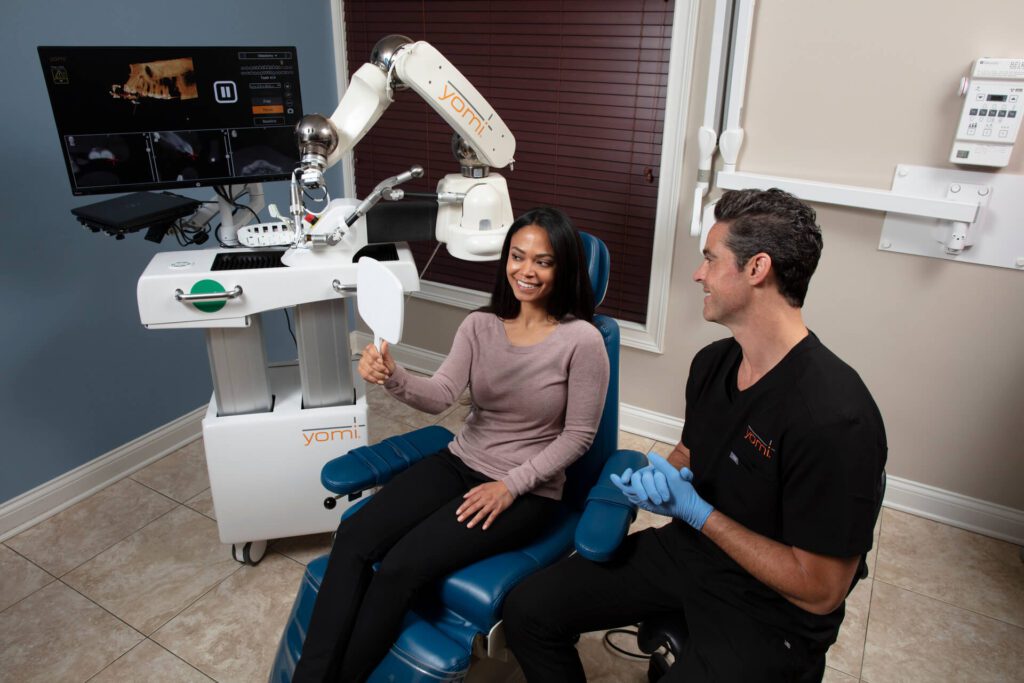
Where this matters most is precision. Yomi® robot-assisted implant planning lets our team map bone density and placement with more accuracy before the drill ever moves, which supports a less invasive approach for patients already healing at a disadvantage. For cases needing grafting or staged treatment, we build the timeline around your realistic healing capacity rather than a one-size schedule.
If you smoke and you’re considering implants, the smartest next step is a real conversation, not guesswork. Visit our dental implants and oral surgery page to see what’s involved, or schedule a consultation and bring your full smoking history. We’ll talk through cessation referrals, timing, and what your specific case actually needs, whether that’s implants now or a staged plan that gets you there safely.
This article is general information, not a substitute for advice from a qualified doctor. Consult a qualified healthcare professional about your own circumstances before acting on anything here.
Sources
- Levels of smoking and dental implants failure: A systematic review and meta‐analysis
- Smoking and Dental Implants: A Systematic Review and Meta-Analysis
- The impact of smoking on failure rates, postoperative infection and marginal bone loss of dental implants
- Tobacco use and cessation — ADA resources
FAQ
Will My Implants Fail If I Smoke?
Not necessarily, but your risk is significantly higher than a non-smoker’s. Research shows smokers face roughly two to two-and-a-half times higher implant failure risk, and heavy smokers over 20 cigarettes a day face a relative risk as high as 4.00 at the patient level. Quitting before and after surgery measurably improves your odds.
Can You Smoke When You Have Implants?
You can, but it raises long-term risk for peri-implantitis and bone loss around the implant. The first 72 hours after surgery are the riskiest window to smoke at all, since that’s when the initial healing clot forms. Long-term smokers also show higher rates of implant complications years after successful placement compared with non-smokers.
Will a Dentist Do Implants If You Smoke?
Most dentists will place implants for smokers, since smoking alone rarely disqualifies a patient outright. A thorough dental consultation reviews your full smoking history, bone health, and medical background to build a plan suited to your actual risk level, sometimes including staged treatment or cessation support before surgery.
What Disqualifies You From Dental Implants?
No single factor automatically disqualifies you, but uncontrolled diabetes, active untreated periodontal disease, insufficient bone volume without grafting options, and certain medications affecting bone healing all raise red flags your dentist will evaluate together. Smoking adds risk on top of these factors rather than serving as a standalone disqualifier.
How Long Should I Quit Smoking Before Dental Implant Surgery?
Many dental teams recommend quitting at least two weeks before surgery to improve blood flow and tissue oxygenation ahead of placement. Avoiding smoking entirely for the first several weeks after surgery, longer for grafted or sinus-lift cases, gives osseointegration its best chance to succeed.