Peri-implantitis is managed in stages, not with a single fix. Clinicians start with careful non-surgical debridement, reassess after six weeks or more, and escalate to surgery only when pockets stay deep or bone loss continues. Antibiotics play a supporting role, not a starring one. None of it works without maintenance visits every three to four months for the life of the implant.
TL;DR:
- Antibiotics are most effective when delivered locally into the pocket, improving outcomes by approximately 0.6 millimeters in pocket reduction, while systemic antibiotics show no significant long-term benefit.
- Surgical options depend on defect shape, with regenerative surgery for deep, contained defects and resective surgery for horizontal or shallow defects, focusing on decontaminating the implant surface effectively.
- Implant removal is necessary only when mobility, extensive bone loss surpassing 50%, or persistent infection indicate the support is beyond salvage.
- Maintenance visits every three to four months, tailored to risk factors, are essential for long-term stability, with patient biofilm control and regular monitoring dictating success.
Table of Contents
- What Is Peri-Implantitis Treatment and When Does It Start?
- Non-Surgical Treatment: What Happens First and What It Fixes
- Do Antibiotics Actually Help Treat Peri-Implantitis?
- Surgical Treatment: Resective, Regenerative, and Decontamination Choices
- When Does an Implant Need to Be Removed?
- How Long Peri-Implantitis Recovery Really Takes: Maintenance and Prognosis
- What the Newest Research Actually Changes for Patients
- Towne Dental’s Approach to Peri-Implantitis Care
- Ready to Get Your Implant Evaluated?
- Where to Read More on Peri-Implantitis Treatment
- Sources
- FAQ
What Is Peri-Implantitis Treatment and When Does It Start?
Peri-implantitis treatment starts the moment inflammation is confirmed alongside bone loss on an X-ray. That combination is what separates it from peri-implant mucositis, which is inflammation without bone loss and often reverses with better brushing and a professional cleaning or two. Peri-implantitis does not reverse on its own. Left alone, it behaves the way periodontitis does around natural teeth: progressive, and eventually threatening the implant itself.
The AO/AAP consensus defines the disease by bleeding or suppuration on probing combined with radiographic bone loss, typically alongside pocket depths of 6 millimeters or more. That threshold matters because it is the trigger point clinicians use to decide how aggressively to treat.
The diagnosis leans on two tools used together. Probing measures pocket depth and checks for bleeding, though probing around implants is less standardized than around natural teeth because there’s no periodontal ligament to cushion the pressure. Radiographs compare current bone height against a baseline image taken at the time the implant was placed or restored, since without that baseline it’s hard to know how much bone has actually been lost versus how much was never there.
Several factors shape both the prognosis and the treatment plan:
- Smoking history slows healing and is one of the strongest predictors of treatment failure.
- A history of periodontitis on natural teeth raises the risk of peri-implantitis and often means a more aggressive approach from the start.
- Prosthetic design matters because crowns with overhanging margins or poor emergence profiles trap plaque and make cleaning nearly impossible, sometimes forcing a redesign before any peri-implant therapy can succeed.
- Bone defect shape, seen on a cone beam scan, determines whether a defect is even a candidate for regenerative surgery later on.
Staging early with accurate radiographs and consistent probing saves patients from both undertreatment and unnecessary surgery.
Non-Surgical Treatment: What Happens First and What It Fixes
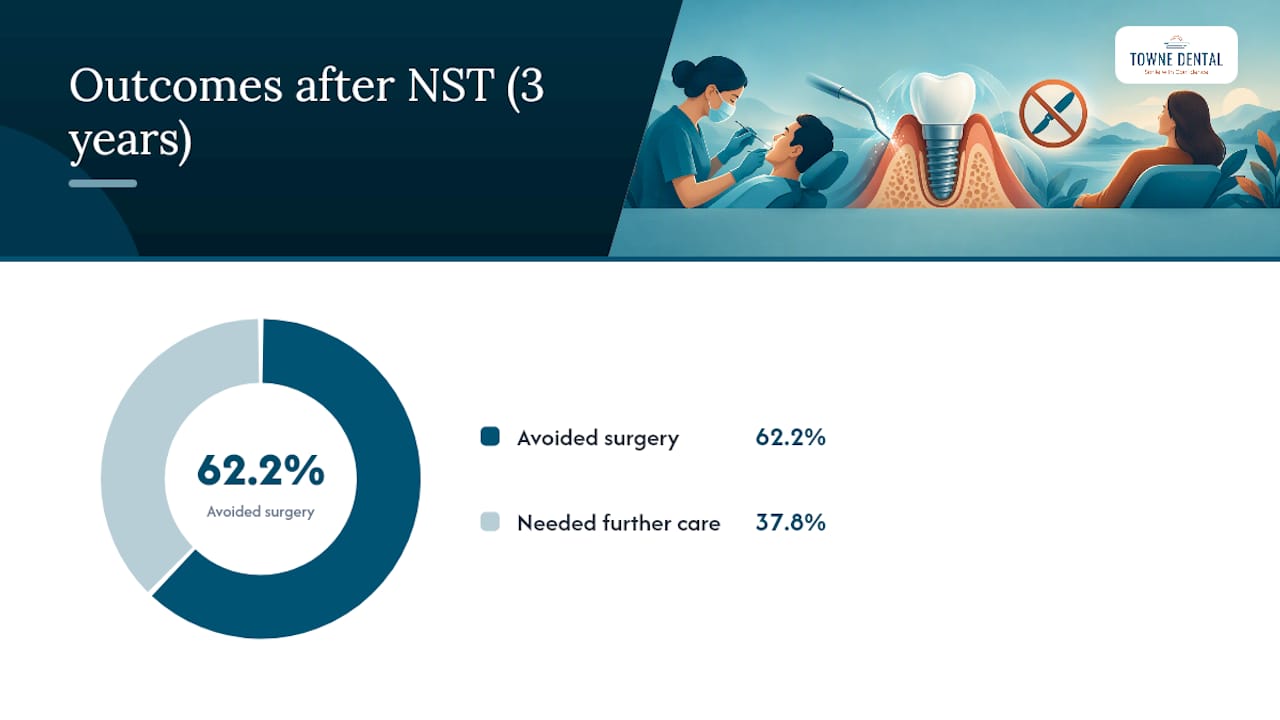
Non-surgical treatment, often shortened to NST, is where every peri-implantitis case begins, and it works better than most patients expect. A cohort study following patients for three years found that 62.2% avoided surgery altogether after NST alone. That’s not a cure rate, but it’s a strong argument for giving mechanical treatment a real chance before jumping to the operating chair.
A typical NST visit follows a sequence:
- Mechanical debridement removes plaque and calculus from the implant surface using instruments designed not to scratch titanium, since scratches create grooves where bacteria hide.
- Air-polishing with fine glycine or erythritol powder cleans below the gumline and around implant threads that hand instruments can’t reach.
- Ultrasonic scaling with implant-safe plastic or carbon-fiber tips breaks up biofilm without damaging the implant surface.
- Titanium brushes come into play when threads are exposed above the bone, since a brush can decontaminate the exposed metal in a way a standard scaler cannot.
- Chemical irrigation with chlorhexidine or saline flushes the pocket after mechanical work, though on its own chlorhexidine does little against an established biofilm.
Chemical adjuncts help but have limits worth understanding. Chlorhexidine rinses and irrigation reduce bacterial load temporarily, yet they don’t penetrate biofilm the way mechanical disruption does, so they’re a supplement to debridement, never a substitute for it.
Outcomes after NST are real but often partial. Research on non-surgical therapy shows pocket reductions of roughly 1 to 1.5 millimeters in moderate defects, with larger reductions in deeper sites. Bleeding on probing typically drops too, though it doesn’t always disappear completely on the first pass.
Pro Tip: Ask your dentist to schedule your re-evaluation for at least six weeks after NST, not sooner. Tissue takes time to heal and mature, and checking too early can make a case look worse than it will settle out to be.
The re-evaluation appointment is where the next decision gets made. If pocket depth has dropped, bleeding has resolved, and bone levels look stable on a follow-up radiograph, the plan shifts into maintenance. If pockets remain 5 millimeters or deeper with persistent bleeding, or if the defect shape suggests mechanical access simply can’t reach the problem, that’s the signal to talk about adjuncts or surgery. Repeating NST once, with a different combination of tools, is reasonable before escalating. Repeating it three or four times without change usually isn’t.
Do Antibiotics Actually Help Treat Peri-Implantitis?
Antibiotics for peri-implantitis are a selective tool, not a default add-on to every debridement appointment. The evidence splits sharply depending on whether the antibiotic is delivered locally or taken systemically.
Local antibiotics placed directly into the pocket, typically minocycline or doxycycline in a chip or gel form, show the more convincing results. A systematic review and meta-analysis found local antibiotics improved pocket depth by around 0.6 millimeters on top of what mechanical treatment achieved alone, with disease resolution rates in the 20 to 30% range compared to roughly 2% for mechanical treatment without them in some trials.
Systemic antibiotics, usually a combination of amoxicillin and metronidazole, tell a murkier story. They can improve short-term clinical numbers in some studies, but the same three-year cohort that tracked surgical outcomes found systemic antibiotics did not significantly reduce the eventual need for surgery.
Key numbers to know: Local antibiotic delivery improved probing depth by about 0.6mm in pooled trial data, while systemic antibiotics showed no statistically significant effect on whether patients eventually needed surgery over three years.
Lasers and antimicrobial photodynamic therapy, or aPDT, occupy a gray zone. Evidence on both is heterogeneous, meaning some trials show a modest bump in outcomes and others show none, with no single laser wavelength or protocol established as a clear winner.
A few practical rules hold up:
- Reserve systemic antibiotics for cases with signs of spreading infection, not routine biofilm control.
- Consider local delivery when a defect’s shape limits how well instruments can physically reach the contaminated surface.
- Never treat antibiotics as a replacement for mechanical debridement. They work as an adjunct or not at all.
- Overprescribing systemic antibiotics for a localized dental infection carries the same stewardship concerns as overprescribing them anywhere else in medicine.
Surgical Treatment: Resective, Regenerative, and Decontamination Choices
Surgery for peri-implantitis becomes the right conversation when pockets stay deep after NST, bone loss keeps progressing on follow-up X-rays, or the defect’s shape makes it physically impossible to clean nonsurgically. Surgery isn’t a failure of the earlier steps. It’s the next stage for the cases NST genuinely can’t reach on its own.
There are two broad surgical paths, and the choice comes down to what the bone defect looks like once the tissue is opened.
Resective (access) surgery flaps back the gum tissue to expose and clean the implant surface directly, then often reshapes the bone to eliminate deep pockets rather than rebuild them. It suits horizontal bone loss and shallow, wide defects where regeneration isn’t realistic. The tradeoff is a more visible metal collar and some gum recession afterward, since the goal is a cleanable, shallow pocket rather than restored height.
Regenerative surgery aims to rebuild lost bone using grafting material, sometimes paired with a barrier membrane, and is reserved for defects with the right shape to hold a graft in place. Deep, narrow, walled defects respond best. Wide, shallow, or noncontained defects tend to lose the graft before it integrates, which is why defect morphology drives so much of the surgical decision.
Whichever approach is chosen, decontaminating the exposed implant surface is the step that determines whether the surgery actually works. Options include:
- Implantoplasty, which mechanically smooths and polishes the implant threads to remove contamination and make the surface harder for bacteria to colonize again.
- Titanium brushes, a newer alternative that a comparative study found noninferior to implantoplasty for reducing probing depth, with the added advantage of better bone level outcomes and a shorter treatment time.
- Er:YAG and Er,Cr:YSGG lasers, which can decontaminate without removing implant surface material, though results across trials remain inconsistent.
- Air-polishing with fine powders, often used as a final step to flush out debris from thread grooves before closing the flap.
Pro Tip: If your case involves a deep, contained bone defect, ask specifically whether a regenerative approach with grafting is on the table versus a resective one. The two produce very different final results, and it’s worth understanding which one your defect shape actually supports before surgery day.
Realistic goals matter here. Surgery aims for stabilization: reduced pocket depth, resolved bleeding on probing, and in select regenerative cases, some degree of reosseointegration where bone reattaches to the implant surface. Full anatomical restoration to a pre-disease state is uncommon. Success in this context means the disease stops progressing, not that the clock gets turned back.
When Does an Implant Need to Be Removed?
Not every peri-implantitis case can be saved, and recognizing that early spares patients months of treatment aimed at an implant that was never going to hold. Clinicians look at a cluster of warning signs together, not any single one in isolation.
- Implant mobility signals the implant has lost its bone anchorage entirely and no surgical technique will restore that.
- Bone loss exceeding roughly 50% of the implant’s length usually means the remaining support can’t be salvaged.
- Persistent infection after appropriate NST and surgical attempts suggests the biological environment around the implant won’t stabilize no matter what’s tried next.
Explantation itself is a straightforward extraction in most cases, followed by a healing period and often a bone grafting procedure to rebuild the site for a future implant. Wait times before reimplantation typically run several months, giving the graft time to mature into stable bone.
How Long Peri-Implantitis Recovery Really Takes: Maintenance and Prognosis
Recovery from peri-implantitis is never really finished. It transitions into ongoing supportive peri-implant therapy, known as SPiT, and that maintenance phase is what determines whether treatment holds for years or fails within months.
A typical SPiT schedule starts with recalls every three to four months, then adjusts based on how stable things stay:
- Early recalls (three to four months) catch any return of bleeding or pocket depth before it becomes bone loss.
- Interval stretching to five or six months becomes reasonable once several consecutive visits show no bleeding and stable radiographic bone.
- Interval tightening back to three months happens the moment risk factors change, like a return to smoking or a new diagnosis of periodontitis elsewhere in the mouth.
Every SPiT visit uses implant-safe instruments, the same categories described in the NST section, since standard steel scalers can scratch titanium and create new bacterial hiding spots.
Patients carry real responsibility in this phase. Daily biofilm control with interdental brushes sized to fit around the implant, an electric toothbrush angled to reach the gumline, and smoking cessation for anyone who still smokes all measurably affect whether the disease returns.
Pro Tip: Interdental brushes work better around implants than floss does, because floss can shred or get caught on rough surfaces near the crown margin. Ask your hygienist to size one specifically to your implant’s gap.
Clinicians track two outcome measures at each recall: no bleeding on probing, and stable bone levels compared to the last radiograph. Without structured SPiT, surgical success rates drop over time as biofilm reaccumulates in the absence of professional monitoring. With it, most stabilized cases stay stable for years.
What the Newest Research Actually Changes for Patients
The AO/AAP consensus shifted the field toward decision trees built on defined criteria, pocket depth, defect shape, and systemic risk factors, rather than clinicians escalating care case by case on instinct. That’s a meaningful change for patients: it means the path from NST to surgery now follows a more predictable, criteria-based logic rather than varying widely from one office to the next.
The antibiotic evidence tells a consistent story across recent reviews. Local antibiotics show a real, if modest, benefit; systemic antibiotics show a mixed one, with the newest cohort data finding no significant reduction in surgical need. Practically, that means:
- Expect staged care that starts nonsurgical, not surgery on the first visit.
- Expect antibiotics offered selectively, tied to specific findings, not routinely.
- Expect maintenance visits to be framed as part of treatment, not an optional afterthought once symptoms improve.
Towne Dental’s Approach to Peri-Implantitis Care
Towne Dental follows this same staged, evidence-based logic: non-surgical therapy first, escalation only when the findings call for it, and a maintenance plan built around each patient’s individual risk profile. An evaluation appointment includes a clinical exam, updated radiographs to compare against baseline bone levels, and a treatment plan discussed in plain language before anything is scheduled.
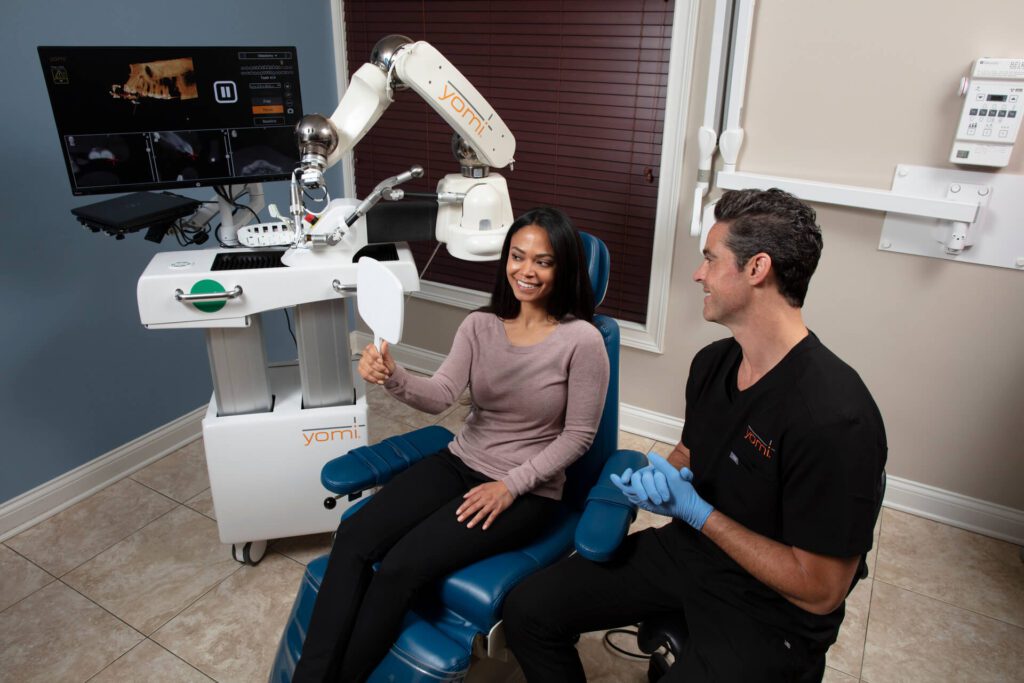
For patients needing implant-related surgical work, Towne Dental’s use of the Yomi Robot supports more precise, less invasive implant placement when replacement becomes necessary. Comfort options, including sedation for anxious patients, are available and tailored individually rather than applied as a one-size-fits-all protocol.
— Towne Dental
Ready to Get Your Implant Evaluated?
If you’re noticing bleeding, tenderness, or a change in how your implant crown fits, waiting rarely makes the picture simpler. An evaluation at this stage means a clinical exam, updated radiographs compared against your original baseline, and a specific plan for what comes next, whether that’s non-surgical therapy, a surgical referral, or reassurance that things look stable.
Towne Dental’s periodontics and gum care team evaluates peri-implant tissue the same way this guide describes: stage the disease first, then match the treatment to what the findings actually show, not to a default protocol. For implants that ultimately need replacement, the practice’s Yomi Robot-assisted placement offers a more precise option than freehand surgical guides alone. If you’ve had ongoing discomfort around an implant, or it’s simply been a while since your last checkup, request an evaluation through Towne Dental’s oral surgery team to get a clear picture of where things stand and what your options are.
Where to Read More on Peri-Implantitis Treatment
- The AO/AAP consensus report lays out the current diagnostic criteria and staged treatment framework referenced throughout this guide.
- The antibiotic meta-analysis breaks down local versus systemic antibiotic outcomes in detail.
- The three-year cohort study tracks how many NST patients avoided surgery and why antibiotics didn’t change that number significantly.
- The comprehensive narrative review covers decontamination methods and realistic treatment goals in depth.
This article is general information, not a substitute for advice from a qualified doctor. Consult a qualified healthcare professional about your own circumstances before acting on anything here.
Sources
- AO/AAP consensus on prevention and management of peri-implant diseases and conditions: Summary report
- Can systemic antibiotics reduce the need for surgical intervention in treating peri-implantitis?
- Antibiotics as adjunctive therapy in the non-surgical treatment of peri-implantitis: A systematic review and meta-analysis
- Study comparing titanium brush and implantoplasty for implant decontamination
FAQ
How Long Does Peri-Implantitis Take to Heal?
Non-surgical treatment typically needs a minimum of six weeks before reassessment, since tissue needs that long to show its true healing response. Full stabilization, including any needed surgery and the transition into maintenance, often takes several months, and healing is best measured by resolved bleeding and stable bone rather than a fixed calendar date.
How Do You Cure Peri-Implantitis?
There’s no guaranteed cure in the sense of restoring the implant site to its original, disease-free state. The realistic goal is stabilization: eliminating bleeding on probing and halting further bone loss through staged non-surgical treatment, selective antibiotics, and surgery when the defect requires it, followed by lifelong maintenance.
What Antibiotics Are Used for Peri-Implantitis?
Local antibiotics like minocycline or doxycycline, delivered directly into the pocket as a chip or gel, show the more consistent benefit for pocket depth and bleeding. Systemic antibiotics, usually amoxicillin combined with metronidazole, are reserved for cases with signs of spreading infection since research shows they don’t reliably reduce the eventual need for surgery.
What Are the Early Signs of Peri-Implantitis?
Early signs include gum redness, swelling, and bleeding when brushing or during a dental probe check around the implant, without any bone loss visible yet on X-rays, which is technically peri-implant mucositis. Once bone loss appears alongside that inflammation, it has progressed to peri-implantitis and needs active treatment rather than just improved home care.
Can Towne Dental Treat Peri-Implantitis?
Yes. Towne Dental evaluates peri-implant disease through clinical exams and radiographs, then follows the staged approach described throughout this guide, starting nonsurgical and escalating only when findings call for it. Pricing for evaluation and treatment is available directly through the practice’s website, since it varies by the extent of care needed.