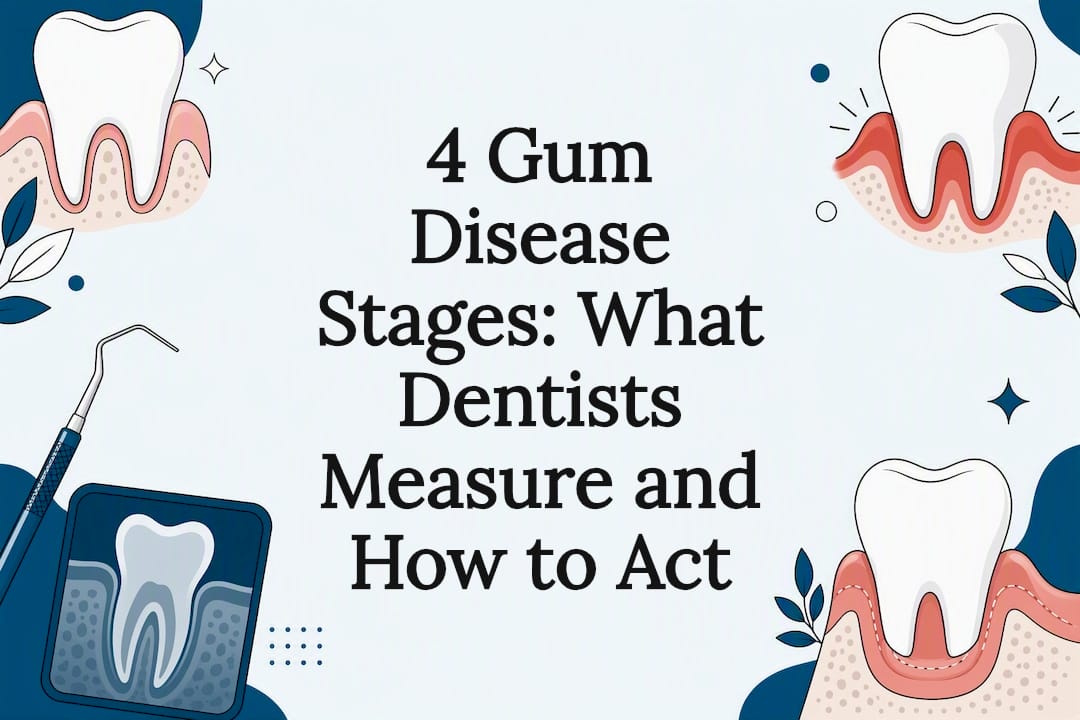
Gum disease progresses through two broad forms and four clinical stages: gingivitis, then periodontitis Stages I through IV… Gingivitis is reversible with better hygiene and a professional cleaning. Once it advances into periodontitis, the bone and ligament holding your teeth in place have started breaking down, and that loss doesn’t grow back. Dentists confirm which stage you’re in using probing depths, attachment loss measurements, and X-rays, not guesswork.
TL;DR:
- Most adult gum disease is already at moderate or advanced stages before symptoms become noticeable, making early detection crucial.
- Dentists determine the stage through probing depth, attachment loss, and radiographs; bleeding on probing indicates active inflammation at any stage.
- Treatment ranges from simple professional cleanings for gingivitis to surgical procedures, with early intervention significantly reducing long-term damage.
- Systemic health issues like diabetes and smoking can accelerate disease progression and affect treatment success, requiring integrated care.
- Proper management depends on accurate staging and regular periodontal evaluations, not just self-assessment or symptom observation.
Table of Contents
- What Are the Stages of Gum Disease?
- How Do Dentists Diagnose and Stage Gum Disease?
- How Is Gum Disease Treated at Each Stage?
- What Do Staging and Grading Actually Mean for You?
- How Can You Prevent Gum Disease From Progressing?
- Which Other Conditions Look Like Gum Disease?
- How Do Dentists Measure Disease Severity Over Time?
- What Happens Long-Term With and Without Treatment?
- Why Do Diabetes and Other Conditions Change the Picture?
- The Real Lesson in the Staging System
- Ready to Find Out Where You Stand?
- Sources
- FAQ
What Are the Stages of Gum Disease?
Every case starts the same way: plaque buildup irritates the gum line and triggers inflammation. What happens next depends on how long it’s ignored.
Gingivitis is the only fully reversible stage. Gums look red or purplish, feel puffy, and bleed when you brush or floss. There’s no bone loss yet, no measurable pocket depth increase, and no permanent damage. A thorough cleaning plus a real commitment to brushing and flossing usually resolves it within a couple of weeks.
Mild (early) periodontitis is where the disease crosses a line it can’t fully uncross. Bacteria have started breaking down the fibers that anchor gum to tooth, creating small pockets where plaque hides below the gumline. You might notice persistent bad breath, slightly longer-looking teeth from early recession, or gums that bleed more easily than before. Bone loss at this point is minimal but detectable on an X-ray.
Moderate periodontitis brings pockets deep enough that home care alone can’t reach the bacteria living in them. Attachment loss and radiographic bone loss are both measurable and meaningful. Some patients notice a bad taste or visible pus when pressing on the gums, along with sensitivity near the roots and the first hints that a tooth feels slightly different when they bite down.
Advanced periodontitis is the stage where teeth are genuinely at risk. Bone support has eroded enough that teeth loosen, shift, or drift out of alignment. Chewing can become painful, and it’s common to lose teeth outright or need complex rehabilitation involving grafting, extractions, or implants.
There’s a useful gap between what patients feel and what a dentist measures. Gingivitis and even early periodontitis often produce no pain at all, which is exactly why the American Academy of Periodontology points to painless progression as the reason so many people don’t seek care until real damage has occurred. By the time you feel it, a dentist has usually already been able to see it for a while.
How Do Dentists Diagnose and Stage Gum Disease?
Staging isn’t a visual guess. It relies on a specific set of measurements taken at your checkup.
- Probing depth. A dentist or hygienist uses a small periodontal probe to measure the space between gum and tooth in millimeters. A healthy pocket runs 1 to 3 millimeters; anything consistently at 4 millimeters or deeper signals periodontitis.
- Clinical attachment loss (CAL). This measures how far the gum tissue has detached from the tooth, factoring in both pocket depth and any gum recession. CAL is the primary number used to assign a periodontitis stage, since it reflects actual structural damage rather than just inflammation.
- Radiographic bone loss. X-rays show how much of the supporting bone around a tooth’s root has disappeared, confirmed against CAL findings to rule out false readings from swelling alone.
- Bleeding on probing (BOP). Gums that bleed when gently probed indicate active inflammation, a key sign of disease activity even when pocket depths look moderate.
- Re-evaluation. After scaling and root planing, dentists recheck pocket depths roughly 3 to 6 weeks later. If pockets haven’t shrunk and bleeding persists, that’s the signal that surgical treatment may be next.
How Is Gum Disease Treated at Each Stage?
Treatment intensity climbs in direct proportion to how much damage has already occurred, which is exactly why catching things early matters so much.
For gingivitis, the fix is almost always non-invasive:
- A professional cleaning to remove hardened plaque (tartar) that a toothbrush can’t touch
- An upgraded home routine, often including an antiseptic rinse
- A follow-up visit to confirm the inflammation has actually resolved
Once periodontitis sets in, scaling and root planing becomes the standard first move. This deep cleaning removes bacterial buildup from below the gumline and smooths root surfaces so gums can reattach. Dentists sometimes pair it with localized antibiotic gel placed directly into pockets, or a short course of oral antibiotics for more widespread infection. Periodontal maintenance visits, typically every 3 to 4 months rather than the standard twice-yearly schedule, become part of long-term management.
Advanced cases often need surgical intervention: flap surgery to access and clean deep pockets, bone grafting to rebuild lost support, or guided tissue regeneration to encourage new attachment growth. When a tooth’s support is too compromised to save, extraction followed by an implant may be the more predictable long-term option.
Pro Tip: Smoking is one of the strongest predictors of poor healing after periodontal treatment. If you smoke and you’re starting scaling and root planing, ask your dentist about cessation support before your first appointment, not after. Diabetes management matters just as much. Uncontrolled blood sugar slows healing and makes infections harder to knock back at every stage.
What Do Staging and Grading Actually Mean for You?
The American Academy of Periodontology’s classification system splits periodontitis into two separate scores, and mixing them up is one of the most common points of confusion for patients reading their own charts.
- Stage (I through IV) describes how much damage has already happened and how complex treatment will be, based on CAL, bone loss on X-rays, and whether teeth have already been lost.
- Grade (A through C) describes how fast the disease is likely to keep progressing, based on factors like smoking status, diabetes control, and the rate of past bone loss relative to age.
Complexity factors, like furcation involvement where bone loss reaches between the roots of a multi-rooted tooth, can push a patient into a higher stage even when their raw numbers look similar to someone else’s. This is why two patients with comparable bone loss sometimes get different treatment plans.
One detail catches people off guard: your stage generally stays on your chart even after successful treatment, because it’s a historical record of damage done, not a live symptom score. Your grade, on the other hand, can shift as your risk factors change.
How Can You Prevent Gum Disease From Progressing?
Prevention is genuinely the cheapest and least painful stage to manage, and most of it comes down to consistency rather than any special product.
- Brush twice daily and floss once, focusing on the gumline where plaque actually accumulates
- Get a professional cleaning every 6 months, or every 3 to 4 months if you’ve already been treated for periodontitis
- Treat persistent bleeding, pus, a loose tooth, or new tooth mobility as reasons to call your dentist promptly, not wait for your next scheduled visit
- Manage smoking and blood sugar levels, since both directly affect how fast gum disease advances and how well treatment works
Which Other Conditions Look Like Gum Disease?
Not every case of red, swollen, or bleeding gums is gum disease, and mistaking a different condition for periodontitis can delay the right treatment.
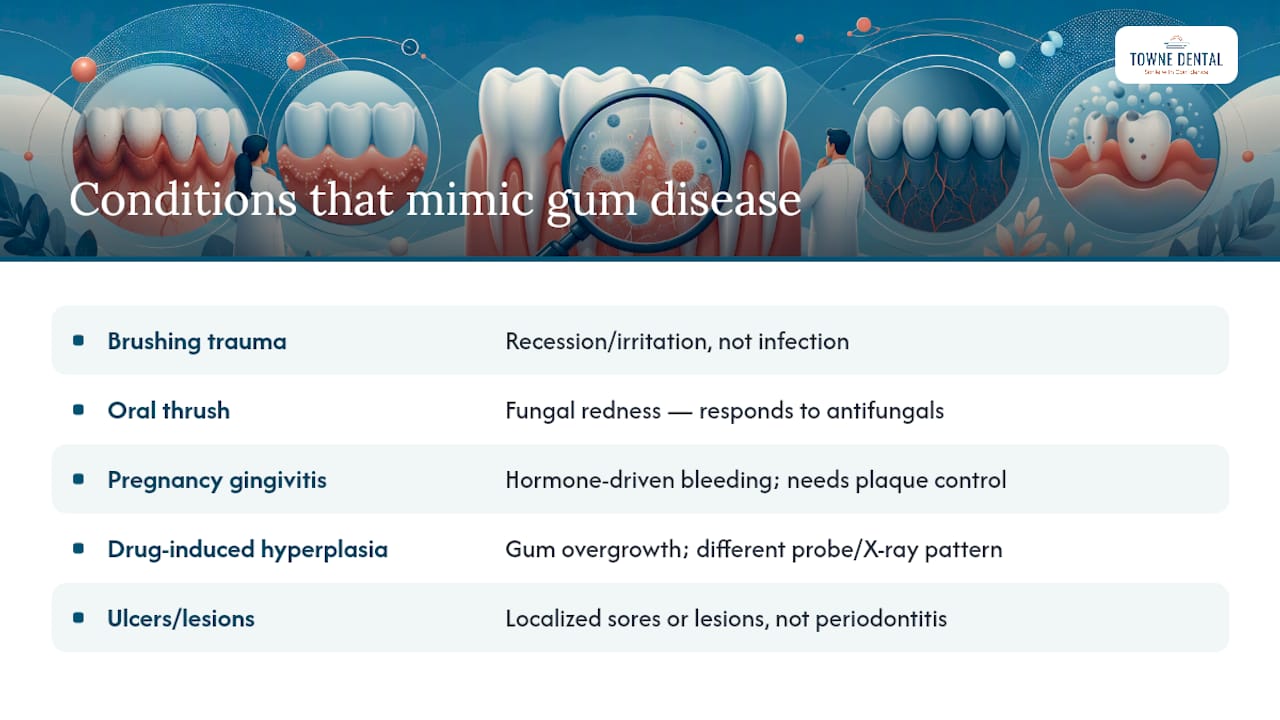
Aggressive brushing with a hard-bristled brush can cause localized recession and irritation that mimics early periodontitis without any actual bacterial infection underneath. Oral thrush, a fungal overgrowth, can cause redness and soreness that looks inflammatory but responds to antifungal treatment, not scaling. Hormonal shifts during pregnancy trigger a condition called pregnancy gingivitis, which produces the same bleeding and swelling as ordinary gingivitis but is driven by hormone fluctuations rather than plaque alone, though the underlying bacteria still need to be controlled.
Certain medications, particularly some blood pressure drugs, anti-seizure medications, and immunosuppressants, cause gum tissue overgrowth (gingival hyperplasia) that can look like advanced disease on a visual exam but shows a different pattern on probing and X-rays. Canker sores, oral herpes lesions, and even some early oral cancers can produce localized redness or bleeding that gets mistaken for gum disease in a quick self-check.
This is the practical argument for a clinical exam over self-diagnosis from a mirror. A dentist differentiates these conditions using the same measurements used to stage periodontitis: probing depth, attachment level, bleeding pattern, and how tissue responds to treatment over time. Symptoms that don’t improve with standard periodontal care are often the first clue that something else is driving the problem.
How Do Dentists Measure Disease Severity Over Time?
Beyond the stage and grade assigned at diagnosis, dentists track several numeric indices to see whether treatment is working or disease is advancing.
The Periodontal Screening and Recording (PSR) index gives a quick, code-based snapshot of gum health across the mouth, often used as a first-pass screening tool before a full periodontal chart. The Gingival Index scores inflammation on a scale based on color, swelling, and bleeding tendency at each tooth. The Plaque Index quantifies how much bacterial film is present at the gumline, which correlates directly with future inflammation risk.
Full periodontal charting, the six-point probing done around every tooth, remains the most detailed measurement, and it’s what actually generates the CAL and pocket depth numbers used for staging. Comparing a current chart against one from a prior visit is how a dentist objectively confirms whether pockets are shrinking after treatment or new attachment loss has appeared somewhere new.
These indices matter because gum disease can look stable to the naked eye while quietly worsening at the microscopic level. A tooth that seems fine visually can still show a jump from a 3 millimeter pocket to a 5 millimeter pocket between two cleanings, and that number, not how the gums look in a mirror, is what drives the treatment decision.
What Happens Long-Term With and Without Treatment?
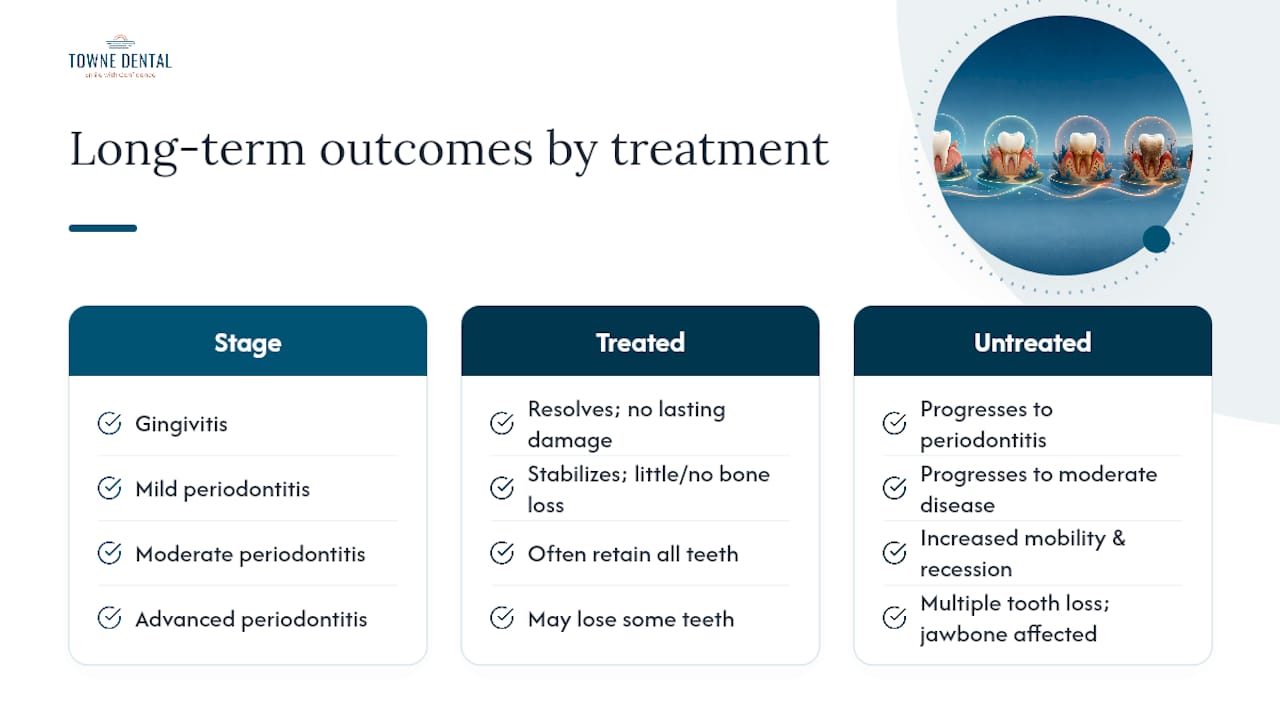
Gingivitis, treated promptly, resolves completely with no lasting damage. Left alone, it doesn’t stay stable. It typically progresses into periodontitis, at which point the clock changes entirely.
Mild periodontitis treated with scaling and root planing has a strong record of stabilizing, often with little to no further bone loss for years, provided maintenance visits continue on schedule. Left untreated, mild disease creeps into moderate territory as pockets deepen and bacteria reach areas a toothbrush can never access.
Moderate periodontitis carries a mixed prognosis. With consistent non-surgical treatment and maintenance, many patients keep every tooth they start with. Without it, tooth mobility and recession accelerate, and the odds of needing surgical intervention climb substantially.
Advanced periodontitis has the least forgiving trajectory. Even with aggressive surgical treatment, some tooth loss is common, and the goal often shifts from “save every tooth” to “stabilize what’s left and plan replacements strategically.” Left completely untreated, advanced disease reliably leads to multiple tooth losses and can affect the jawbone structure needed for future implants. The takeaway that matters most: every stage responds better to intervention than the one after it, which is the entire argument for not waiting on symptoms to escalate.
Why Do Diabetes and Other Conditions Change the Picture?
Gum disease doesn’t develop in isolation from the rest of your health, and diabetes is the clearest example of that two-way relationship.
High blood sugar impairs the body’s ability to fight the bacteria driving gum inflammation, which means people with poorly controlled diabetes tend to develop periodontitis faster and more severely than people without it. The relationship runs in both directions: untreated periodontitis makes blood sugar harder to control, creating a cycle where each condition worsens the other. This is part of why chronic gum inflammation carries systemic weight beyond the mouth, with research increasingly connecting it to broader inflammatory load in the body.
Practically, this changes treatment at every stage. A diabetic patient with mild periodontitis may need shorter intervals between maintenance visits than a non-diabetic patient with the same pocket depths, because healing response and bacterial control both run slower when blood sugar isn’t well managed. For moderate to advanced cases, dentists often coordinate more closely with a patient’s physician, since stabilizing blood sugar tends to improve how well the gums respond to scaling and root planing or surgery.
Other systemic factors carry similar weight: smoking suppresses blood flow to gum tissue and slows healing at any stage, autoimmune conditions can accelerate tissue breakdown, and certain medications independently affect gum tissue regardless of oral hygiene. None of this means the disease is out of a patient’s hands. It means the plan has to account for what’s happening in the rest of the body, not just what’s visible at the gumline.
The Real Lesson in the Staging System
Most people treat “I have gum disease” as one diagnosis. It isn’t. The AAP/EFP framework exists precisely because a Stage I patient and a Stage IV patient are dealing with fundamentally different problems, and lumping them together is where a lot of the fear and confusion around this topic comes from.
The conventional advice, brush more, floss more, is correct but incomplete. It treats every case like gingivitis, when in reality a huge share of adults are already past that point without realizing it. The actual priority for most readers here isn’t a better toothbrush. It’s getting an actual periodontal chart done, because a stage or grade you can’t see on an X-ray isn’t one you can manage by guessing.
If there’s one thing worth taking from the grading side of this system, it’s that risk factors like smoking and blood sugar control aren’t secondary concerns. They can move you between grades faster than most people assume, which changes how aggressively a dentist should be watching your case.
— Towne Dental
Ready to Find Out Where You Stand?
Full periodontal charting should be part of a real evaluation, not a quick visual check, to determine an actual stage and grade instead of a vague assessment. That distinction is the whole point of this article: you can’t manage what hasn’t been measured.

A first periodontal visit typically includes a full six-point probing chart, a review of your bleeding pattern, and X-rays if it’s been a while since your last set. Bring a list of current medications and let the front desk know if you’ve noticed bleeding, loose teeth, or bad breath that hasn’t gone away with brushing. From there, the Periodontics team at Towne Dental can map out exactly where you land on the staging scale and what treatment, from a straightforward cleaning to a referral through oral surgery for grafting or extraction, actually fits your case. If it’s been over six months since your last cleaning, that’s reason enough to book an evaluation now rather than wait for a symptom to force the issue.
This article is general information, not a substitute for advice from a qualified doctor. Consult a qualified healthcare professional about your own circumstances before acting on anything here.
Sources
FAQ
Can You Live a Long Life With Gum Disease?
Yes, especially with gingivitis or well-managed periodontitis. Untreated advanced periodontitis raises the risk of tooth loss and has been linked to broader inflammatory health effects, so ongoing management matters more than the diagnosis alone.
How Do I Know What Stage of Gum Disease I Have?
You can’t reliably self-diagnose your stage; it requires a dentist to measure pocket depth, clinical attachment loss, and bone levels on an X-ray. Bleeding and visible recession are hints, but the actual stage is a clinical measurement, not a guess.
Can Gum Disease Be Reversed?
Gingivitis is fully reversible with a professional cleaning and improved home care. Periodontitis, once bone and attachment loss have occurred, can be managed and stabilized but the lost bone and tissue don’t regenerate on their own.
How Do I Get Healthy Gums Again?
Start with a professional cleaning to remove plaque and tartar below the gumline, then commit to daily brushing and flossing at the gum margin. If pockets are already present, scaling and root planing followed by regular periodontal maintenance is the standard path back to stability.