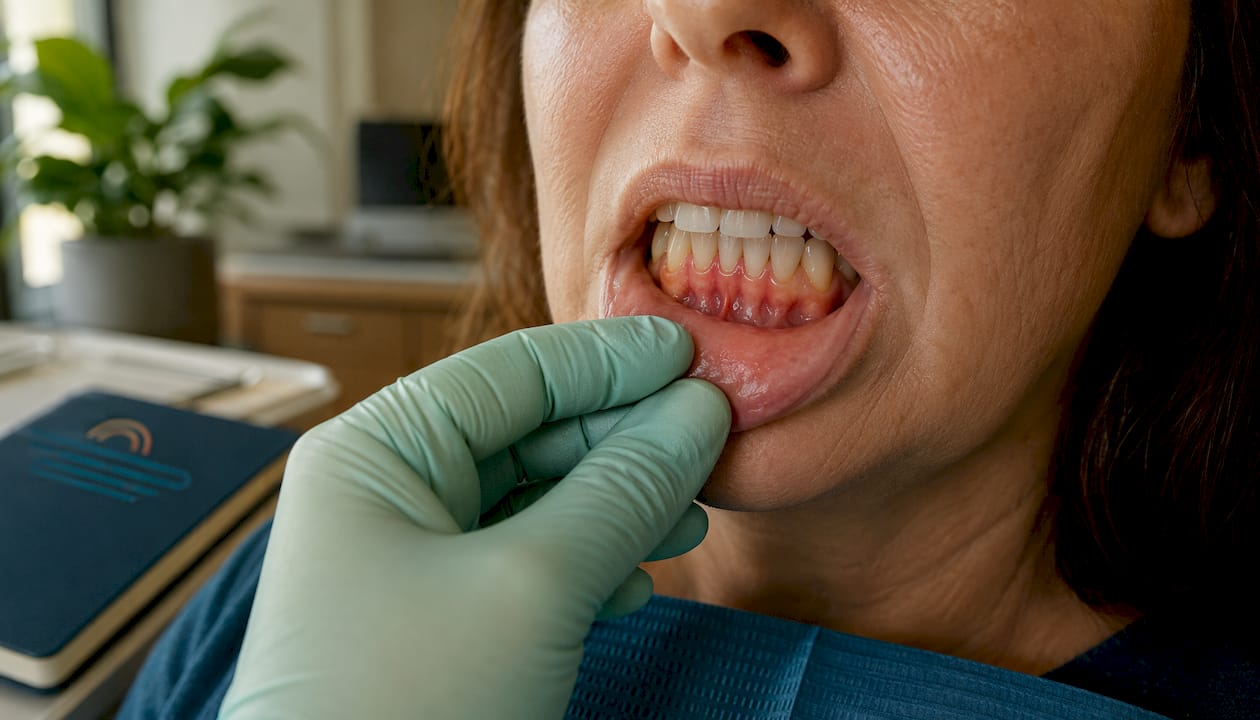
If you can see your teeth through your bottom gums, you’re most likely looking at gum recession — gum tissue that has pulled away from the tooth surface and exposed the root underneath. This is not a cosmetic quirk. It signals tissue loss that needs a professional measurement to determine how far it has progressed and whether active disease is driving it. Schedule a dentist or periodontist exam, especially if you also have sensitivity, bleeding, or any swelling. The sooner you get a clinical measurement, the more treatment options stay on the table.
Towne Dental evaluates and treats gum recession at its Ft. Myers-Naples locations, with periodontal services ranging from deep cleaning to surgical grafting.
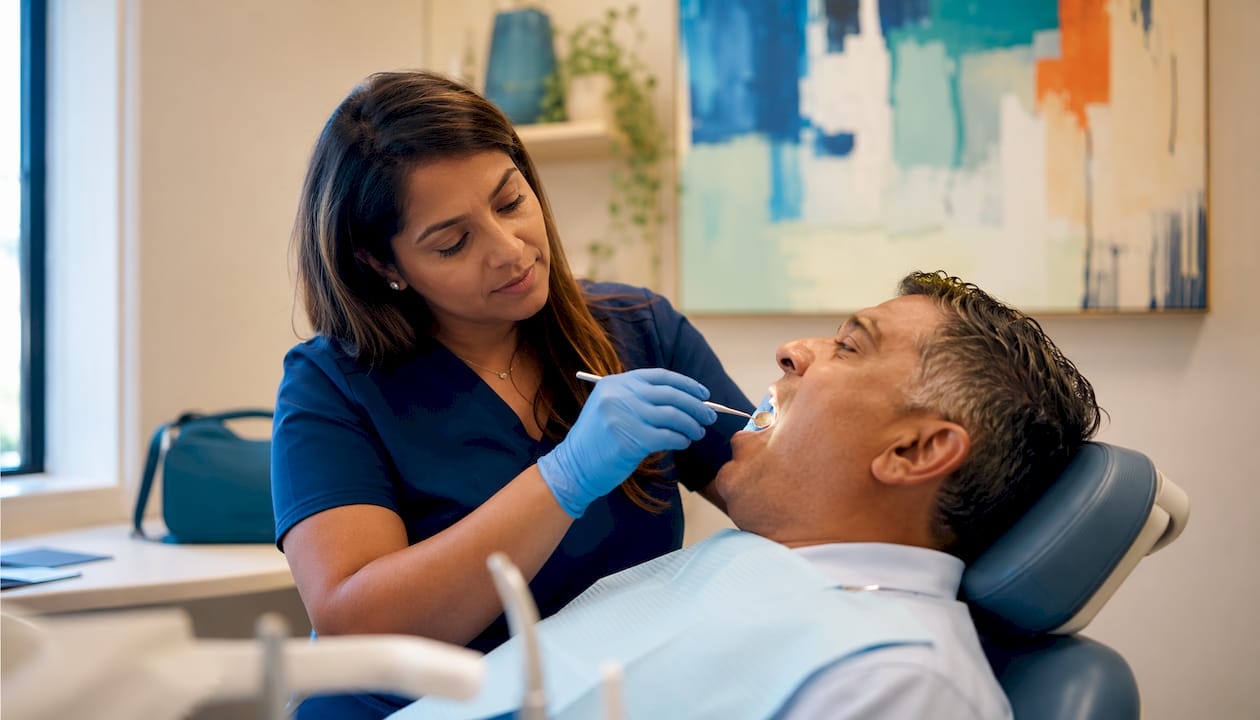
Table of Contents
- Why can you see your bottom teeth through your gums?
- What other symptoms usually come with receding bottom gums?
- How does a dentist diagnose gum recession and root exposure?
- Treatment options by severity: from home care to surgical grafting
- How to prevent recession from getting worse
- When should you call a dentist or see a periodontist now?
- Recovery timeline and cost expectations in the U.S.
- How to prepare for your dental appointment
- Key Takeaways
- A clinician’s view on visible root exposure
- Exposed roots and gum recession care at Towne Dental
- Authoritative sources and further reading
- FAQ
Why can you see your bottom teeth through your gums?
Gum recession means the gum margin has migrated toward the root, leaving part of the tooth structure that was never meant to be exposed sitting in plain sight. The root surface looks slightly darker or more yellow than the enamel crown above it, which is often the first visual clue patients notice.
The most common causes:
- Periodontal (gum) disease — plaque and bacteria trigger inflammation that destroys the attachment between gum and tooth over time
- Aggressive brushing — scrubbing too hard or using a medium/hard-bristle brush physically wears the gum margin away
- Thin gum biotype or genetics — some people simply have less gum tissue to begin with, making recession more likely
- Orthodontic tooth movement — teeth pushed outside the bone envelope during treatment can pull the gum with them
- Bruxism (grinding or clenching) — chronic force on teeth stresses the supporting structures
- Tobacco use — smoking and smokeless tobacco impair blood flow and healing in gum tissue
- Trauma — a direct injury to the mouth or a poorly fitting partial denture can strip tissue
Less common possibilities include a tooth fracture that exposes root structure, tooth rotation or mobility that changes the gum contour, or, rarely, oral lesions including early oral cancer. Any of these require a professional assessment to rule out.
Pro Tip: Visual appearance alone tells you nothing about severity. A millimeter of visible root on one person may represent stable, long-standing recession; the same appearance in another person may reflect active bone loss. Only periodontal probing and X-rays can tell the difference.
What other symptoms usually come with receding bottom gums?
Root surfaces lack the enamel layer that protects the crown of a tooth. Once exposed, they respond to temperature, pressure, and sugar in ways that can range from mildly annoying to genuinely disruptive. The most apparent sign of gum recession is root exposure itself, but sensitivity to heat, cold, and sweets is a close second.
Common accompanying symptoms include:
- Sensitivity or sharp pain when eating or drinking hot, cold, or sweet foods
- Discomfort or pain during brushing near the gumline
- Teeth that look visually longer than they used to
- Bleeding when brushing or flossing — often the earliest warning sign
- Persistent bad breath from bacterial activity in periodontal pockets
- Loose teeth in more advanced cases
Absence of pain does not mean absence of disease. Many patients with significant recession and early bone loss feel nothing until the situation has progressed considerably. Bleeding on probing and pocket depth measurements are more reliable indicators of active disease than pain alone.
The red-flag symptoms that push this from “schedule soon” to “call today” are frequent or heavy bleeding, pus or swelling around a tooth, sudden increased tooth mobility, or a visible rapid change in the gum shape over days or weeks. Exposed roots may not always be visible depending on tooth location, so sensitivity and bleeding alone should prompt evaluation even when you cannot see the root directly.
How does a dentist diagnose gum recession and root exposure?
A visual exam gets the conversation started, but dentists diagnose gum recession by measuring attachment loss and probing pocket depths with a calibrated periodontal probe. Here is the typical sequence:
- Visual inspection — the clinician notes gum color, contour, swelling, and any visible root surfaces
- Periodontal probing — a thin, millimeter-marked probe is walked around each tooth to measure the sulcus (the space between gum and tooth); a healthy sulcus runs about 1–3 mm; readings above 3 mm indicate pocketing, and recession measurements record how far the gum margin has migrated from its normal position
- Periodontal charting — all measurements are recorded tooth by tooth, creating a baseline map of attachment levels
- Dental X-rays — radiographs reveal bone height around the roots; bone loss changes the treatment calculus significantly because it affects long-term prognosis
- Inflammation and bleeding assessment — bleeding on probing signals active inflammation, which distinguishes stable cosmetic recession from progressive disease
A general dentist performs this initial exam. If measurements reveal advanced bone loss, deep pockets, or a need for surgical grafting, a referral to a periodontist is standard. Towne Dental’s team handles both the initial evaluation and advanced periodontal care in-house, which cuts down on the back-and-forth.
Pro Tip: Bring a short symptom log to your appointment — when you first noticed the change, which teeth feel sensitive, and how often you see blood. A two-minute note on your phone speeds the exam considerably and helps the clinician prioritize which areas to probe first.
Treatment options by severity: from home care to surgical grafting
Treatment follows a logical sequence: stop the damage first, then repair what was lost if needed. Clinicians rarely jump to surgery before confirming that disease and trauma are under control.
| Treatment category | What it does | When it’s used | Typical recovery |
|---|---|---|---|
| Home care | Removes plaque, reduces trauma, desensitizes roots | Mild recession, stable disease | Immediate; symptom relief in days–weeks |
| Professional nonsurgical | Scaling and root planing, antimicrobial therapy | Active disease, moderate pocketing | 1–2 weeks |
| Surgical grafting | Replaces lost tissue, covers exposed roots | Significant recession, cosmetic need, or functional concern | Several weeks; full maturation over months |
Conservative care for mild cases centers on eliminating the causes. That means switching to a soft-bristle brush, correcting technique (45° angle at the gumline, gentle circular motion), and using a desensitizing toothpaste or topical fluoride varnish. Mild recession responds well to these changes when caught early, though home care prevents worsening rather than regrowing lost tissue.
Scaling and root planing is the standard nonsurgical step when active infection or inflammation is present. The clinician removes plaque and calculus from below the gumline and smooths the root surface to discourage bacterial reattachment. Antimicrobial rinses or locally delivered antibiotics may accompany this.
Surgical grafting becomes the conversation once disease is controlled and the patient either has functional concerns (root cavities, sensitivity that doesn’t respond to desensitizing agents) or wants cosmetic coverage. Connective tissue grafts from the palate are often preferred for predictable root coverage and tissue thickness; free gingival grafts are used when the goal is to increase the zone of attached gum rather than cover the root. Oral surgery recovery involves a few weeks of soft-tissue healing, dietary modifications, and staged follow-up visits.
How to prevent recession from getting worse
Home care cannot reverse tissue loss, but it absolutely can stop new loss from happening. These are the clinician-endorsed daily habits that matter most:
- Brush with a soft-bristle brush at a 45° angle to the gumline using gentle pressure — medium and hard brushes are a leading cause of abrasion-driven recession
- Switch to a non-abrasive desensitizing toothpaste if you’re already receding; whitening and tartar-control formulas often contain abrasives that accelerate root surface wear
- Clean between teeth daily with floss or interdental brushes to remove plaque from areas a brush cannot reach
- Use an antiseptic mouth rinse when your hygienist recommends it, particularly during active treatment
- Wear a nightguard if you grind or clench — bruxism places enormous lateral force on teeth and their supporting structures
- Quit tobacco — smoking impairs gum tissue healing and masks bleeding that would otherwise signal early disease
- Keep routine cleaning appointments — professional removal of calculus is the one thing home care cannot replicate
Pro Tip: Ask your hygienist to watch you brush for 30 seconds at your next appointment. Most patients who think they brush gently are actually scrubbing. A technique correction demonstrated in the chair sticks better than any written instruction.
When should you call a dentist or see a periodontist now?
If your symptoms are pain-free and the change in your gumline has been gradual, a scheduled appointment within the next few weeks is appropriate. But certain signs push the timeline to today or tomorrow.
Early evaluation increases the likelihood of less invasive treatment. Delay often converts treatable recession into cases requiring grafts or more complex periodontal therapy.
Call your dentist promptly if you notice any of the following:
- New or worsening sensitivity that makes eating or drinking difficult
- Frequent or heavy bleeding from the gums
- Swelling, redness, or pus around a tooth
- A tooth that feels loose or has shifted position
- Visible rapid changes in the gumline over days
If you have pus, fever, or severe pain, treat this as a dental emergency and seek same-day dental care. These symptoms can indicate an abscess, which spreads if left untreated. For anything that falls short of emergency but still concerns you, knowing the signs that warrant an endodontist can help you triage whether the pain is coming from the root canal system or the surrounding gum tissue.
Recovery timeline and cost expectations in the U.S.
Recovery depends almost entirely on which treatment you need.
- Home care and desensitizing measures — sensitivity often improves within days to a few weeks once the source of trauma is removed
- Scaling and root planing — gum tissue typically settles within 1–2 weeks; a follow-up visit at 4–6 weeks checks healing and re-probes pockets
- Soft-tissue graft — the surgical site heals over several weeks, with full tissue maturation taking several months; dietary restrictions (soft foods, no hard or crunchy items) apply for the first few weeks
Cost varies considerably based on the number of teeth treated, whether specialist care is involved, and your geographic area. A single scaling and root planing quadrant runs less than a graft procedure, which itself varies by technique and how many teeth are covered. Ask the clinic for a written estimate before treatment and request an insurance preauthorization so you know your out-of-pocket exposure in advance. If the full treatment plan feels financially heavy, ask about phased treatment — stabilizing disease first, then addressing cosmetic coverage in a later appointment cycle — and whether payment plans or financing are available.
How to prepare for your dental appointment
Walking in organized saves time and helps the clinician focus on what matters.
- Take photos of the area — a clear photo of the affected gum taken in good light gives the clinician a visual baseline and helps document changes over time
- Write a short symptom log — note when you first noticed the change, which teeth are affected, whether you have sensitivity and to what (hot, cold, sweet, pressure), and how often you see blood
- List your current medications — some medications cause dry mouth or gum changes that are clinically relevant
- Bring your dental insurance card — or know your plan details so the front desk can verify coverage before treatment is proposed
- Prepare your questions — useful ones include: “What is the measured recession in millimeters?”, “Is there bone loss visible on X-rays?”, “What are the nonsurgical options?”, and “If grafting is recommended, what does recovery look like?”
The clinician will perform a visual exam, periodontal probing and charting, and likely take X-rays. From there, you’ll receive a staged treatment plan with options and associated costs. Nothing is done without your consent.
Key Takeaways
Visible tooth roots through the bottom gums almost always indicate gum recession, and the severity can only be determined through professional probing and X-rays, not appearance alone.
| Point | Details |
|---|---|
| Most likely cause | Gum recession exposes roots when tissue pulls away from the tooth; periodontal disease is the most common driver. |
| Diagnosis requires measurement | Probing in millimeters and dental X-rays determine severity; visual inspection alone is not enough. |
| Stop damage before repair | Clinicians control disease and trauma first; grafting is considered only after inflammation is resolved. |
| Urgent red flags | Heavy bleeding, pus, fever, severe pain, or sudden tooth mobility require same-day dental care. |
| Towne Dental | Provides periodontal evaluation, scaling and root planing, gum grafting, and oral surgery at its Ft. Myers-Naples locations. |
A clinician’s view on visible root exposure
The patients who do best with gum recession are the ones who come in before the situation forces their hand. By the time someone notices visible root exposure on their own, the tissue loss has usually been building for months or years. That’s not a reason to panic, but it is a reason to move quickly on getting a measurement.
The priority order matters here. Stopping active disease and inflammation comes first, always. There’s no point in grafting over a site that still has active infection — the graft won’t hold, and you’ve added a surgical recovery for nothing. Once the tissue is stable and the plaque control is solid, then the conversation about coverage or cosmetic correction makes sense.
What most patients underestimate is how much a technique change alone can accomplish. Switching from a medium-bristle brush to a soft one, correcting the angle, and using a desensitizing toothpaste can meaningfully reduce sensitivity and stop new recession within weeks. That’s not a substitute for professional care, but it’s a real and immediate step that costs almost nothing.
Probing and X-rays aren’t just formalities. They’re the only way to know whether you’re dealing with stable, long-standing recession or an active process that’s quietly destroying bone. Towne Dental’s periodontal team stages care based on those measurements — monitoring mild cases, treating active disease nonsurgically, and offering grafting when tissue replacement is genuinely indicated.
Exposed roots and gum recession care at Towne Dental
Gum recession caught early is far less complicated to treat than recession that has been progressing for years. Towne Dental’s Ft. Myers-Naples team offers the full range of care for patients who notice visible root exposure: periodontal evaluation with probing and charting, scaling and root planing for active disease, gum grafting for tissue replacement, and oral surgery when more advanced intervention is needed. Sedation options are available for patients who find dental visits stressful.

For patients whose recession has a cosmetic dimension once disease is controlled, the team also provides cosmetic dentistry options to address the appearance changes that come with longer-looking teeth. Treatment plans are staged and personalized — no one-size-fits-all approach. To schedule a periodontal evaluation or request an urgent appointment for concerning symptoms, visit Towne Dental’s services page or call the clinic directly.
Authoritative sources and further reading
- Gum Recession: Causes, Prevention, Surgery & Treatment — Cleveland Clinic — primary source for the definition of gum recession, diagnostic probing, and staged treatment approach
- Gum Recession — MSD Manual — supports treatment spectrum from conservative care to surgical grafting and home-care expectations
- Receding gums — Healthline — covers causes, progression from gingivitis to periodontitis, and grafting techniques
- Exposed tooth root: Symptoms, treatment, pictures, and more — Medical News Today — urgency guidance and clinical recommendation for prompt evaluation
- Towne Dental Periodontics — Naples, FL — local periodontal evaluation and treatment services
FAQ
What should I do if I can see my teeth through my gums?
Schedule a dental exam as soon as possible. A clinician will probe the area in millimeters and take X-rays to determine whether you have stable recession or active periodontal disease requiring treatment.
Why are my bottom teeth showing through my gums?
The most likely explanation is gum recession, where gum tissue has pulled away from the tooth and exposed the root surface. Common causes include gum disease, aggressive brushing, thin gum tissue, grinding, and tobacco use.
Is it normal for teeth to be visible through the gums?
No. Healthy gums cover the root and maintain a sulcus depth of about 1–3 mm. Visible root structure means tissue has been lost, which requires professional evaluation to measure severity and identify the cause.
Who should I see about my gums?
Start with a general dentist, who will perform a visual exam and periodontal probing. If measurements reveal advanced bone loss, deep pockets, or a need for grafting, the dentist will refer you to a periodontist. Towne Dental handles both levels of care at its Ft. Myers-Naples locations.
Can receding gums get worse if left untreated?
Yes. Untreated recession can progress to bone loss, deeper periodontal pockets, root cavities, and eventually tooth loss. Early intervention keeps treatment options simpler and less invasive.
This article is general health information, not professional dental or medical advice. Confirm your specific situation with a licensed dentist or periodontist.