Yes, gum disease can cause bad breath, and when the odor keeps coming back after brushing, mouthwash and mints, it is one of the first things a dentist checks. Gum disease, from gingivitis to advanced periodontitis, is a recognized cause of bad breath. The reason is bacterial: the germs that inflame your gums release foul-smelling gases, and they live in places a toothbrush and a breath spray never reach. Below, we explain how that works, how to tell gum-related breath from other causes, what treatment looks like, and what you can do at home between visits.
TL;DR
- Bacteria linked to gum disease produce sulfur gases that smell bad, and they hide in the gum pockets and along the gumline.
- Breath that stays bad despite good brushing, plus bleeding, red or swollen gums, points toward gum disease. Other causes, especially the tongue, are also common.
- Gingivitis can be reversed. Periodontitis cannot be reversed, but professional care can slow and manage it.
- Mouthwash only masks the smell. Lasting fixes are a professional cleaning, daily cleaning between teeth, and treating the infection underneath.
- Persistent bad breath with gum symptoms deserves a dental visit, not another bottle of rinse.
Table of Contents
- Why gum disease makes your breath smell
- Signs your bad breath may be coming from your gums
- When bad breath is not gum disease
- Gingivitis vs. periodontitis: what can be reversed
- How to get rid of bad breath caused by gum disease
- Preventing it from coming back
- When to see a dentist
- Our perspective: treat the cause, and make the visit easy
- Gum care at Towne Dental
- FAQ
- Sources
Why gum disease makes your breath smell
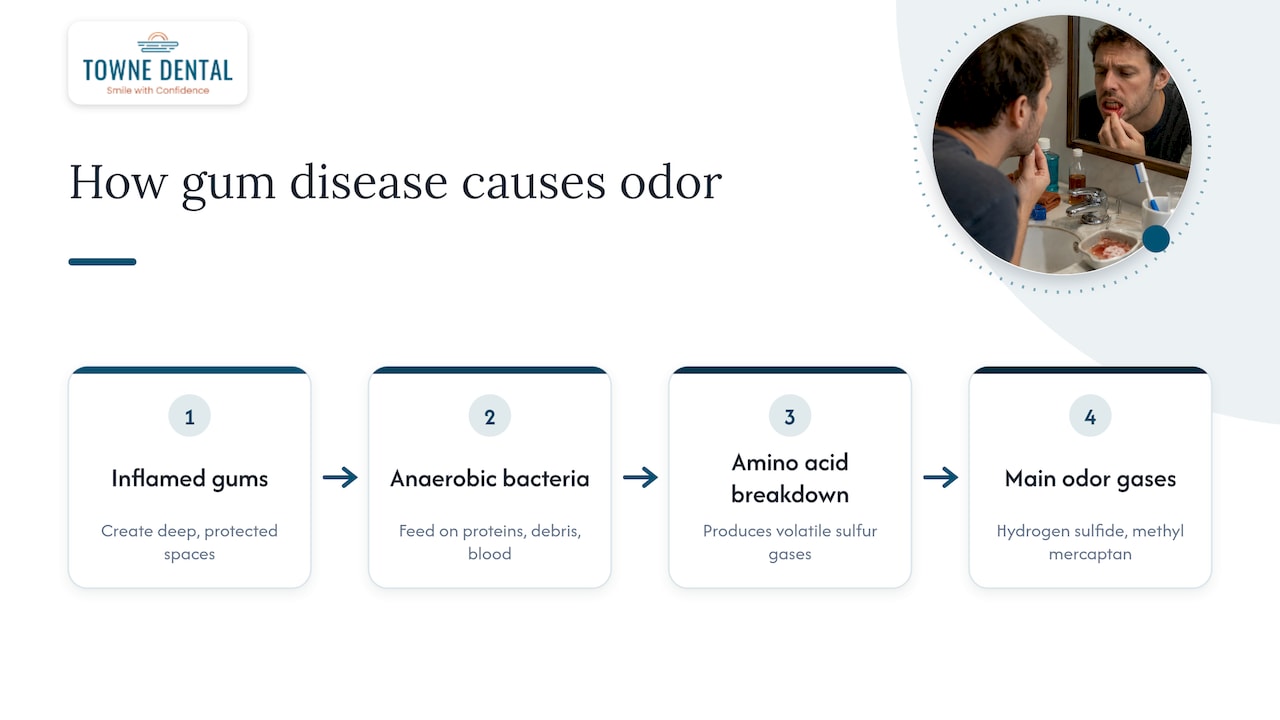
Your mouth is home to hundreds of bacterial species. Most are harmless. Some thrive without oxygen, and they love the deep, protected spaces that form when gums become inflamed and pull away from teeth. As they feed on proteins from food debris, dead cells and blood, they release gases.
Research describes this process clearly. Oral malodor comes mainly from bacteria breaking down amino acids into volatile, bad-smelling gases, and the anaerobic bacteria tied to periodontal disease are especially involved. The Merck Manual adds that gum and periodontal disorders produce sulfur compounds when oral bacteria degrade sulfur-containing amino acids.
Two gases do most of the damage. Hydrogen sulfide and methyl mercaptan are primarily responsible for mouth odor, and high levels of methyl mercaptan are mostly produced by periodontal pathogens. That is why gum-related breath often has a distinct, sulfurous quality that people describe as rotten or metallic, and why it tends to be worse than the “morning breath” everyone gets.
Why it doesn’t go away
Simple bad breath from last night’s dinner fades when you brush. Gum-related odor persists because the source is not on the surface. As gum disease progresses, the space between tooth and gum deepens into a pocket. Plaque hardens into tartar there, bacteria multiply, and the gum tissue bleeds, which gives the bacteria even more to feed on. You can brush for two minutes and still carry a reservoir of bacteria below the gumline.
The same mechanism explains why the smell often comes with a bad taste. The NHS-style clinical guidance used in the UK lists a foul taste in the mouth among the features of periodontitis, alongside loose or drifting teeth, gum recession and painful chewing.
Signs your bad breath may be coming from your gums
Bad breath alone does not prove gum disease. Bad breath together with gum changes makes it much more likely. Mayo Clinic lists these signs of periodontitis:
- Swollen, tender or red gums
- Gums that bleed easily, for example when you brush or floss
- Receding gums, so teeth look longer
- Pus between your teeth and gums
- Loose teeth or tooth loss
- Painful chewing
- Bad breath that won’t go away
A few quick self-checks help you decide how urgent this is:
- Look at your gums in good light. Healthy gums are firm and pale pink. Puffy, dark red or shiny gums are inflamed.
- Floss and watch. Bleeding that happens every time, not just after skipping a week, is a warning sign.
- Check for a bad taste. A constant sour or metallic taste alongside the odor suggests a bacterial source.
- Notice the timing. Breath that is bad all day, not only in the morning or after certain foods, fits a persistent source.
- Press gently on the gumline. Any pus or tenderness needs an appointment.
A rare but serious form
A less common condition, acute necrotizing ulcerative gingivitis, comes on fast. UK clinical guidance describes rapid onset, punched-out ulcers on the gums, intensely painful gums and, rarely, severe bad breath. If your gums suddenly become very painful and ulcerated, call a dentist promptly rather than waiting for a routine slot.
When bad breath is not gum disease
It is worth being fair to the other suspects, because treating the wrong cause wastes months. The Merck Manual says halitosis can also result from tongue bacteria, plaque, smoking, foods, reduced salivary flow, sinus infection, GERD or systemic illness. It also notes that most cases come from conditions inside the mouth, which is good news: a dentist can usually find and treat the cause.
| Likely source | What it tends to look like | Who to see |
|---|---|---|
| Gum disease | Bleeding, red or swollen gums, bad taste, odor all day | Dentist or periodontist |
| Coated tongue | White or brown coating at the back of the tongue, no gum symptoms | Dentist or hygienist |
| Dry mouth | Sticky feeling, worse with certain medications or mouth breathing | Dentist, sometimes your physician |
| Tooth decay or a failing filling | Odor tied to one area, food trapping, sensitivity | Dentist |
| Sinus infection or reflux | Congestion, post-nasal drip or heartburn | Primary care provider |
| Smoking and tobacco | Constant stale smell | Dentist and primary care |
The tongue deserves a special mention. The back of the tongue retains large amounts of debris and microorganisms, so odor can come from there alongside gum inflammation. Some reviews go further and treat tongue coating as a dominant factor in oral malodor, besides gingivitis and periodontitis. In practice, many people have both problems at once, which is why a thorough exam beats guessing.
If your dentist finds a healthy mouth, the next step is different. Mayo Clinic notes that you may be sent to your primary healthcare professional or a specialist if another condition is suspected.
Gingivitis vs. periodontitis: what can be reversed
Gum disease comes in stages, and the stage decides what you can expect.
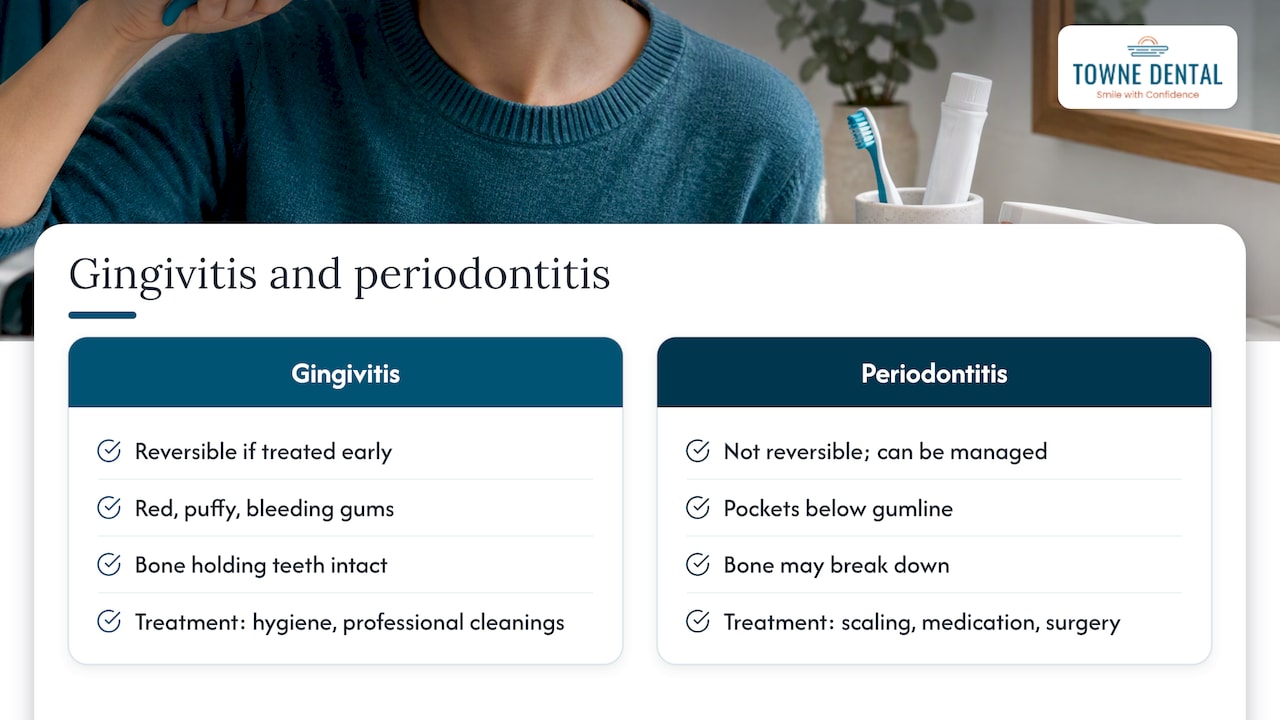
Gingivitis is the early stage. Gums are red, puffy and bleed easily, but the bone holding your teeth is still intact. According to the CDC, gingivitis is reversible with routine oral hygiene and professional cleanings. Mayo Clinic makes the same point with a caveat: it works only if treated early, before bone loss.
Periodontitis is the advanced stage. Infection has spread below the gumline, pockets have formed and bone may be breaking down. The CDC states that periodontitis cannot be reversed, but it can be slowed and managed with professional treatment, which may include scaling and root planing, medication or surgery.
That is why the question “can I reverse my gum disease?” has two honest answers. If it is gingivitis, yes, and bad breath often improves quickly once the inflammation settles. If it is periodontitis, you control it for life, and the breath improves as the bacterial load drops. Either way, the earlier you start, the less you lose.
How to get rid of bad breath caused by gum disease
The fix has two parts: remove what is already there, and stop it from rebuilding.
Step 1: A professional exam and cleaning
You cannot scrape hardened tartar off with a toothbrush. Mayo Clinic says a dentist may recommend professional cleaning to remove bacteria from deep pockets. At the exam, the dentist or hygienist measures pocket depths, checks for bleeding and looks at X-rays for bone changes. That tells you whether you need a routine cleaning or a deeper gum treatment. For a plain-language look at what the deeper option involves, see our guide to gum pockets treatment.
Step 2: Treat the infection, not just the smell
If periodontitis is confirmed, treatment targets the bacteria and the pockets that shelter them. Options range from deep cleaning below the gumline to medication and, in advanced cases, surgery. Your dentist chooses based on pocket depth, bone loss and your overall health. A rinse alone will never do this job.
Step 3: Home care that actually reaches the problem
Daily habits keep the bacteria from rebuilding. The American Dental Association’s MouthHealthy site says brushing twice a day and cleaning between your teeth daily helps remove the bacteria that cause bad breath. Mayo Clinic adds that food particles left in the mouth when you skip brushing and flossing can cause bad breath.
A practical routine:
- Brush for two minutes, morning and night, along the gumline at a slight angle.
- Clean between teeth once a day with floss, interdental brushes or a water flosser.
- Gently clean your tongue, especially the back, with a brush or scraper.
- Brush or rinse after meals when you can.
- If plaque is the culprit, a dentist may recommend an antibacterial rinse or toothpaste. Ask which one suits you rather than choosing by marketing.
What doesn’t work
Mints, gum and strong mouthwashes cover odor for an hour or so. If your breath improves only while the product is in your mouth, the source is still active. Using more of it can also delay a diagnosis, which matters because periodontitis damages bone quietly.
Preventing it from coming back
Once gums are healthy, keeping them that way is mostly routine. MouthHealthy’s prevention list includes brushing twice a day, cleaning between teeth daily, keeping saliva flowing, quitting smoking and visiting your dentist regularly.
On timing, regular cleanings are usually recommended every 6 to 12 months, and people with risk factors such as dry mouth or smoking may need them more often. Ask your dentist what interval fits you. Someone who has been treated for periodontitis often needs a tighter schedule than someone with a healthy mouth.
Some situations raise the risk and are worth flagging at your visit:
- Pregnancy. Hormonal changes can make gums bleed more easily. We cover this in bleeding gums during pregnancy.
- Dry mouth. Certain medications reduce saliva, and saliva is your natural rinse.
- Tobacco use. It raises gum disease risk and adds its own odor.
- Dental implants. Gums around implants need the same attention as natural teeth. Our dental implant maintenance guide explains the daily and yearly routine.
When to see a dentist
Book a visit if your bad breath lasts more than a couple of weeks despite good brushing, or if you notice bleeding, swelling, receding gums, loose teeth or pus. Johns Hopkins Medicine says bad breath is one of the main symptoms of gum disease, which needs care right away from an oral health provider. The Merck Manual adds that when there are no signs elsewhere in the body, visible oral disease such as periodontitis may be presumed to cause the halitosis, and a dentist should be consulted.
See a physician instead, or as well, if your mouth looks healthy but you have heartburn, long-lasting congestion, or other symptoms outside the mouth.
A note on timing: gum disease usually does not hurt until it is well advanced. Waiting for pain means waiting for bone loss.
Our perspective: treat the cause, and make the visit easy
At Towne Dental, we see the same pattern often. Patients arrive embarrassed about their breath, having tried every rinse on the shelf, and surprised that the real issue is inflamed gums they had not noticed. The embarrassment is the biggest obstacle. People delay for months because they expect judgment or discomfort.
Our approach starts with a thorough look at the whole mouth, not just the symptom. We check your gums, your teeth, old restorations and your tongue, because bad breath rarely has a single tidy cause. If gum disease is part of the picture, we build a treatment plan around your stage of disease and your comfort, and we explain each step before we do it. Anxious patients can ask about our sedation options so the visit feels manageable.
Our view is simple: bad breath that persists is information, not a character flaw. Gum disease is common and treatable, and the sooner it is caught, the more of your natural teeth and your confidence you keep. That also matters for later choices. Healthy gums and bone are the foundation for everything from crowns to implants.
— Towne Dental
Gum care at Towne Dental
If you live in Southwest Florida, including Naples, Bonita Springs, Estero, Fort Myers, Cape Coral, Marco Island or Ave Maria, we can examine your gums and tell you where your breath problem is coming from. Our team offers periodontics and gum care alongside general dentistry, including teeth cleaning, and emergency visits if your gums are painful or swollen. You can see everything we do on our services page, or start from our home page to request an appointment. We do not publish prices online, so contact us about costs and what your insurance may cover.
FAQ
Can gum disease cause bad breath even if I brush every day?
Yes. Brushing cleans tooth surfaces, but bacteria in gum pockets and between teeth are out of its reach. Daily cleaning between teeth helps, though established pockets and hardened tartar need professional removal.
What does gum disease breath smell like?
People usually describe a sulfurous, rotten or metallic odor that lingers through the day, often with a bad taste. That fits the research: the gases behind mouth odor, hydrogen sulfide and methyl mercaptan, are sulfur compounds. You cannot always smell your own breath, so a bad taste or a candid friend is a better clue.
Will my breath improve after gum treatment?
For most people it does, because treatment removes the bacteria producing the gases. Gingivitis can be reversed with cleanings and good home care. With periodontitis, the disease is managed rather than cured, so keeping up your home routine and follow-up visits is what keeps the breath fresh.
Is bad breath always a sign of gum disease?
No. A coated tongue, dry mouth, decay, smoking, sinus problems and reflux can all cause it. A dental exam is the quickest way to sort out which one applies, and your dentist can point you to a physician if the cause is outside the mouth.
Does mouthwash fix gum disease breath?
It masks it for a short time. An antibacterial rinse can help when your dentist recommends one for plaque, but it supports treatment rather than replacing it.
Sources
- Bad breath: Symptoms and causes, Mayo Clinic
- Bad breath: Diagnosis and treatment, Mayo Clinic
- Periodontitis: Symptoms and causes, Mayo Clinic
- Halitosis, Merck Manual Professional Edition
- About Periodontal (Gum) Disease, CDC
- Periodontal diseases as a source of halitosis: a review
- The relationship between oral malodor, gingivitis, and periodontitis
- Oral malodour (halitosis), PMC
- Gingivitis and periodontitis: diagnosis, NICE CKS (UK)
- Bad Breath, MouthHealthy
- Halitosis (Bad Breath), Johns Hopkins Medicine