Most dental bridge cold sensitivity comes from exposed dentin, temporary pulp inflammation, or a small gap where the bridge meets the tooth. The single most useful thing you can do right now: switch to a desensitizing toothpaste and stop drinking ice-cold beverages until you know what you’re dealing with.
Quick facts:
- Cold sensitivity after a new bridge is common and usually resolves over a few weeks if the abutment teeth were not root-canaled before placement
- Sensitivity that is sharp, brief, and triggered only by cold is usually reversible
- Call a dentist promptly if you have throbbing pain, swelling, night pain, or a loose bridge
Table of Contents
- Why is my dental bridge sensitive to cold?
- How long does sensitivity after a dental bridge usually last?
- What you can do at home right now
- When should you see a dentist about bridge pain?
- What your dentist will do at the exam
- How to protect your bridge long term
- Towne Dental Naples: a local option for bridge-related problems
- What dentists actually watch for in post-bridge sensitivity
- Key Takeaways
- Towne Dental Naples is ready when you need an exam
- FAQ
Why is my dental bridge sensitive to cold?
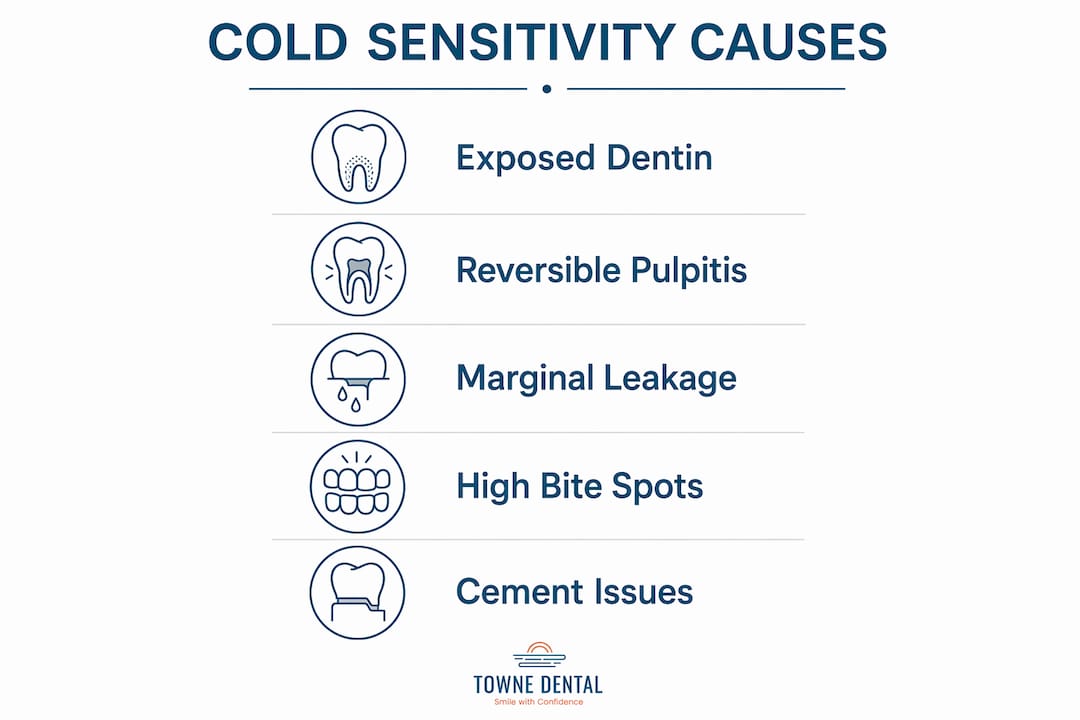
Exposed dentin, marginal leakage, and pulp irritation are the three primary reasons cold stimuli reach the nerve beneath a restoration. Here is how each cause works:
- Exposed dentin after tooth preparation. Shaping the abutment teeth removes enamel and opens microscopic tubules that connect the outer tooth surface to the pulp. Cold liquid flows into those tubules and triggers a sharp response.
- Reversible pulpitis. Drilling and crown placement temporarily inflame the pulp. The nerve becomes hypersensitive while it heals, reacting to temperatures it would normally ignore.
- Marginal leakage or poor fit. A gap between the crown margin and the tooth lets cold fluids seep underneath. Even a hairline gap is enough to cause cement breakdown and micro-movement that exposes dentin.
- Decay under the bridge. Old or dissolving cement allows bacteria in. Decay softens dentin and amplifies thermal sensitivity dramatically.
- Gum recession around abutment teeth. Receded gum margins expose cementum and dentin, which have no enamel layer to buffer temperature changes.
- Occlusal high spots or bruxism. A bridge that sits even fractionally too high contacts first during biting, bruising the periodontal ligament and producing pain patients often describe as temperature sensitivity.
- Metallic conduction. Metal-based bridges conduct thermal changes faster than ceramic, so cold reaches the underlying tooth more quickly.
Pro Tip: Do a quick self-check. If the pain is sharp and disappears within a few seconds of removing the cold stimulus, that points to reversible sensitivity. If it lingers for 30 seconds or more, or if it starts spontaneously without any trigger, that is a red flag for irreversible pulpitis — call your dentist.
How long does sensitivity after a dental bridge usually last?
- First 48 hours: The most intense window. Cement is still setting, and the pulp is reacting to the preparation. Avoid temperature extremes entirely during this period.
- Days 3–14: Sensitivity should gradually decrease. Mild cold reactions are still normal, especially if the abutment teeth were not root-canaled.
- Weeks 2–4: Mild temperature sensitivity in the first one to two weeks after fitting is considered a normal healing response. By week four, it should be fading noticeably.
- Beyond 4 weeks or worsening at any point: Not normal. This warrants a dental exam to rule out decay, pulpitis, or a margin problem.
The first 48 hours matter most. Clinicians consistently advise avoiding extreme hot and cold during this window — not because the bridge itself is fragile, but because the pulp is at its most reactive right after preparation and the cement needs time to fully cure. Protecting this window reduces the risk of prolonged inflammation.
One important variable: if your abutment teeth already had root canals before the bridge was placed, you should feel little to no temperature sensitivity at all. Persistent sensitivity in a root-canaled tooth points to a structural issue, not pulp inflammation.
What you can do at home right now
- Switch to a desensitizing toothpaste and use it consistently, not just when it hurts
- Avoid very cold or very hot foods and drinks; lukewarm water and room-temperature meals are your best friends for the next week or two
- Rinse gently with warm saltwater to reduce gum irritation around the margins
- Use a floss threader or interdental brush to clean under the bridge without snapping floss against the gum line
- Take an OTC pain reliever (ibuprofen or acetaminophen) as directed if discomfort is affecting sleep or eating
- Drink enough water throughout the day — saliva buffers and insulates tooth surfaces, so dry mouth from dehydration or indoor heating makes sensitivity noticeably worse
| Do | Avoid |
|---|---|
| Desensitizing toothpaste (twice daily) | Ice water, iced coffee, frozen treats |
| Lukewarm rinses and drinks | Very hot soups, coffee, or tea |
| Gentle flossing with a threader | Aggressive flossing that snaps at the gum line |
| Soft foods for the first week | Hard, crunchy, or sticky foods |
| Stay hydrated | Mouth breathing or dry-mouth triggers |
| OTC analgesics as directed | Acidic drinks that erode margins |
Pro Tip: Look for potassium nitrate or stannous fluoride on the ingredient label. Potassium nitrate calms nerve transmission; stannous fluoride physically occludes the open tubules. Both mechanisms are clinically recognized first-line treatments for reversible sensitivity — either ingredient works, and some products combine both.
When should you see a dentist about bridge pain?
Home care is appropriate for mild, brief cold sensitivity in the first few weeks. These symptoms mean you need a professional exam sooner:
- Pain that persists more than a few seconds after the cold stimulus is removed
- Spontaneous throbbing or aching with no trigger
- Pain that wakes you at night
- Swelling in the gum or jaw near the bridge
- Fever or any sign of infection
- A bridge that feels loose, rocks, or has a visible gap at the margin
- Food consistently trapping under the bridge in a new spot
- Sensitivity that is getting worse, not better, after two weeks
If you notice swelling, fever, or pus, treat it as a dental emergency and contact a clinic that offers same-day emergency care immediately. Severe, lingering, or spontaneous pain that does not respond to OTC analgesics is the classic indicator that the pulp may be irreversibly damaged — a condition that typically requires endodontic evaluation.
What your dentist will do at the exam
Diagnostic steps, in order:
- Clinical exam of the bridge margins, gum tissue, and surrounding teeth
- Bite check to identify any high occlusal contacts
- Percussion and thermal tests to locate the source of sensitivity
- X-rays to check for decay under the bridge, bone loss, or root issues
- Cement and margin inspection for gaps or dissolution
- Pulp testing when irreversible pulpitis is suspected
| Treatment | When it’s used | What to expect |
|---|---|---|
| Bite adjustment | High occlusal spot causing ligament bruising | Single visit; relief often immediate |
| Re-cementing | Loose bridge or dissolved cement | Same-day procedure; sensitivity resolves as seal restores |
| Margin sealing | Small gap without full bridge failure | Minimally invasive; reduces leakage |
| Decay removal and repair | Caries under the bridge | May require a new crown or bridge |
| Root canal therapy | Irreversible pulpitis or abscess | One to two visits; bridge usually preserved |
| Bridge replacement | Structural failure or repeated leakage | Full restoration; longest recovery |
Sedation options are worth asking about if dental anxiety has been keeping you from scheduling the exam you know you need.
How to protect your bridge long term
Daily care routine:
- Thread floss under the pontic every day using a floss threader or floss tape
- Follow with an interdental brush to clear debris from the margins
- Brush twice daily with a fluoride or desensitizing toothpaste
- Rinse with a fluoride mouthwash if your dentist recommends it
- Stay hydrated and manage dry mouth, especially if you take medications that reduce saliva
- Keep every scheduled cleaning and checkup — gum disease care around abutment teeth directly affects bridge longevity
Preventive checklist:
- Ask your dentist about a nightguard if you grind your teeth; bruxism is one of the fastest ways to crack cement and stress abutment teeth
- Monitor gum recession around the bridge and report any changes early
- Have margins checked at every cleaning visit; catching a small gap early avoids a full replacement later
- If the bridge feels loose at any point, call immediately — a loose bridge left in place invites decay
A well-fitted bridge with intact cement is the single biggest factor in long-term comfort. Material choice matters less than the quality of the seal and the health of the abutment teeth underneath.
Towne Dental Naples: a local option for bridge-related problems
If you are in the Marco Island or Naples area and need an exam, Towne Dental Naples covers the full range of services relevant to dental bridge cold sensitivity.
| Feature | Details | Google Reviews |
|---|---|---|
| Towne Dental Naples | Emergency dentistry, endodontics/root canal, bridge and crown repair, re-cementing, sedation dentistry | 4.9★ (over 900 reviews) |
Address: 3751 Tamiami Trl E, Naples, FL 34112
When Towne Dental is a strong fit:
- You need a same-day or urgent exam for worsening or spontaneous pain
- Your dentist suspects irreversible pulpitis and you need an endodontic evaluation on-site
- Dental anxiety has been delaying care and you want sedation options available
- You need bridge re-cementing or margin repair without a referral chain
How to prepare for your call or visit:
- Note exactly when the sensitivity started and whether it is getting better or worse
- Describe the pain character: sharp and brief vs. lingering vs. spontaneous
- Take a photo of the bridge margin if you can see a visible gap or discoloration
- Bring any previous X-rays if you have them
What dentists actually watch for in post-bridge sensitivity
Quick answers to the questions patients ask most:
- Is cold sensitivity normal after a bridge? Yes, if it is mild, brief, and in the first two to four weeks on teeth that were not root-canaled. It reflects the pulp adjusting to preparation.
- How long should it last? Most cases settle within two to four weeks. Sensitivity beyond that point needs a clinical look.
- Can it be reversed? Often yes. Desensitizing agents and professional adjustments resolve most cases of reversible sensitivity without further intervention.
- Does it mean I need a root canal? Not automatically. A root canal is indicated for irreversible pulpitis — persistent, spontaneous, or severe pain that does not calm down. Brief cold sensitivity alone is not a root canal indicator.
The underlying mechanism is called the hydrodynamic theory: fluid movement in exposed dentinal tubules transmits thermal changes directly to the pulp’s nerve fibers, producing that sharp, immediate cold response. Sealing those tubules, either with desensitizing products or proper crown margins, stops the signal at its source.
Pro Tip: Clinicians often find that a bite adjustment resolves what a patient has been calling “cold sensitivity” for weeks. If your pain is worse when you bite down than when you drink something cold, mention that specifically — it changes the diagnostic direction entirely.
Key Takeaways
Cold sensitivity after a dental bridge is usually reversible, but the first two to four weeks and the character of your pain are the clearest guides to whether home care or a dental exam is the right next step.
| Point | Details |
|---|---|
| Most common causes | Exposed dentin, reversible pulpitis, and marginal leakage account for the majority of post-bridge cold sensitivity. |
| Normal timeline | Mild sensitivity typically resolves within a few weeks; worsening or persistent pain beyond that needs a clinical exam. |
| First-line home care | Desensitizing toothpaste with potassium nitrate or stannous fluoride, lukewarm foods, and staying hydrated reduce symptoms while the pulp heals. |
| Red flags requiring prompt care | Spontaneous pain, night pain, swelling, fever, or a loose bridge mean call a dentist the same day. |
| Local exam option | Towne Dental Naples offers emergency dentistry, endodontics, and sedation at 3751 Tamiami Trl E, Naples, FL 34112. |
A note from Krunal
Cold sensitivity after a bridge genuinely worries patients, and that concern is understandable. What most people do not realize is that the majority of cases are straightforward: the pulp is irritated, the margins need a small adjustment, or the bite is slightly off. None of those require anything dramatic. What does matter is acting on the red flags quickly. A loose bridge or spontaneous night pain left untreated for weeks is what turns a simple re-cement into a root canal, or a root canal into a replacement. The guidance here reflects what any careful clinician would tell you in the chair: manage the mild stuff at home, watch the timeline, and do not talk yourself out of calling when the symptoms are telling you something is wrong.
Towne Dental Naples is ready when you need an exam
If cold sensitivity has lasted more than two weeks, or if any of the red flags above sound familiar, a same-day evaluation is the fastest way to know what you are actually dealing with. Towne Dental Naples offers emergency dental care, on-site endodontics, bridge repair and re-cementing, and sedation dentistry for patients who need a gentler experience. The clinic serves Marco Island and the surrounding Naples area.

For bridge repair, crown work, or a full restorative consultation, visit the cosmetic and restorative services page to see what’s available. When you call, tell the front desk how long the sensitivity has lasted, whether the pain is spontaneous or triggered, and if the bridge feels loose at all. That information gets you to the right appointment type on the first call.
Useful sources
- PubMed — dentin hypersensitivity and hydrodynamic mechanism literature — foundational research on why cold triggers pain through exposed tubules
- Cleveland Clinic — tooth sensitivity and treatment guidance — clinical overview of reversible vs. irreversible pulpitis and desensitizing treatments
- American Dental Association — oral health guidance — hydration and dry-mouth recommendations relevant to sensitivity management
- Oral Health Australia — crowns, bridges, and tooth sensitivity — patient-facing explanation of gum recession and root exposure under restorations
- Towne Dental Naples — clinic services — verified local clinic offering emergency dentistry, endodontics, and sedation in Naples, FL
- Alternatives to dental implants: your 2026 options guide — broader context on restorative choices for patients evaluating long-term options
FAQ
Is it normal for a bridge to be sensitive to cold?
Yes, mild cold sensitivity is a normal response in the first two to four weeks after bridge placement, particularly when the abutment teeth were not root-canaled. It reflects the pulp adjusting to preparation and the new restoration.
How long should a dental bridge be sensitive?
Most sensitivity resolves within two to four weeks. If it persists beyond that, or worsens at any point, schedule a dental exam to rule out marginal leakage, decay, or pulpitis.
Can sensitivity to cold be reversed?
Often yes. Desensitizing toothpaste and professional adjustments resolve most cases of reversible sensitivity. Irreversible pulpitis, marked by spontaneous or severe lingering pain, may require root canal therapy.
Does cold sensitivity mean I need a root canal?
Not automatically. Brief, triggered cold sensitivity is usually reversible. A root canal becomes necessary only when the pulp is irreversibly damaged, which presents as persistent, spontaneous, or severe pain that does not subside.
What if my bridge feels loose and cold-sensitive at the same time?
A loose bridge combined with cold sensitivity suggests cement dissolution or marginal leakage. Contact a dentist promptly for re-cementing or margin evaluation — leaving a loose bridge in place accelerates decay under the margins.