Mild tooth sensitivity after a filling is common and usually resolves within days to a few weeks as your tooth settles. Seek care if the pain worsens, throbs, wakes you up, or lingers beyond a few weeks. In the meantime, desensitizing toothpaste, gentle brushing, and avoiding hot, cold, or sweet triggers will usually keep you comfortable while your tooth heals.
TL;DR:
- Most sensitivity after a filling lasts for up to two weeks and typically improves steadily without intervention, especially with gentle care.
- Persistent, worsening, or severe pain, especially if accompanied by swelling or fever, requires prompt dental evaluation to rule out complications like pulpitis or infection.
- Combining desensitizing toothpaste, soft brushing, and avoiding hot, cold, or sugary foods can usually manage normal post-filling discomfort effectively.
- High or poorly sealed fillings that cause biting pain often improve with a quick bite adjustment conducted by the dentist.
- If sensitivity persists beyond four weeks or worsens, a dental visit should focus on bite correction, nerve testing, and X-ray assessment to diagnose underlying issues.
Table of Contents
- What normal post-filling sensitivity feels like
- Common causes of sensitivity after a filling
- How long sensitivity typically lasts
- Warning signs that need prompt dental evaluation
- Safe at-home care to ease normal sensitivity
- What your dentist will check and treatment options if sensitivity continues
- Prevention: how dentists reduce sensitivity during fillings
- How we think about persistent post-filling sensitivity
- Getting your sensitivity checked at Towne Dental
- FAQ
- Sources
What normal post-filling sensitivity feels like
Expect brief twinges, not constant pain. A tooth that reacts to cold drinks, hot coffee, sweets, or a gust of cold air right after a filling is behaving the way restored teeth often do while the nerve settles down from the drilling and the new material.
Normal sensitivity tends to follow a pattern:
- It’s mild and comes and goes rather than sitting there constantly.
- It fades a little more each day rather than staying flat or climbing.
- Biting pressure might cause a brief twinge but not sharp, lasting pain.
Teeth that were sensitive before the filling, often because of decay sitting close to the nerve, sometimes feel better once the decay is removed and sealed. Others experience a short-term bump in sensitivity as the tooth adjusts, which is also typical.
Common causes of sensitivity after a filling
Several things happen at once during a filling, and each can contribute to the discomfort you feel afterward.
- Nerve irritation: Drilling close to the nerve, especially for deep cavities, inflames the pulp temporarily.
- Fluid movement in the tooth: Microscopic channels called dentinal tubules shift fluid when exposed to temperature changes, triggering a sharp, brief signal to the nerve.
- Material behavior: Composite resin shrinks slightly as it hardens, which can leave tiny gaps that let fluid move more than usual, and some materials simply conduct temperature differently than natural tooth structure.
- Moisture during bonding: Composite fillings are technique-sensitive. Even a brief lapse in keeping the area dry during bonding can increase postoperative sensitivity.
- A high filling: If the filling sits slightly taller than your bite, every time you close your mouth that tooth absorbs extra force, which causes pain specifically on biting.
Sensitivity after composite fillings is well documented. Research from the PEARL Network found postoperative hypersensitivity is a common, often temporary experience after resin-based composite restorations, with many patients improving within a few weeks of follow-up even though some report appreciable sensitivity along the way.
How long sensitivity typically lasts
Most people see a steady, predictable improvement rather than an abrupt end to discomfort.
- Days 1 to 3: Sensitivity is often at its most noticeable, especially to cold and biting pressure.
- Week 1 to 2: Most mild cases show clear improvement, with fewer and shorter episodes of discomfort.
- Week 3 to 4: Many cases resolve entirely by this point, according to findings on postoperative hypersensitivity in composite restorations, though a minority of patients experience sensitivity that lingers longer.
- Beyond 4 weeks: Sensitivity that persists this long, without steady week-over-week improvement, is worth having checked.
Deep fillings, teeth that were sensitive before treatment, and certain material choices can all stretch out the healing window. The key sign to watch for isn’t the exact day count but the direction: it should be getting better, not staying the same or getting worse.
Warning signs that need prompt dental evaluation
Not every ache after a filling is routine healing. Some symptoms point to a problem that won’t resolve without treatment.
- Pain that worsens, throbs, or includes swelling rather than fading over days.
- Pain severe enough to wake you at night or that disrupts normal eating and sleeping.
- Pain that only happens on biting and doesn’t settle, which usually points to a filling sitting too high.
- An exaggerated, lingering reaction to cold, where the discomfort continues well after the cold is gone. The American Association of Endodontists identifies this pattern as a classic marker of symptomatic irreversible pulpitis, a condition that needs endodontic assessment rather than home care.
- Fever, facial swelling, or any sign the discomfort is spreading beyond the tooth itself.
Pro Tip: If pain only shows up when you bite down, don’t wait it out. A quick bite adjustment often resolves it in minutes.
Safe at-home care to ease normal sensitivity
While you wait out the normal healing window, a few habits make a real difference in day-to-day comfort.
- Switch to a desensitizing toothpaste containing potassium nitrate or stannous fluoride, used twice daily.
- Use a soft-bristled brush and skip abrasive whitening pastes until the sensitivity settles.
- Be gentle flossing around the treated tooth rather than snapping floss against the gumline.
- Choose lukewarm foods and drinks over very hot, cold, or sugary ones, and chew on the other side if biting hurts.
- Take an NSAID like ibuprofen or acetaminophen for discomfort, following package directions. ADA guidance recommends against placing aspirin directly on the gums, since it can burn soft tissue rather than relieve pain.
If sensitivity hasn’t improved at all within a week or two, or if any warning sign shows up sooner, it’s time to call rather than wait. The ADA’s MouthHealthy guidance backs this same approach: home measures for mild, improving sensitivity, and a dental visit for anything that worsens or sticks around.
What your dentist will check and treatment options if sensitivity continues
A visit for persistent sensitivity usually starts with a straightforward exam rather than anything invasive.
- Bite check: Your dentist looks for high spots on the filling using articulating paper and adjusts the surface so your bite closes evenly.
- Cold and percussion testing: Tapping the tooth and applying a cold stimulus helps determine whether the nerve is simply irritated or showing signs of real trouble.
- X-rays: These rule out decay left under the filling, a cracked tooth, or a restoration that’s too close to the nerve.
- Desensitizing agents or a new liner: For irritated nerves without deeper damage, your dentist may apply a desensitizing agent or place a protective liner under the restoration.
- Repair or replacement: A filling with a persistent gap, poor seal, or contamination issue may need to be redone rather than patched.
- Root canal evaluation: When testing shows the nerve has moved past simple irritation into irreversible pulpitis, root canal therapy becomes the appropriate next step rather than a last resort.
Dentists generally start conservative and escalate only when the evidence points that way, which is also why diagnosis before treatment matters.
Prevention: how dentists reduce sensitivity during fillings
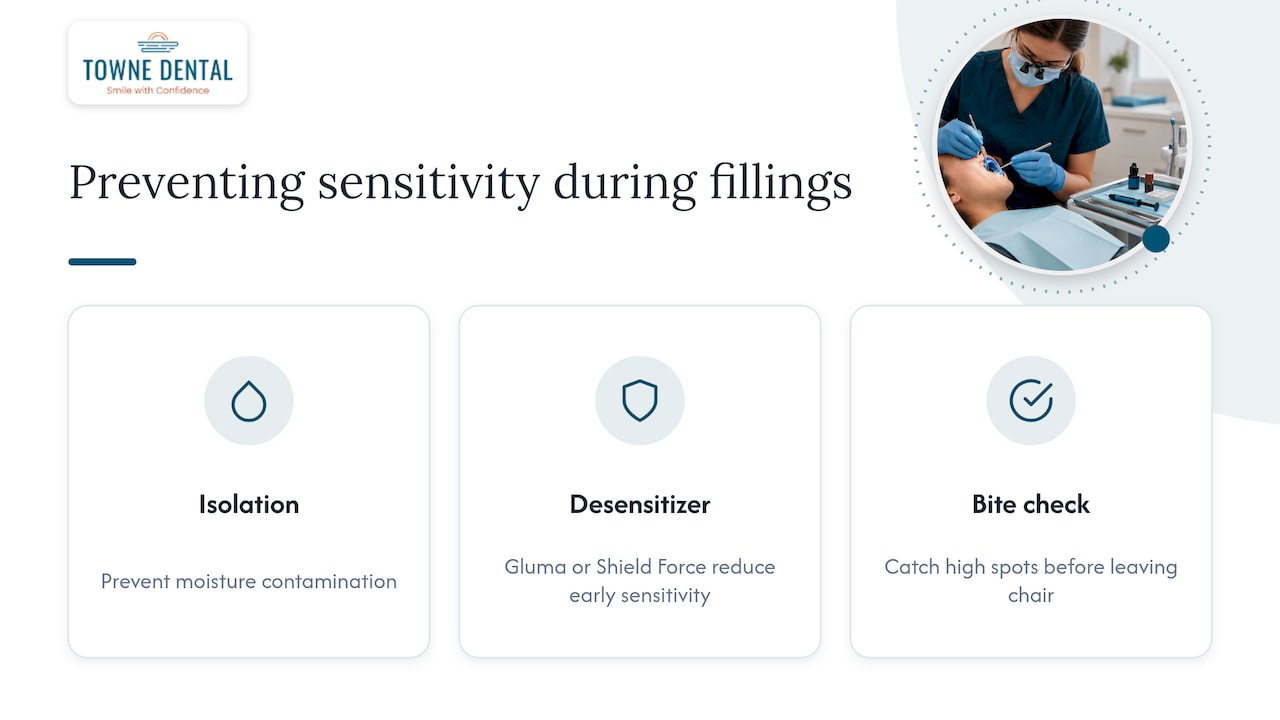
Keeping the area completely dry during bonding matters more than it seems. Moisture contamination during a composite filling is one of the most common contributors to postoperative sensitivity, so proper isolation during the procedure counts. Many dentists also apply a desensitizing agent at the time of the filling. Clinical trials show that agents like Gluma and Shield Force can meaningfully reduce early postoperative sensitivity, with the benefit most noticeable in the first day or two. A careful bite check before you leave the chair catches high spots before they become days of discomfort.
How we think about persistent post-filling sensitivity
Lingering sensitivity is treated as information, not an inconvenience to brush off. A tooth that isn’t settling down the way it should is telling us something, whether that’s a bite that needs a small adjustment or a nerve that needs more attention than a toothpaste switch can offer. The approach favors the simplest fix that actually solves the problem, backed by a team that works through everything from routine fillings to advanced implant techniques. If your sensitivity is getting worse instead of better, don’t wait out the uncertainty. Contact a dental professional to figure out what’s actually going on.
— Towne Dental
Getting your sensitivity checked at Towne Dental
Most post-filling discomfort sorts itself out with a little patience and the right toothpaste. When it doesn’t, a short appointment usually settles things faster than another week of guessing.

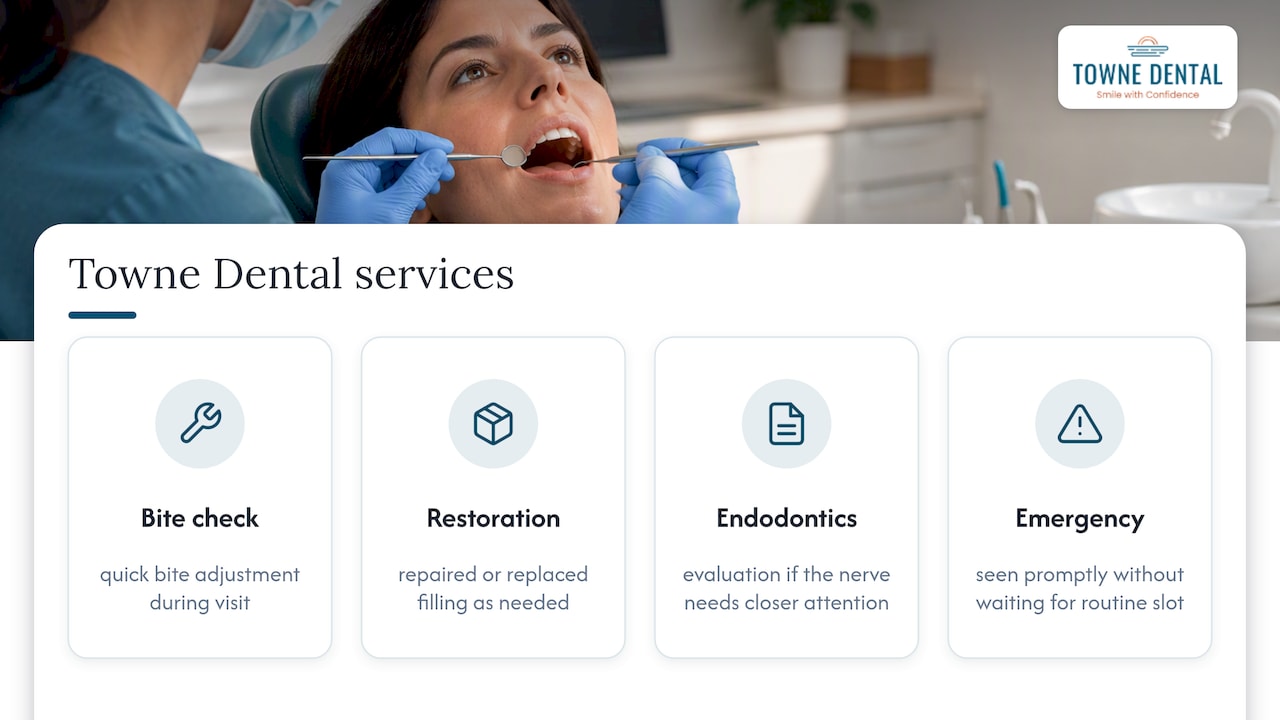
Towne Dental handles the full range of situations that come with lingering filling discomfort: a quick bite adjustment, a repaired or replaced restoration, or an endodontic evaluation if the nerve needs closer attention. If the pain has turned sharp, swollen, or disruptive, our emergency dentistry team can see you without the usual wait for a routine slot. A typical visit for ongoing sensitivity includes a bite check, a cold test, and an X-ray if needed, so you leave with an actual answer instead of another round of wait and see. You can review our full range of services or book directly through Townedentalfl.
This article is general information, not a substitute for advice from a qualified doctor. Consult a qualified healthcare professional about your own circumstances before acting on anything here.
FAQ
How long should sensitivity last after fillings?
Most mild sensitivity improves within days to two weeks, and many cases resolve by around four weeks. If you’re not seeing steady improvement by then, or symptoms are getting worse instead of better, it’s worth having the tooth checked.
Why does my tooth filling hurt after 2 years?
Pain from a filling placed years ago usually points to a new problem rather than leftover postoperative sensitivity, such as a cracked filling, decay forming underneath it, or a nerve that’s finally reacting to old trauma. An exam and X-ray can tell whether the fix is a repair, a replacement, or root canal evaluation.
How to help nerve pain after filling?
Desensitizing toothpaste, a soft-bristled brush, and avoiding very hot or cold food can ease mild nerve irritation while it settles. An NSAID like ibuprofen can help with discomfort, but pain that’s sharp, throbbing, or lingers after cold exposure needs a dental evaluation rather than home care alone, since that pattern can signal irreversible pulpitis.
What does a broken filling feel like?
A broken or loose filling often feels like a sudden rough edge or gap where the tooth used to feel smooth, sometimes with sharp sensitivity when you bite or a piece that feels like it’s moving. Food frequently gets stuck in the area, and the sensitivity tends to be sudden rather than the gradual fade typical of normal healing.
Sources
- Postoperative Hypersensitivity and Its Relationship to Preparation Variables in Class I Resin-Based Composite Restorations: Findings from the PEARL Network
- AAE diagnostic guidance on pulpal diagnosis