If your temporary crown fell out, here is the short version: find the crown, rinse it gently, and call your dentist today. Most dental offices can fit you in shortly, and acting quickly matters because gum tissue can begin shifting after a short period in a way that prevents your permanent crown from seating correctly. Until you get there, a pharmacy temporary crown cement (Dentemp or a similar kit) gives you a safe short-term hold. Denture adhesives like Fixodent or Poligrip work in a pinch. Toothpaste or sugar-free gum are last resorts only.
Quick action checklist:
- Retrieve the crown carefully and rinse it under lukewarm water.
- Inspect it for cracks. If it is broken, skip re-seating and just protect the tooth.
- Try a dry fit first, no cement, to confirm orientation.
- Apply a small amount of pharmacy temporary cement if the crown is intact and the fit is clean.
- Avoid chewing on that side and stick to soft foods.
- Call your dentist and request an appointment within 24–48 hours. Beyond this window, gum tissue can shift into the space and prevent your permanent crown from fitting correctly.
Emergency signs — go now: Severe uncontrolled pain, facial swelling, heavy bleeding, difficulty breathing or swallowing, or a fractured tooth with jagged edges means you should call 911 or go to the nearest emergency room immediately. Do not wait for a routine appointment.
A lost temporary crown is common and almost always manageable. The steps above cover the vast majority of cases. The sections below explain each one in more detail.
Table of Contents
- Why did your temporary crown come off?
- What to do the moment your temporary crown falls out
- Safe temporary reattachment options and what to avoid
- How to protect the exposed tooth until your dental visit
- When a lost temporary crown is a dental emergency
- How long can you safely wait, and what happens if you wait too long?
- How to reduce the chance of it happening again
- What your dentist will likely do when you come in
- Key Takeaways
- A note on what this situation actually means
- Towne Dental is ready when you need care
- Useful sources
- FAQ
Why did your temporary crown come off?
Temporary crowns are cemented with a weaker, water-soluble cement by design. Your dentist needs to remove the temporary at your next appointment without damaging the prepared tooth underneath, so the hold is intentionally modest. That means it does not take much to dislodge one.
The most common triggers are sticky or hard foods — caramel, gummy candies, hard pretzels, ice — that grip or crack the temporary material. Flossing incorrectly (pulling straight up instead of sliding the floss out to the side) can lift the crown off the tooth. Bruxism, or nighttime grinding, puts repeated lateral force on the temporary that the weak cement was never designed to handle.

Less commonly, the prepared tooth had insufficient structure for the temporary to grip, or the cement margin broke down from normal saliva exposure over time. If your permanent crown appointment is still several weeks away, simple aging of the cement is a real possibility. None of these scenarios signal a catastrophe. They do mean you need to act promptly.
What to do the moment your temporary crown falls out
Follow these steps in order. Do not skip the dry-run step.
- Retrieve the crown. If it fell on the floor or into food, pick it up carefully. If you think you may have swallowed it, do not panic — swallowed dental pieces almost always pass without issue, but mention it to your dentist.
- Rinse gently. Hold the crown under lukewarm (not hot) water to remove debris. Rinse your mouth gently too. Avoid vigorous swishing, which can irritate the exposed tooth.
- Inspect the crown. Look for cracks, chips, or missing pieces. A broken temporary cannot be safely re-seated. If it is damaged, skip to step 6.
- Dry-run the fit. Place the crown on the tooth without any cement to confirm it seats fully and in the correct orientation. If it does not drop into place easily, do not force it. A crown that does not fit cleanly needs professional attention before anything else.
- Apply temporary cement if the fit is good. Place a pea-sized amount of pharmacy temporary crown cement (Dentemp, Recapit, or a comparable kit) inside the crown. Seat it firmly, bite down on a folded piece of gauze for the time the product instructions specify, then remove any excess cement from around the gumline with a toothpick or clean fingertip. Check that your bite feels normal. These steps are safe when the crown is intact and you have no signs of infection or severe pain.
- If you cannot re-seat it, cover the exposed tooth with orthodontic wax or a small piece of sugar-free gum to reduce sensitivity, and avoid chewing on that side entirely.
- Call your dentist. Tell them whether the crown is intact, whether you have pain, and ask for the earliest available appointment. Most offices reserve time for situations exactly like this.
Pro Tip: Always do the dry run before applying any cement. A crown seated in the wrong orientation with cement in place is much harder for your dentist to remove and can damage the prepared tooth.
Safe temporary reattachment options and what to avoid
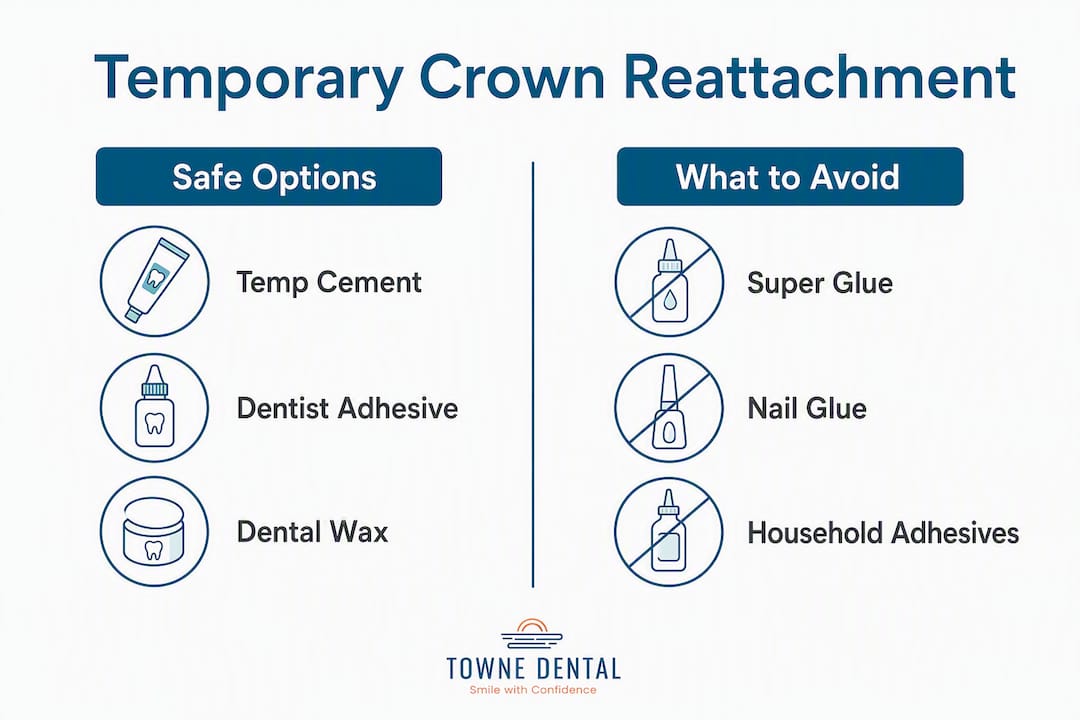
Three categories of over-the-counter products can help in the short term. None of them replace professional recementation.
| Option | Examples | Expected hold | Best for | Limitations |
|---|---|---|---|---|
| Temporary crown cement | Dentemp, Recapit | Short-term | Intact crown, clean fit, no pain | Fails with moisture; not a permanent fix |
| Denture adhesive paste | Fixodent, Poligrip | Short period | When no cement kit is available | Weaker hold; can wash out during eating |
| Toothpaste or sugar-free gum | Any brand | Very brief | Absolute last resort only | Very short hold; gum can stick to tissue |
Pharmacy cements are stop-gap measures. They provide short-term protection but do not match the strength or seal of what your dentist uses. Even if the crown feels secure after home reattachment, you still need a professional appointment within 24–48 hours to minimize the risk of gum tissue shifting and future problems with your permanent crown.
What to avoid absolutely: Never use super glue, nail glue, or any household cyanoacrylate adhesive. These bond to oral tissue, introduce chemicals that are not safe for intraoral use, and create residues that make your dentist’s job significantly harder and potentially more expensive. The same goes for epoxy or craft glue.
Pro Tip: Dry the inside of the crown with a clean tissue before applying temporary cement. Moisture is the main reason pharmacy cements fail within the first hour.
How to protect the exposed tooth until your dental visit
Even with a temporary reattachment in place, the tooth underneath is more vulnerable than usual. A few practical measures reduce the chance of additional damage.
- Chew on the opposite side. Every bite on the affected side risks dislodging the temporary or stressing the prepared tooth.
- Eat soft foods. Yogurt, scrambled eggs, mashed potatoes, and similar foods put minimal force on the area. Avoid anything sticky, crunchy, or hard until the dentist has seen you.
- Shield a sensitive tooth. If the crown is off entirely and the tooth is sensitive to air or temperature, a small piece of orthodontic wax pressed gently over the surface reduces discomfort until your appointment.
- Manage pain carefully. Over-the-counter analgesics like ibuprofen or acetaminophen, taken at the labeled dose, handle mild to moderate sensitivity. Clove oil applied with a cotton swab can temporarily numb the area, but use it sparingly.
- Keep the area clean. Brush softly around the tooth with a soft-bristled brush. Do not poke the exposed margin with a toothpick or any sharp instrument.
Pro Tip: Desensitizing toothpaste (Sensodyne or similar) applied directly to the exposed tooth surface and left for a few minutes before rinsing can reduce temperature sensitivity noticeably.
When a lost temporary crown is a dental emergency
Most cases are not emergencies. A temporary crown that came off with no pain, no swelling, and an intact tooth underneath is a prompt-care situation, not a 911 situation. That said, certain signs change the picture entirely.
Go to an emergency room or call 911 immediately if you experience: severe pain that over-the-counter medication cannot control, visible facial swelling or swelling spreading toward the jaw or neck, heavy bleeding that does not stop with gentle pressure, difficulty breathing or swallowing, or a fractured tooth leaving sharp jagged edges that cut your tongue or cheek.
These signs can indicate a spreading infection, a dental abscess, or structural damage that goes beyond the crown itself. Per ADA guidance on dental emergencies, if your dental office is closed when an emergency occurs, go to your local emergency room. Most dental offices also keep time in their daily schedule for urgent patients, so call first thing in the morning if the situation is serious but not life-threatening.
How long can you safely wait, and what happens if you wait too long?
| Time since crown fell off | Likely situation | Risk level |
|---|---|---|
| 24–48 hours | Tooth exposed, minor sensitivity possible; gum tissue may begin shifting | Low to moderate; book appointment now |
| 48 hours to 1 week | Tissue shift more likely; permanent crown fit at risk | High; call immediately |
| More than 1 week | Significant tissue change; possible decay or sensitivity | Very high; may need new temporary or crown remake |
The 48-hour window is the critical threshold. Gum tissue can migrate into the space the crown occupied, which means the permanent crown your lab is fabricating may no longer fit correctly when it arrives. That can mean additional impressions, delays, and added cost.
If you reattached the crown with pharmacy cement, remember these products are intended to last 24–48 hours at most. The tooth still needs professional recementation within that timeframe.
How to reduce the chance of it happening again
A few straightforward habits lower the risk of losing a temporary crown a second time.
- Avoid sticky and hard foods for the entire duration you are wearing the temporary. This includes caramel, gum, hard candy, ice, and raw carrots.
- Floss carefully. Slide the floss out to the side rather than pulling it straight up, which can catch the crown and lift it.
- Wear a nightguard if you grind. Bruxism is one of the most common reasons temporaries fail. If your dentist has mentioned grinding, ask about a nightguard before your permanent crown is placed.
- Tell your dentist if you lose temporaries repeatedly. Some patients need a stronger temporary cement or a different temporary material. That is a straightforward conversation to have before the next crown is placed.
- Attend your permanent crown appointment on schedule. The longer a temporary stays in place, the more likely the cement is to break down.
What your dentist will likely do when you come in
The appointment is usually straightforward. Your dentist will examine the tooth and the crown, take an X-ray if there is any concern about decay or fracture beneath the surface, and remove any home-applied cement from both surfaces. If the temporary is intact and the tooth shows no new problems, recementation takes under 30 minutes in most cases.
If the tooth has developed decay at the margin, or if the temporary cracked, the dentist may need to take a new impression or scan and fabricate a replacement temporary while the permanent crown is still being made. That adds a visit and some cost, but it is not unusual.
On the cost side, recementing an intact temporary is typically one of the lower-cost dental procedures. Complications, like decay removal or a new temporary, raise the scope. Call your office before the appointment to ask whether the visit falls under your existing treatment plan or whether it will be billed separately. Most dental insurance plans cover recementation as part of the crown procedure, but coverage varies.
Key Takeaways
A temporary crown that fell out needs professional recementation within 24–48 hours to prevent gum tissue from shifting and compromising the fit of your permanent crown.
| Point | Details |
|---|---|
| Act within 24–48 hours | Gum tissue can shift after 48 hours, preventing the permanent crown from fitting correctly. |
| Use pharmacy cement first | Dentemp or a similar kit gives a 24–48 hour hold; denture adhesives (Fixodent, Poligrip) provide a weaker, short-term backup. |
| Never use household glue | Super glue and nail glue bond to oral tissue and make professional removal harder and riskier. |
| Know the emergency signs | Severe pain, facial swelling, heavy bleeding, or breathing difficulty means go to the ER now. |
| Towne Dental can help | Towne Dental offers emergency dental services and same-week crown appointments for exactly this situation. |
A note on what this situation actually means
Temporary crown loss gets treated as a crisis more often than it deserves. The tooth is prepared, the permanent crown is on its way, and the temporary was always a placeholder held in with cement designed to come off. When it does come off early, the clinical path forward is clear and well-practiced.
What concerns me more than the lost crown itself is the response people have when they cannot reach a dentist immediately. The instinct to reach for whatever adhesive is under the sink is understandable but genuinely risky. Household cyanoacrylates are not the same as dental cement in any meaningful way, and the damage they can cause to soft tissue or the prepared tooth surface is not always reversible without additional work. A pharmacy kit costs a few dollars and is available at most drugstores. That is the right tool for the job.
The other thing worth saying plainly: if you have been putting off the permanent crown appointment, a lost temporary is the clearest possible signal to stop doing that. The longer a prepared tooth goes without its final restoration, the more vulnerable it becomes to decay, fracture, and sensitivity. The temporary was never meant to be the end of the story.
Towne Dental is ready when you need care
When a temporary crown comes off unexpectedly, you want a dental team that can see you quickly and handle whatever they find. Towne Dental offers emergency and general dentistry services designed for exactly these situations, from straightforward recementation visits to more complex cases where the tooth beneath the crown needs additional care before the permanent restoration goes in.

New patients are welcome. The team at Towne Dental will examine the crown and the prepared tooth, remove any home-applied cement, and either recement the temporary or move directly toward your permanent crown if the timing is right. If complications like decay or a fractured tooth surface are found, the clinic has the in-house capability to address them without a referral.
To book an appointment or ask whether your situation needs same-day attention, contact Towne Dental directly through the website or call the clinic. For urgent cases, the emergency dentistry page has same-day contact options.
Useful sources
The guidance in this article draws on the following authoritative sources. For case-specific advice, always follow up with a licensed dental professional.
- Dental Emergency — MouthHealthy, American Dental Association
- What to do if your crown falls out — Healthline
- General Dentistry for All Ages — Towne Dental
This article provides general information only and is not a substitute for professional dental advice. Confirm current guidance and your specific treatment options with a licensed dentist.
FAQ
How long can you go without a temporary crown?
Aim to see a dentist within 24–48 hours. Beyond that period, gum tissue can shift into the space and interfere with the fit of your permanent crown.
Can I brush my teeth if my temporary crown fell off?
Yes, but brush very gently around the exposed tooth using a soft-bristled brush. Avoid pressing directly on the prepared tooth surface and skip any vigorous rinsing that could irritate the area.
Why would a temporary crown fall out?
Temporary crowns are cemented with a weaker, water-soluble cement by design so the dentist can remove them easily. Sticky or hard foods, improper flossing technique, and nighttime grinding are the most common triggers for early dislodgement.
Can I reattach a temporary crown myself?
Yes, if the crown is intact and fits cleanly. Use a pharmacy temporary crown cement like Dentemp, perform a dry run first to confirm orientation, then apply a small amount and seat the crown firmly. Never use household adhesives like super glue, which can bond to oral tissue and complicate removal. Call your dentist regardless, as pharmacy cements provide a 24–48 hour temporary hold at most.