Snap-in dentures are implant-retained removable overdentures that give most patients far more stability than conventional dentures while staying removable for daily cleaning. The clinical term is “implant-supported overdenture,” and for adults who are fully or nearly toothless, they represent a meaningful upgrade over traditional dentures without the cost or complexity of a fully fixed implant bridge. The McGill consensus statement designates mandibular implant overdentures as the minimum standard of care for edentulous patients, particularly in the lower jaw where conventional dentures perform worst.
- The lower jaw typically needs a small number of implants while the upper arch usually requires more due to softer bone density.
- Peer-reviewed studies report higher overall satisfaction for implant overdentures compared with conventional complete dentures, with improved comfort, stability, and chewing efficiency.
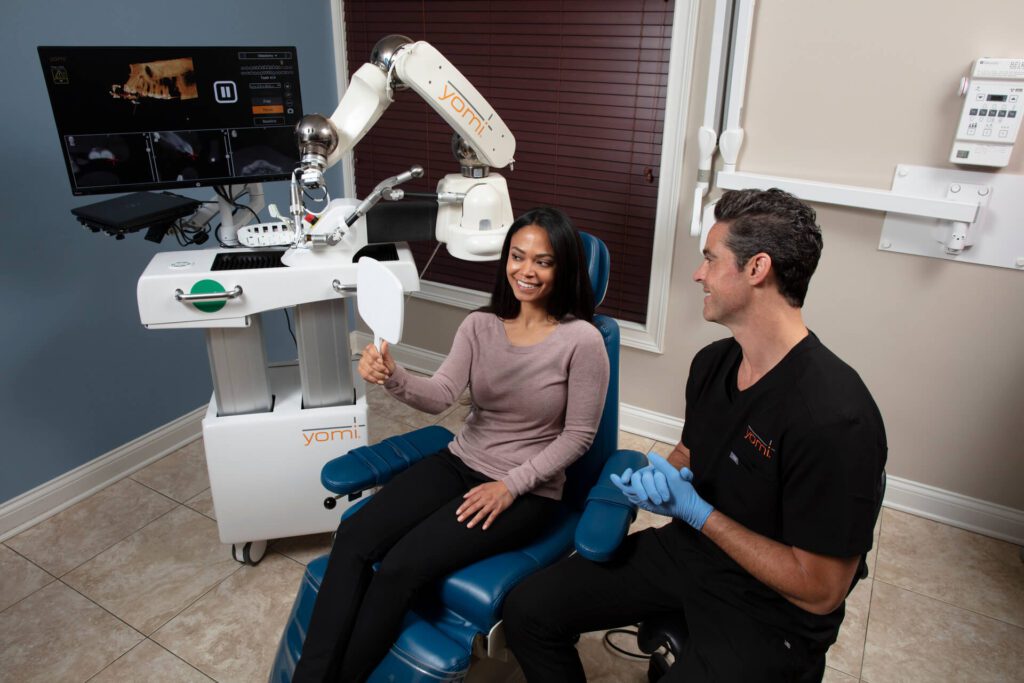
- Towne Dental offers implant-supported overdenture treatment with CBCT planning, oral surgery, and Yomi® robotic-assisted implant placement in Southwest Florida.
TL;DR: If you’re edentulous or nearly so and struggling with a loose lower denture, ask your dentist for a CBCT scan and suitability assessment. That one appointment tells you whether snap-in dentures are realistic for your bone volume and budget.
Table of Contents
- What are snap-in dentures and how do they attach?
- What does the snap-in denture procedure look like?
- What are the real pros and cons of snap-in dentures?
- How do snap-in dentures compare with other options?
- Who is a good candidate for snap-in dentures?
- How much do snap-in dentures cost in the U.S.?
- How do you care for snap-in dentures?
- What complications and risks should you know about?
- How do you choose the right dentist for snap-in dentures?
- What patients can expect at Towne Dental
- How long does it take to get used to snap-in dentures?
- What do long-term clinical studies show about success rates?
- How do snap-in dentures affect oral hygiene and diet?
- Can you upgrade from snap-in dentures to a fixed solution later?
- Key Takeaways
- The case for starting with an overdenture
- Snap-in denture consultations at Towne Dental
- FAQ
What are snap-in dentures and how do they attach?
The basic concept: titanium implant posts are placed into the jawbone, and a removable denture base snaps onto those posts through a set of precision attachments. The denture itself still covers the gum tissue, but the implants hold it firmly in place rather than relying on suction, adhesive, or gum contact alone. This is what separates an implant-supported overdenture from a conventional denture, and it’s the reason chewing force and stability improve so substantially.
Locator attachments
The most common attachment system uses locator abutments, which are low-profile metal posts that screw into each implant. The denture base holds matching female housings containing color-coded nylon inserts. Each color represents a different retention strength, so the dentist can dial in how firmly the denture snaps. The inserts are replaceable when they wear out, which is a significant maintenance advantage. Locator attachments work well when vertical space between the arches is limited, and they’re self-aligning, meaning the denture seats correctly even if you don’t place it perfectly straight.
Bar-retained systems
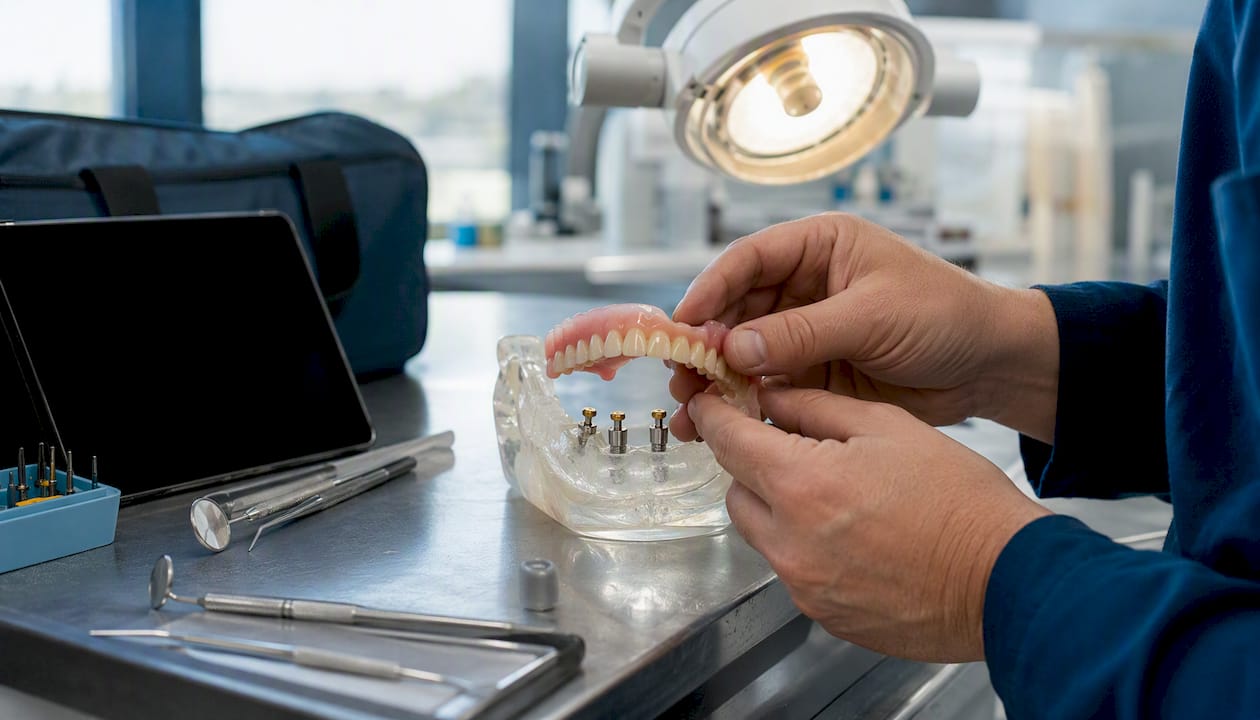
A bar-retained overdenture connects two or more implants with a custom metal bar that runs along the arch. The denture clips onto this bar rather than onto individual abutments. Bar systems distribute chewing forces across all implants simultaneously, which makes them exceptionally stable and well-suited to patients with strong bite forces. The trade-off is cost and vertical space: bar fabrication adds lab expense, and the system requires more room between the arches than locator attachments do.
Ball-and-socket attachments
Less common today, ball-and-socket attachments use a rounded ball on the implant abutment that snaps into a rubber O-ring inside the denture. They’re straightforward and inexpensive but wear faster than locator systems and offer less precise retention control.
Implant counts and the mandible advantage
An overdenture typically rests on 2–4 implants per arch. Two implants in the lower jaw is a well-researched, predictable configuration and the one the McGill consensus specifically endorses as the minimum standard. The upper jaw usually needs 4 implants because maxillary bone is less dense, and the palate creates different load-distribution demands. Patients who need only 2 lower implants often find the cost and surgical burden much more manageable than they expected.
What does the snap-in denture procedure look like?
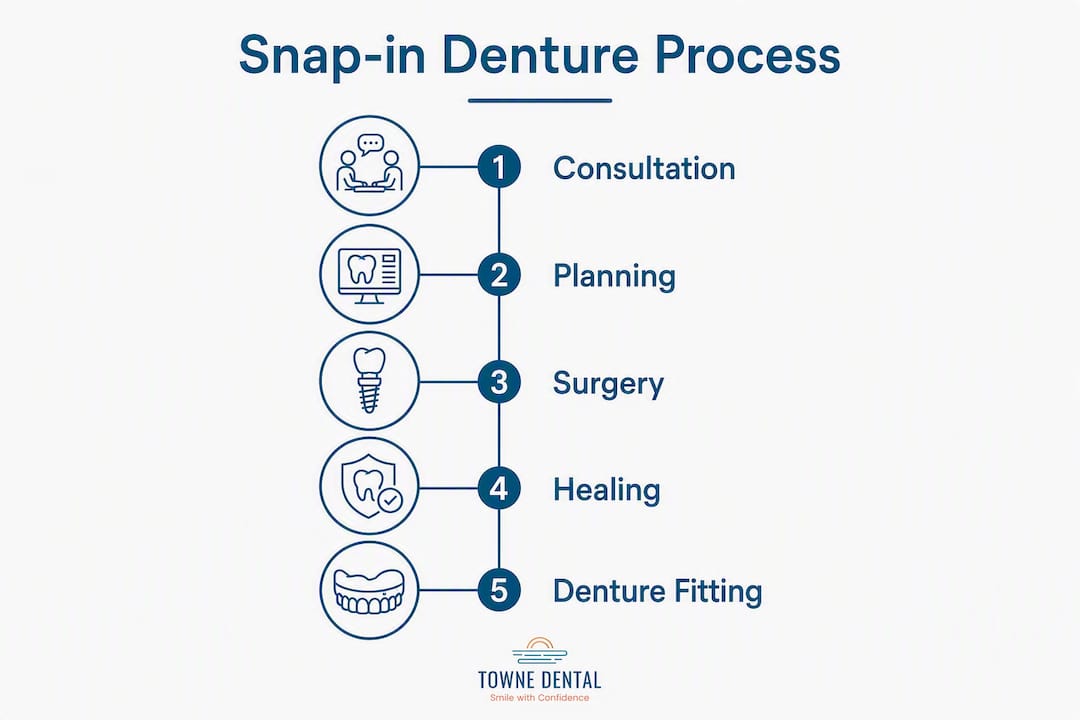
Treatment is a multi-phase process. Here’s what to expect from start to finish.
-
Consultation and CBCT imaging. The dentist reviews your medical and dental history, takes a cone-beam CT scan to assess bone volume and anatomy, and discusses which attachment system and implant count fits your situation. This visit also surfaces whether bone grafting is likely.
-
Preparatory care. Any remaining teeth that need extraction are removed. If bone volume is insufficient, grafting is done at this stage. Grafting adds healing time before implants can be placed.
-
Implant placement. The oral surgeon places the titanium posts under local anesthesia. Sedation is available for patients who prefer it. The procedure itself is typically completed in one appointment.
-
Osseointegration and healing. The implants fuse with the jawbone over the next several months. This healing phase commonly runs 3–6 months, though cases involving grafting can take longer. During this period, patients wear a temporary denture or a modified version of their existing one.
-
Attachment placement and denture pickup. Once the implants have integrated, the abutments or bar are connected and the final denture is fitted. The dentist verifies the snap retention, bite, and comfort before the patient leaves.
-
Follow-up adjustments. Most patients return within a few weeks for minor adjustments. Periodic follow-ups are scheduled to monitor implant health and denture fit.
The overall timeline from first consultation to final delivery typically runs 3–9 months. Cases requiring significant bone grafting or multiple extractions sit at the longer end of that range.
What are the real pros and cons of snap-in dentures?
Benefits worth knowing
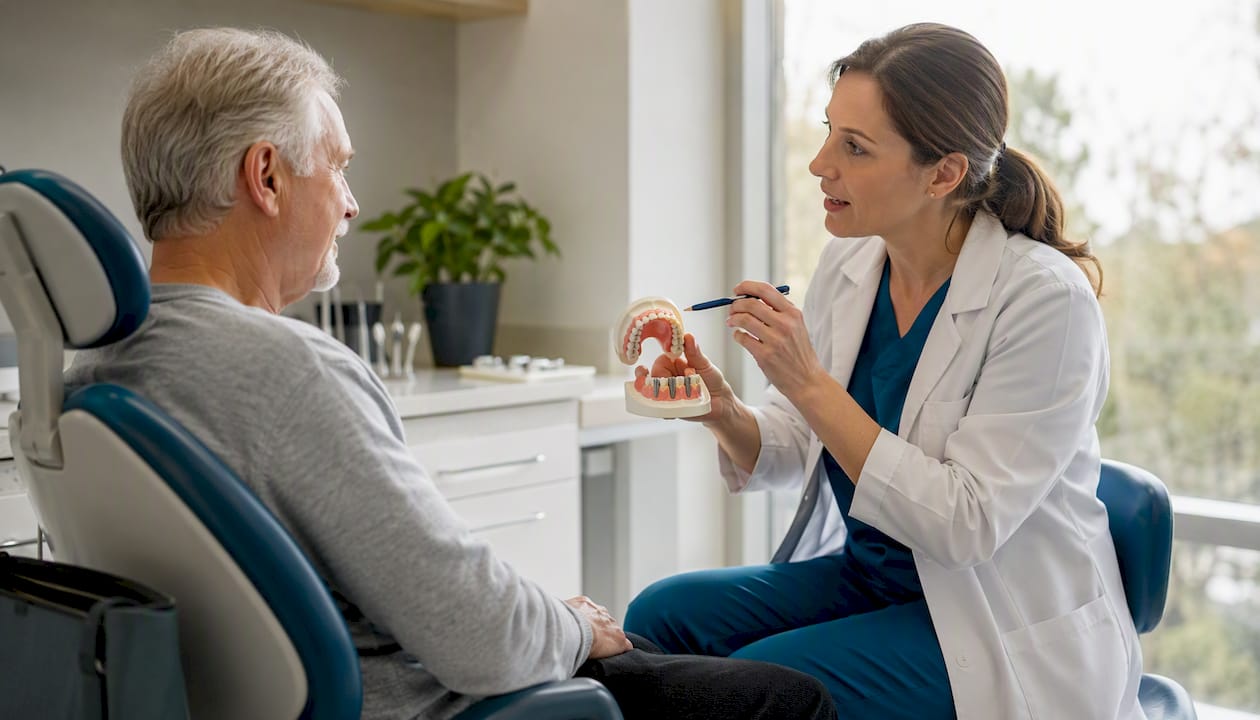
Stability is the headline advantage. Implant-retained overdentures restore a significantly higher proportion of natural chewing force compared to traditional adhesive-based dentures, which means patients can eat foods they’ve avoided for years. Speech improves because the denture doesn’t shift during consonant sounds. Confidence in social situations tends to follow.
Bone preservation is a benefit that often surprises patients. Implants transmit chewing forces directly into the jawbone, which slows the progressive bone resorption that conventional dentures accelerate over time. A conventional denture sitting on the gum provides no such stimulus, so the ridge gradually shrinks beneath it. Snap-in dentures slow that process considerably.
Daily cleaning is also simpler than most people expect. The denture removes completely, so you can clean both the prosthesis and the implant sites with standard tools, no special flossing techniques required.
Patient satisfaction data: A comparative study found mean overall satisfaction scores of 8.7 for implant-supported overdentures versus 6.6 for conventional complete dentures, with implant patients rating comfort, stability, and chewing efficiency higher across every measured dimension.
Drawbacks to weigh honestly
Surgery is unavoidable. Even a straightforward 2-implant lower overdenture requires an oral surgical procedure with a healing period. Patients who are medically compromised, heavy smokers, or on certain medications may not be good candidates.
The nylon inserts in locator attachments wear out and need periodic replacement, typically every 1–3 years depending on use. The denture base itself will eventually need relining as the gum ridge changes shape, usually every 3–5 years. These are predictable costs, but they’re real ones.
Upfront cost is higher than conventional dentures. That gap narrows over time as conventional dentures accumulate adhesive, reline, and replacement costs, but the initial investment is still a barrier for many patients.
How do snap-in dentures compare with other options?
| Dimension | Traditional denture | Snap-in overdenture | Fixed implant bridge |
|---|---|---|---|
| Stability / chewing | Low; relies on suction or adhesive | High; implant-retained | Highest; fully fixed |
| Implants required | — | a few implants per arch | several implants per arch |
| Cost per arch (typical) | conventional denture cost varies | implant overdentures have a moderate cost range | fixed implant bridges are significantly more costly |
| Maintenance | Relines, adhesive | Insert replacement, relines | In-mouth cleaning, professional hygiene |
| Removable | Yes | Yes | No |
| Bone preservation | Poor | Good | Good |
| Surgical complexity | None | Moderate | High |
| Best jaw | Either | Lower jaw especially | Either |
The All-on-4 fixed implant bridge delivers the highest stability and the closest feel to natural teeth, but it requires more implants, more complex surgery, and significantly higher cost. Snap-in overdentures occupy a practical middle ground: meaningfully better than conventional dentures, accessible to patients who can’t afford or don’t qualify for a fully fixed solution.
Pro Tip: If you’re on the fence between a snap-in overdenture and a fixed bridge, ask your dentist whether the implants placed for an overdenture can later support a fixed prosthesis. Many cases are convertible, which lets you start with the lower-cost option and upgrade later if your budget or bone volume allows.
Who is a good candidate for snap-in dentures?
The ideal candidate is fully or nearly edentulous in at least one arch, has sufficient bone volume in the anterior jaw (or is willing to undergo grafting), and wants removable cleaning access rather than a fixed prosthesis. Patients who’ve struggled with loose lower dentures for years are often the most motivated and the most satisfied with the outcome.
Common contraindications include:
- Uncontrolled systemic disease (uncontrolled diabetes, autoimmune conditions): raises infection and healing risk; medical clearance is required before surgery.
- Heavy smoking: significantly increases implant failure rates; most surgeons require patients to quit or substantially reduce smoking before and after placement.
- Bisphosphonate medications (used for osteoporosis): can impair bone healing; disclose all medications at consultation.
- Insufficient bone without grafting options: some patients lack the anatomy for grafting; a CBCT scan determines this definitively.
- Severe bruxism: heavy grinding accelerates attachment wear and can stress implants; a night guard and careful case planning are needed.
A CBCT scan is the essential planning tool for any implant case. It maps bone density, height, and width in three dimensions and identifies anatomical structures like the inferior alveolar nerve that affect implant positioning. Always confirm at your consultation whether grafting is likely, because that changes both the timeline and the total cost. For patients with significant bone loss, dental implants without bone grafting are sometimes possible with angled implant placement, but this requires careful evaluation.
How much do snap-in dentures cost in the U.S.?
Cost ranges vary by arch, implant count, attachment system, and geography. Here are the typical figures:
| Configuration | Typical U.S. cost range |
|---|---|
| Lower overdenture (2 implants) | $5,000–$10,000 |
| Upper overdenture (4 implants) | $8,000–$15,000 |
| Both arches | $12,000–$25,000 |
These ranges come from prosthodontic overdenture guides and reflect the full treatment cost, not just the denture. The denture itself is rarely the largest line item. The total investment includes implants, abutments, attachments, grafting if needed, lab fabrication, and follow-up maintenance, so a quote that lists only the prosthesis fee is incomplete.
What to confirm in any written estimate:
- Per-implant fee (placement and implant fixture separately)
- Abutment and attachment hardware costs
- Denture fabrication (lab fee)
- Bone grafting and membrane costs, if applicable
- Extractions, if remaining teeth need removal
- Follow-up appointments and first-year maintenance
- Cost of replacement nylon inserts over time
For a deeper look at what drives implant pricing, the dental implant cost breakdown covers regional variation and cost factors in detail.
Insurance and financing: Most dental insurance plans classify implants as elective and cover little or nothing. Some plans cover the prosthetic portion (the denture itself) under their major restorative benefit. FSA and HSA funds can be applied to implant treatment. Third-party financing through CareCredit or Lending Club Patient Solutions is widely available and lets patients spread payments over 12–60 months. Ask specifically about phased treatment: some clinics will place implants in one phase and fabricate the final denture in a second phase, splitting the cost across two benefit years.
How do you care for snap-in dentures?
Daily care is straightforward but non-negotiable. Skipping it leads to peri-implant infection, which is the primary cause of implant failure after the initial healing period.
Daily home care:
- Remove the denture each night and soak it in a denture-cleaning solution or plain water (never hot water, which warps acrylic).
- Clean the denture with a soft-bristle brush; avoid abrasive toothpaste that scratches the surface.
- Clean around each implant site with an interdental brush or soft-bristle toothbrush.
- Use a water irrigator (such as a Waterpik) to flush debris from around the abutments.
- Rinse your mouth before reinserting the denture.
Routine professional maintenance:
- Implant health check every 6 months (probing, X-rays as needed).
- Nylon insert inspection and replacement as needed, typically every 1–3 years.
- Denture reline when the fit loosens due to bone remodeling, typically every 3–5 years.
- Denture tooth replacement or full prosthesis replacement when wear becomes significant, typically after 5–10+ years.
Nylon inserts and attachments wear with use and require periodic replacement; this is expected and not a sign of failure. The bar or abutment hardware itself lasts much longer. A well-maintained denture base with quality acrylic teeth can serve a patient for 7–10 years before replacement becomes necessary, though heavy grinders may see shorter lifespans.
For patients concerned about long-term coverage, reviewing a dental implant warranty policy before committing to a provider is worth the time.
What complications and risks should you know about?
Short-term post-surgical issues
Swelling, soreness, and minor bleeding in the first 48–72 hours are normal. Transient numbness around the surgical site is common and usually resolves within days to weeks. Most patients manage discomfort with over-the-counter pain relievers and prescribed antibiotics.
Less common short-term complications include:
- Implant mobility or failure to integrate (more common in smokers and patients with uncontrolled diabetes)
- Surgical site infection requiring antibiotic treatment or debridement
- Temporary difficulty speaking or eating during the healing phase
Longer-term risks
Peri-implantitis, an inflammatory condition around the implant similar to gum disease, is the leading cause of late implant failure. It’s largely preventable with consistent home care and professional maintenance. Patients who smoke, have poor oral hygiene, or have uncontrolled systemic disease carry higher risk.
Red flags that require prompt attention:
- Persistent pain beyond the first week post-surgery
- Swelling that worsens after the third day rather than improving
- Fever above 101°F
- Implant that feels loose or moves when you press on it
- Foul taste or discharge from the surgical site
For urgent concerns after hours, Towne Dental’s emergency dental services provide a contact path for time-sensitive situations.
How do you choose the right dentist for snap-in dentures?
Provider selection matters more for implant cases than for most dental procedures, because the surgical and prosthetic phases require different skill sets and the outcome depends on both.
Provider vetting checklist:
- Documented implant placement experience (ask how many overdenture cases they’ve completed)
- Prosthodontic or restorative expertise for the prosthetic phase (sometimes a separate specialist)
- In-house CBCT and digital planning capability
- Established lab relationship for denture fabrication
- Clear aftercare and warranty policy in writing
- Familiarity with the McGill consensus and its implications for mandibular overdenture planning
Questions to ask at your consultation:
- How many implants do you recommend for my case, and why?
- Which attachment system do you recommend, and what are the trade-offs?
- Is bone grafting likely based on my CBCT, and is that cost included in the estimate?
- What will I wear during the healing period?
- What does ongoing maintenance cost annually?
- Can these implants later support a fixed bridge if I want to upgrade?
- Can I have an itemized written estimate before I commit?
- What is the expected total timeline from consultation to final delivery?
For complex full-arch cases, prosthodontist involvement or at minimum a clinician who follows published clinical guidance like the McGill consensus is a reasonable standard to hold providers to.
What patients can expect at Towne Dental
Towne Dental’s approach to implant-supported overdentures combines digital planning with surgical precision and a clear, phased treatment structure. Patients can expect:
- A CBCT scan at the initial consultation to assess bone volume and implant positioning before any treatment is proposed
- Oral surgery capability in-house, including implant placement and bone grafting when needed
- Yomi® robotic-assisted implant placement for cases where robotic guidance improves precision and reduces surgical invasiveness
- Sedation options for patients with dental anxiety or who prefer a more comfortable surgical experience
- Itemized treatment estimates so patients understand each cost component before committing
- Phased treatment planning that can spread procedures across time to manage cost
- Routine maintenance programs to monitor implant health and prosthesis fit after delivery
The clinic’s oral surgery team handles the surgical phase, and the restorative team coordinates the prosthetic outcome. Patients who want to understand the full scope of available services can review Towne Dental’s complete services page before their first appointment.
To book a consultation and request a CBCT assessment, contact Towne Dental directly. Bring your insurance card, a list of current medications, and any existing denture to the first visit.
How long does it take to get used to snap-in dentures?
Most patients adapt to snap-in dentures faster than they expect, but the adjustment period is real. The first week involves learning the snap mechanism: how to seat the denture correctly, how firmly it should feel, and how to remove it without excessive force. Locator attachments are self-aligning, which shortens this learning curve considerably.
Speech typically normalizes within 1–2 weeks. The denture occupies slightly different space than a conventional denture, and the tongue adjusts its positioning for certain sounds. Reading aloud for 10–15 minutes daily during the first week accelerates this process noticeably.
Chewing adaptation takes a bit longer. Start with soft foods during the first 2–4 weeks post-delivery, then gradually reintroduce firmer textures. The implants are fully integrated by this point, but the surrounding soft tissue and the patient’s confidence both need time to catch up. Most patients are eating a near-normal diet within a month.
Soreness at the attachment sites during the first few weeks is common and usually resolves with minor adjustments at follow-up visits. If a specific spot consistently causes discomfort, the dentist can relieve that area of the denture base. Don’t try to adjust the denture yourself.
What do long-term clinical studies show about success rates?
The evidence base for implant-supported overdentures is among the strongest in implant dentistry. Clinical studies consistently report improved patient-reported outcomes for overdentures compared with conventional dentures across comfort, stability, and chewing efficiency, with success rates that hold up over 5–10 year follow-up periods when patients are properly selected and maintained.
The McGill consensus, now more than two decades old and repeatedly validated by subsequent research, established that mandibular implant overdentures should be the standard of care for edentulous patients, not an elective upgrade. That language reflects how strong the evidence was even at the time of publication.
Implant survival rates for overdenture cases in well-selected patients are consistently high in the literature, with most long-term studies reporting rates above 90% at 5 years. Failure rates climb when patients smoke, have uncontrolled diabetes, or skip professional maintenance. The prosthesis itself (the denture) has a shorter functional lifespan than the implants and typically needs replacement or significant rework within 7–10 years.
How do snap-in dentures affect oral hygiene and diet?
The removable design is a genuine hygiene advantage. Every surface of the denture can be cleaned outside the mouth, and the implant sites are fully accessible for brushing and irrigation. This is meaningfully simpler than cleaning around a fixed bridge, where food traps under the prosthesis and specialized flossing tools are required.
The main hygiene risk is peri-implant tissue inflammation from inadequate cleaning around the abutments. Biofilm accumulates at the gum-abutment junction, and if it’s not disrupted daily, it progresses to peri-implantitis. A water irrigator is the most effective tool for this area; interdental brushes sized to fit around the abutments are the second line of defense.
Dietary restrictions after full healing are minimal. Most patients can eat foods they avoided with conventional dentures: corn on the cob, apples, crusty bread, and most meats. The exceptions are extremely hard foods (hard candies, ice chewing) and very sticky foods (caramel, chewing gum) that can dislodge or stress the attachments. These aren’t absolute prohibitions, but they shorten the lifespan of the nylon inserts and should be minimized.
Can you upgrade from snap-in dentures to a fixed solution later?
Yes, in many cases. This is one of the more underappreciated features of the overdenture approach. If the implants placed for an overdenture are positioned correctly and have sufficient bone support, they can often serve as the foundation for a fixed implant bridge later. The patient would need additional implants in some cases (moving from 2 to 4 for a lower arch fixed bridge, for example), but the existing implants remain in place and contribute to the final structure.
This convertibility makes the overdenture a logical starting point for patients who want the benefits of implant support now but anticipate wanting a fixed solution in the future. It’s worth asking your dentist explicitly whether the planned implant positions are compatible with a future fixed conversion, because not all placement plans account for this.
The reverse, converting a fixed bridge back to a removable overdenture, is also possible but less common. It’s typically done when a patient has difficulty maintaining the hygiene demands of a fixed prosthesis or when bone loss around implants requires a design change.
Key Takeaways
Snap-in dentures (implant-supported overdentures) offer a clinically validated middle ground between conventional dentures and fixed implant bridges, with the lower jaw requiring as few as 2 implants to achieve dramatically better stability and patient satisfaction.
| Point | Details |
|---|---|
| Implant count and cost | Lower arch: 2 implants, $5,000–$10,000; upper arch: 4 implants, $8,000–$15,000; both arches $12,000–$25,000. |
| McGill consensus | Mandibular implant overdentures are the minimum standard of care for edentulous patients, not an optional upgrade. |
| Maintenance reality | Nylon inserts need replacement every 1–3 years; relines every 3–5 years; denture base lasts 5–10+ years with proper care. |
| Upgrade path | Implants placed for an overdenture can often support a fixed bridge later if positioned correctly, making this a convertible investment. |
| Towne Dental | Offers CBCT planning, in-house oral surgery, Yomi® robotic implant placement, and phased treatment options in Southwest Florida. |
The case for starting with an overdenture
Most of the patients I see who are weighing snap-in overdentures against fixed implant bridges are asking the wrong question. They want to know which option is “better,” when the more useful question is which one they can actually succeed with, given their bone volume, budget, and maintenance habits.
Fixed bridges deliver the highest stability, but they also demand meticulous hygiene, more implants, more surgery, and significantly more upfront cost. For a patient who’s already anxious about dental procedures and working within a real budget, pushing them toward a fixed solution they’ll struggle to maintain isn’t better care. It’s just more expensive care.
The McGill consensus didn’t designate mandibular overdentures as the standard of care because they’re a compromise. It did so because the evidence showed they transform quality of life for edentulous patients in a way that’s reproducible, affordable, and sustainable. Two implants in the lower jaw can change how a person eats, speaks, and feels about themselves. That’s not a consolation prize.
What I’d encourage any patient to do is get the CBCT first, understand the bone situation clearly, and then have an honest conversation about what each option actually requires over 10 years, not just at the time of placement. The overdenture often wins that comparison.
Snap-in denture consultations at Towne Dental
Towne Dental gives patients considering implant-supported overdentures a clear, structured path from first appointment to final delivery. The clinic combines in-house oral surgery, CBCT digital planning, and Yomi® robotic-assisted implant placement, which means the surgical and prosthetic phases are coordinated under one roof rather than split across multiple providers.
At your first visit, you’ll receive a CBCT scan, a clinical assessment of bone volume and implant suitability, and an itemized estimate that breaks down each cost component before you commit to anything. Phased treatment options are available for patients who want to spread the cost across time. Sedation is offered for patients who prefer a more comfortable surgical experience.
To book your consultation, visit Towne Dental’s services page or call the clinic directly. Bring your insurance card, a current medication list, and any existing denture to the first appointment. The team will walk you through what’s realistic for your anatomy, your timeline, and your budget.
Useful sources
- McGill consensus statement on mandibular implant overdentures (PubMed)
- Clinical outcomes for implant overdentures (PubMed)
- CBCT planning and grafting considerations (PubMed)
- Implant-supported dentures: process, benefits, and care (Cleveland Clinic)
- Dental implant surgery overview (Mayo Clinic)
FAQ
What are the disadvantages of snap-in dentures?
The main drawbacks are surgical requirement, periodic maintenance costs (nylon insert replacement every 1–3 years, relines every 3–5 years), and higher upfront cost compared to conventional dentures. Patients who smoke, have uncontrolled systemic disease, or lack sufficient bone volume may not qualify without additional procedures.
How much does a full set of snap-in dentures cost?
Both arches typically run $12,000–$25,000 in the U.S., depending on implant count, attachment system, and whether bone grafting is needed. A lower arch alone (2 implants) generally costs $5,000–$10,000; an upper arch (4 implants) runs $8,000–$15,000.
How long do snap-in dentures last?
The implants themselves can last decades with proper care. Nylon retention inserts typically need replacement every 1–3 years, the denture base usually requires relining every 3–5 years, and the full prosthesis generally lasts 5–10+ years before replacement becomes necessary.
Are snap-in dentures worth it?
For most edentulous patients, particularly those with a loose lower denture, the answer is yes. Clinical studies report mean satisfaction scores of 8.7 vs. 6.6 for implant overdentures compared with conventional dentures, and the McGill consensus designates mandibular implant overdentures as the minimum standard of care, not an elective upgrade. Towne Dental can assess your specific bone volume and candidacy with a CBCT scan at the initial consultation.