Silver diamine fluoride (SDF) is a clinician-applied liquid that can arrest many small cavities without drilling, but it permanently darkens the treated area, so it works best when a dentist can diagnose the lesion, explain the trade-off, and schedule follow-up. It is not appropriate for teeth with a silver allergy or signs of pulpitis, such as spontaneous pain or swelling, which need definitive treatment instead.
TL;DR:
- SDF is most effective on shallow to moderate cavities, especially in children or anxious patients, when reapplied every six months for optimal results.
- Permanent dark staining from SDF is inevitable, particularly on visible front teeth, so selective application and later restorative coverage help manage cosmetic concerns.
- Lesions that remain soft or show signs of infection, such as pain or swelling, require definitive treatment like a filling or root therapy instead of SDF.
- Re-evaluation two to four weeks after initial application is crucial to confirm the lesion has hardened and darkened as expected, with ongoing reapplications depending on healing.
- SDF should not be used for patients with silver allergies or advanced pulp involvement, and it functions best as part of a comprehensive, monitored treatment plan.
Table of Contents
- What silver diamine fluoride is and how it works
- Who is a good candidate for SDF and who should avoid it
- What happens during SDF application and how to care for your teeth afterward
- How well SDF works and what the research shows
- The cosmetic trade-off: permanent staining and how to manage it
- When to come back: reapplication schedule and monitoring
- How SDF compares to other caries-management options
- How Towne Dental fits SDF into a treatment plan
- Where SDF earns its reputation and where it does not
- Book an SDF evaluation and follow-up care at Towne Dental
- Sources
- FAQ
What silver diamine fluoride is and how it works
Silver diamine fluoride is a clear liquid made of three active ingredients: silver, fluoride, and ammonia. Each does a specific job. Silver acts against the bacteria that cause decay, fluoride helps rebuild the mineral structure of the tooth, and ammonia keeps the silver and fluoride stable in solution so the mixture can be applied directly to a cavity with a small brush.
Decay happens when acid-producing bacteria dissolve the mineral in tooth enamel and dentin faster than saliva can repair it. SDF interrupts that cycle in two ways. The silver component works against the bacteria living inside the softened, decayed tissue, while the fluoride encourages new mineral to form on the exposed dentin surface. Together, these actions can turn an active, soft, progressing lesion into an inactive one that stops advancing.
That inactive state is what dentists call an “arrested” lesion, and it looks and feels different from active decay. Instead of soft, sticky, light brown or yellow tissue, an arrested lesion becomes hard to the touch and turns black or dark brown. The AAP explains that SDF is a quick way to help stop or slow cavities, and that the treated area typically stains permanently once the decay has hardened.
That hardness matters clinically for a simple reason: a hard, dark lesion is no longer feeding active bacterial growth, so it is far less likely to cause pain or spread to neighboring teeth. A dentist checking a treated tooth is looking for exactly that combination of color change and firmness, since the two together are the practical signal that treatment worked. If a lesion stays soft despite the dark color, that usually means the decay is still active underneath and needs another look.
The ADA notes that 38% SDF is FDA cleared for treating tooth sensitivity and is commonly used off-label to arrest cavities, a use supported by a substantial body of clinical research even though it falls outside the product’s original approved indication. Off-label use is common and legal in dentistry when supported by evidence, but it is worth understanding that the caries-arrest application rests on this off-label pathway rather than a caries-specific FDA approval.
Because SDF works on the surface of a lesion rather than by removing decayed tissue with a drill, it does not “cure” a cavity in the way a filling replaces lost structure. It stops the disease process and buys time, sometimes permanently for a baby tooth close to falling out, sometimes as a bridge to a restoration placed later under better conditions.
Who is a good candidate for SDF and who should avoid it
SDF fits a specific set of clinical situations rather than every cavity. It tends to work best for shallow to moderate lesions that a dentist can see and clean, and it is especially useful when conventional treatment is difficult to deliver right away.
Good candidates typically include:
- Young children with early childhood caries who cannot yet tolerate a drill or injection comfortably.
- Anxious patients of any age who need a quick, needle-free way to stop a cavity from progressing.
- Medically complex patients, including those with conditions that make sedation or lengthy procedures riskier.
- People with limited access to care, where SDF can prevent a small cavity from becoming an emergency before a full restorative visit is possible.
On the other side, an AAP overview of SDF indications lists a known silver allergy as a clear contraindication, since the treatment relies on silver as its active antimicrobial agent. The same guidance notes that SDF does not treat underlying infection and should not be used as a substitute for restorative care when decay has already reached the pulp, the nerve tissue inside the tooth.
Signs that point away from SDF and toward more definitive treatment include spontaneous pain that wakes a child at night, visible swelling near a tooth, a draining bump on the gum, or a tooth that has darkened well beyond the surface lesion. Those symptoms suggest pulpitis or infection, conditions SDF cannot resolve.
Even for good candidates, SDF is sometimes a temporary measure rather than a final answer. A cavity on a permanent molar in an adult, for instance, may be arrested with SDF short-term but still scheduled for a filling once anxiety, cost, or scheduling barriers are resolved.
What happens during SDF application and how to care for your teeth afterward
An SDF appointment is short and does not require needles or a drill, which is part of why it works so well for anxious or very young patients. The AAP notes the treatment itself usually takes just a few minutes once the tooth is identified and ready.
- Diagnosis. The dentist examines the tooth, sometimes with an X-ray, to confirm the cavity is a good candidate and rule out deeper infection.
- Isolation and drying. The tooth is isolated with cotton or a similar barrier and dried so the liquid is not diluted by saliva.
- Application. A small microbrush applies the SDF directly onto the decayed area only, avoiding healthy tooth structure and soft tissue.
- Wait time. The liquid sits on the lesion for about one minute, though some protocols allow it to stay slightly longer.
- Removing excess. Any extra liquid is wiped away or gently rinsed to limit staining beyond the treated spot.
- Optional varnish. A fluoride varnish may be layered on top to help mask taste and add extra protection.
Most patients notice a metallic taste immediately after application, and some report mild, temporary staining on the gums or lips if the liquid touches soft tissue. Both usually fade within a day or two. Because the solution is silver-based, it can also leave a temporary dark mark on skin or clothing if spilled, so most offices are careful with protective barriers during the procedure.
For aftercare, patients can generally eat and drink normally once numbness (if any local anesthetic was used elsewhere) has worn off, since SDF itself does not require dietary restriction. Regular brushing and flossing continue as usual, and there is no special rinse required. Any skin staining from an accidental drip typically fades on its own within a few days as skin cells turn over.
Pro Tip: Ask your dentist to point out exactly which teeth were treated and what the healthy dark-and-hard result should look like at your next visit, so you know what to check for at home.
How well SDF works and what the research shows
The evidence behind SDF’s caries-arrest effect comes largely from systematic reviews and clinical trials rather than a single landmark study, and the pattern across that research is fairly consistent. A 2019 evidence-based dentistry update summarizing this literature reports that 38% SDF arrests caries in primary teeth with pooled arrest rates commonly falling between about 66% and 81%, depending on the protocol used and how often the treatment was reapplied.
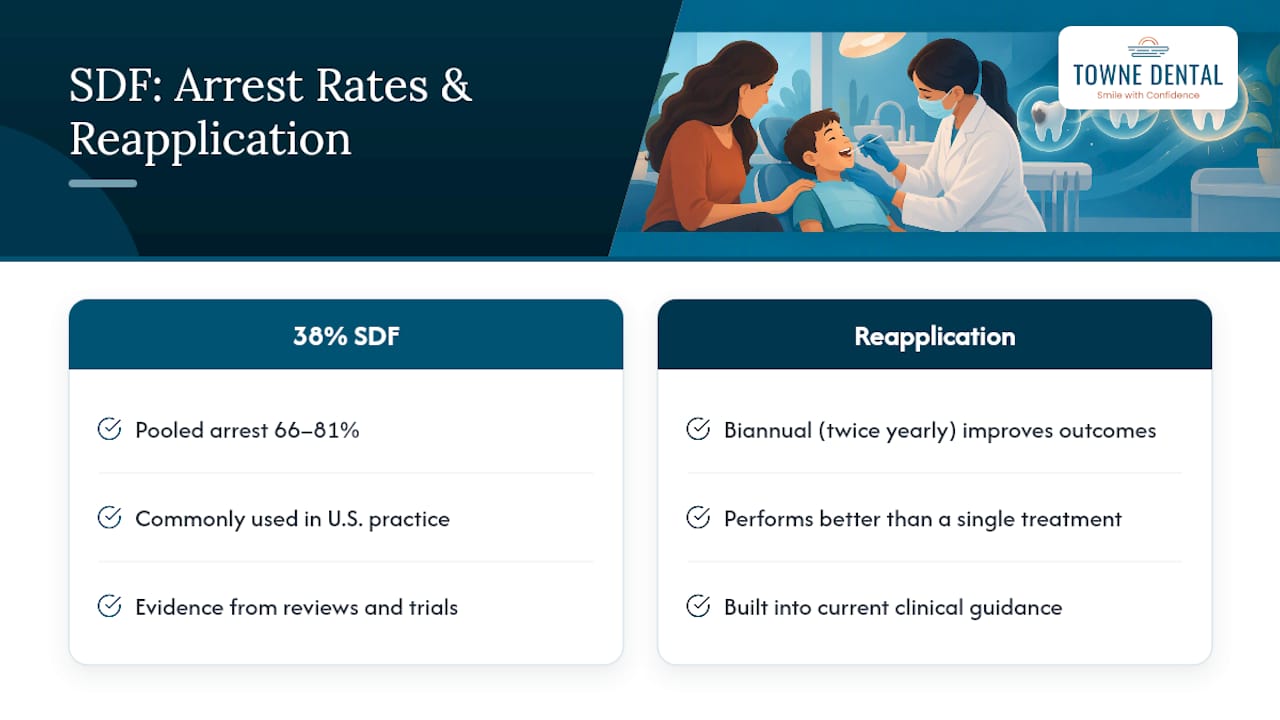
Reapplying SDF twice a year improves outcomes: the same review found that biannual application performs better for sustained arrest than a single treatment, which is why most current clinical guidance builds reapplication into the plan from the start rather than treating SDF as a one-time fix.
This concentration is the one most commonly studied and used in U.S. practice, which is part of why product labeling and FDA clearance records reference it specifically.
Results also differ depending on where the decay is and whose teeth are being treated. Arrest rates tend to be higher on primary (baby) teeth than on some other lesion types, and cavities that are easy to clean and directly accessible with a brush respond better than lesions hidden between teeth or under old fillings. Root caries in older adults, a different clinical picture from childhood cavities, has also been studied with SDF, though the evidence base there is smaller than for pediatric primary-tooth decay.
It is worth being honest about what the research does not yet settle. Long-term studies comparing different reapplication schedules head-to-head are limited, and questions remain about the ideal frequency for specific lesion types, the best combination of SDF with other fluoride treatments, and how outcomes compare across different populations and diets. Systematic reviews describe SDF as one of the more effective noninvasive options currently studied for early lesions, without claiming it works for every cavity or every patient.
None of this changes the basic picture: for the right lesion, applied correctly and reapplied on schedule, SDF has one of the better-documented success rates among noninvasive caries treatments available today.
The cosmetic trade-off: permanent staining and how to manage it
The single biggest trade-off with SDF is cosmetic, and it deserves to be understood clearly before treatment, not discovered afterward. When SDF arrests a cavity, the treated area does not just stop decaying, it turns black or dark brown, and that discoloration is permanent on that specific spot. For a baby tooth, the stain typically remains until the tooth falls out naturally. For a permanent tooth, the mark stays until the area is either restored with a filling or crown, or left as is.
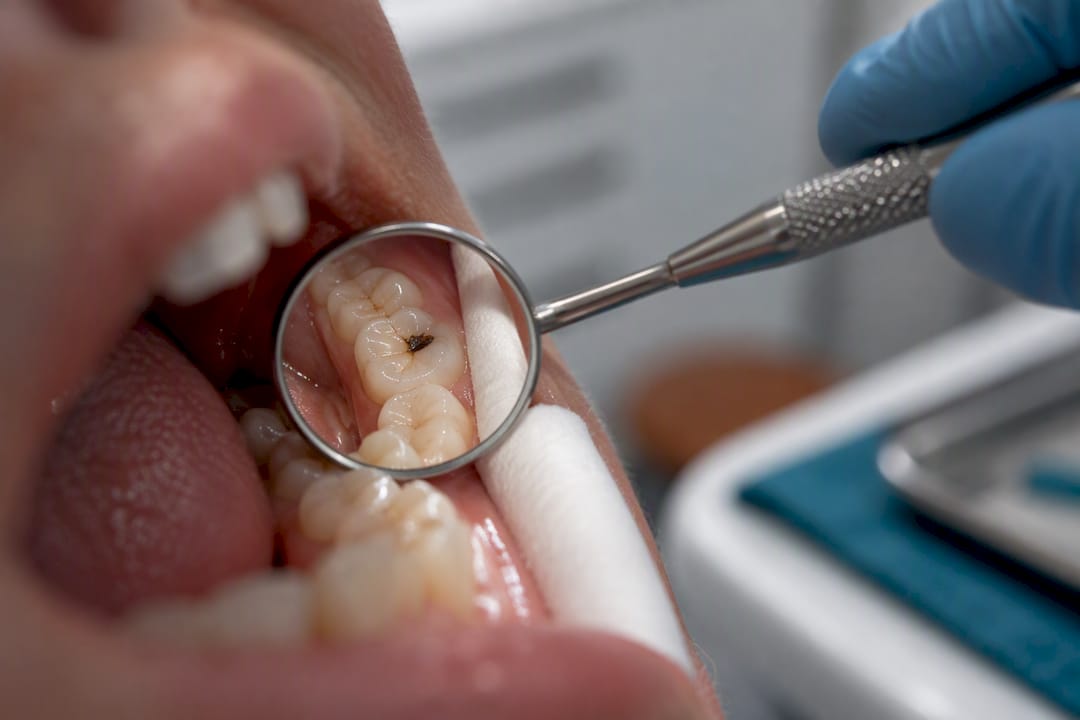
Because the staining is often on a back tooth or a spot not visible when smiling, many families find it an acceptable trade for avoiding a drill, an injection, or sedation, particularly in a young child. For a cavity on a front tooth, the cosmetic impact is more visible and worth discussing directly with the dentist before treatment.
A few practical strategies help manage the esthetic concern:
- Selective application limits SDF strictly to the decayed surface, sparing surrounding healthy enamel from any discoloration.
- Potassium iodide, used by some clinicians immediately after SDF, can lighten the initial dark color somewhat, though the underlying arrest and any long-term darkening can still occur.
- Restorative coverage later, such as a tooth-colored filling or crown placed once the lesion is stable, can mask the stain permanently for a visible tooth.
- Timing around visible teeth lets families weigh SDF for back teeth first while choosing a different approach for a front tooth cavity.
Informed consent should cover all of this clearly: what the treated tooth will look like afterward, that the change is not temporary, and what options exist if the family later wants the stain covered. An AAPD chairside guide for SDF case selection and consent recommends discussing staining, monitoring needs, and treatment limits as part of the consent conversation, not as an afterthought.
This is also where having an established dental home matters. A dentist who knows the patient’s history and can track the treated tooth over time is far better positioned to recommend when, or whether, a follow-up restoration makes sense.
When to come back: reapplication schedule and monitoring
SDF is not a single visit and done, at least not usually. Guidance from the AAPD chairside guide recommends an early check at two to four weeks after the first application, mainly to confirm that the lesion has become hard and dark as expected. If it has not, that is a signal the arrest was incomplete and needs another look.
Beyond that early check, most protocols call for reapplying SDF roughly every six months for lesions that need ongoing management, though some programs use an annual schedule depending on the patient and setting. The AAP family FAQ notes that reapplication commonly falls somewhere between three and twelve months, which is a fairly wide window that depends on the individual case and the dentist’s judgment.
Monitoring visits typically check for:
- Hardness and color of the treated lesion, since a hard, dark spot indicates successful arrest.
- New or expanding decay nearby, which would call for a fresh application or a different approach.
- Pain, swelling, or sensitivity, any of which suggest the lesion has progressed toward the nerve.
- Tooth mobility or structural loss, particularly in baby teeth nearing natural exfoliation.
When monitoring shows the lesion has not stabilized, or when new symptoms appear, the next step usually shifts from SDF toward restorative treatment: a filling, a crown, pulpal therapy such as a pulpotomy, or in more advanced cases, extraction. SDF is meant to slow or stop the disease process, not to replace those treatments when they become necessary.
How SDF compares to other caries-management options
SDF is one tool among several noninvasive and restorative options, and understanding where it fits helps families make sense of a dentist’s recommendation.
- Fluoride varnish strengthens enamel broadly and helps prevent new cavities, but it does not arrest an already-cavitated lesion the way SDF can.
- Dental sealants protect the grooves of healthy or minimally affected teeth from decay starting in the first place, which makes them a strong preventive complement once a cavity is under control.
- Atraumatic restorative treatment (ART) removes soft decay by hand and places a simple filling material without a drill, sitting between SDF and a full restoration in terms of invasiveness.
- Definitive restorations, such as fillings or crowns, remain the standard for deeper decay or lesions in visible areas where staining is unacceptable.
- Sedation or general anesthesia may be indicated when a young child or medically complex patient needs multiple restorations at once and cannot tolerate treatment while awake.
SDF’s real strength is in “buying time.” A cavity that would otherwise progress while a family arranges a restorative appointment, saves for the cost, or waits for a child to be developmentally ready for a filling can often be stabilized with SDF in the meantime. It also pairs naturally with other preventive steps: a tooth treated with SDF still benefits from good brushing, a lower-sugar diet, and sealants on adjacent healthy teeth to reduce the chance of new decay starting nearby.
How Towne Dental fits SDF into a treatment plan
At Towne Dental, SDF is considered case by case, alongside sedation and definitive restorative options, rather than treated as a default answer for every cavity. A young child with several small, early lesions and significant dental anxiety might be a strong candidate for SDF as a first step, particularly when the goal is to avoid a drill at that visit. A child or adult with deeper decay showing signs of pulpitis, by contrast, needs restorative or endodontic treatment regardless of how well SDF might arrest a shallower lesion elsewhere in the mouth.
Follow-up is planned from the start rather than left open-ended. That typically means scheduling the early hardness and color check, setting a reapplication timeline if the lesion needs ongoing management, and discussing whether a permanent restoration should eventually cover a stained area on a visible tooth. For patients who need more than SDF alone can offer, whether that is a filling, a crown, or a procedure requiring sedation dentistry for a child who cannot tolerate treatment while awake, the practice coordinates that next step as part of the same care plan rather than a separate referral.
Families with a child who has multiple cavities across several teeth often benefit from this kind of combined approach: SDF for the lesions that qualify, pediatric dental care to monitor everything over time, and restorative treatment scheduled for anything that needs more than arrest.
Where SDF earns its reputation and where it does not
SDF has earned a place in modern dentistry for a specific, narrow reason: it gives dentists a fast, needle-free way to stop a cavity from getting worse in a patient who cannot or will not tolerate a drill that day. That is a real and useful advantage, and it deserves the attention it gets.
Where the conventional conversation about SDF falls short is in treating it as a simple substitute for a filling. It is not. It is a management tool with a real cosmetic cost, a real need for follow-up, and real limits on which lesions it can help. Too much of the public discussion skips past the staining trade-off or the reapplication schedule, leaving parents surprised months later.
If you take one thing from this, prioritize the follow-up conversation as much as the treatment itself. Ask when the next check happens, what a successful result should look like, and what happens if the lesion does not arrest. SDF works best as part of an ongoing relationship with a dentist, not as a one-time fix you can forget about.
— Towne Dental
Book an SDF evaluation and follow-up care at Towne Dental
Towne Dental evaluates cavities case by case to determine whether SDF, a filling, or another approach fits best, and coordinates follow-up restorative or sedation care under one roof so families are not left arranging separate referrals.

What that looks like in practice:
- A dentist examines the tooth or teeth involved and discusses whether SDF, a sealant, or a restoration is the right first step.
- If SDF is a good fit, the visit also includes a plan for the early check and any reapplication schedule.
- For children who need more extensive work or cannot tolerate treatment while awake, relaxing sedation options are available and coordinated as part of the same plan.
- Insurance and financing questions are handled directly with the office, since coverage for SDF and related treatments varies by plan.
To schedule an evaluation, visit Towne Dental or review the full list of dental services to find the right starting point for your family.
Sources
The clinical guidance and evidence summarized in this article draw on family-facing and professional resources from the AAP, ADA, AAPD, and the FDA, along with peer-reviewed evidence reviews. Readers and clinicians looking for more detail can consult:
- Evidence-Based Dentistry Update on Silver Diamine Fluoride — PMC (2019)
- Silver Diamine Fluoride (SDF) FAQ for Families — AAP
- FDA 510(k) — Centrix FluoroSilver Silver Diamine Fluoride 38% (K222459)
- Chairside Guide: Silver Diamine Fluoride in the Management of Dental Caries Lesions — AAPD (PDF)
This article is general information, not a substitute for advice from a qualified doctor. Consult a qualified healthcare professional about your own circumstances before acting on anything here.
FAQ
Is SDF better than a filling?
SDF and a filling solve different problems: SDF arrests decay without removing tooth structure, while a filling removes decay and restores the tooth’s shape. For shallow lesions in an anxious or very young patient, SDF’s noninvasive arrest rates make it a reasonable first step, but deeper decay or a visible front tooth often still needs a filling.
How long does SDF take to turn black?
The treated lesion typically begins darkening within days, and a dentist usually checks for the expected hardness and color change at a follow-up visit two to four weeks later, as recommended in the AAPD chairside guide. If the spot has not hardened and darkened by then, the lesion likely needs another application.
What is the “zombie effect” of SDF?
This is a term some parents and clinicians use informally to describe the black, hardened look of an arrested lesion, since the darkened tooth surface can look dramatic even though the decay underneath has stopped progressing. It is not a clinical term with a fixed definition, but it generally refers to the permanent staining that comes with successful arrest.
Is silver diamine fluoride safe for kids?
SDF is generally considered a safe, needle-free option for children, according to AAP guidance for families, and it can reduce the need for sedation in some cases by avoiding drills and injections. It is not appropriate for a child with a known silver allergy or for a tooth already showing signs of infection or nerve involvement.
How often does SDF need to be reapplied?
Reapplication schedules vary by case, but the AAP notes it commonly falls between three and twelve months, with many dentists favoring a biannual schedule for the best sustained results. Your dentist will set the exact timing based on how the lesion responds at follow-up checks.