Periodontal maintenance is prescribed, ongoing care that follows active treatment for gum disease, designed to stop the infection from coming back and to keep your teeth anchored in place. The single most important action you can take is sticking to the recall schedule your dentist sets for you, usually every 3 to 6 months depending on your risk level. Skip it, and the disease tends to return.
TL;DR:
- Maintaining a 3 to 6 month recall schedule is critical, especially for high-risk patients such as smokers or those with uncontrolled diabetes.
- A periodontal maintenance visit includes full periodontal charting, subgingival cleaning, and possible additional therapy on inflamed sites, not just a regular cleaning.
- Long-term success depends heavily on patient compliance with scheduled visits, as skipping appointments significantly increases the risk of disease recurrence.
- Insurance coverage for periodontal maintenance (D4910) varies by plan and may require prior authorization or have visit limits; clarify coverage details beforehand.
- Supporting long-term tooth retention relies on ongoing care, diligent home hygiene, and addressing risk factors like smoking and blood sugar control.
Table of Contents
- What makes periodontal maintenance different from a routine cleaning
- What to expect at a periodontal maintenance visit
- How often you’ll need maintenance visits
- The evidence behind why maintenance works
- Risk factors that change your maintenance plan
- What you can do between appointments
- Understanding insurance coverage for maintenance visits
- How we approach periodontal maintenance at Towne Dental
- The part of gum disease care most people get wrong
- Ready to schedule your periodontal maintenance visit?
- FAQ
- Sources
What makes periodontal maintenance different from a routine cleaning
A periodontal maintenance visit is not the same service as the cleaning you got before you had gum disease. Once you have been treated for periodontitis, the American Dental Association considers you a person with a history of periodontitis permanently, even after successful therapy, which means your care shifts from prevention to management.
- D1110 (prophylaxis) is routine cleaning for healthy gums with no history of periodontal disease.
- D4910 (periodontal maintenance) is a distinct procedure for patients previously treated for periodontitis, billed and coded differently because the clinical goal is different.
- Maintenance is lifelong. There is no point at which you graduate back to standard cleanings once periodontitis has been diagnosed and treated.
What to expect at a periodontal maintenance visit
Each visit follows a consistent sequence built around catching problems before they progress.
- Your dental and medical history gets reviewed for changes, including new medications or diagnoses like diabetes.
- Your hygienist charts probing depths at six points per tooth, checking for bleeding, recession, and mobility.
- Subgingival areas get debrided and polished, with focused scaling and root planing on any sites that show renewed inflammation.
- You get coaching on technique adjustments for whatever home care gaps the exam reveals.
- If a site is not responding, your clinician may recommend adjunctive therapy or a referral for further evaluation.
Pro Tip: Bring a current medication list to every maintenance visit. Several common drugs cause dry mouth, which raises your risk of plaque buildup between appointments.
How often you’ll need maintenance visits
Most people start on a 3-month recall immediately after active periodontal therapy. Guideline and evidence summaries describe this as the common starting point, with later intervals personalized anywhere from 3 to 12 months based on how your gums respond.
- Deep pockets that persist after treatment usually keep you on a shorter interval.
- Smoking slows healing and tends to justify closer monitoring.
- Uncontrolled diabetes affects how well your tissue heals and recovers.
- Any site that bleeds on probing or shows new attachment loss gets flagged for a shorter recall.
Guidelines recommend risk-based recall intervals rather than one fixed schedule for everyone, with higher-risk patients often kept at 3-month visits. Your clinician reassesses at every visit and moves your interval up or down based on what the charting and bleeding scores show, not on a fixed calendar.
The evidence behind why maintenance works
Supportive periodontal therapy is associated with lower rates of tooth loss and greater long-term stability among patients who actually keep their appointments. That compliance piece matters more than almost anything else in the research: the people who benefit most are the ones who show up on schedule, not just the ones who had the best initial response to treatment.
The literature on isolated mechanical plaque removal during maintenance is less definitive than the overall picture suggests. Still, prospective data consistently support maintenance as the mechanism that catches early relapse before it becomes bone loss, which is the outcome that actually costs you teeth. A maintenance visit that finds a reactivated site lets your dentist retreat it locally instead of waiting for it to become a surgical problem.
Risk factors that change your maintenance plan
Certain conditions and habits interact directly with how well maintenance works for you.
- Smoking is a major, modifiable risk factor that increases the severity of gum disease and reduces how well periodontal treatment holds up over time.
- Diabetes is linked to poorer periodontal outcomes, and treating periodontitis can help with glycemic control in return.
- Immunosuppression, medications that cause dry mouth, and genetic susceptibility can all push your clinician toward a shorter recall interval.
Cessation counseling and diabetes management are not side conversations. They tend to be decisive factors in whether your maintenance plan actually holds.
What you can do between appointments
Brush twice daily with fluoride toothpaste, and clean between your teeth daily with floss, interdental brushes, or a water flosser, whichever you will actually use consistently. Watch for bleeding, swelling, or any looseness in a tooth, and call your dentist if you notice a change rather than waiting for your next scheduled visit.
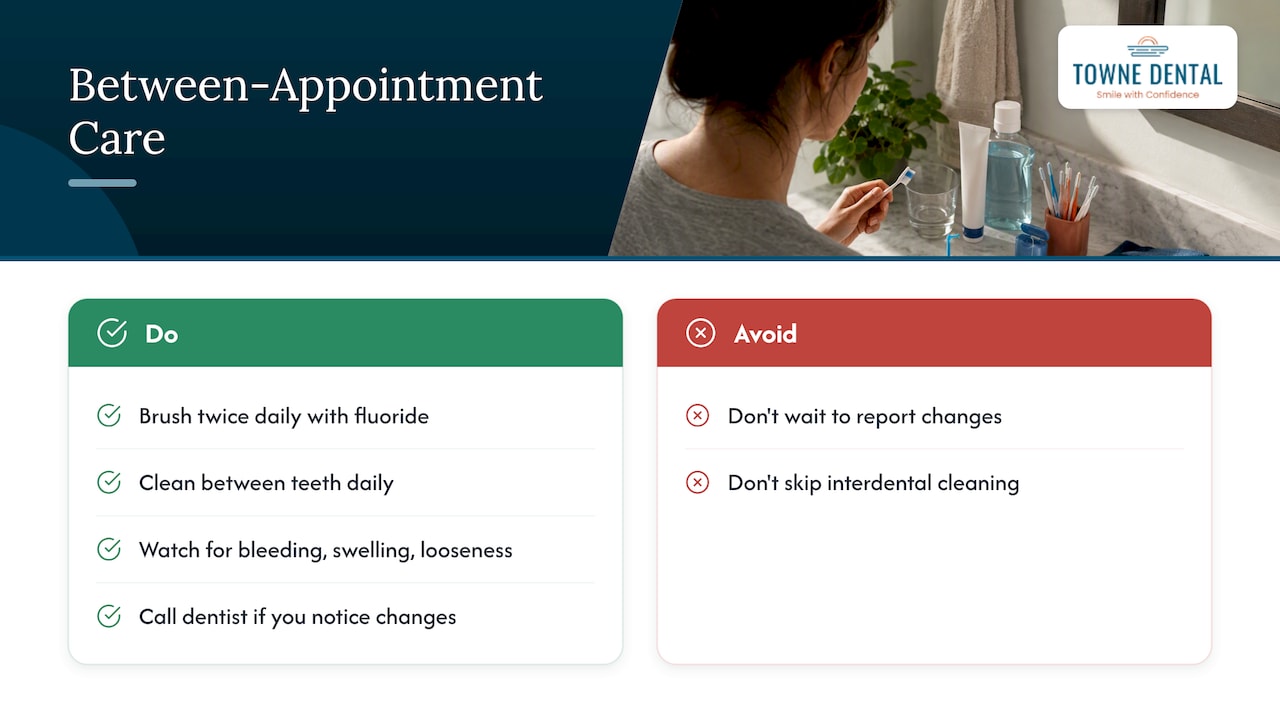
Pro Tip: If regular floss feels impossible to stick with, switch to interdental brushes or a water flosser. The method that matters is the one you’ll actually keep doing.
Quitting smoking and keeping blood sugar controlled both belong in this routine, alongside a quick review of any new medications with your provider.
Understanding insurance coverage for maintenance visits
Insurance plans treat D4910 (maintenance) differently from D1110 (prophylaxis) and from D4341/D4342 (scaling and root planing), and that coding distinction affects what gets covered. Frequency limits, prior authorization rules, and annual visit caps vary by plan, so it pays to ask your front desk or insurer directly: Is D4910 covered, how many visits per year, and does a lapse in treatment change your coverage category?
How we approach periodontal maintenance at Towne Dental
We build individualized periodontal maintenance plans around your charting results and risk profile, not a generic schedule. Our approach pairs comprehensive diagnostics with patient education, so you understand exactly why your interval is set where it is and what role your home care plays in keeping it there.
The part of gum disease care most people get wrong
The biggest misconception about periodontal maintenance is treating it like a finish line instead of an ongoing commitment. Patients often view the initial round of scaling and root planing as “fixing” their gum disease, then skip follow-up visits once symptoms fade. That is exactly backward: the research on supportive periodontal therapy shows that outcomes track compliance, not just the quality of the original treatment.
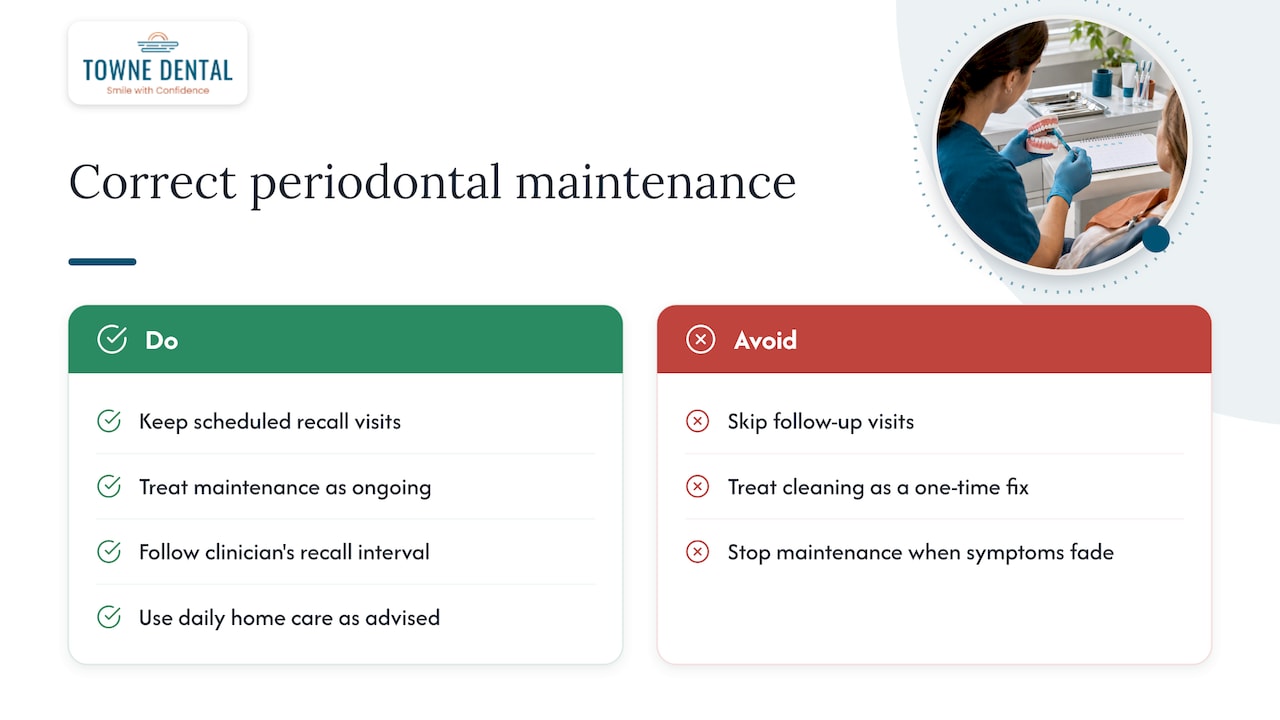
Conventional advice tends to oversell the single deep cleaning and undersell the schedule that comes after it. A patient who gets excellent scaling and root planing but skips the next three recall visits is likely to end up back where they started. The patients who keep their teeth long-term are the ones who treat maintenance as a standing appointment, the way they would treat a prescription that does not work if you stop taking it.
If you take one thing from this, prioritize the recall interval your clinician sets over any other single factor, including which specific products you use at home.
— Towne Dental
Ready to schedule your periodontal maintenance visit?
![CTA image placeholder]

If it has been more than a few months since your last periodontal visit, we welcome you to schedule an evaluation through our periodontics and gum care page. Bring your insurance card and a current medication list so we can map out the right interval from day one. Have questions about coverage? Call ahead and we will help you verify benefits before your visit.
This article is general information, not a substitute for advice from a qualified doctor. Consult a qualified healthcare professional about your own circumstances before acting on anything here.
FAQ
Is periodontal maintenance worth it?
Yes. Patients who keep up with supportive periodontal therapy show lower rates of tooth loss and more stable gum health over time than those who skip visits. The benefit comes specifically from consistent attendance, not from any single appointment.
What is included in periodontal maintenance?
A maintenance visit includes an updated health history, full periodontal charting at six points per tooth, subgingival cleaning below the gumline, and polishing, along with hygiene coaching tailored to what the exam finds. Your clinician may add focused scaling and root planing on any site showing renewed inflammation.
Is periodontal maintenance the same as deep cleaning?
No. Deep cleaning, or scaling and root planing, is the active treatment used to resolve an existing infection, while periodontal maintenance is the ongoing supportive care that follows it to prevent recurrence. The American Dental Association treats these as distinct stages of care with different clinical goals.
Does insurance cover periodontal maintenance?
Coverage depends on your specific plan, since insurers code periodontal maintenance (D4910) separately from routine cleanings (D1110), and benefits vary by provider. Ask your insurer directly about visit frequency limits and whether a lapse in care affects your coverage category.
Sources
- Periodontitis | American Dental Association
- Benefits of Dental Scaling and Polishing in Adults: A Rapid Review and Evidence Synthesis
- Smoking, Gum Disease, and Tooth Loss | CDC
- Supportive periodontal therapy review (PubMed)