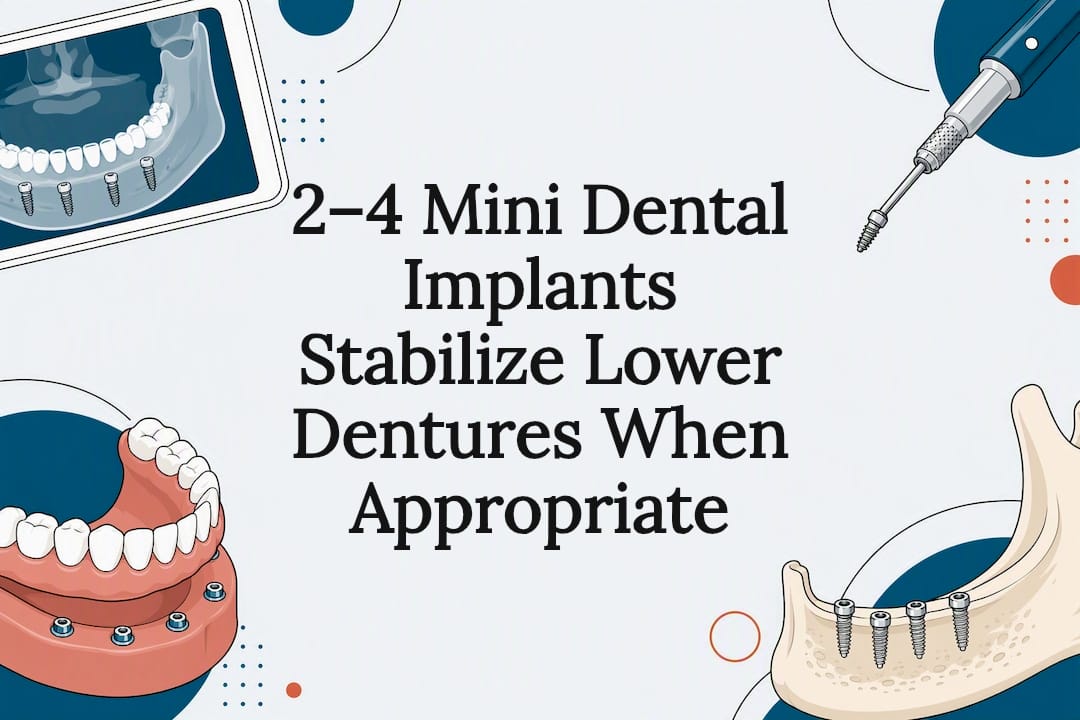
Mini dental implants are reduced-diameter, one-piece fixtures (usually 1.8 to 3.3 mm wide) placed with less surgery than standard implants. The strongest evidence backs one job in particular: stabilizing a loose lower denture and filling narrow ridge sites where a standard implant won’t fit. They’re not a blanket swap for standard implants, especially for fixed bridges or back-tooth crowns that carry heavy bite force.
TL;DR:
- Mini dental implants are ideal for stabilizing loose lower dentures and narrow ridges, but are not recommended for heavy load-bearing crowns or fixed bridges.
- Their smaller diameter and flapless placement often allow same-day denture attachment, reducing surgery time and recovery, with costs typically ranging from $500 to $1,500 per implant.
- Success depends heavily on bone density; denser cortical bone yields better stability, while soft or resorbed ridges increase early failure risk.
- Proper case selection involves thorough imaging, medical evaluation, and habit management, especially for patients with grinding habits or compromised healing.
- Long-term durability for overdentures is favorable with routine O-ring maintenance every 12 to 18 months, but evidence for longevity in fixed restorations remains limited.
Table of Contents
- What Are Mini Dental Implants?
- What Are the Benefits of Mini Dental Implants?
- Who Needs Mini Dental Implants (and Who Doesn’t)?
- What Happens During the Mini Implant Procedure?
- Mini Implants vs Traditional Implants: Where the Limits Are
- What Does It Cost, and Does Insurance Help?
- How Do You Care for Mini Dental Implants Long Term?
- How Do You Choose a Provider for Mini Implants?
- Towne Dental’s Approach to Implant Precision
- A Clinician’s View on Where Mini Implants Fit
- Ready for an Implant Evaluation?
- Where This Information Comes From
- Sources
- FAQ
What Are Mini Dental Implants?
A mini dental implant is a single, solid titanium screw, no separate abutment piece bolted on later, which is the main mechanical difference from a standard implant. Clinical literature puts the diameter at 1.8 to 3.3 mm, against 3.5 to 6 mm for conventional fixtures. That narrower body is exactly why MDIs can go into ridges too thin for a standard implant, often without cutting open the gum tissue.
The top of the implant ends in a small ball. A denture fitted with matching O-ring sockets snaps onto that ball, and the rings hold the plate down against the gum. StatPearls notes this ball-and-socket setup supports overdenture retention when the case is chosen carefully.
- One-piece design: implant and attachment post are a single unit, no internal abutment screw.
- Diameter range: 1.8 to 3.3 mm versus 3.5 to 6 mm for standard implants.
- Retention method: ball-head top clicks into an O-ring embedded in the denture base.
- Placement advantage: narrower body often allows flapless insertion through a small punch in the gum.
What Are the Benefits of Mini Dental Implants?
The appeal comes down to less surgery for a similar functional payoff, at least in the right case. Flapless placement means no stitches in many cases, which shortens the appointment and the recovery that follows. Some patients walk out with a denture that clicks into place the same day.
Cost is the other draw. Because the fixture itself is smaller and the surgical protocol is simpler, per-implant fees tend to run lower than standard implants, and grafting the jawbone first often isn’t necessary. Healthline reports per-implant costs commonly in the $500 to $1,500 range, though total treatment price depends heavily on the prosthesis.
Reported patient benefits include:
- Reduced surgical invasiveness, frequently without flap surgery
- Lower per-unit implant cost compared with standard fixtures
- Often no bone grafting needed, even in resorbed ridges
- Same-day denture stabilization in eligible cases
- Shorter recovery window with less postoperative swelling
None of this means MDIs beat standard implants across the board. It means they solve a specific problem, a loose lower denture or a ridge too narrow for wider hardware, efficiently and at lower cost.
Who Needs Mini Dental Implants (and Who Doesn’t)?
Candidacy hinges on three things: your medical history, the bone and gum tissue at the implant site, and habits like clenching or grinding. Uncontrolled diabetes, conditions that slow wound healing, and certain anticoagulant therapies can all complicate placement and need review before treatment planning starts.
Bone quality matters just as much as bone quantity. Research on implant stability shows denser cortical bone (Lekholm and Zarb Type I to II) gives MDIs a much better shot at success than the softer Type III to IV bone found in some resorbed ridges. Weak cortical contact undermines the initial stability the implant needs to integrate.
What a dentist typically screens for:
- Systemic health: diabetes control, clotting medications, autoimmune conditions affecting healing
- Bone density and ridge width, confirmed with a panoramic x-ray at minimum
- Gum health, since active periodontal disease raises failure risk
- Bite habits, particularly bruxism, which stresses the narrower implant body
- 3D imaging via CBCT when ridge width is borderline or planning is complex
Pro Tip: If your dentist recommends a nightguard alongside mini implants, wear it. Grinding puts lateral force on a narrower implant body than it was designed to absorb long term.
What Happens During the Mini Implant Procedure?
Planning starts with imaging. A panoramic x-ray gives a baseline view of bone height and nerve position, and a CBCT scan adds three-dimensional detail when the ridge is narrow or the case is complicated. This step decides whether an MDI even fits where you need it.
Placement itself is often flapless: the dentist creates a small pilot channel through the gum tissue and threads the implant in with a self-tapping motion, watching insertion torque to confirm it’s seated with enough primary stability. StatPearls documents this streamlined surgical protocol as one reason MDIs appeal to patients who want to avoid a more invasive flap procedure.
Typical timeline:
- Consultation and imaging (same day or a separate visit)
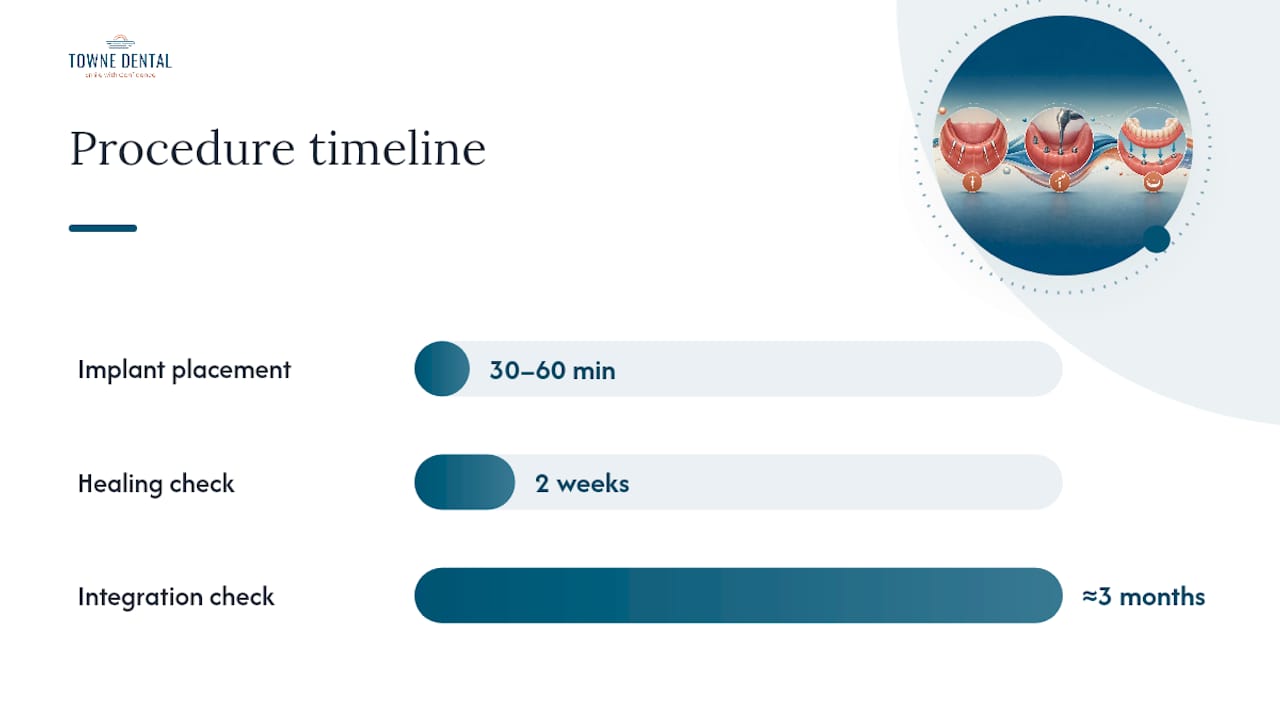
- Implant placement, usually 30 to 60 minutes for multiple units
- Immediate loading with a modified or new overdenture in many overdenture cases
- Healing check at two weeks, then a longer integration check around three months
- Follow-up adjustments as swelling resolves and bite settles
Single-tooth cases sometimes call for staged loading, waiting for full integration before attaching a permanent crown, rather than loading the implant the same day. A dental implant timeline resource can walk you through what each stage actually feels like.
Mini Implants vs Traditional Implants: Where the Limits Are
The trade-off is mechanical, not just a matter of preference. A narrower implant body has a smaller fourth-power moment of inertia, the engineering measure of how well a cylinder resists bending, which limits fatigue resistance under heavy chewing force. That’s the core reason clinicians avoid MDIs for single posterior molar crowns in patients with normal bite strength.
Evidence depth is the other gap. Decades of long-term data support standard implants for full-arch fixed bridges and molar replacement. Support for MDIs is concentrated specifically in denture stabilization and narrow-ridge cases, with far less research on how they hold up under fixed, heavy-load restorations over ten or twenty years.
Key differences that affect long-term outcomes:
- Load-bearing capacity: standard implants handle posterior molar forces better; MDIs are built for lighter, denture-retention loads
- Attachment wear: the O-ring in overdenture cases wears down and needs periodic replacement, something standard implant crowns don’t require
- Evidence base: standard implants have broader long-term data across restoration types; MDI evidence skews toward overdenture success
- Failure pattern: MDIs placed in soft, low-density bone show higher early-failure risk than in dense cortical bone
When a patient wants a fixed bridge or a single back-tooth crown and has enough bone width, most clinicians recommend a standard implant, sometimes with grafting first, over squeezing in a mini implant that wasn’t designed for that load.
What Does It Cost, and Does Insurance Help?
Per-implant fees for MDIs commonly run $500 to $1,500, noticeably below standard implant pricing. That figure is just the fixture, though. The final bill depends on how many implants your case needs and what kind of prosthesis attaches to them.
Factors that move the total price:
- Number of implants placed (a full lower overdenture might use two to four MDIs)
- Denture fabrication or retrofitting an existing denture with O-ring housings
- Lab fees for custom attachments
- Follow-up visits for adjustment and O-ring replacement over time
Dental insurance treats implants inconsistently. Some plans cover a portion of the surgical placement but exclude the prosthetic component, or vice versa. Financing programs like CareCredit are common ways patients bridge the gap, and it’s worth asking your provider’s billing office which option fits before treatment starts.
How Do You Care for Mini Dental Implants Long Term?
Daily hygiene isn’t dramatically different from natural teeth, but the attachment area needs extra attention. Brush around the ball attachment and under the denture base daily, and use an interdental brush or water flosser to clear debris the O-ring housing tends to trap.
Maintenance schedule to expect:
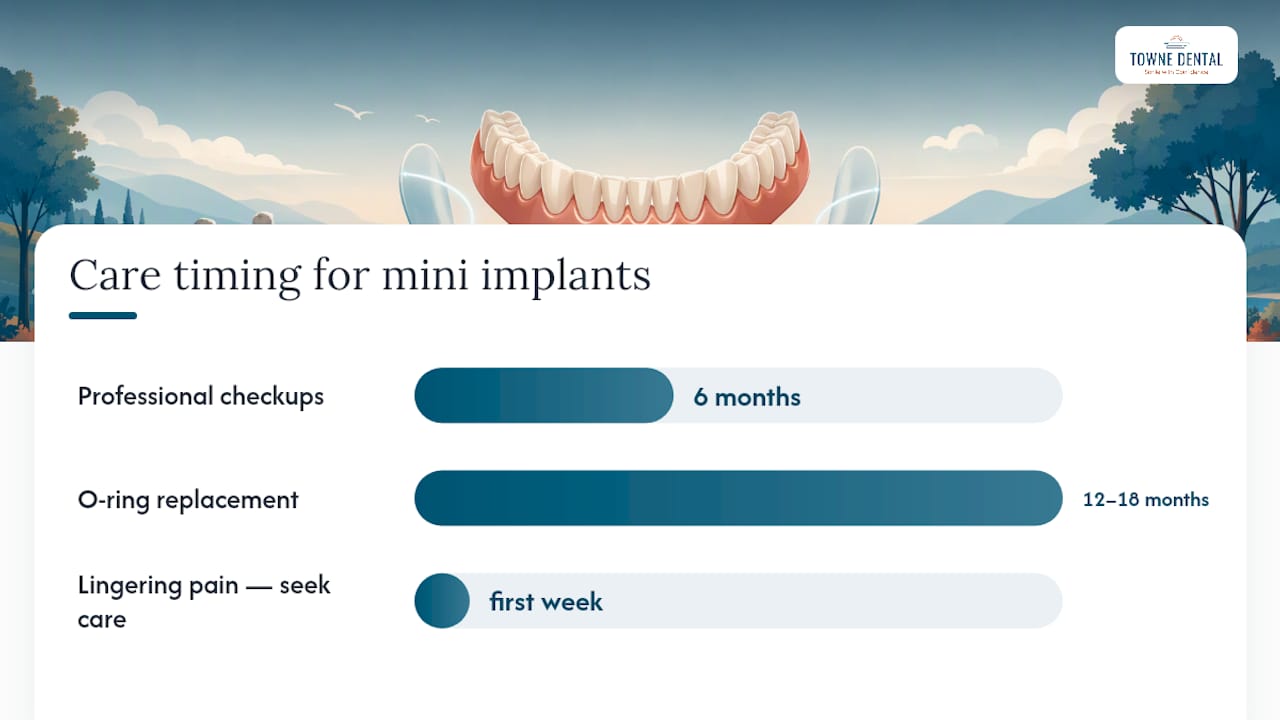
- O-ring replacement roughly every 12 to 18 months, depending on wear, per manufacturer guidance on attachment mechanics
- Professional checkups typically every six months to assess implant stability and occlusion
- Occlusal adjustment if the bite feels uneven after the denture settles
Call your dentist promptly if you notice implant mobility, pain that lingers past the first week, swelling, or numbness. Those symptoms point to infection or integration failure, and waiting rarely helps.
Pro Tip: Keep a spare set of O-rings at home once your dentist confirms the size. A worn ring loses retention gradually, and most patients notice the denture feels “looser” days before it fails completely.
How Do You Choose a Provider for Mini Implants?
Ask directly how many MDI cases the dentist has placed, and whether they use CBCT imaging for ridge assessment rather than relying on a flat x-ray alone. A thorough evaluation includes a full medical history review, an occlusal (bite) analysis, and 3D imaging before any commitment.
Questions worth asking at a consultation:
- What imaging will you use to confirm my bone width and density?
- How many mini implant cases have you placed, and what’s your complication rate?
- Is my case better suited to a mini implant or a standard implant?
- What’s the expected lifespan for my specific situation?
Walk away from any consultation built around price alone, with no imaging, or one offering guarantees no dentist can honestly make. Documented outcomes and a clear explanation of why MDIs fit your case, specifically, are the trust signals that matter.
Towne Dental’s Approach to Implant Precision
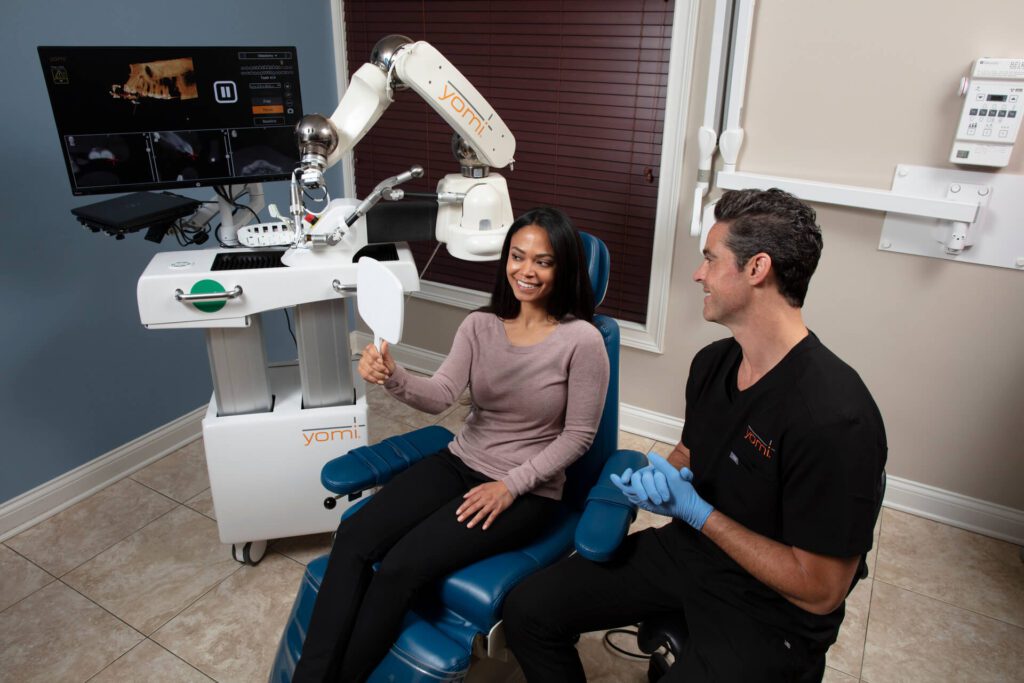
Towne Dental evaluates implant candidacy with the same rigor whether a case points toward mini implants or standard implants, using Yomi robotic-assisted surgery to guide placement with real-time precision. That technology, paired with tailored treatment planning, helps reduce invasiveness without cutting corners on diagnostics.
A Clinician’s View on Where Mini Implants Fit
Mini implants earn their place for denture retention and narrow anterior sites where a standard implant simply won’t fit without grafting. When a patient needs permanence under heavy bite force, a molar crown or a fixed bridge, standard implants remain the better-supported choice. The right call depends less on preference and more on matching your timeline, budget, and how permanent you need the result to be against what the bone and bite actually allow.
— Towne Dental
Ready for an Implant Evaluation?
Deciding between a mini implant and a standard implant isn’t something to guess at from an article, it comes down to your bone density, ridge width, and bite force, and that only shows up clearly on imaging. Towne Dental’s evaluations start with a full diagnostic workup, including CBCT scans when the case calls for it, so you get a recommendation built on your anatomy rather than a one-size answer.

If you’ve been dealing with a loose lower denture or you’re missing teeth and unsure which implant type fits your situation, scheduling an oral surgery consultation is the most direct way to find out. Towne Dental’s team will walk you through whether a mini implant, a standard implant, or a combination approach gets you the most stable, longest-lasting result. Explore the full range of cosmetic and restorative options available before your visit, and come in with your questions ready. If mobility, pain, or a denture emergency is the reason you’re reading this today, same-day emergency care is also available.
Where This Information Comes From
The clinical claims here draw on peer-reviewed literature and professional references rather than marketing copy. The PubMed literature on reduced-diameter implants and StatPearls’ clinical overview of mini implants anchor the definitions, indications, and procedural details. Bone density thresholds come from PubMed research on implant stability, and practical cost ranges are drawn from Healthline’s consumer guide. Trade-level analysis of clinical boundaries comes from Decisions in Dentistry, and readers researching quality-of-life benefits for older adults with implants can find additional background from Y-Brush’s coverage of senior implant outcomes.
This article is general information, not a substitute for advice from a qualified doctor. Consult a qualified healthcare professional about your own circumstances before acting on anything here.
Sources
- PubMed: clinical literature on reduced-diameter implants
- StatPearls: Dental Mini-Implants
- Healthline: Mini dental implants guide
FAQ
Are Mini Dental Implants as Strong as Regular Implants?
No. Their narrower diameter gives them less resistance to bending fatigue, which is why clinicians generally avoid them for posterior molar crowns or fixed bridges under heavy bite force.
How Long Do Mini Dental Implants Last?
Long-term data is more limited than for standard implants, but overdenture cases with proper case selection show favorable outcomes; O-ring attachments typically need replacement every 12 to 18 months.
Can Mini Dental Implants Be Used for Dentures?
Yes, this is their best-supported use. Multiple MDIs (often two to four) placed in the lower jaw can stabilize a removable overdenture through a ball-and-O-ring attachment system.
What Is the Recovery Time for Mini Dental Implants?
Recovery is often faster than standard implants because placement is frequently flapless, with many patients resuming normal eating within days rather than weeks.
Does Towne Dental Offer Mini Dental Implants?
Towne Dental evaluates each patient’s bone density and ridge anatomy to determine whether a mini implant or a standard implant, placed with Yomi robotic assistance, fits their case best.