If you’re 1–3 days past a tooth extraction and the pain is getting worse instead of better, that’s the clearest warning sign of dry socket. Clinically known as alveolar osteitis, the condition occurs when the blood clot that forms in the empty socket dissolves or dislodges too early, leaving bone and nerve endings exposed. According to the Mayo Clinic, dry socket symptoms typically include:
- Severe, throbbing pain starting 1–3 days after extraction, often worse than the initial post-op pain
- Radiating pain that spreads to your ear, temple, or neck on the same side
- Visible empty socket or exposed bone where the clot should be
- Bad taste or persistent bad breath that doesn’t resolve with gentle rinsing
- Possible low-grade fever in some cases
What to do right now: Call your dentist or their after-hours line. Until you’re seen, avoid straws, smoking, and spitting — all of which can worsen the problem. Over-the-counter ibuprofen or acetaminophen can take the edge off, but they rarely eliminate the pain once dry socket sets in.
Seek urgent care immediately if you have: uncontrolled pain that doesn’t respond to any medication, a fever above 101°F, spreading swelling in your jaw or neck, or any difficulty breathing or swallowing. Those signs point beyond dry socket to a possible infection requiring prompt evaluation.
Alveolar osteitis affects a small percentage of routine extractions, though that rate climbs significantly after impacted third-molar removals.
Table of Contents
- What dry socket symptoms actually feel like
- How to tell dry socket apart from normal healing
- How dentists diagnose dry socket in the clinic
- How dry socket is treated and what to expect for pain relief
- How to reduce your risk after a tooth extraction
- Why the pain pattern is the most important clinical clue
- Key Takeaways
- What a dental practice wants you to know about dry socket
- Towne Dental is here when post-extraction pain won’t wait
- Authoritative resources and further reading
- FAQ
What dry socket symptoms actually feel like
The pain is the story. Most patients describe it as a deep, throbbing ache that feels nothing like the dull soreness of normal healing. It often starts around day 2 or 3 post-extraction, and the defining feature is that it keeps intensifying rather than fading. Many patients report it as worse than the toothache that led to the extraction in the first place.
The radiation pattern is a useful clue. Pain that travels up toward your ear, across your temple, or down into your neck on the extraction side is a hallmark sign. That pattern reflects exposed nerve endings in the socket, not a separate problem with your ear or jaw joint.
Beyond pain, MedlinePlus notes that a persistent bad taste and noticeable bad breath (halitosis) are common. Food debris can collect in the open socket and compound both the odor and the discomfort. If you notice a funny taste in your mouth that won’t clear, that’s worth flagging to your dentist alongside the pain.
Visually, you may see a grayish-white area where the dark clot should be, or you might spot what looks like bone. The socket may appear partially empty. That said, visual inspection has real limits — more on that below.
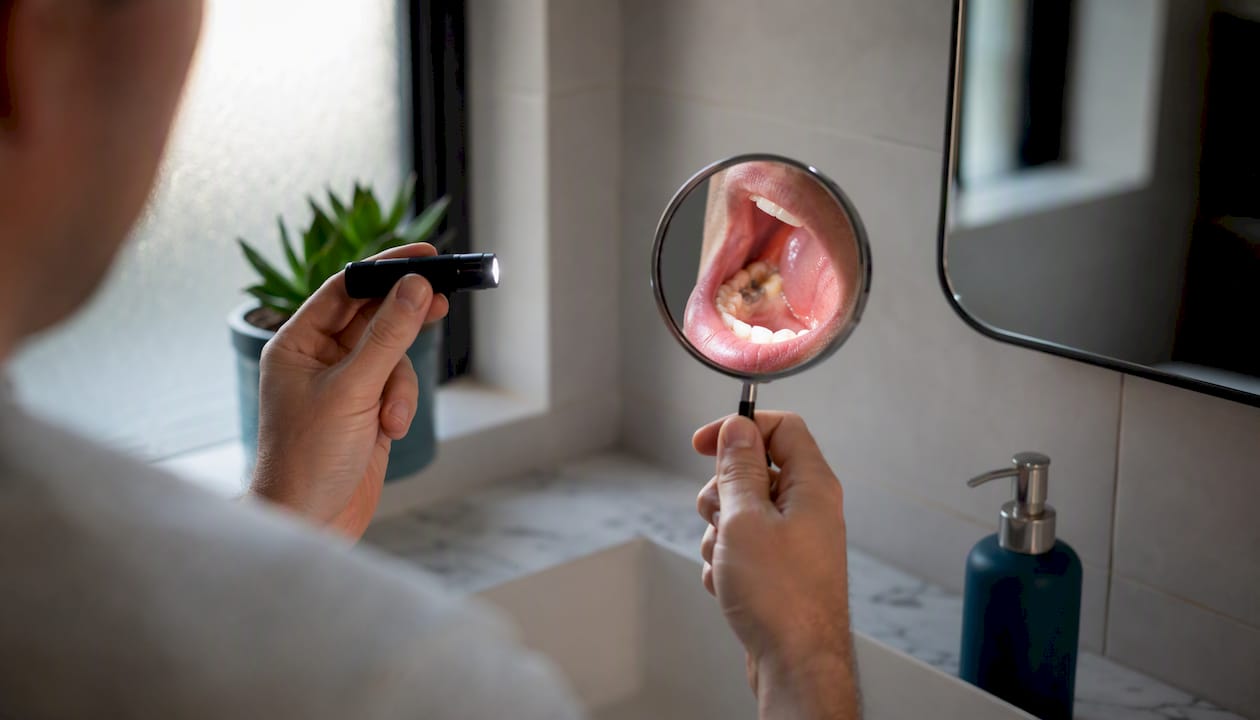
Pro Tip: To check the socket safely, use a flashlight and a mirror in good lighting. Tilt your head and look without touching or probing the area. Never use a finger, cotton swab, or toothpick to investigate — any contact can dislodge fragile healing tissue and make things worse.
How to tell dry socket apart from normal healing
The single most reliable distinction is the pain trajectory, not what the socket looks like.
Normal post-extraction healing follows a predictable arc: pain peaks in the first 24 hours, then gradually eases over the next few days. You might need ibuprofen or acetaminophen for a day or two, but by day 3 or 4, things should feel noticeably better. Medical News Today describes normal healing as involving a stable, dark-red or maroon clot sitting in the socket, with steady improvement in discomfort.
Dry socket follows the opposite pattern: initial improvement, then a sudden spike in pain around day 2 or 3. That reversal is the clinical red flag.
| Feature | Normal healing | Dry socket |
|---|---|---|
| Pain timing | Peaks at 24 hours, then improves | Worsens at day 1–3 after initial relief |
| Pain quality | Dull soreness, manageable with OTC meds | Intense, throbbing, radiating |
| Socket appearance | Dark-red/maroon clot present | Clot absent or partially missing; possible exposed bone |
| Breath/taste | Mild or normal | Persistent bad taste, noticeable bad breath |
| Fever | Absent | Possible low-grade fever |
One important caution: don’t rely on appearance alone. White or yellowish tissue inside the socket can be normal granulation tissue forming during healing. It’s easy to mistake that for exposed bone. Worsening pain is a far more reliable indicator than a photo or a quick look in the mirror.
How dentists diagnose dry socket in the clinic
There’s no lab test or X-ray that definitively confirms dry socket. StatPearls notes that no universal diagnostic criteria exist — diagnosis is clinical, driven by the patient’s pain history and a focused oral exam. The dentist looks for an absent or partially missing clot, visible bone, and a pain pattern consistent with alveolar osteitis.
Expect your dentist to ask:
- When did the pain start, and has it been getting better or worse?
- Does the pain radiate, and where?
- Are you a smoker, or did you use a straw or spit in the first 24–48 hours?
- Have you had a fever, or noticed swelling beyond the extraction site?
- What medications have you taken, and did they help?
X-rays may be ordered to rule out a retained root fragment or underlying bone infection, but they’re not required to diagnose dry socket itself. The clinical picture — worsening pain, missing clot, exposed bone — is usually enough for a dentist to act.
Pro Tip: Before your appointment, write down the exact day your pain started, how it has changed hour by hour, and any medications you’ve taken with their doses and timing. That timeline is the single most useful thing you can bring. Avoid aggressively rinsing or irrigating the socket right before you arrive — it can temporarily alter what the dentist sees.
How dry socket is treated and what to expect for pain relief
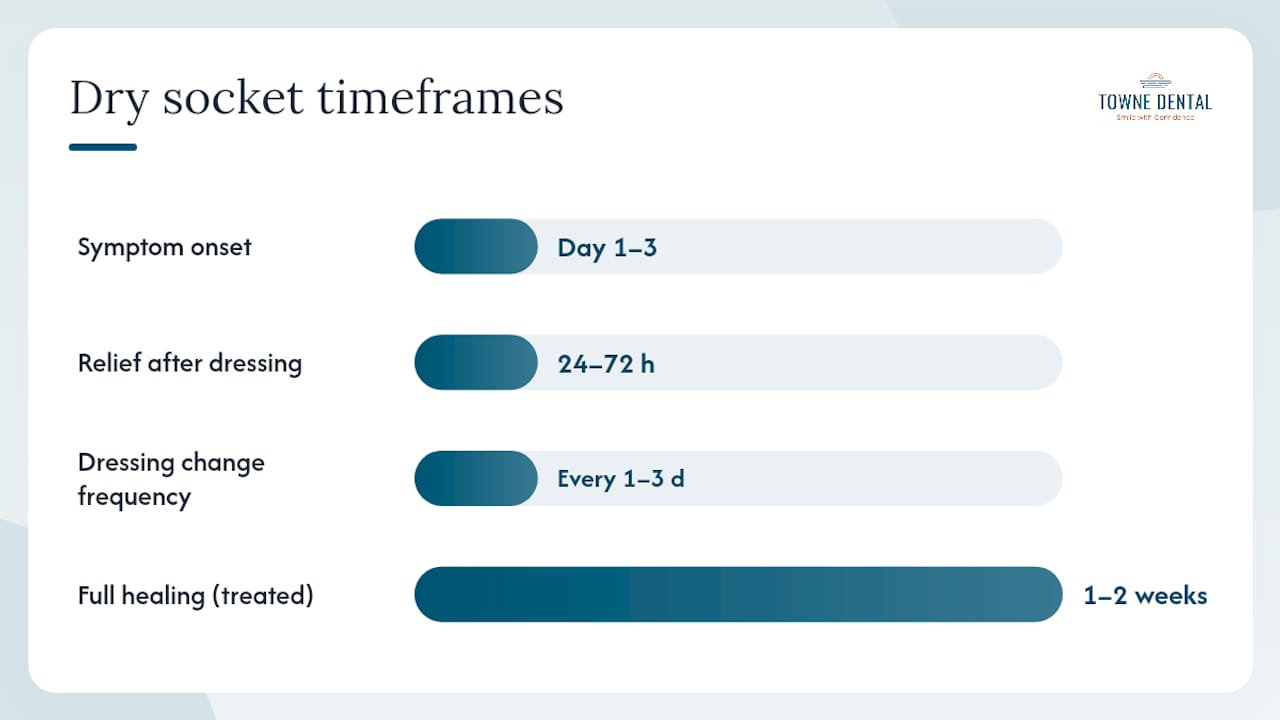
The good news: treatment is straightforward and usually brings noticeable relief within 24–72 hours.
In the office, the dentist will first irrigate the socket to flush out debris and bacteria. StatPearls stresses that curettage (scraping the socket walls) is specifically discouraged because it can further expose bone — irrigation is the safer and more effective approach. After cleaning, a medicated dressing is placed directly in the socket. The MSD Manual describes dressings saturated with iodoform and eugenol (or similar agents like butamben) as the standard approach; these provide local analgesia and typically wash out on their own within a few days. Dressing changes may be needed every 24–48 hours until symptoms resolve.
| Timeline | What to expect |
|---|---|
| Symptom onset | Day 1–3 after extraction |
| Relief after dressing | Usually within 24–72 hours |
| Dressing change frequency | Every 1–3 days as needed |
| Full healing (treated) | Usually about one to two weeks |
Antibiotics are not routinely prescribed for dry socket. The condition is not primarily an infection. They’re appropriate only when there are systemic signs of infection — spreading swelling, high fever, or lymph node involvement.
For at-home care until you’re seen, the Mayo Clinic recommends gentle saltwater rinses (after the first 24 hours), avoiding smoking, and steering clear of straws and carbonated drinks. Some patients are given a small syringe to gently flush the socket at home between appointments. Soft foods — yogurt, mashed potatoes, scrambled eggs — reduce trauma to the area.
- Avoid straws, smoking, and spitting
- Rinse gently with warm salt water after meals (not in the first 24 hours)
- Take OTC analgesics (ibuprofen or acetaminophen) as directed
- Eat soft foods and chew on the opposite side
- Follow all dressing-change appointments your dentist schedules
How to reduce your risk after a tooth extraction
Most dry socket cases are preventable with careful behavior in the first few days. The clot is most vulnerable in the first 72 hours, so that’s when your choices matter most.
Do:
- Keep your head elevated, especially when sleeping, for the first 24–48 hours
- Follow any prescribed medications exactly as directed
- Eat soft foods and stay well hydrated
- After the first 24 hours, rinse gently with warm salt water after meals
- Ask your dentist whether a chlorhexidine rinse is appropriate for your case — it’s sometimes recommended for higher-risk patients, but not universally
Don’t:
- Smoke or use any tobacco product for at least 72 hours (ideally longer)
- Use a straw for any beverage
- Spit forcefully
- Rinse aggressively in the first 24 hours
- Poke or probe the socket with your tongue, finger, or any object
If you take oral contraceptives, talk to your dentist before the procedure. Some clinicians recommend scheduling extractions during the low-estrogen phase of the pill cycle to reduce clotting interference, though this is a conversation to have with your provider. For a broader checklist of recovery habits, post-oral surgery care covers the full first-week picture.
Pro Tip: Plan your meals before the extraction. Stock your kitchen with soft foods for at least three days: applesauce, soup (not too hot), yogurt, smoothies eaten with a spoon, and mashed vegetables. Having everything ready removes the temptation to eat something crunchy or use a straw when you’re hungry and in pain.
For patients navigating more complex post-surgical healing, this implant recovery guide covers overlapping principles around clot protection and tissue healing timelines.
Why the pain pattern is the most important clinical clue
Dentists don’t wait for a lab result to treat dry socket. Because no universal diagnostic criteria exist, the clinical standard is to treat on suspicion when the pain history and exam are consistent with alveolar osteitis. StatPearls is explicit on this point: patient pain is the primary diagnostic driver, and withholding treatment while waiting for certainty only prolongs suffering.
The fibrinolytic theory explains why the pain is so severe. When the clot dissolves, the underlying alveolar bone and its nerve supply are directly exposed to the oral environment — saliva, food, temperature, and bacteria. That exposure triggers intense, constant nerve stimulation. It’s not inflammation in the usual sense; it’s raw nerve exposure, which is why standard anti-inflammatory medications often provide only partial relief.
Pain trajectory is what separates dry socket from the normal post-extraction soreness that every patient experiences. Steady improvement means healing is on track. A sudden worsening after initial improvement means something has gone wrong with the clot. Medical News Today frames this distinction clearly: the reversal pattern is the signal, not the absolute pain level.
Pro Tip: When you call your dentist, lead with the timeline: “My extraction was on [date], I felt okay for the first day, and then on day [X] the pain got significantly worse and now radiates to my ear.” That description alone tells a clinician almost everything they need to prioritize your appointment.
Key Takeaways
Dry socket is identified primarily by worsening pain 1–3 days after extraction, not by how the socket looks — and prompt dental treatment with irrigation and a medicated dressing typically brings relief within 24–72 hours.
| Point | Details |
|---|---|
| Core diagnostic sign | Pain that worsens at day 1–3 after initial improvement is the primary red flag. |
| Visual signs can mislead | White or yellow tissue may be normal healing; rely on pain trajectory, not appearance alone. |
| Highest-risk patients | Smokers, oral contraceptive users, and those with impacted third-molar extractions face elevated risk. |
| Treatment timeline | Medicated dressings typically relieve pain within 24–72 hours; full healing usually takes 7–14 days. |
| Towne Dental | Towne Dental provides emergency and same-week care for post-extraction pain, including socket irrigation and medicated dressing placement. |
What a dental practice wants you to know about dry socket
Prompt assessment genuinely reduces suffering. Dry socket is one of those post-op complications where waiting even a day or two longer than necessary means unnecessary pain — and the treatment itself is quick, focused, and effective. When a patient comes in describing worsening pain that radiates to the ear starting around day 2, the clinical path is clear: irrigate, dress, and schedule a follow-up.
When you come in, bring a list of every medication you’re taking (including oral contraceptives and supplements), the exact date and time of your extraction, and a note on when the pain changed character. If you have photos of the socket taken in good lighting, those can be useful context, though the exam will be the deciding factor.
Towne Dental is here when post-extraction pain won’t wait
Post-extraction pain that’s getting worse on day 2 or 3 needs to be seen, not managed at home with painkillers. Towne Dental offers emergency dental care and same-week appointments specifically for situations like this — socket irrigation, medicated dressing placement, and pain management handled by an experienced team that knows what to look for.

The clinic’s oral surgery team in Naples, FL handles post-extraction complications including dry socket, and the broader dental services include everything from the initial exam through follow-up dressing changes. No need to wait it out or guess whether what you’re feeling is normal. If the pain is worsening, call Towne Dental and get seen.
Authoritative resources and further reading
These are the primary sources behind the guidance in this article. Each one is worth bookmarking, and bringing them to your appointment can help frame the conversation with your dentist.
- Dry socket – Symptoms and causes – Mayo Clinic
- Dry socket – Diagnosis and treatment – Mayo Clinic
- Alveolar Osteitis – StatPearls – NCBI Bookshelf
- Dry socket vs normal socket: Pictures, symptoms, and healing time
- Postextraction problems – MSD Manual Professional Edition
- Dry socket — MedlinePlus patient instructions
- PMC article on alveolar osteitis
FAQ
How do you know if a dry socket is forming?
The clearest sign is pain that worsens around day 1–3 after extraction rather than improving, often radiating toward the ear or temple. A visible empty socket or persistent bad taste alongside that pain pattern strongly suggests dry socket.
Will a dry socket heal on its own?
Dry socket is self-limiting, but healing without treatment is slow and painful — it can take weeks. A dentist can place a medicated dressing that typically brings significant relief within 24–72 hours, making treatment well worth pursuing rather than waiting it out.
What are the riskiest days for dry socket?
Days 1–3 after extraction carry the highest risk, as the blood clot is most vulnerable to dislodgement or breakdown during that window. Avoiding straws, smoking, and forceful spitting during this period is the most effective prevention.
How can you tell the difference between dry socket and normal healing?
Normal healing pain steadily improves after the first 24 hours; dry socket pain reverses that pattern and gets worse. A stable dark-red clot in the socket points to normal healing, while an absent clot or visible bone alongside worsening pain points to dry socket.
Does Towne Dental treat dry socket?
Yes. Towne Dental provides emergency and same-week appointments for post-extraction complications including dry socket, offering socket irrigation, medicated dressing placement, and pain management at its Naples, FL location.