Yes, many cases of dry socket are preventable. The single most important step is protecting the blood clot that forms in the socket right after extraction, so avoid suction, smoking, and forceful rinsing, and follow your dentist’s specific aftercare instructions closely for at least the first few days.
TL;DR:
- Protect the blood clot in the socket by avoiding suction, smoking, and forceful rinsing during the first few days after extraction.
- Rinsing with chlorhexidine before and after extraction can reduce dry socket risk by around 40%, especially in high-risk cases like impacted molars.
- The highest risk period for dry socket is days two to five post-extraction, particularly if pain worsens instead of improves during this window.
- Intra-socket measures like platelet-rich fibrin show promise but lack enough evidence for broad recommendation; routine antibiotics are not advised.
- Tighter precautions and professional follow-up are advised for surgical, impacted, or complicated extractions with multiple risk factors.
Table of Contents
- Your prevention checklist for the first two weeks
- What the research actually shows about chlorhexidine, antibiotics, and PRF
- Who faces the highest risk and when it peaks
- What to do if you suspect dry socket
- How Towne Dental’s approach lowers your risk from the start
- Why the standard advice sells patients short
- Getting help from Towne Dental if something feels wrong
- Sources
- FAQ
Your prevention checklist for the first two weeks
The clot that forms in your socket within the first hour is your body’s scaffold for healing. Everything you do in the days after extraction should protect it.
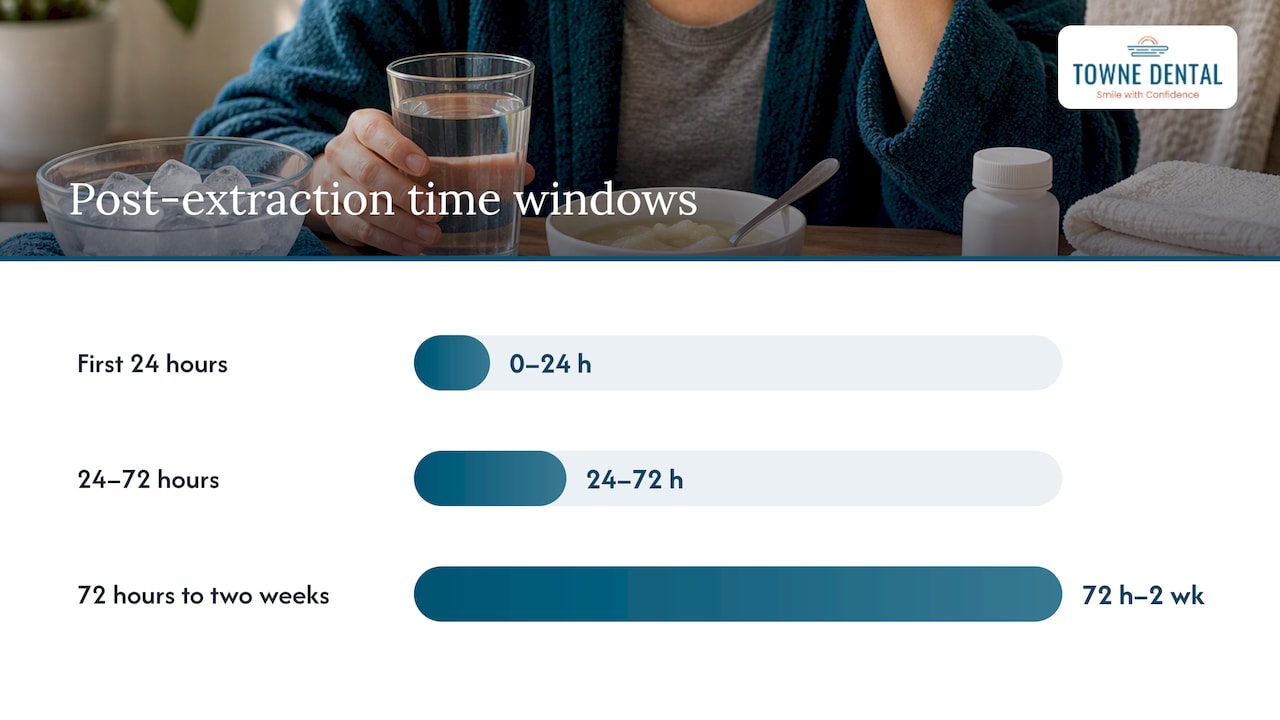
In the first 24 hours:
- Bite on gauze with steady pressure for 30 to 45 minutes to control bleeding.
- Keep your head elevated, even while sleeping, to reduce throbbing and swelling.
- Skip rinsing, spitting, and using a straw entirely.
- Do not smoke or use any nicotine product, including vaping or nicotine pouches.
From 24 to 72 hours, you can usually start gentle warm saline rinses, letting the water fall out of your mouth rather than spitting it. Moderate evidence supports warm saline mouth baths as a helpful addition to standard aftercare. Stick to a soft diet (yogurt, mashed potatoes, smoothies eaten with a spoon, not sipped through a straw) and chew on the opposite side of your mouth.
From 72 hours to two weeks, continue gentle brushing around the site, avoid hard or sticky foods, and watch for pain that worsens instead of easing. For a detailed walkthrough of this window, our post on the first 72 hours of wisdom tooth recovery covers the transition step by step.
- Take pain medication exactly as your dentist prescribes.
- Avoid aspirin unless your dentist says otherwise, since it can increase bleeding.
- Sleep on your back with an extra pillow rather than on the side of the extraction.
- If bleeding restarts during travel or at night, bite on a clean, damp gauze pad or tea bag for 20 minutes before calling your dentist.
Pro Tip: Set a phone reminder for gentle saline rinses after meals starting on day two. Consistency matters more than intensity.
For a broader list of aftercare habits, see 10 things to do after oral surgery for faster recovery.
What the research actually shows about chlorhexidine, antibiotics, and PRF
Not every prevention method has equal backing. A Cochrane review on alveolar osteitis found that rinsing with 0.12% or 0.2% chlorhexidine mouthwash before and after extraction reduces dry socket risk by roughly 40%, with chlorhexidine gel in the socket showing even greater risk reduction
A meta-analysis behind these figures shows that the number needed to treat (NNT) to prevent one case of dry socket shifts sharply with baseline risk: at a 1% baseline incidence, dozens of patients need treatment to prevent one case, while at a 30% baseline, as seen with impacted third molars, the NNT drops much lower, meaning the same intervention delivers far more real-world benefit for higher-risk patients.
- Chlorhexidine rinses and gels have moderate-certainty evidence behind them.
- Routine systemic antibiotics are not recommended for prevention and are reserved for select high-risk impacted third-molar cases or suspected infection.
- Platelet-rich fibrin (PRF) and similar intrasocket measures look promising in small trials, but the evidence base remains too limited to recommend broadly.
A systematic review of prevention interventions echoes this: chlorhexidine has the strongest support, while most other measures lack consistent proof. Timing matters too: rinses typically start about 24 hours after extraction, and swishing should always be gentle rather than vigorous. For more on safe formulations, see our guide to antiseptic mouthwash for tooth infection.
Who faces the highest risk and when it peaks
Dry socket does not hit everyone equally. Routine extractions carry a 1% to 5% incidence, while surgically removed, impacted third molars can see incidence as high as 30%.
- Traumatic or difficult extractions carry significantly higher odds of dry socket than straightforward ones.
- Smoking after extraction, prior infection at the site, and poor oral hygiene all raise risk.
- Oral contraceptive use and hormonal fluctuation are associated with higher rates in some studies.
The riskiest window falls between days two and five after extraction, when pain that should be easing instead intensifies. If you had a surgical or impacted extraction, or you carry several risk factors at once, tighter precautions and a conversation with your dentist about chlorhexidine rinses make sense.
What to do if you suspect dry socket
Dry socket pain behaves differently from normal healing. Instead of gradually fading, it tends to worsen around 48 to 72 hours after extraction, often with a foul taste or odor and a visibly empty socket where the clot should be. For a full symptom breakdown, see dry socket symptoms: how to spot it.
- Avoid touching or rinsing the site aggressively; a gentle saline rinse is fine if tolerated.
- Take acetaminophen or ibuprofen as directed, and call your dentist the same day.
- Expect an exam, saline irrigation of the socket, and often a medicated dressing or analgesic packing to ease pain while healing continues.
- Fever, heavy bleeding, or pain that medication cannot touch are urgent signs.
- Visibly exposed bone at the extraction site warrants a same-day call.
- Antibiotics are added only if your dentist suspects an active infection, not as routine treatment.
How Towne Dental’s approach lowers your risk from the start
Prevention starts before the extraction ever happens. Minimally invasive technique and careful, experienced handling of the socket reduce the tissue trauma that drives up dry-socket risk in the first place.
- Oral surgery and tooth extraction performed with attention to minimizing bone and soft-tissue trauma.
- Sedation dentistry available for patients who feel anxious about surgical extractions, including impacted third molars.
- Emergency dentistry for same-day evaluation if pain worsens instead of improving.
- Personalized aftercare instructions given at discharge, paired with resources like 10 things to do after oral surgery.
For complex or impacted third-molar cases, a specialist referral or sedation option is often worth discussing before the procedure, not after.
Why the standard advice sells patients short
Most dry-socket advice online is a list of dos and don’ts with no sense of proportion. It rarely mentions that the benefit of measures like chlorhexidine rinses scales with your actual risk level, so a low-risk patient with a simple extraction gains far less from strict protocols than someone facing a surgical third-molar removal. That distinction gets lost in generic checklists.
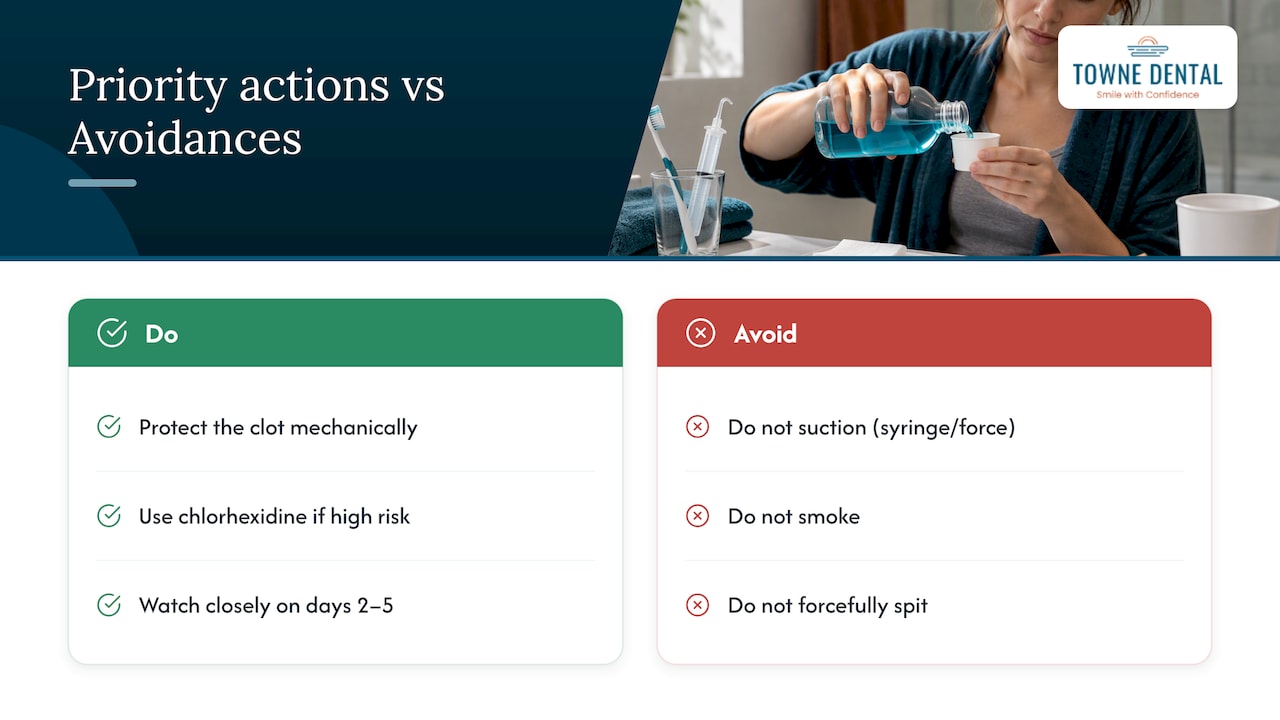
The bigger gap is timing awareness. Patients are told to “watch for symptoms” without being told that days two through five are the window that matters most. Vigilance on day one and casualness on day four is backward.
If there is one priority, it is this: protect the clot mechanically first (no suction, no smoking, no forceful spitting), then layer on chlorhexidine if you are in a higher-risk group. Everything else, including PRF and other emerging measures, is still unproven enough to treat as optional rather than essential.
— Towne Dental
Getting help from Towne Dental if something feels wrong
If you are recovering from an extraction and pain is getting worse instead of better, do not wait it out. Towne Dental offers oral surgery and tooth extraction with attention to gentle technique, plus emergency dentistry for same-day evaluation when something does not feel right.

- Call or book online through our services page to schedule an evaluation.
- Bring your insurance information, a list of current medications, and any post-op instructions you were given.
- Keep following your prevention checklist, and call promptly if pain worsens after day two instead of easing.
Our team can walk you through what to expect before treatment on our pre-surgery preparation page as well.
Sources
This article draws on the Cochrane review on alveolar osteitis, a StatPearls clinical summary, and peer-reviewed incidence and trial data linked throughout.
This article is general information, not a substitute for advice from a qualified doctor. Consult a qualified healthcare professional about your own circumstances before acting on anything here.
- Cochrane review: prevention and treatment of alveolar osteitis (dry socket)
- Prevention and treatment of dry socket — trial and meta-analysis results
FAQ
What are the odds of getting a dry socket?
Odds depend heavily on the type of extraction. Routine extractions carry roughly a 1% to 5% chance, while surgically removed, impacted third molars have a substantially higher incidence
Can salt water rinse prevent dry socket?
Warm saline rinses are not a proven standalone prevention method, but moderate evidence supports them as a helpful adjunct to good oral hygiene once you are past the first 24 hours. Chlorhexidine rinses, not plain saline, have the strongest evidence for actually lowering dry-socket risk.
What are the riskiest days for dry socket?
Symptoms typically emerge and worsen between two and five days after extraction, which is when vigilance matters most. Pain that improves steadily is normal healing; pain that intensifies in this window is the hallmark of dry socket.
What is the number one cause of dry socket?
Disruption or loss of the protective blood clot in the socket is the central cause, and it is most often triggered by smoking, forceful spitting or nose-blowing, or vigorous rinsing too soon after extraction. Traumatic or difficult extractions also carry significantly higher risk of clot disruption independent of aftercare habits.