Most dental plans either exclude implants entirely or classify them as “major” restorative work, which means you’re typically looking at about half reimbursement — capped by an annual maximum that often runs a few thousand dollars. On a procedure that averages $4,507 nationwide, that math leaves most patients paying the bulk out of pocket. Dental implants insurance is a real category, but the gap between what plans promise and what they actually pay tends to surprise people.
Here’s what to do right now:
- Pull your plan’s Summary of Benefits and Coverage (SBC) and search for “implants” and “major restorative.”
- Ask your dental office to submit a predetermination of benefits before any work is scheduled.
- Compare HSA/FSA balances and clinic financing options as your primary payment strategy.
Key Takeaways
Most patients pay the majority of implant costs out of pocket, making predetermination and financing strategy more important than shopping for the “best” dental plan.
| Point | Details |
|---|---|
| Coverage is limited | Most plans cap major restorative at 50%, with annual maximums of $1,000–$2,500 on a $4,507 average implant. |
| Four clauses to check | Missing-tooth exclusion, LEAT rule, waiting periods (up to 24 months), and annual maximums determine actual payout. |
| Predetermination is essential | Submit a written predetermination with CDT codes before scheduling surgery to avoid surprise bills. |
| HSA beats most financing | HSA funds roll over, are tax-free, and can pay for implants — often cheaper than deferred-interest financing. |
| Phase treatment strategically | Splitting implant stages across two calendar years can double your insurer’s annual maximum contribution. |
Table of Contents
- What are dental implants, and which type do you need?
- How much do dental implants cost in the U.S.?
- Does dental insurance cover implants, and how do plans handle them?
- When might medical insurance, Medicare, or Medicaid cover implants?
- How to find a dental plan that actually helps with implant costs
- How to check your coverage and get a predetermination
- Ways to make dental implants more affordable
- What to expect during the implant process
- How Towne Dental helps patients navigate implants, financing, and the process
- What most people get wrong about dental implants insurance
- Sources
- FAQ
What are dental implants, and which type do you need?
A dental implant is a titanium post surgically placed into the jawbone, topped with an abutment and a custom crown, to replace a missing tooth root-to-tip. The CDC’s oral health guidance recommends reviewing your plan documents and consulting a provider before assuming any procedure is covered, and implants are a prime example of why.
The common procedure types:
- Single-tooth implant: One post, one abutment, one crown. The most common scenario and the baseline for cost comparisons.
- Implant-supported bridge: Two implant posts anchor a multi-tooth bridge, replacing several adjacent teeth without individual crowns on each.
- Full-arch/All-on-4: Four to six implants support a full arch of teeth. Often used when most or all teeth in a jaw are missing.
- Implant-retained denture: Implants snap into or attach to a removable denture, giving it stability without permanently fixing it.
Implants preserve jawbone density in a way bridges and dentures can’t, and they typically last decades with proper care. A dental implant warranty from your clinic adds another layer of long-term protection worth asking about.
Pro Tip: Bone grafting or a sinus lift is often required before implant placement if bone volume is insufficient. These add-ons can add $500–$3,000 to the total cost and extend the timeline by several months. Ask your dentist upfront whether imaging shows you’ll need either.

How much do dental implants cost in the U.S.?
A complete single implant averaged $4,507 nationwide in 2026, but that figure masks significant variation. California and New York metro areas routinely run higher; Alabama and rural Midwest markets tend to come in lower. For a detailed breakdown of what U.S. patients pay by component, the picture looks roughly like this:
| Component | Typical U.S. Range |
|---|---|
| Implant post (surgical placement) | $1,500–$2,000 |
| Abutment | $300–$500 |
| Crown (porcelain or zirconia) | $1,000–$2,000 |
| Bone graft (if needed) | $500–$3,000 |
| CBCT imaging/cone beam scan | $200–$500 |
| Full single implant (all-in) | $3,000–$4,500+ |
Key cost drivers beyond the base procedure:
- Location: Urban specialty practices charge more than suburban general dentists.
- Surgeon credentials: Oral surgeons and periodontists typically charge more than general dentists for the surgical phase.
- Materials: Zirconia crowns cost more than porcelain-fused-to-metal but are more durable and natural-looking.
- Number of implants: Full-arch cases scale differently; All-on-4 pricing is usually quoted per arch, not per tooth.
- Preparatory work: Extractions, grafts, and sinus lifts are billed separately and can rival the implant cost itself.
Does dental insurance cover implants, and how do plans handle them?
Most dental plans classify implants as major restorative work.
But if your annual maximum is $1,500 and you’ve already used $300 on cleanings, the plan pays $1,200 total. You pay $3,300.
Four policy clauses cause the most surprises:
- Missing-tooth/pre-existing exclusion: Many plans won’t cover an implant for a tooth that was already missing when you enrolled. If you lost the tooth before your current plan started, you may get nothing.
- Least expensive alternative treatment (LEAT) / alternate-benefit rule: Insurers may cap reimbursement at what a bridge or denture would cost, even if you choose an implant. So the plan pays “bridge rates” and you absorb the difference.
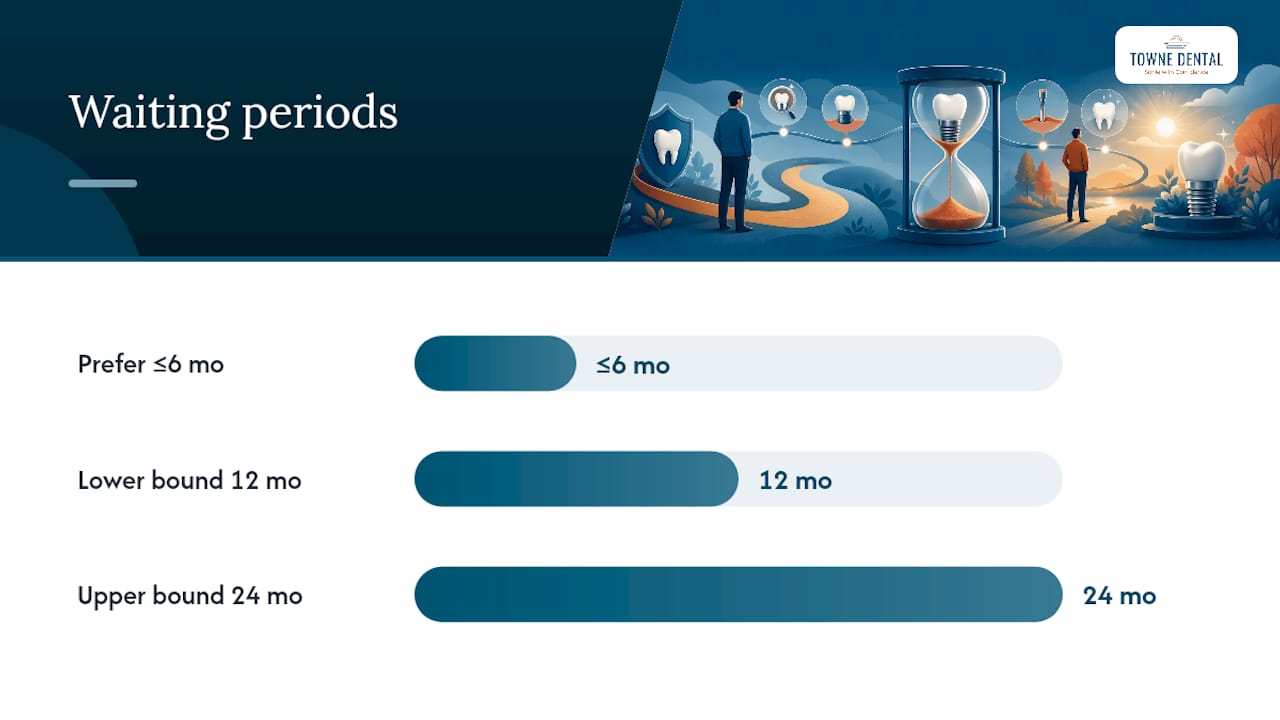
- Waiting periods: Plans commonly impose 6–12 month waits for major services, sometimes up to 24 months. Some plans also phase in reimbursement percentages, paying only 10%–25% in year one and increasing over time.
- Annual maximums: These haven’t kept pace with procedure costs. A $1,500 annual max made more sense when implants were rare; today it barely covers the crown.
How plan type affects your coverage
PPO plans give you the most flexibility: you can see any licensed dentist, and in-network providers offer discounted rates.
DHMO (dental HMO) plans require you to use network providers and often have lower premiums, but implant coverage is frequently excluded or limited to specific network specialists.
Discount/membership plans are not insurance. No annual maximums, no waiting periods, no reimbursement — just a reduced fee at the chair.
Indemnity plans reimburse a set dollar amount per procedure regardless of provider. Coverage for implants varies widely by plan design.
Pro Tip: Always request a predetermination of benefits in writing before scheduling implant surgery. This is a formal estimate from your insurer showing exactly what they’ll pay, which clauses apply, and what you’ll owe. It’s not a guarantee of payment, but it’s the closest thing to one.
When might medical insurance, Medicare, or Medicaid cover implants?
The short answer: rarely, and only under specific medical circumstances.
Standard medical insurance, Original Medicare Parts A and B, and most Medicaid programs do not cover routine dental implants. The exceptions are narrow:
- Medically necessary reconstruction: When implants are part of rebuilding bone or tissue after tumor removal, radiation damage to the jaw, or severe trauma, medical insurance may cover the surgical placement phase. The abutment and crown typically remain dental expenses.
- Medicare Advantage: Some Medicare Advantage (Part C) plans include limited dental benefits. Coverage varies significantly by plan and carrier. Check the plan’s Evidence of Coverage document, not just the marketing summary.
- Medicaid: Adult dental benefits vary by state. Routine implants are uncommon under Medicaid; coverage is generally limited to medically necessary reconstruction cases, and many states cover only extractions for adults.
If you believe your case qualifies as medically necessary, ask your dentist and your physician to document the medical indication in writing before submitting any claim.
How to find a dental plan that actually helps with implant costs
Most standard dental plans are optimized for preventive care, not major restorative work. If implants are your primary goal, you need to shop differently.
When evaluating any plan, ask these questions in writing:
- Does the Summary of Benefits explicitly list implants as a covered service?
- Are implants excluded by name in the exclusions section?
- What is the waiting period for major restorative services?
- What is the annual maximum, and does it reset on a calendar year or policy year?
- Does the plan apply a least expensive alternative treatment rule?
- Is there a missing-tooth or pre-existing condition exclusion?
- What is the in-network vs. out-of-network reimbursement difference?
What the major carriers typically look like
Humana offers several plan tiers; some include implant coverage after a waiting period, but dental insurance waiting period rules mean you may wait 12–24 months before major benefits kick in. Check the specific plan, not the carrier’s general reputation.
Guardian has PPO plans that include major restorative coverage with implants listed as a covered service on select plans. Annual maximums and LEAT rules still apply.
Cigna dental plans vary widely. Some include implants under major restorative; others exclude them. The LEAT rule is common across Cigna plans, so even covered implants may be reimbursed at bridge rates.
Delta Dental is one of the largest networks in the country. Plan coverage depends entirely on whether your employer or individual plan selected implant coverage as an option. Delta Dental’s own guidance on waiting periods is worth reading before you assume coverage.
Plans worth prioritizing if implants are your main concern:
- PPO plans with annual maximums above $2,000
- Plans that explicitly list implants as covered under major restorative
- Plans with waiting periods of 6 months or less for major services
- Plans with no missing-tooth exclusion (or a short lookback period)
Avoid plans with $1,000 annual maximums and 12–24 month waiting periods if implants are your near-term goal. The math simply doesn’t work in your favor.
Pro Tip: Ask your HR department or insurance broker for the actual plan document (not just the brochure) and search it for “implant,” “osseointegration,” and “alternate benefit.” Those three terms will tell you most of what you need to know.
How to check your coverage and get a predetermination
A predetermination of benefits is the most reliable way to know what your insurer will actually pay before any work begins. Here’s the process:
- Collect your policy documents. Get the full plan document and the SBC. Note your annual maximum, remaining balance for the year, and any waiting period status.
- Get a full treatment plan from your dentist. Ask for all ADA CDT procedure codes, including any anticipated bone grafts, imaging (D0330 for CBCT), extractions, and the implant phases (D6010 for surgical placement, D6057/D6058 for abutment and crown).
- Have the dental office submit a predetermination. The office sends the treatment plan and codes to your insurer before scheduling surgery. Request that the insurer respond in writing.
- Review the predetermination carefully. Look for LEAT language, missing-tooth clause application, waiting period notes, and the dollar amount the plan will actually pay. If denied or reduced, ask for the specific reason code and the appeals process in writing.
Pro Tip: Record the predetermination reference number and the name of the insurer representative you speak with. Keep every piece of correspondence. If you appeal a denial, that paper trail is your evidence.
Ways to make dental implants more affordable
Dental insurance is often most valuable for preventive care. For implants, financing and tax-advantaged accounts frequently deliver more predictable savings than relying on a policy.
Your realistic options:
- HSA (Health Savings Account): HSA funds can pay for qualified dental expenses, including implants, and roll over year-to-year. If you’re on a high-deductible health plan, maxing your HSA contributions before implant treatment is one of the most tax-efficient moves available.
- FSA (Flexible Spending Account): FSA funds are also eligible for dental implants, but most FSAs have use-it-or-lose-it rules. Time your treatment to use FSA funds before the plan year ends.
- CareCredit and third-party financing: CareCredit, LendingClub Patient Solutions, and similar lenders offer promotional periods with deferred interest. Read the fine print: deferred interest is not the same as 0% interest if you carry a balance past the promo period.
- In-office payment plans and phased treatment: Many clinics offer installment plans. Phasing treatment across two calendar years (implant post in December, crown in January) can let you use two separate annual maximums.
- Dental membership/discount plans: These are not insurance, but they offer immediate discounts with no waiting periods. Useful if you’re uninsured or your plan excludes implants.
- Dental schools: Accredited dental school clinics perform implants at reduced fees under faculty supervision. Quality is generally high; timelines are longer.
- Interest-free payment programs: Some clinics partner with programs that offer structured interest-free payment options, worth comparing against CareCredit’s promotional terms.
Pro Tip: Before signing a financing agreement, calculate the total cost including interest over the full repayment period. Tapping an HSA or personal savings often costs less than a financing product with deferred interest, even when the promotional rate looks attractive.
What to expect during the implant process
The implant timeline is longer than most patients expect, and understanding it helps you plan both financially and logistically.
- Consultation and imaging: CBCT scan, treatment planning, and assessment of bone volume. This is when bone graft need is identified.
- Extraction (if needed): If the tooth is still present, removal happens first. Some cases allow immediate implant placement; others require healing time.
- Bone grafting (if needed): Grafting adds 3–6 months of healing before implant placement can proceed. See what to expect with implants when bone volume is limited.
- Implant post placement: Surgical phase. The titanium post is placed into the jawbone under local anesthesia or sedation.
- Osseointegration: The post fuses with the bone over 3–6 months. This is the longest phase and cannot be rushed.
- Abutment and crown placement: Once osseointegration is confirmed, the abutment is attached and the final crown is placed.
Factors that extend the timeline:
- Bone grafts or sinus lifts
- Smoking (impairs healing and osseointegration)
- Uncontrolled diabetes or other systemic conditions
- Infection or implant failure requiring removal and re-placement
The multi-stage billing structure matters for insurance planning. If your annual maximum is $1,500, placing the implant post in November and the crown in January means two separate benefit years, potentially doubling the insurer’s contribution.
How Towne Dental helps patients navigate implants, financing, and the process
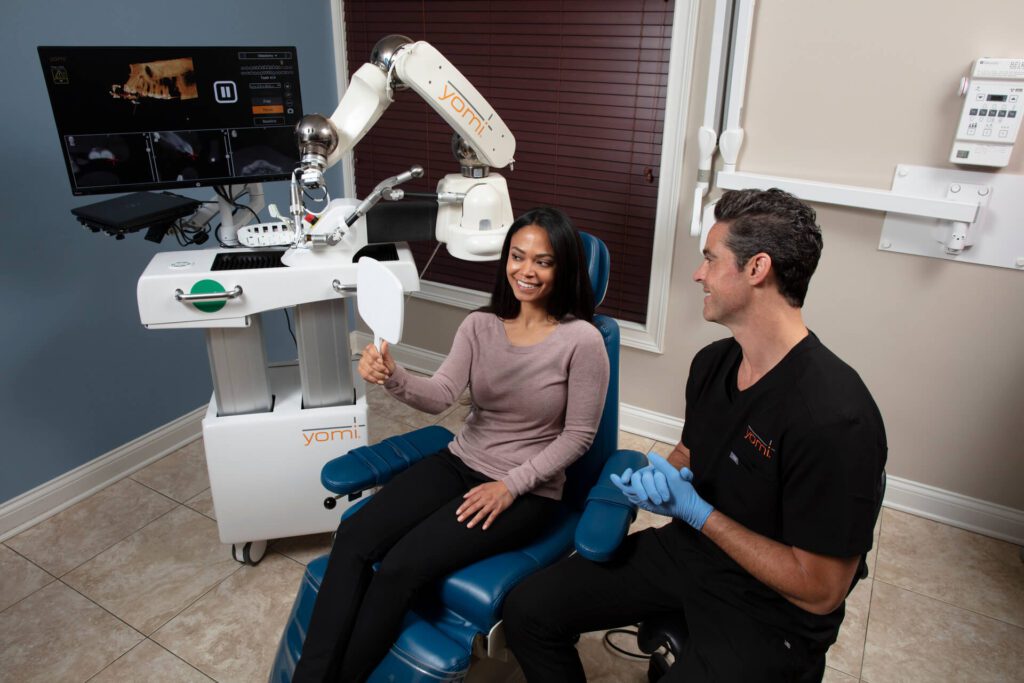
Towne Dental uses the Yomi® robotic-assisted implant system for surgical placement, which improves precision and reduces tissue trauma compared with freehand techniques. For patients anxious about surgery, that level of accuracy translates to a less invasive procedure and a more predictable recovery.
Beyond the technology, the clinic offers practical support at every stage of the financial process:
- Pre-treatment cost estimates broken down by procedure code
- Assistance submitting predeterminations to your insurer
- Phased treatment planning to spread costs across benefit years
- In-office payment plans and guidance on HSA/FSA use
- Patient education on which procedures are likely to be covered vs. billed to you directly
The full range of dental services at Towne Dental includes oral surgery, periodontics, bone grafting, and restorative work, so the entire implant process from extraction through crown can be managed in one place rather than coordinated across multiple specialists.
Pro Tip: Bring your predetermination letter and the full list of CDT procedure codes to your Towne Dental consultation. The team can match those codes to their fee schedule and show you exactly what will be billed to insurance versus what you’ll pay directly, before you commit to anything.

Ready to understand your implant costs and coverage before committing to treatment? Schedule a consultation at Towne Dental to get a full treatment plan, predetermination support, and a clear picture of your out-of-pocket costs.
What most people get wrong about dental implants insurance
The conventional advice is to “find a plan that covers implants.” That framing sends people down the wrong path. The better question is: how much will this plan actually pay, after every clause is applied, for my specific situation?
The missing-tooth exclusion alone eliminates coverage for a huge share of patients. If you lost a tooth before your current plan started, many plans treat that tooth as a pre-existing condition and pay nothing toward an implant, regardless of what the brochure says about major restorative coverage. The LEAT rule is the second trap: a plan that “covers implants” may still reimburse you at bridge rates, which are meaningfully lower.
Annual maximums are the third problem, and they’re structural. A $1,500 annual maximum made sense decades ago when dental costs were lower. Today it covers less than a third of an average single implant. Patients who spend months comparing plan premiums often find the difference in annual maximums is the only number that actually matters.
The smarter approach: treat dental insurance as a partial subsidy for preventive care and accept that implants will require a separate financing strategy. Max your HSA, ask your clinic about phased treatment across benefit years, and get a predetermination before you spend a dollar. That sequence does more for your out-of-pocket cost than any plan comparison.
This article is general information, not a substitute for advice from a qualified doctor. Consult a qualified healthcare professional about your own circumstances before acting on anything here.
Sources
These resources are worth bookmarking before you call your insurer or HR department:
Bring these links or printouts to your HR benefits meeting, your insurer call, or your dental consultation. The more specific your questions, the more useful the answers.
FAQ
Are dental implants covered by insurance in the U.S.?
Patients usually pay the majority of the cost out of pocket.
What insurance is best for dental implants?
PPO plans with annual maximums above $2,000, no missing-tooth exclusion, and explicit implant coverage under major restorative give you the best chance of meaningful reimbursement. Humana, Guardian, Cigna, and Delta Dental all offer plans with varying implant coverage, so comparing the actual plan document matters more than the carrier name.
How much does a dental implant cost in the U.S. with insurance?
A complete single implant averages $4,507 nationally. After a typical plan pays its share (often $1,000–$1,500 after annual maximum limits), most patients pay $3,000 or more out of pocket.
Does Medicare cover dental implants?
Original Medicare Parts A and B generally do not cover routine dental implants. Some Medicare Advantage plans include limited dental benefits, but coverage varies by plan. Check the plan’s Evidence of Coverage document for specifics.
How much does Delta Dental cover for implants?
Delta Dental’s implant coverage depends entirely on the specific plan your employer or you selected. Request the full plan document and look for “implant” in both the benefits schedule and the exclusions list.