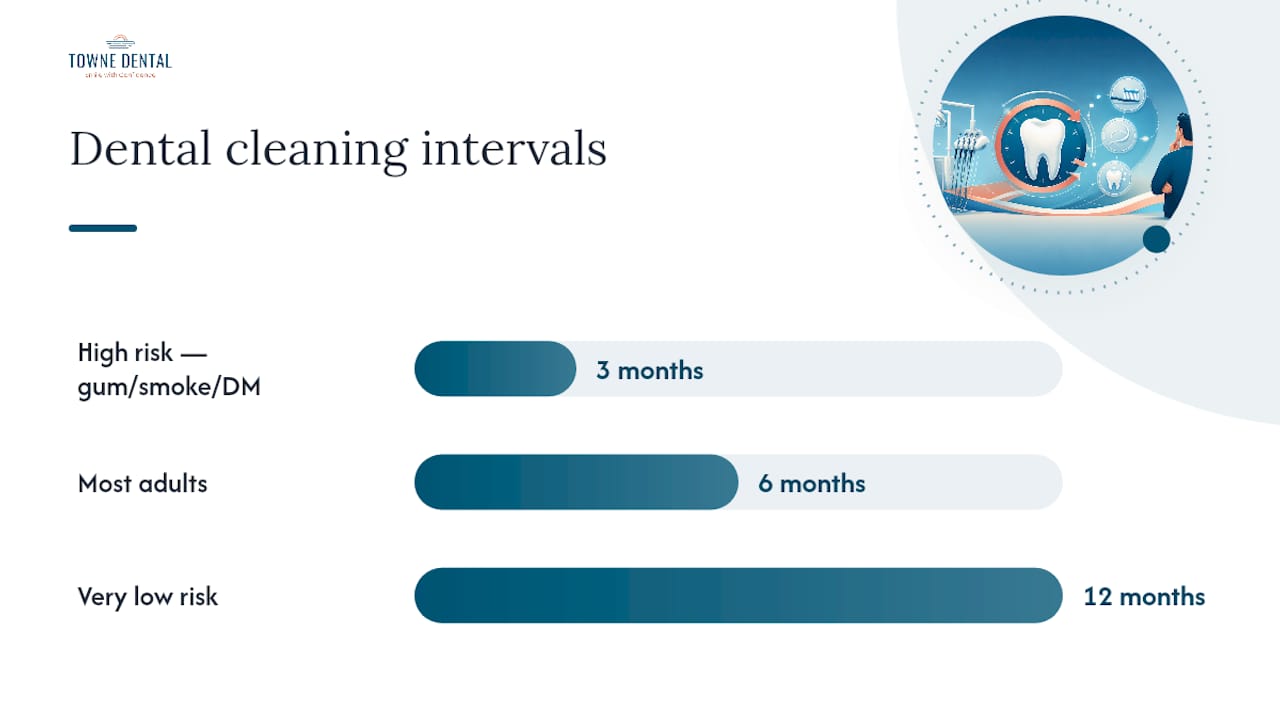
Most people need a professional cleaning about twice a year, but that number isn’t a strict rule; it’s a starting point. Patients with gum disease history, smoking, or diabetes often need a visit every three months, while some low-risk adults with excellent home care can safely stretch to a year. A scoping review found weak evidence for any fixed universal interval, and the American Dental Association backs individualized recall based on your actual risk, not a calendar.
Key Takeaways
Dental cleaning frequency should be set by individual risk factors like pocket depth and bleeding on probing, not a fixed six-month calendar rule.
| Point | Details |
|---|---|
| Six months is a starting point | Average-risk adults typically do well on a 6-month cadence, but it’s not universal. |
| High-risk groups need more | Smokers, diabetics, and periodontitis patients often require cleanings every 3 months. |
| Low-risk patients may extend | Excellent home care and stable exams can support a 12-month interval for some adults. |
| Evidence favors personalization | Reviews from Cochrane and a scoping review support risk-based recall over fixed rules. |
| Towne Dental sets intervals clinically | Recall schedules are based on pocket depths, bleeding scores, and restorative history, not a default calendar. |
Table of Contents
- Recommended Dental Cleaning Schedule at a Glance
- Who Needs More Frequent Dental Cleanings?
- Can You Wait Longer Than Six Months Between Cleanings?
- What Happens During a Dental Cleaning?
- Is There Strong Evidence Behind the 6-Month Rule?
- How Does Your Dentist Decide Your Recall Schedule?
- What Does Dental Cleaning Cost With and Without Insurance?
- Get a Personalized Cleaning Schedule at Towne Dental
- Sources
- FAQ
Recommended Dental Cleaning Schedule at a Glance
Your risk category, more than your calendar, determines how often you should sit in the chair.
- Low risk: about once a year, sometimes semiannually depending on exam findings
- Average/maintenance: about twice a year, the most common benchmark
- Higher risk: every few months
- After periodontal therapy: around every 3 months initially, then adjusted based on healing
Pro Tip: Track whether your current interval is working by watching three things between visits: less gum bleeding when you floss, stable or improving pocket depths at your exam, and fewer surprise problems that force an unscheduled trip in. If those trends hold, your schedule is doing its job.
These numbers are a jumping-off point. The sections below break down exactly which risk factors push someone toward more frequent cleanings, and which ones support waiting longer.
Who Needs More Frequent Dental Cleanings?
Some people simply accumulate risk faster than a standard six-month gap can manage. If you fall into one of these groups, more frequent visits usually aren’t optional.
- History of periodontitis: patients on supportive periodontal therapy need tighter recall because disease can quietly restart between visits
- Smokers: tobacco use drives inflammation and masks bleeding, one of the earliest warning signs of gum disease
- Uncontrolled diabetes: impaired healing and higher infection risk mean plaque does more damage faster
- Heavy calculus formers: some people’s saliva chemistry hardens plaque into tartar much faster than others
- Extensive restorative work: crowns, bridges, and dentures create ledges where plaque hides
- Impaired dexterity: arthritis or other conditions that limit brushing and flossing effectiveness
- Immunocompromised patients: reduced ability to fight off oral bacteria
For these groups, a 3-month interval is common, and periodontal maintenance schedules are supported by the evidence specifically for people already treated for periodontitis.
Can You Wait Longer Than Six Months Between Cleanings?
Some patients genuinely don’t need the standard cadence. If you have consistently excellent home care, no periodontitis history, stable exam findings, and healthy saliva flow, your dentist may reasonably space visits to 12 months.
Watch for signals that mean you shouldn’t wait, no matter what your last interval was:
- Bleeding gums during brushing or flossing
- New tooth sensitivity or looseness
- Persistent bad breath that toothpaste doesn’t fix
- Visible tartar buildup you can feel with your tongue
A very small subset of low-risk adults may stretch further, but the evidence here is mixed enough that this decision belongs with your dentist, not a self-diagnosis.
What Happens During a Dental Cleaning?
Not every cleaning looks the same, and understanding the differences explains why one visit takes 20 minutes and another takes an hour.
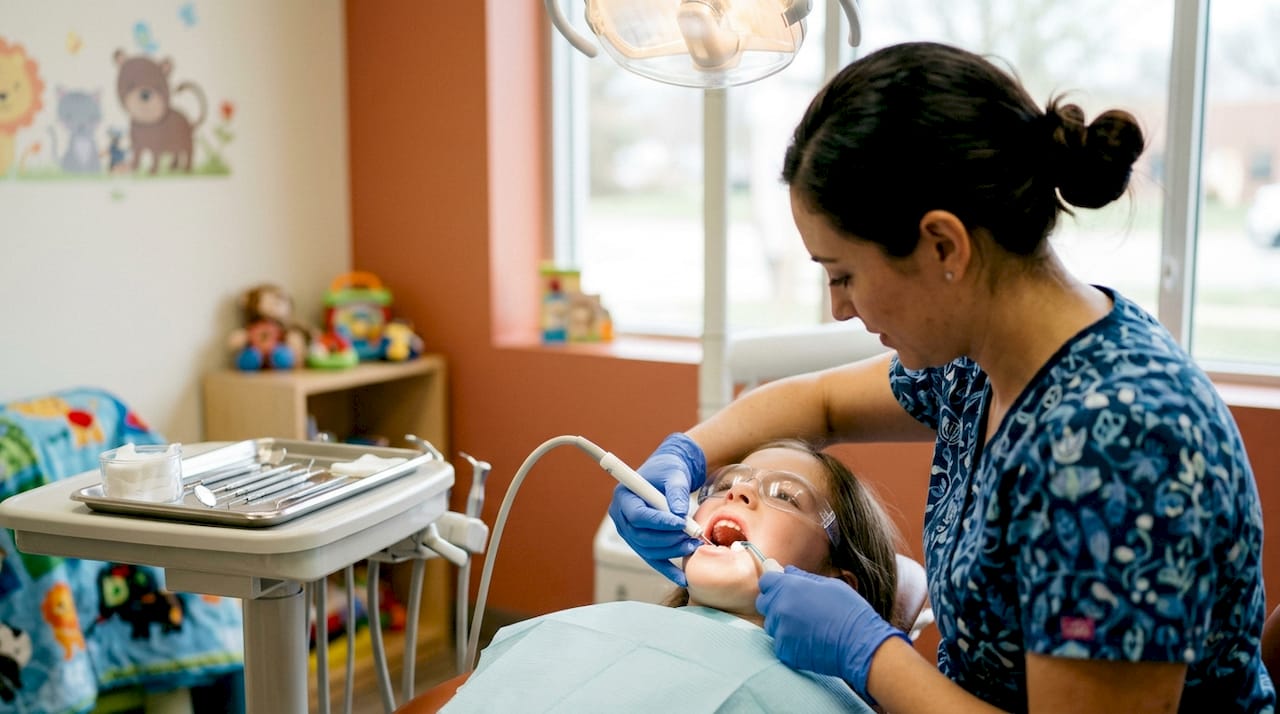
A routine visit typically includes an exam, prophylaxis (scaling and polishing), flossing, and oral hygiene instruction, with fluoride added for higher-risk patients. Prophylaxis is designed for healthy gums. Periodontal maintenance, sometimes called supportive periodontal therapy, is a different service entirely for patients already treated for gum disease, and it can’t be substituted with a standard cleaning. Scaling and root planing is the therapeutic, deeper version used to treat active disease below the gumline.
- Routine prophylaxis typically lasts several minutes
- Periodontal maintenance or scaling/root planing usually requires longer appointments
That time difference isn’t just about thoroughness. Insurance often treats these as distinct billing codes, which is worth confirming before you book.
Is There Strong Evidence Behind the 6-Month Rule?
The six-month interval has less scientific backing than most people assume. A Cochrane review found little or no clinical difference between six-month and 12-month routine scale and polish for gingivitis and probing depths in low-risk adults, though six-month care did produce a small calculus reduction.
Multiple trials on regular attenders without severe periodontitis found routine cleanings at six-month or annual intervals made little measurable difference to gum health or quality of life over two to three years, though the shorter interval left slightly less calculus behind.
That calculus reduction sounds meaningful until you consider its clinical impact is genuinely unclear. Where evidence is much stronger is periodontal maintenance: patients treated for periodontitis benefit clearly from 3 to 12 month tailored recall, and adherence to that schedule tracks with lower rates of tooth loss.
- Low-risk adults: weak evidence for any universal fixed interval
- Periodontitis patients: solid support for 3-month initial maintenance
- Guideline consensus: risk-based scheduling over a blanket rule, a position the ADA’s evidence resources reinforce
The takeaway isn’t “cleanings don’t matter.” It’s that the calendar shouldn’t be the only thing deciding your schedule.
How Does Your Dentist Decide Your Recall Schedule?
Your dentist isn’t picking a number out of habit. They’re weighing several measurable factors: pocket depths at each tooth, bleeding on probing, radiographic bone levels, your cavity risk, how much restorative work you have, and systemic factors like smoking or diabetes control.
You can steer that conversation with a short checklist:
- What is my periodontal risk level, specifically?
- What clinical findings support this particular interval?
- If something changes between now and my next visit, how soon should I come back?
- Are my pocket depths and bleeding scores trending better or worse than last time?
Keep a mental note of your answers year over year. If your dentist mentions worsening bleeding or new pocket depth, that’s your cue to ask about tightening the schedule rather than waiting for the next scheduled reminder.
What Does Dental Cleaning Cost With and Without Insurance?
Cleaning costs vary by location and complexity, so check local pricing rather than assuming a national average. Most dental insurance plans cover one to two prophylaxis visits per year with a copay, which is part of why the six-month default became so entrenched in the first place.
- Ask whether exams and cleanings can be bundled to reduce visit costs
- Check if scheduling aligns with your plan’s coverage year to maximize benefits
- Look into HSA or FSA funds for out-of-pocket costs
- Ask about sliding-scale options if you’re between insurance plans
Pro Tip: If your dentist recommends more frequent visits than you expected, ask directly for the clinical rationale, and ask whether a shorter, hygiene-focused maintenance visit could meet that need at lower cost than a full appointment.
Why personalized recall is the standard we hold ourselves to
At Towne Dental, we don’t hand every patient the same six-month card and call it care. Pocket depths, bleeding scores, and how well someone’s home care is actually working tell us far more than a calendar does. Sticking to the interval we prescribe, especially after periodontal treatment, is one of the biggest factors in whether gum disease stays gone.
Get a Personalized Cleaning Schedule at Towne Dental
If the sections above told you that a flat six-month rule doesn’t fit your situation, that’s normal; most people’s risk profile calls for something more specific. Towne Dental builds your recall schedule around actual clinical measurements, whether that means a straightforward general dentistry checkup twice a year or ongoing periodontal maintenance for patients managing gum disease.

Rather than guessing at your risk level from a symptom list, our team measures pocket depths, checks for bleeding on probing, and reviews your restorative history to set an interval that actually matches your mouth. If you’re not sure whether you’re due for a cleaning or need something more frequent, browse our complete dental services and schedule an evaluation to get a schedule built around your risk factors, not a generic recall postcard.
Sources
The clinical picture in this article draws on systematic evidence and major guideline sources rather than a single opinion.
This article is general information, not a substitute for advice from a qualified doctor. Consult a qualified healthcare professional about your own circumstances before acting on anything here.
FAQ
How often do I really need a dental cleaning?
Most adults do well with a cleaning every six months, but people with gum disease history, diabetes, or smoking habits often need one every three months, while very low-risk patients may extend to 12 months.
How frequently can I clean my teeth professionally without it being excessive?
There’s no upper safety limit on professional cleanings when they’re clinically indicated. Periodontal maintenance every three months is standard for treated periodontitis patients and isn’t considered excessive.
What’s the difference between a regular cleaning and periodontal maintenance?
A regular cleaning, or prophylaxis, is for healthy gums, while periodontal maintenance is a separate therapeutic service for patients already treated for gum disease. One can’t substitute for the other.
Will my insurance cover more than two cleanings a year?
Many plans cover one to two prophylaxis visits annually, but coverage for additional periodontal maintenance visits varies by plan, so it’s worth checking your specific benefits before scheduling.
Can I ask Towne Dental to reassess my cleaning schedule?
Yes. Towne Dental evaluates pocket depths, bleeding on probing, and your restorative and health history at each visit to adjust your recall interval as your risk changes.