Choose an onlay when healthy tooth structure can be preserved; choose a crown when the tooth needs full coverage and structural reinforcement. That single rule covers the majority of cases, and it reflects the dominant principle in restorative dentistry: use the most conservative restoration that safely protects the tooth.

For most patients, the decision comes down to how much of the original tooth remains. If the damage is moderate — a large filling that has failed, a broken cusp, or a cavity that has spread across the chewing surface but left the outer walls intact — an onlay is often the right call. It covers only what needs covering. When the tooth is severely weakened, cracked deeply, or has just had a root canal with little structure remaining, a crown is the appropriate choice because it encases the entire visible tooth and prevents further fracture.
Three quick decision rules worth knowing before your consult:
- Preserve structure when you can. Onlays remove less enamel and dentin than crowns, making them the more conservative option for moderate damage.
- Severe damage, root canals, and large cracks usually require a crown. Full coverage provides structural reinforcement that a partial restoration cannot.
- Your priorities matter. Aesthetics, cost, and how many dental visits you can manage all factor into the final choice — and both options offer tooth-colored materials.
Pro Tip: At your first consult, ask your dentist: “Is the damage limited to the chewing surface and cusps, or does it extend below the gumline?” That one question will tell you a lot about whether you are a candidate for an onlay.
Table of Contents
- What is a dental onlay, and how does it differ from a filling or crown?
- When does a tooth actually need a crown?
- How do crowns and onlays compare across the key decision factors?
- When do clinicians recommend an onlay versus a crown?
- What happens during the appointments?
- What materials are used, and how long do restorations last?
- How much do onlays and crowns cost, and what does insurance cover?
- Pros, cons, and red flags that should change your decision
- Questions to ask your dentist before choosing between a crown and an onlay
- Key Takeaways
- The case for preservation-first dentistry
- Towne Dental offers conservative restorations and expert guidance for your decision
- Useful sources and further reading
- FAQ
What is a dental onlay, and how does it differ from a filling or crown?
An onlay is a partial-coverage restoration that covers one or more cusps of a back tooth. It sits somewhere between a filling and a crown on the spectrum of dental restorations — larger than a filling, smaller than a crown. Some clinicians call it a “partial crown,” which is an accurate description of what it does.
Dentists consider an onlay when a tooth has moderate damage that a filling cannot reliably handle but does not yet need full coverage. Common scenarios include:
- A large existing filling that has cracked or broken down, leaving the surrounding tooth structure sound
- A broken cusp where the facial (cheek-side) and lingual (tongue-side) walls remain intact
- A mesial-occlusal-distal (MOD) preparation where the chewing surface and both contact points need coverage but the outer walls are healthy
- A cavity that has spread across the biting surface but has not reached below the gumline
The materials used for onlays include lithium disilicate (a strong, tooth-colored ceramic), leucite-reinforced glass ceramic, composite resin, and gold. Tooth-colored ceramics are the most common choice today because they match natural tooth shade and bond well to enamel. Gold remains a durable option for patients who are not concerned about appearance, particularly on second molars where bite forces are highest.
One clinical advantage that often goes unmentioned: onlays typically have supragingival margins — meaning the restoration edge sits at or above the gumline rather than beneath it. That placement makes impressions more accurate, keeps the gum tissue healthier, and makes home hygiene easier. You can floss right to the margin without the thread disappearing under the gum.
“Choosing an onlay often reflects a clinical commitment to tooth preservation rather than a lower-cost or lower-quality fix; when properly selected and cemented, tooth-colored onlays can be a long-term option.” — Acibadem Health Library
When does a tooth actually need a crown?
A crown is a full-coverage restoration that encases the entire visible portion of the tooth above the gumline. Think of it as a protective cap: it replaces the outer surface of the tooth entirely rather than patching a specific area.
Crowns become necessary when the tooth has lost so much structure that a partial restoration would not hold or would leave the remaining tooth walls at risk of fracturing. The most common clinical indications are:
- After a root canal — when little natural tooth remains above the gumline, particularly on molars that absorb heavy chewing forces
Crown materials include all-ceramic options like zirconia (extremely strong, good for back teeth) and lithium disilicate (excellent aesthetics, good for front and premolar teeth), porcelain-fused-to-metal (PFM), and full-cast metal. Zirconia has largely replaced PFM in many practices because it avoids the dark metal line that can appear at the gumline as gums recede over time.
The preparation for a crown removes significantly more tooth structure than an onlay. The dentist reduces the tooth on all sides to create a uniform thickness for the crown material, and the margins often extend slightly below the gumline. That subgingival margin placement complicates impression-taking and can expose the margin as the gum recedes with age.
“When an onlay fails, clinicians can often remove or repair the restoration and still have enough tooth structure to place a crown later; the reverse is not always true once a crown has been placed and more tooth structure is removed.” — JERD Systematic Review
Pro Tip: Ask your dentist where the crown margin will sit. If it is subgingival, ask why — and whether your gum health is stable enough to support that placement long-term. Patients with periodontal concerns may need gum treatment before a crown is placed.
How do crowns and onlays compare across the key decision factors?
| Dimension | Onlay | Crown |
|---|---|---|
| Coverage | Covers one or more cusps; partial coverage | Encases the entire visible tooth above the gumline |
| Tooth structure preserved | More conservative; less enamel and dentin removed | More reduction required on all surfaces |
| Typical lifespan | Studies report survival rates comparable to crowns in select cases; long-term data still evolving | Generally well-documented; 10 years with good hygiene and maintenance |
| Aesthetic options | Tooth-colored ceramics (lithium disilicate, leucite), composite, gold | All-ceramic (zirconia, lithium disilicate), PFM, full-cast metal |
| Procedure complexity | Two visits (traditional lab) or one visit (CAD/CAM in-office) | Two visits (traditional) or one visit (CAD/CAM); may require build-up or core |
| Cost/insurance pattern | Often higher out-of-pocket; some insurers reimburse at filling rate or require prior authorization | Typically covered as a major restorative procedure; more predictable insurance coding |
| Typical indications | Moderate damage, intact outer walls, supragingival decay, large filling failure | Severe structural loss, post-root canal, deep cracks, subgingival decay |
| Maintenance | Supragingival margins support easier flossing and hygiene; routine exams needed | Subgingival margins require careful hygiene; gum recession can expose margin over time |
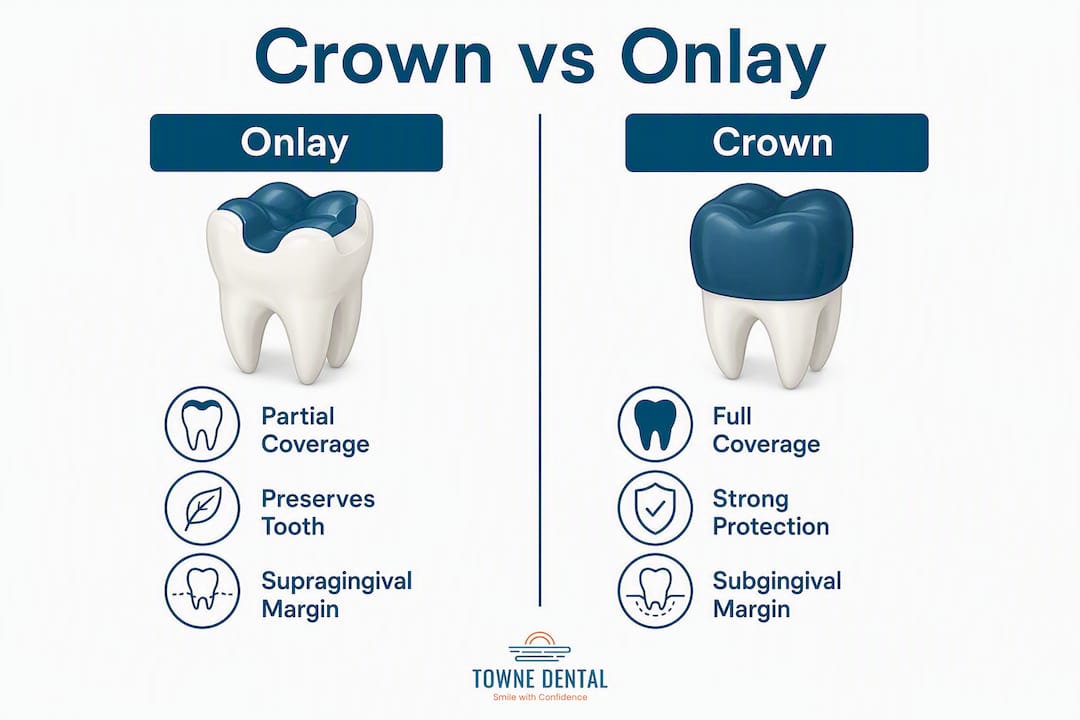
The biggest practical trade-off is conservation versus absolute protection. An onlay preserves more of what is already there. A crown provides more complete structural reinforcement, which matters when the remaining tooth walls are thin or compromised.
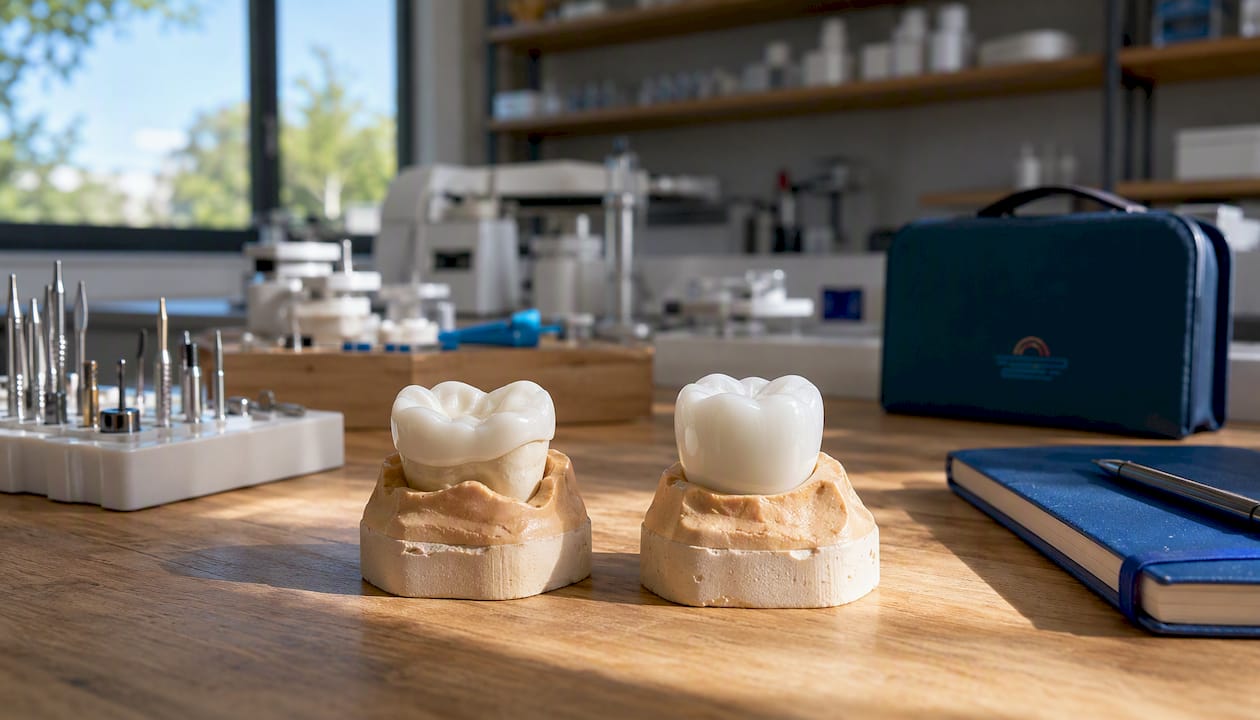
Mode of failure is another dimension worth understanding. When crowns fail, the failure tends to be more catastrophic — a fracture that may not be repairable, or decay that undermines the margin and requires extraction. Onlay failures are often less severe: a chipped ceramic that can be repaired, or a debonded restoration that can be recemented or replaced while the underlying tooth remains intact.
In an 18-month randomized clinical study of root canal-treated molars with a single proximal defect, metal onlays showed 95% survival compared to 90% for metal crowns — a difference that was not statistically significant (P = 0.294). That finding supports the idea that onlays can perform comparably to crowns in carefully selected cases, at least over shorter follow-up periods.
When do clinicians recommend an onlay versus a crown?
The clinical literature on this question is honest about its limits. A systematic review published in the Journal of Esthetic and Restorative Dentistry found that for posterior teeth with MOD preparations, onlays can be an advantageous alternative to crowns — but the evidence is insufficient to make universal recommendations. That is not a reason to avoid onlays; it is a reason to have a thorough conversation with your dentist about your specific tooth.
Here is how the clinical indications typically break down:
Onlay is usually appropriate when:
- The damage is confined to the occlusal (chewing) surface and one or both contact points
- The facial and lingual walls are intact and have adequate thickness
- Decay margins are at or above the gumline (supragingival)
- The tooth has not had a root canal, or has had one but retains sufficient coronal structure
- The patient wants to preserve as much natural tooth as possible
Crown is usually the safer choice when:
- Structural loss is extensive and the remaining walls are thin or undermined
- The tooth has had a root canal and little coronal tooth structure remains, especially on a molar
- Cracks extend through multiple surfaces or approach the root
- Decay extends significantly below the gumline, making a clean onlay margin impossible
- A previous crown has failed and the underlying tooth has been further compromised
“For posterior teeth with MOD tooth structure loss, onlays can be an advantageous alternative to crowns, but the evidence is insufficient to make universal recommendations.” — JERD Systematic Review
A practical scenario: a patient comes in with a large amalgam filling on a lower molar that has cracked, but the outer walls of the tooth are intact and the decay is confined to the chewing surface. That tooth is a strong onlay candidate. Now consider a different patient whose molar just had a root canal, has an existing large filling, and shows a crack running toward the gumline. That tooth needs a crown. The difference is not about cost or preference — it is about what the tooth can structurally support.
For patients navigating post-root canal restoration choices, the decision between an onlay and a crown depends heavily on how much tooth structure survived the endodontic procedure and whether the remaining walls can bear occlusal forces without fracturing.
What happens during the appointments?
Both onlays and crowns typically require two visits in a traditional workflow, though in-office CAD/CAM technology has made single-visit restorations increasingly common.
Traditional two-visit workflow
Visit 1 (60–90 minutes):
The dentist removes decay and shapes the tooth to receive the restoration. For an onlay, this means preparing the occlusal surface and any affected cusps while leaving the outer walls intact. For a crown, the tooth is reduced on all surfaces. An impression or digital scan is taken, a temporary restoration is placed, and the case is sent to a dental lab.
Between visits (1–2 weeks):
The lab fabricates the restoration from the chosen material. Patients wear a temporary that protects the tooth but is not meant for long-term use — avoid sticky or hard foods during this period.
Visit 2 (45–60 minutes):
The temporary is removed, the permanent restoration is tried in for fit and bite, adjustments are made, and it is cemented. Onlays typically require resin cement for optimal bonding and long-term success; the cement choice affects both longevity and the ability to repair the restoration later if needed.
Single-visit CAD/CAM workflow
Advances in CAD/CAM technology have made it possible to design and mill a ceramic onlay or crown in the office in a single appointment. The dentist prepares the tooth, takes a digital scan, designs the restoration on-screen, and mills it from a ceramic block while the patient waits. Total chair time is typically 90–120 minutes. There is no temporary restoration and no second visit.
“CAD/CAM adoption is reducing the gap in clinician familiarity with onlays versus crowns, making conservative restorations more accessible to patients.” — Clinicians Report
Aftercare tips:
- Mild sensitivity to temperature is normal for a few days after cementation
- Avoid very hard or sticky foods for 24 hours after the final cementation
- Floss gently around the new restoration from day one
- Return immediately if the bite feels high or if you notice sharp pain on biting
Patients with dental anxiety should ask specifically about sedation options and whether the practice offers single-visit restorations. Fewer appointments and a predictable timeline can make a significant difference in the overall experience.
What materials are used, and how long do restorations last?
Material choice affects both how the restoration looks and how long it lasts. Here is a patient-friendly breakdown:
Lithium disilicate (e.max): The most popular tooth-colored ceramic for onlays and anterior/premolar crowns. Strong, highly aesthetic, bonds well to tooth structure. Works best in areas with moderate bite forces.
Zirconia: The strongest all-ceramic option, preferred for posterior crowns where bite forces are highest. Less translucent than lithium disilicate, so it is not always the first choice for visible front teeth, though newer monolithic zirconia formulations have improved aesthetics considerably.
Leucite-reinforced glass ceramic: An older ceramic material still used for onlays. Good aesthetics, somewhat lower fracture resistance than lithium disilicate.
Porcelain-fused-to-metal (PFM): A crown material with a metal substructure and a porcelain outer layer. Durable and well-studied, but the metal margin can become visible if gums recede. Less common in new restorations as zirconia has largely replaced it.
Gold: Exceptionally durable and kind to opposing teeth. Still a legitimate choice for second molars in patients who are not concerned about appearance. Gold onlays and crowns have decades of clinical data behind them.
Composite resin: Used for onlays in some cases, particularly as a more affordable option. Less wear-resistant than ceramics and more prone to staining over time.
Lifespan ranges vary considerably depending on the study and the patient population. The clinical literature shows significant heterogeneity in how onlays and crowns are compared, and long-term evidence is still evolving. What is clear is that patient-specific factors often matter more than material choice alone:
- Bruxism (teeth grinding): The single biggest accelerant of restoration failure. Patients who grind should wear a nightguard and discuss this with their dentist before choosing a material.
- Tooth location: Molars absorb far more force than premolars. A ceramic onlay on a second molar in a heavy grinder is a higher-risk placement than the same restoration on a premolar.
- Margin placement and cementation: Properly placed supragingival margins and correct resin cement technique significantly improve onlay longevity.
- Oral hygiene and recall visits: Secondary decay at the margin is one of the most common causes of restoration failure. Annual exams and consistent hygiene prevent it.
How much do onlays and crowns cost, and what does insurance cover?
Cost is one of the most common questions patients ask, and the honest answer is that it varies by region, material, and provider. As a general observation, dental crowns in the United States usually cost several hundred to a few thousand dollars per tooth depending on material and location; onlays tend to fall in a similar or slightly lower cost range, though prices vary widely. Always confirm current fees directly with your dental office.
The insurance picture is more complicated. Most dental plans classify crowns as a major restorative procedure and cover a percentage (often 50%) after the deductible, subject to annual maximums. Onlays are sometimes coded and reimbursed differently. Some insurers reimburse onlays at the same rate as a filling rather than a crown, which can leave patients with a larger out-of-pocket balance than expected.
Additional costs that can add up:
- Core buildup: If the tooth needs a foundation before the crown, that is a separate procedure code and a separate charge.
- Crown lengthening: When decay extends below the gumline, a minor surgical procedure may be needed to expose enough tooth structure for a proper margin. This involves the periodontal team and adds both time and cost.
- Root canal: If the tooth needs endodontic treatment before the crown, that cost is separate.
Questions to bring to your insurance call:
- What is the procedure code my dentist is submitting?
- Is this covered as a major restorative or a basic restorative?
- Is prior authorization required?
- What is my remaining annual maximum?
- Does my plan have a waiting period for major restorative work?
Bring the tooth number, the procedure code, and a written treatment recommendation from your dentist to that call. If your insurer denies coverage for an onlay, ask your dentist whether an appeal with clinical documentation (photos, X-rays, written rationale) is worth pursuing.
Pros, cons, and red flags that should change your decision
Onlay pros and cons
| Onlay | |
|---|---|
| Pros | Preserves more natural tooth structure; supragingival margins support gum health; failures are often less catastrophic and may be repairable; single-visit option available with CAD/CAM |
| Cons | Not appropriate for severely damaged teeth; some insurers reimburse at a lower rate; requires precise preparation and resin cementation for best results; not all practices offer in-office milling |
Crown pros and cons
| Crown | |
|---|---|
| Pros | Full structural protection for severely weakened teeth; well-established long-term data; predictable insurance coding; appropriate after root canal on molars |
| Cons | Requires more tooth reduction; subgingival margins can complicate hygiene and impression accuracy; failures can be more catastrophic; once placed, future options are more limited |
Red flags that favor a crown over an onlay:
- Deep subgingival decay that makes a clean onlay margin impossible
- Vertical root fractures or cracks extending toward the root
- Insufficient remaining tooth structure to retain an onlay
- Extensive cracks running through multiple surfaces
- Post-root canal molar with minimal coronal tooth remaining
Red flags that complicate crown placement:
- Very short clinical crown height (insufficient retention without crown lengthening)
- Active periodontal disease — gum health must be stabilized before placing a crown with subgingival margins
- Poor bone support that may indicate the tooth has a limited prognosis regardless of restoration
“Many restoration failures are due to secondary caries, fractures, marginal deficiency, wear, or postoperative sensitivity; mode of failure for crowns is often more catastrophic than for onlays.” — Critical Review, Walsh Medical Media
When red flags are present, a second opinion is worth seeking. Ask a different clinician: “Given the remaining tooth structure and the location of the decay, is there a conservative option that would be safe long-term?” If two dentists independently recommend a crown, that is a strong signal. If one recommends an onlay and another recommends a crown for the same tooth, ask both to explain their reasoning in terms of margin location and remaining wall thickness.
Questions to ask your dentist before choosing between a crown and an onlay
Bring this list to your consult. The answers will tell you which restoration is appropriate and whether the practice has the tools to deliver it well.
Diagnosis and tooth condition:
- How much of my natural tooth structure remains after removing the decay or old filling?
- Are the outer walls of my tooth intact and thick enough to support an onlay?
- Where will the restoration margins sit — above or below the gumline?
- Is there any crack that extends toward the root?
- Has this tooth had a root canal, and if so, how much coronal structure is left?
Procedure and logistics:
6. Do you offer single-visit CAD/CAM restorations, or will this require two appointments?
7. Will I need a core buildup, crown lengthening, or any other procedure before the restoration?
8. What sedation options are available if I have dental anxiety?
Materials:
9. What material do you recommend for my tooth, and why?
10. What cement will you use, and how does that affect the longevity of the restoration?
Cost and insurance:
11. What procedure code will you submit to my insurance?
12. Can you provide a written predetermination of benefits before I commit?
Maintenance:
13. Do I grind my teeth, and if so, should I get a nightguard before or after the restoration?
14. How will I know if the restoration is failing, and what are the warning signs?
Pro Tip: If your dentist recommends a crown for a tooth with intact outer walls and supragingival decay, ask specifically why an onlay is not appropriate. A good clinician will explain the reasoning clearly. If the answer is vague, a second opinion from a restorative dentist is reasonable.
Key Takeaways
An onlay is the right first choice when healthy tooth structure can be preserved; a crown is appropriate when the tooth is too damaged or weakened for partial coverage to safely protect it.
| Point | Details |
|---|---|
| Default to conservation | Choose an onlay when outer walls are intact and decay is supragingival; it preserves more natural tooth structure. |
| Crown when structure is compromised | Severe damage, post-root canal molars, and deep cracks require full coverage for structural protection. |
| Failure mode matters | Onlay failures are often repairable; crown failures tend to be more catastrophic, limiting future options. |
| Insurance requires preparation | Onlays may be reimbursed at a lower rate; call your insurer with the procedure code before treatment begins. |
| Towne Dental evaluates both options | Towne Dental offers CAD/CAM restorations, sedation, and a conservative-first approach to help you decide between a crown and an onlay. |
The case for preservation-first dentistry
The conventional wisdom in dentistry used to be straightforward: when in doubt, crown it. A crown covers everything, protects everything, and the patient leaves with a restoration that feels solid and complete. That logic made sense when ceramic onlays were harder to fabricate precisely and when CAD/CAM technology was not widely available. It makes less sense now.
What the evidence actually shows is that onlays, when properly selected and cemented, perform comparably to crowns in many MOD cases over the short and medium term. The 18-month clinical study showing 95% onlay survival versus 90% crown survival on root canal-treated molars is one data point, but the broader pattern in the literature is consistent: the gap in survival rates between well-placed onlays and crowns is smaller than most patients assume. The more meaningful difference is in what happens when things go wrong. A debonded onlay or a chipped ceramic can often be managed without losing the tooth. A fractured crown that has undermined the remaining tooth structure is a different problem entirely.
There is also something worth saying about the irreversibility of tooth reduction. Every time a drill removes enamel and dentin, that tissue is gone permanently. A crown placed at age 40 will likely need to be replaced at some point, and each replacement cycle removes a little more tooth. Starting with an onlay when the clinical situation supports it is not a compromise. It is a way of keeping future options open.
The caveat is real: not every tooth is an onlay candidate, and pushing for conservation when the tooth genuinely needs full coverage is its own form of poor judgment. The goal is not to avoid crowns. The goal is to use them when they are actually necessary.
Towne Dental offers conservative restorations and expert guidance for your decision
Deciding between a crown and an onlay is not something you should have to figure out alone from a checklist. At Towne Dental, the evaluation starts with a thorough clinical exam, digital X-rays, and a direct conversation about what your tooth can support and what your priorities are. The practice offers in-office CAD/CAM restorations, which means a single-visit onlay or crown is a real option for many patients rather than a two-week process with a temporary in place.

Sedation options are available for patients who find dental procedures stressful, and the team’s conservative-first philosophy means an onlay will be recommended when the tooth structure supports it — not defaulted to a crown because it is the faster path. For patients who need more complex care, Towne Dental’s full range of dental services includes endodontics, periodontics, and oral surgery, so the entire treatment sequence can be coordinated in one place. To schedule a restorative exam and get a clear recommendation on whether a crown or onlay is right for your tooth, contact Towne Dental directly.
Useful sources and further reading
The clinical evidence on crowns versus onlays is genuinely useful reading for patients who want to understand the research behind their dentist’s recommendation.
- Onlays/partial crowns versus full crowns in restoring posterior teeth (PMC) — A systematic review examining survival and complication rates; the most comprehensive source for understanding the evidence base.
- JERD Systematic Review: Do onlays and crowns offer similar outcomes for MOD preparations? — The key citation for the finding that onlays are viable alternatives in many MOD cases, with important caveats about evidence quality.
- Clinicians Report: Are Tooth-Colored Onlays Viable Alternatives to Crowns? — A practical clinical summary covering margin advantages, CAD/CAM adoption, and cementation considerations.
FAQ
Is an onlay better than a crown?
An onlay is the better choice when the tooth has moderate damage and intact outer walls, because it preserves more natural tooth structure. A crown is better when the tooth is severely weakened or post-root canal and needs full structural protection.
Why do dentists sometimes recommend crowns over onlays?
Crowns provide complete coverage and are appropriate for teeth with extensive structural loss, deep cracks, or minimal remaining coronal structure after a root canal. Historical training patterns also play a role, though CAD/CAM adoption has made onlays more accessible in recent years.
What are the main disadvantages of onlays?
Onlays are not suitable for severely damaged teeth, require precise preparation and resin cementation for best results, and some dental insurers reimburse them at a lower rate than crowns, which can increase out-of-pocket costs.
Why doesn’t insurance always cover onlays?
Some insurers classify onlays as a basic restorative procedure rather than a major one, reimbursing at a filling rate rather than a crown rate. Calling your insurer with the specific procedure code before treatment begins is the best way to avoid billing surprises.
Can an onlay be placed after a root canal?
Yes, in some cases. An 18-month clinical study found that metal onlays showed 95% survival on root canal-treated molars with a single proximal defect, compared to 90% for crowns. Whether an onlay is appropriate after a root canal depends on how much coronal tooth structure remains.