Ceramic brackets themselves resist staining, but the clear elastic ligatures holding your wire in place, and sometimes the bonding adhesive underneath, are what actually turn yellow. Both the American Association of Orthodontists and the American Dental Association point to plaque, pigmented food and drink, and tobacco as the drivers. The fix is straightforward: brush after meals, rinse when you can’t, and ask your orthodontist to swap ligatures at your next adjustment.
TL;DR:
- Ligatures made from polyurethane are the main cause of staining, with coffee, red wine, and dark foods being the biggest culprits over weeks of daily exposure.
- Switching to self-ligating ceramic brackets can significantly reduce discoloration by eliminating elastic ties that absorb pigments.
- Routine cleaning, especially brushing after meals and rinsing immediately after pigmented drinks, can prevent and reduce ligature staining.
- Staining discoloration is purely cosmetic and does not affect the effectiveness of the orthodontic treatment or tooth movement.
- Most stains are temporary and can be replaced at routine adjustments, but early replacement is available upon request for special occasions.
Table of Contents
- What Actually Stains: Brackets, Ligatures, and Adhesives
- Foods, Drinks, and Habits That Cause the Most Staining
- A Daily Routine That Keeps Ceramic Braces Clear
- If Staining Already Happened: What to Do Next
- Whitening and Cosmetic Options While You’re in Braces
- Does Staining Actually Slow Down Your Treatment?
- How Fast Do Ceramic Braces Stain, and Does It Get Worse?
- Can a Dentist Professionally Clean Stained Ceramic Braces?
- Why Your Brushing Habits Matter More Than Your Diet
- Towne Dental’s Perspective on Managing Ceramic Braces Staining
- Keep Your Ceramic Braces Looking Their Best With Towne Dental
- Sources
- FAQ
What Actually Stains: Brackets, Ligatures, and Adhesives
Ceramic brackets are made from polycrystalline or monocrystalline alumina, a dense, glass-like material that doesn’t absorb liquid the way plastic does. That’s why the brackets stay mostly clear for the entire time you wear them. The part that actually discolors is the elastic ligature, the small rubber-like ring that ties the wire into each bracket slot.
Ligatures are typically made from polyurethane, a polymer that behaves very differently from ceramic. It absorbs water, and along with the water comes whatever pigment is dissolved in it. Coffee, curry, and red wine all contain molecules that latch onto that polymer structure and don’t let go easily. Sunlight and saliva enzymes speed up the process, a kind of slow photochemical breakdown that shifts the ligature from clear to yellow over days or weeks. Manufacturing quality varies by brand too, which is part of why one patient’s ties look fine at three weeks and another’s look dingy.
Lab research backs this up. A 2015 immersion study found ceramic brackets developed measurable color changes when soaked in coffee, red wine, and cola, with red wine producing the most intense shift. A 2022 in-vitro study went further, testing both brackets and adhesives, and found:
- Nearly all bracket and adhesive samples showed statistically significant discoloration after exposure to staining beverages.
- Coffee had the greatest overall impact on color change across the materials tested.
- Adhesive brands varied widely. Transbond XT held its color better than BracePaste in that comparison.
If you want to sidestep the ligature problem entirely, ask about self-ligating ceramic brackets. They use a built-in clip instead of a replaceable elastic tie, which removes the single biggest source of visible discoloration.
Foods, Drinks, and Habits That Cause the Most Staining
Some habits do far more damage than others, and it comes down to two things: how strong the pigment is and how long it sits against your ligatures. Coffee and red wine consistently rank as the worst offenders in lab testing, and tobacco use compounds the problem by adding tar and nicotine staining on top of dietary pigments.
The highest-risk list looks like this:
- Coffee and black tea
- Red wine
- Curry and turmeric-based sauces
- Dark berries (blueberries, blackberries, cherries)
- Tomato-based sauces
- Cola and other dark sodas
- Colored sports drinks and popsicles
- Smoking or any tobacco product
Coffee shows up as the single biggest contributor to color change in the 2022 dental-materials study, likely because its yellow pigments absorb readily into the polymer used in both ligatures and adhesives.
Frequency matters more than any single exposure. One glass of red wine at dinner isn’t going to ruin your ligatures. Three cups of coffee a day, every day, for weeks between adjustments, will. Rinsing with water right after a pigmented drink knocks pigment off the surface before it sets, but it doesn’t undo absorption that’s already happened, so treat rinsing as damage control, not a shield.
A Daily Routine That Keeps Ceramic Braces Clear
You don’t need a complicated regimen. You need a consistent one. The AAO’s treatment guidance centers on plaque control, and that same routine happens to be exactly what keeps ligatures looking clear longer.
- Brush after every meal with a soft-bristled brush and fluoride toothpaste, angling the bristles to clean above and below each bracket where food and plaque collect.
- Clean around wires and bracket edges using a proxy brush or interdental brush; these small, flag-shaped brushes reach spots a regular toothbrush skips entirely.
- Floss daily, using a floss threader or a water flosser if traditional flossing around wires feels impossible.
- Rinse with water immediately after coffee, tea, wine, or dark sauces when brushing isn’t an option, and use a straw for dark beverages when you can.
- Bring up ligature color at every adjustment. Ask your orthodontist about tooth-colored ties or a self-ligating system if yellowing bothers you between visits.
Your orthodontist replaces ligatures at routine adjustment appointments, so even if they’ve picked up some color, a fresh clear set is only a short wait away.
Pro Tip: Keep a travel toothbrush in your bag or car. The single biggest predictor of ligature staining isn’t what you eat. It’s how long pigmented food sits on your braces before you get to a sink.
Avoid anything abrasive or chemical. Whitening powders, baking soda scrubs, hydrogen peroxide rinses beyond what your dentist recommends, and picking at ligatures with a fingernail or tool can all irritate gum tissue or loosen bonded brackets. A complete hygiene guide from Lucilla Dental covers the mechanics of brushing around wires in more detail if you want a visual walkthrough. For food-specific guidance on what’s safe to eat right after an adjustment, Towne Dental’s braces eating list breaks down safe swaps for the tender first few days.
If Staining Already Happened: What to Do Next
Yellow ligatures aren’t an emergency, and they aren’t permanent. They come off at your next scheduled adjustment, when your orthodontist replaces them as a routine part of tightening your wire. If the color bothers you before then, call the office. Most practices will swap ties early on request, especially ahead of a wedding, graduation, or photo day.
What you should not do is treat this at home with anything aggressive:
- Skip bleach, hydrogen peroxide beyond a dentist-approved rinse, or any household chemical near your ligatures or brackets.
- Skip abrasive powders or scrubbing pastes marketed for deep whitening. They can scratch bracket surfaces and irritate gums.
- Don’t pick at ties with tweezers, a pin, or your fingernail. You risk cutting your cheek or dislodging the wire.
Cosmetic staining alone can wait for your next visit. Call sooner if you notice a loose bracket, a poking or broken wire, bleeding gums, or real pain, since those are functional problems, not cosmetic ones. If you spot chalky white patches near the gumline instead of yellow ligatures, that’s a different issue entirely: early enamel decalcification from plaque buildup, and it needs a professional look and possibly remineralization treatment, not a whitening fix.
Whitening and Cosmetic Options While You’re in Braces
Whitening toothpaste will not rescue a yellowed ligature. Research on ligature discoloration and dentifrices found mixed results from whitening pastes, some shifted the tint of the ligature rather than actually removing the pigment, which isn’t the same as making it look clean.
Professional bleaching carries its own trap while brackets are bonded: bleach only reaches enamel it touches directly. The tooth surface hidden under each bracket won’t lighten along with the rest of the tooth, and once braces come off, you’re left with visibly uneven color, lighter enamel around a slightly darker square where the bracket sat. Most orthodontists recommend waiting until after debonding to bleach for exactly this reason. Towne Dental’s guide to evidence-based whitening options walks through timing this correctly so you don’t end up with a patchy result.
In the meantime, your realistic cosmetic levers are tooth-colored ligatures instead of clear ones (paradoxically, colored ties hide staining better than clear ones do), or asking about a self-ligating bracket system that skips elastic ties altogether.
Does Staining Actually Slow Down Your Treatment?
No. Discoloration is purely cosmetic. A yellowed ligature still holds the wire with the same force as a clear one, and pigment buildup on the surface of a tie has no bearing on how your teeth move. Treatment timelines are driven by tooth movement, bone remodeling, and how consistently you show up for adjustments, not by how your braces look between visits.
Where staining does matter is confidence. Patients who notice yellowing between appointments often report feeling more self-conscious smiling in photos or at work, even though nothing about their bite correction has changed. That’s a fair concern, and it’s exactly why asking for early ligature replacement before a big event is a reasonable request, not a vanity ask.
The bigger risk hiding behind cosmetic staining isn’t color. It’s what heavy staining habits usually travel with: frequent sugary or acidic drinks, inconsistent brushing, and extended contact time between food and enamel. Those same conditions that yellow a ligature are the ones that encourage plaque buildup around bracket edges, and that can leave a permanent mark in the form of white-spot decalcification once brackets come off. Staining is the visible warning sign. The enamel underneath is the thing actually worth protecting.
How Fast Do Ceramic Braces Stain, and Does It Get Worse?
Staining is progressive, not sudden. Lab studies that immerse ceramic brackets in coffee, red wine, and cola track color change across days and weeks of exposure, and the pattern is consistent: the longer the exposure, the more pronounced the shift, with red wine and coffee pulling ahead of other beverages fairly early in that timeline according to the 2015 color-stability research.
In real life, that translates to a slow build rather than an overnight change. A ligature placed at your adjustment might look nearly identical to day one after a week of normal eating. By week three or four, if your diet leans heavily on coffee, tea, or tomato-based meals, you’ll likely notice a yellow tint creeping in, especially near the edges where the tie contacts the bracket wing. By the six-to-eight-week mark, most patients are due for a new set anyway, which is why the standard adjustment schedule doubles as a built-in reset for appearance.
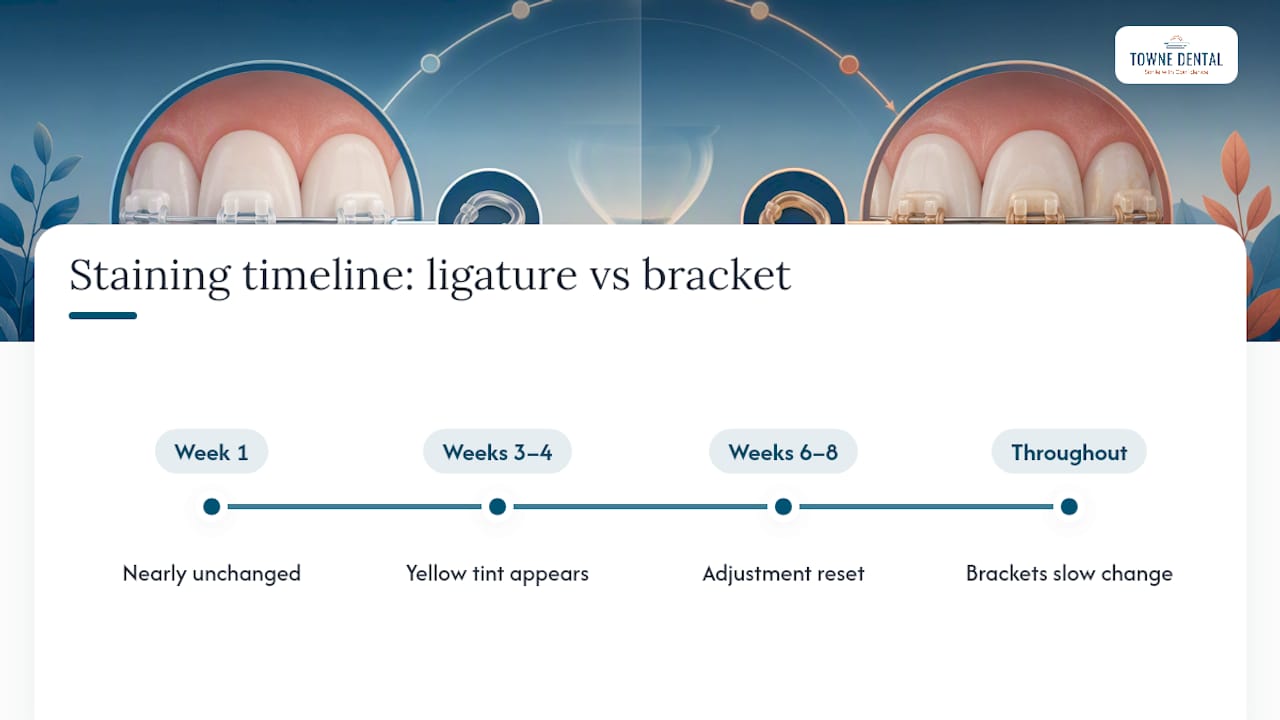
Ceramic brackets, on the other hand, degrade in appearance far more slowly. Because the alumina material barely absorbs liquid, any color change to the bracket body itself tends to be minor and gradual across the full course of treatment, not something you’d notice month to month. The visible clock you’re watching is almost always the ligature’s clock, not the bracket’s.
Can a Dentist Professionally Clean Stained Ceramic Braces?
Your dental hygienist can remove surface plaque and some extrinsic staining from the ceramic bracket itself and from the tooth enamel around it during a routine cleaning, using the same polishing tools and techniques applied to natural teeth, just navigated carefully around wires and brackets. That helps with plaque-related dulling and keeps enamel healthy, which matters more clinically than cosmetic color anyway.
What a professional cleaning cannot do is bleach or “clean” a stained ligature back to clear. Ligatures aren’t tooth structure, they’re a removable polymer part, and once pigment has absorbed into that material, polishing tools have nothing to work on. The only real fix for a discolored tie is replacement, which happens as a normal step at your adjustment visit rather than as a special cleaning procedure.
If decalcification (those white, chalky spots) shows up alongside staining, that’s where professional intervention actually changes outcomes. A dentist can apply fluoride varnish or recommend a remineralizing treatment to help strengthen weakened enamel before it progresses toward a permanent white or brown mark. That’s a separate service from routine cleaning and worth flagging specifically if you notice those spots, since catching it early makes a real difference.
Why Your Brushing Habits Matter More Than Your Diet
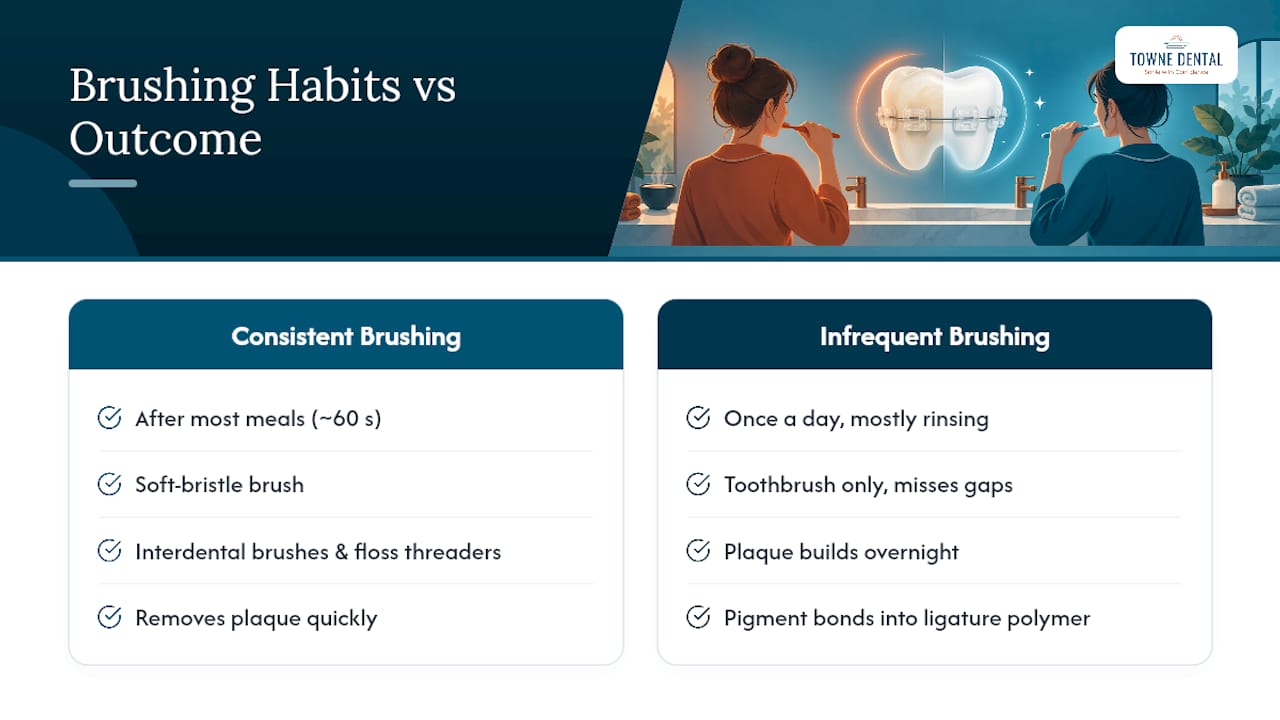
Diet gets the attention, but oral hygiene is the bigger lever. Two patients can drink the same amount of coffee and end up with completely different results depending on how consistently they clean their braces. Plaque itself has a dulling, cloudy effect on both ceramic brackets and ligatures, and it also traps pigmented food particles against the tooth and appliance surface for hours instead of minutes. The AAO’s core hygiene guidance is built around exactly this: soft-bristle brushing, fluoride toothpaste, and interdental tools that reach the spots a regular brush skips.
Patients who brush thoroughly after most meals, even a quick 60-second pass, tend to show noticeably less ligature discoloration by their next adjustment than patients who brush once a day and rely on rinsing the rest of the time. That’s not a discipline lecture. It’s simply how the chemistry works: pigment that gets removed within an hour or two never gets the chance to bond deeply into the ligature’s polymer structure the way pigment sitting there overnight does.
Interdental brushes and floss threaders matter just as much as the toothbrush itself, since the space between the wire and the gumline is exactly where plaque and pigment concentrate and where a standard brush can’t reach. Skipping that step for even a few days lets buildup accumulate in a spot you can’t easily see in the mirror, which is often why staining seems to “suddenly” appear when really it’s been quietly building for a week or two.
Towne Dental’s Perspective on Managing Ceramic Braces Staining
The advice we give patients boils down to something simpler than most staining articles suggest: don’t try to eliminate every pigmented food from your life, because that’s not realistic and it’s not necessary. Focus on the two things that actually move the needle, cleaning consistently and getting ligatures swapped on schedule, and the cosmetic issue mostly takes care of itself.
We also think patients underestimate how much their choice of appliance affects this problem before treatment even starts. If staining between visits is a real concern for you, that’s worth raising during your consultation, not after you’ve already noticed yellow ties in the mirror. Our orthodontics team can walk through whether a self-ligating system or a specific ligature material makes sense for your lifestyle, particularly if you drink coffee daily or you’re not going to give up curry night. That conversation, had early, saves a lot of frustration later.
— Towne Dental
Keep Your Ceramic Braces Looking Their Best With Towne Dental
Ceramic braces staining is best treated as a planning problem, not just a cleaning problem. During an orthodontic consultation, diet and habits can be reviewed upfront to help choose between ligature types or a self-ligating system before treatment starts, to avoid troubleshooting yellow ties months into treatment.

Beyond ligature selection, our orthodontics services cover the full range of appliance options, and our general dentistry team can build a hygiene routine around your specific braces, wires, and bite. If staining becomes a persistent issue or you suspect early enamel changes near your brackets, that’s a conversation worth having at a regular visit rather than waiting for your next scheduled adjustment. Schedule a consultation with Towne Dental to talk through which ceramic braces setup fits your daily habits and how to keep them looking clear from the day they go on.
Sources
This article draws on guidance from the American Association of Orthodontists, the American Dental Association, and peer-reviewed studies on ceramic bracket and adhesive color stability.
- AAO — FAQs: Braces (page 3)
- Color stability of ceramic brackets immersed in potentially staining solutions (2015)
- Color Stability of Orthodontic Ceramic Brackets and Adhesives in Potentially Staining Beverages—In Vitro Study (2022)
FAQ
Will the Staining From My Braces Go Away?
Yes. Ligature discoloration is temporary and gets replaced at your next adjustment appointment, typically every four to eight weeks. The ceramic bracket itself rarely stains enough to notice, so once new ties go on, your braces look clear again.
What Foods Can Stain Ceramic Braces?
Coffee, red wine, curry and turmeric sauces, dark berries, tomato-based sauces, cola, and colored sports drinks cause the most staining, along with tobacco use. Lab testing found coffee produces the greatest overall color change among common staining beverages.
What Are the Downsides of Ceramic Braces?
Beyond the staining risk on elastic ligatures, ceramic brackets are more brittle than metal and can be slightly bulkier, and they’re generally a bit more expensive. They’re also not always recommended for patients with a severe bite correction, since the material can be more prone to breaking under heavy force.
Do Ceramic Braces Stain Yellow?
The brackets themselves rarely turn yellow because the ceramic material barely absorbs liquid. The elastic ligatures are what commonly pick up a yellow tint from coffee, tea, and other pigmented foods, which is why the AAO notes ligatures as the component most likely to discolor.