Cleaning a fixed dental bridge requires two things working together: daily interdental cleaning under the pontic and around the abutment teeth, plus regular professional maintenance visits. A bridge is permanent and cannot be removed for cleaning, so plaque that collects underneath it puts the supporting teeth and gums at risk. Floss threaders, superfloss, interdental brushes, and water flossers are the common tools, and the right one is whichever you will actually use every single day.
TL;DR:
- Regular use of interdental brushes, floss threaders, or water flossers is crucial for cleaning under a fixed bridge, with tools chosen based on what you will use daily.
- Weekly inspections should include checking if larger interdental brushes fit without resistance and observing gum margins for redness or puffiness to detect early problems.
- Professional cleanings provide access to calculus removal, probing, and inspections that home tools cannot achieve, especially around the bridge’s margins and below the gumline.
- Signs of loosening, persistent bleeding, bad taste, or pain require prompt dental consultation, and do not attempt to re-cement a loose or fallen bridge yourself.
- Personalized recall intervals and cleaning routines should be based on individual gum health, bridge age, and hygiene habits, with in-office demonstrations helping establish effective daily practices.
Table of Contents
- Which tools work best for cleaning a fixed bridge?
- Your daily and weekly bridge cleaning routine
- What professional cleanings do that home care cannot
- Warning signs that mean you should call your dentist
- How Towne Dental supports patients between visits
- Book a bridge check and cleaning demonstration
- Sources
- FAQ
Which tools work best for cleaning a fixed bridge?
A standard string of floss cannot get under a pontic because the bridge is fused to the teeth on either side, so patients need tools designed to reach that gap. A floss threader lets you pull ordinary floss under the connector, while superfloss combines a stiff threading end with a spongy segment built to clean wider spaces without shredding. Both are inexpensive and widely recommended as the starting point for daily bridge care.
Interdental brushes are small, bristled brushes sized to slide between teeth and under pontics. According to the ADA, the correct approach is to start with the smallest brush that fits and increase size only if it slides in without resistance, since forcing a brush that is too large can injure the gum tissue between teeth. Bendable interdental brushes make it easier to angle the tip around back teeth.
Water flossers use a pressurized stream to flush debris from under the bridge and around the abutments. MouthHealthy notes they are a helpful option for people who struggle with manual flossing under a fixed bridge, particularly those with limited dexterity, though most clinicians treat a water flosser as an addition to mechanical cleaning rather than a full replacement for it.
Rounding out the routine,:
- A soft-bristle toothbrush cleans the bridge surface and gumline without wearing down enamel or irritating tissue.
- An antiseptic mouthwash can serve as an adjunct when your dentist recommends one for extra plaque control.
- Floss threaders and superfloss handle the connector area that a toothbrush cannot reach.
- Interdental brushes and water flossers both work well around abutment teeth, and many patients use both.
Pro Tip: Keep a floss threader or interdental brush in your bag or car. The tool that is actually within reach at the end of a long day is the one that gets used.
Your daily and weekly bridge cleaning routine
A workable routine does not need to be complicated, but the order matters because loosening debris first makes the rest of the cleaning more effective.
- Brush all surfaces of the bridge and natural teeth with a soft-bristle brush for two minutes, angling the bristles toward the gumline.
- Thread superfloss or floss on a threader under the pontic, sliding it in a C shape against each abutment tooth to clear the sides you cannot see.
- Work an interdental brush gently between the bridge and gum tissue, starting with the smallest size that fits without force.
- Finish with a water flosser, angled toward the gumline at low to medium pressure, to flush out any remaining debris under the connector.
- Rinse with plain water or an antiseptic mouthwash if your dentist has recommended one.
Once a week, take a closer look. Check whether a slightly larger interdental brush now fits without resistance, since tissue and spacing can change over time, but only size up with your clinician’s guidance. Look at the gum margins around each abutment for redness or puffiness, and check the contact points where the bridge meets your natural teeth for any looseness or grit. If your dentist has prescribed a short-term antiseptic rinse for a specific concern, this is a reasonable time to use it.
A systematic review of maintenance regimens links consistent oral hygiene aids and structured professional intervention to better long-term outcomes for fixed and implant-borne restorations. Skipping either half of that equation, home care or professional recall, tends to show up later as inflammation or restoration failure.
What professional cleanings do that home care cannot
A hygienist has instruments and training that reach past what floss and brushes can accomplish. During a maintenance visit, the dental team typically:
- Removes hardened calculus that has already bonded to the tooth surface, which no home tool can break loose.
- Flosses and inspects under the pontic with specialized instruments to catch anything missed at home.
- Checks the margins where the bridge meets the tooth for cement breakdown or gaps where bacteria could enter.
- Performs periodontal probing to measure gum health around each abutment.
- Takes radiographs or clinical images periodically to watch for changes below the gumline.
Clinical practice guidelines developed from systematic review evidence call for lifelong, risk-based professional recall for patients with fixed restorations rather than a single fixed schedule for everyone. In practice, that often means recall visits every three to six months for patients at higher risk of gum disease or with a history of bridge problems, and six to twelve months for patients with strong hygiene and stable gum health. Your own interval should reflect your bridge’s age, your gum health, and how consistent your home routine has been, which is why your dentist sets it individually rather than by a blanket rule.
Warning signs that mean you should call your dentist
Most bridge problems give some warning before they become emergencies. Contact your dentist promptly if you notice any of the following.
- The bridge feels loose or moves when you bite or press on it with your tongue.
- You have persistent bleeding, swelling, or a draining area near an abutment tooth.
- A bad taste or odor lingers around the bridge despite cleaning.
- You feel sharp or lingering pain when chewing.
If a bridge comes off entirely, do not try to re-cement it yourself. Rinse it gently, store it somewhere safe, bring it with you to the appointment, and stick to a soft diet until you’re seen.
Pro Tip: A gentle warm salt water rinse can reduce irritation while you wait for your appointment, but it is a stopgap, not a fix.

How Towne Dental supports patients between visits
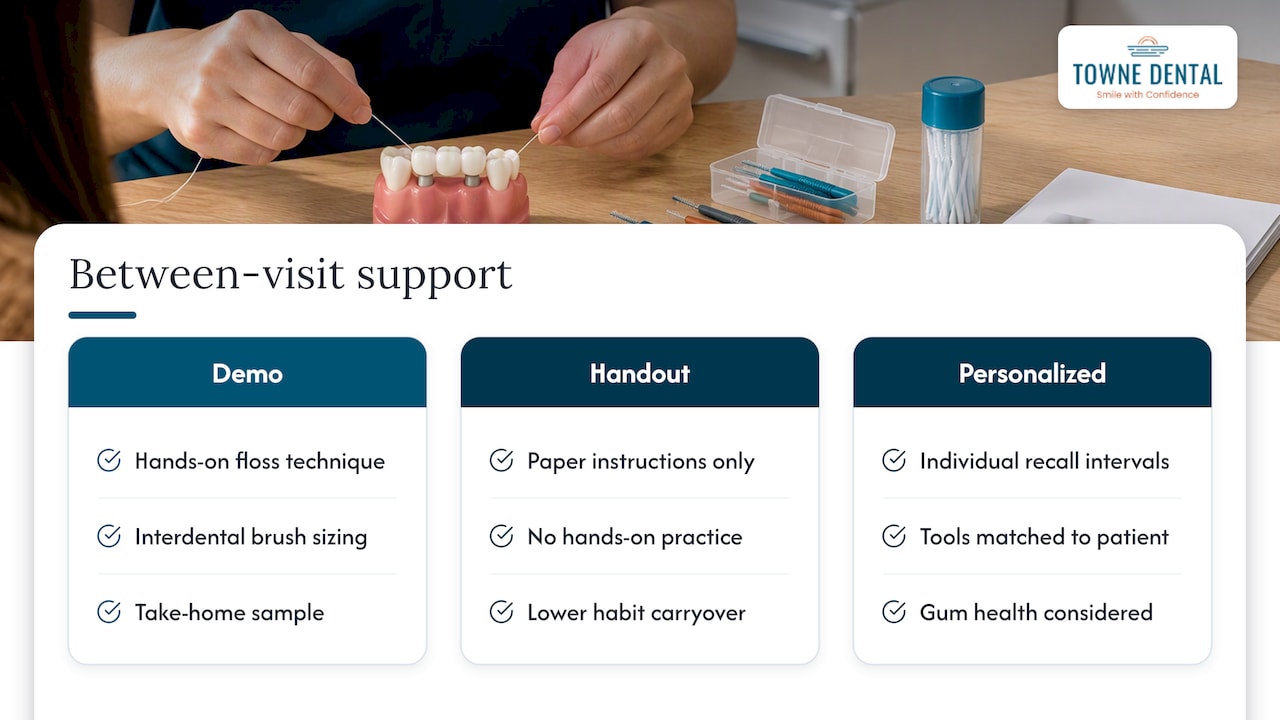
Patients are more likely to keep up an interdental routine when a clinician has actually shown them how to do it. Hygiene visits for bridge patients typically include a hands-on demonstration of threading floss under the pontic and sizing an interdental brush correctly, along with a sample to take home. That kind of in-office start tends to carry over into daily habits far better than a printed handout does.
Recall intervals and specific cleaning tools are set for the bridge and the patient individually rather than by a single standard schedule, factoring in gum health alongside the restoration when planning that schedule.
— Towne Dental
Book a bridge check and cleaning demonstration
A fixed bridge holds up best when daily care and professional maintenance are both dialed in, and getting there is easier with someone showing you the technique in person rather than guessing from instructions online.

Towne Dental’s general dentistry team handles bridge maintenance, hygiene visits, and periodontal care, and a hygiene or evaluation visit is a practical way to have your bridge checked, get a hands-on demonstration of the right tools for your mouth, and leave with a recall plan built around your own risk factors. Schedule a visit with Towne Dental to get started.
This article is general information, not a substitute for advice from a qualified doctor. Consult a qualified healthcare professional about your own circumstances before acting on anything here.
Sources
- Clinical practice guidelines for recall and maintenance of patients with tooth-borne and implant-borne dental restorations.
- A Systematic Review of Recall Regimen and Maintenance Regimen of Patients with Dental Restorations. Part 2: Implant-Borne Restorations
- Fixed prosthetic restorations and periodontal health: a narrative review
- Choosing an interdental cleaning method — ADA News
- MouthHealthy — bridges
FAQ
How often should you clean under a dental bridge?
You should clean under a fixed bridge at least once a day with an interdental tool such as superfloss, a floss threader, or an interdental brush, in addition to twice-daily brushing. A water flosser can be added for extra flushing but generally works best alongside mechanical cleaning rather than replacing it.
Can you use a regular water flosser on a dental bridge?
Yes, a water flosser is a widely recommended option for cleaning around a fixed bridge, especially for people who find threading floss under the pontic difficult. Aim the stream at a low angle along the gumline at low to medium pressure rather than relying on it as your only cleaning method.
What happens if you don’t clean under a bridge properly?
Plaque that builds up under an uncleaned bridge can inflame the gums and increase the risk of decay on the abutment teeth that anchor it, which over time can undermine the restoration itself. A narrative review on fixed prosthetics links poor cleanability and inconsistent hygiene to higher biofilm buildup and gum inflammation around bridges.
What should you do if your bridge feels loose or falls out?
Stop chewing on that side, avoid trying to re-cement it yourself, and call your dentist promptly. Bring the bridge with you to the appointment and keep to soft foods until it has been evaluated.
How often do you need professional cleanings with a bridge?
Recall frequency for bridge patients is typically personalized, often every three to six months for higher-risk patients and six to twelve months for those with stable gum health, based on guideline recommendations for fixed restorations. Your dentist sets the exact interval based on your gum health, bridge age, and hygiene consistency.