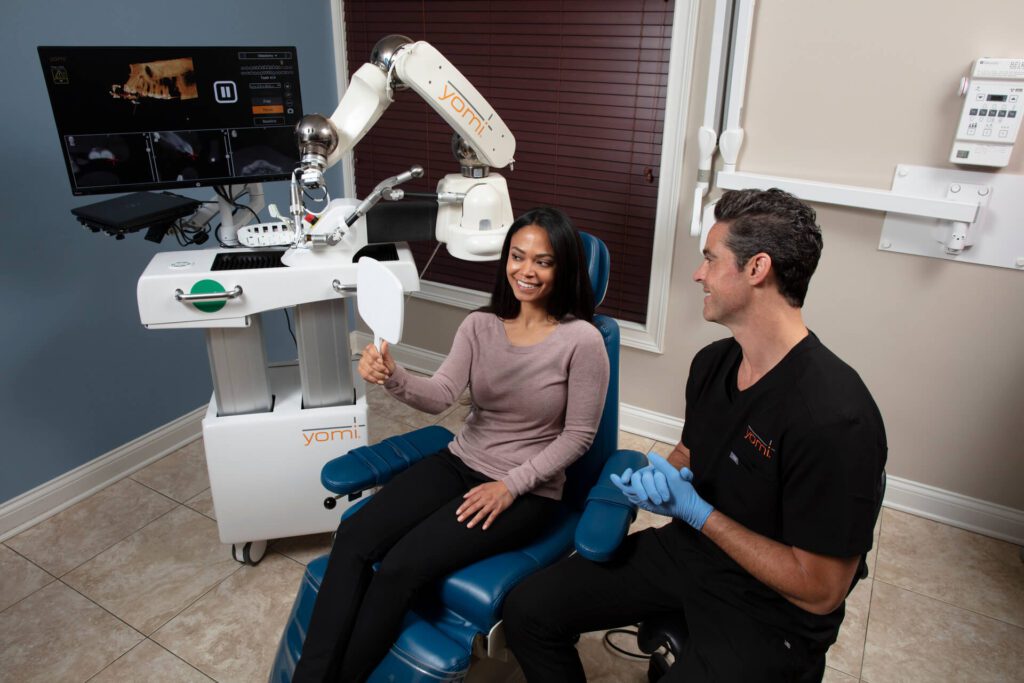
The Yomi dental robot, developed by Neocis and FDA-cleared under multiple 510(k) submissions, is a haptic-guidance robotic navigational system that augments surgeon control during dental implant placement. It does not operate autonomously. The surgeon always holds the drill; Yomi constrains deviation and delivers real-time haptic, visual, and audio feedback to keep placement on plan. For patients, that means measurably better accuracy. A randomized controlled trial found robotic-assisted placement achieved a mean platform global deviation of 0.70 mm and an angular deviation of 1.09° versus much larger deviations in the freehand group (1.24–2.13 mm platform/apex deviation, 7.43° angular deviation) — a difference that matters most in the esthetic zone where a few degrees off-axis can compromise the final crown’s appearance. Towne Dental offers Yomi-assisted implant surgery for patients who want that level of precision.
Table of Contents
- How does the Yomi dental robot work step by step?
- What patients gain from Yomi-assisted implant surgery
- Why clinicians and practices choose to add Yomi
- Clinical evidence and FDA clearance status for Yomi and Yomi S
- Who is a good candidate for Yomi-assisted implants?
- What does Yomi-assisted surgery cost, and where can you find it?
- Questions to ask before booking a Yomi-assisted implant consult
- How Towne Dental uses Yomi for implant care
- Key Takeaways
- Why our team chose Yomi
- Towne Dental’s Yomi-assisted implant consultations
- Useful sources
- FAQ
How does the Yomi dental robot work step by step?
Yomi is a haptic-guidance robotic navigational system. The surgeon retains full, continuous control of the handpiece throughout the procedure; the robot’s arm acts as a smart constraint, not an autopilot.
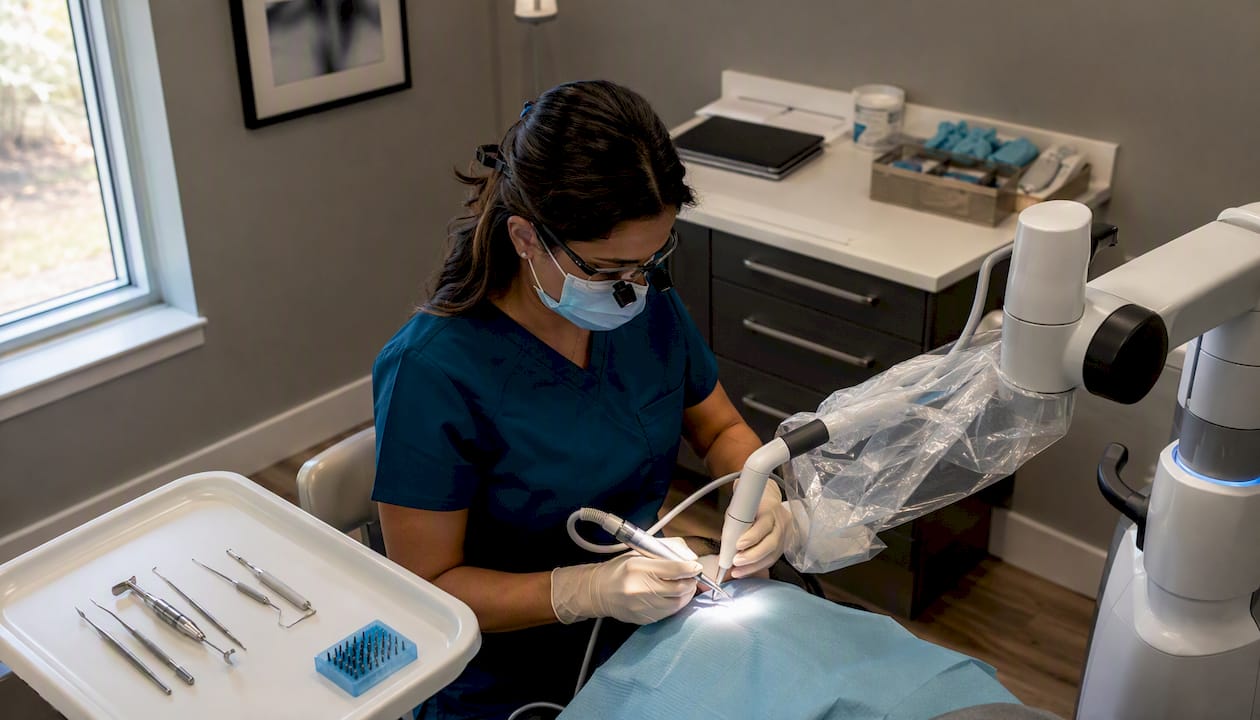
The workflow runs in three connected phases:
| Step | What Happens | Who Does It |
|---|---|---|
| 1. CBCT Imaging | Cone-beam CT scan captures jaw anatomy in 3D | Imaging technician / clinician |
| 2. YomiPlan | Restorative-driven virtual implant placement in planning software | Clinician (often with restorative team) |
| 3. Registration | Patient trackers or splints attached intraorally to link scan to patient | Surgical team |
| 4. Intra-op Guidance | Robotic arm constrains drill path; haptic, visual, and audio feedback active | Surgeon (robot guides) |
| 5. Osteotomy & Placement | Surgeon drills and seats implant within robot-guided corridor | Surgeon |
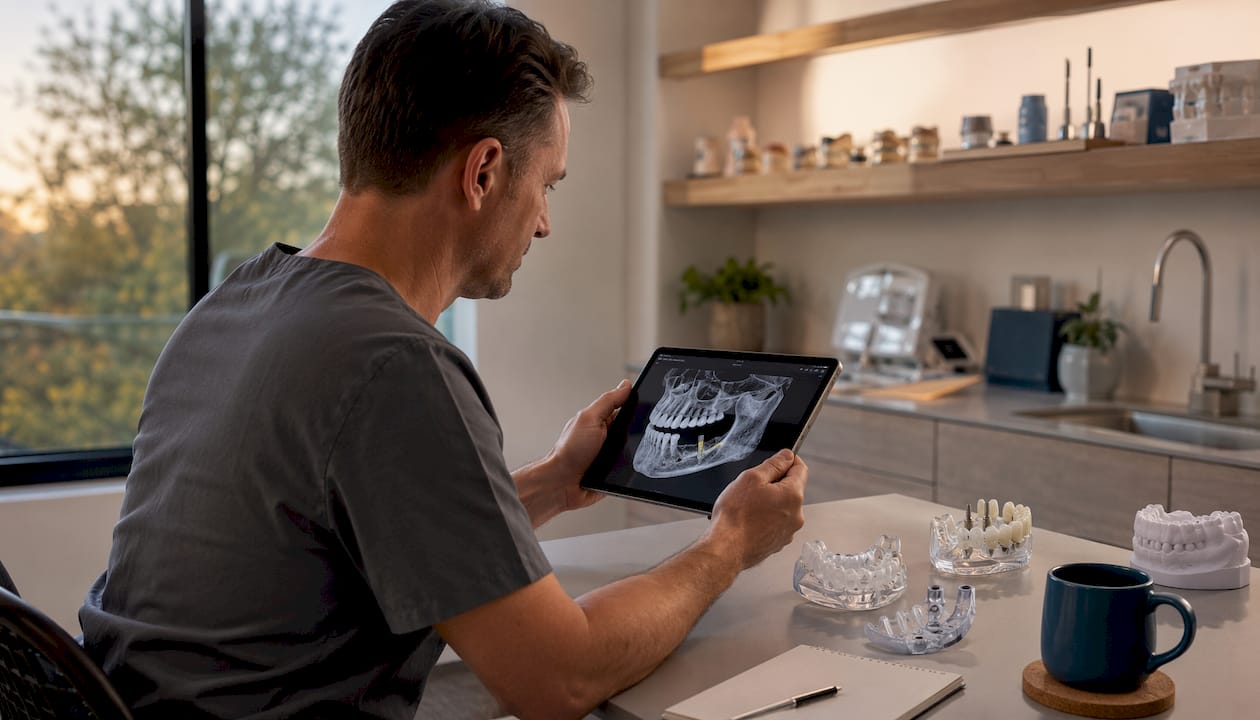
The key technical distinction from static surgical guides is real-time patient tracking. Static guides are pre-fabricated and fixed; if the patient shifts or anatomy differs slightly from the scan, the guide cannot adapt. Yomi’s dynamic tracking via splints or trackers compensates for patient movement intraoperatively, keeps the surgical field unobstructed, and allows irrigation without removing a guide. Navigation-only systems provide visual feedback on a screen but no physical constraint on the drill. Yomi adds the haptic layer — the robot physically resists deviation from the planned path.
Pro Tip: Minimizing registration error starts before the patient sits down. Confirm that the CBCT scan was taken with the patient biting in centric occlusion and that the tracker splint fits without rocking. A poorly seated splint is the single most common source of intraoperative drift.
What patients gain from Yomi-assisted implant surgery
Precision is the headline benefit, but what it translates to in the chair matters more to most patients.
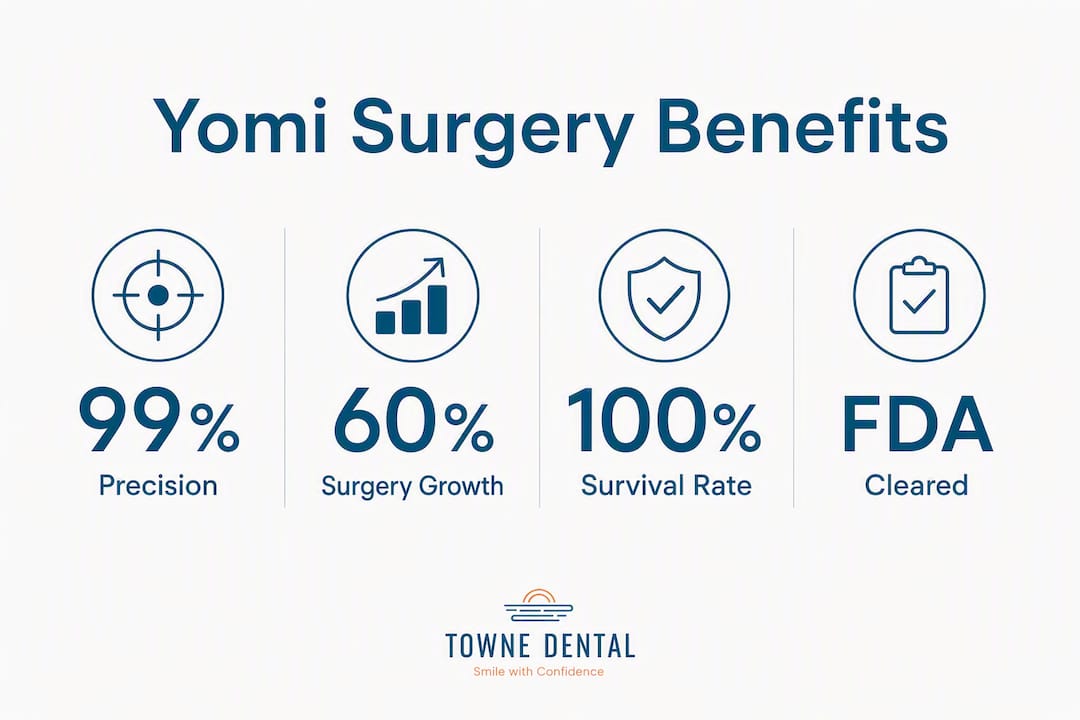
When an implant lands within fractions of a millimeter of the planned position, several downstream outcomes improve. The risk of encroaching on the inferior alveolar nerve or the sinus floor drops. Osteotomies can be more conservative because the surgeon is not compensating for anticipated drift. In the anterior zone — the visible teeth — angulation directly determines whether the crown looks natural or slightly off. Robotic assistance consistently shows lower apical and angular deviations than freehand or even dynamic navigation-only approaches.
Patient benefits that follow from that accuracy:
- Reduced risk of nerve or sinus injury due to tighter placement control
- More conservative osteotomies, meaning less bone removal and less post-op swelling
- Better anterior esthetics — angulation accuracy translates directly to crown emergence profile
- Predictable “time to teeth” when immediate-loading protocols are used, since correct primary stability is easier to achieve with precise placement
- Fewer revision procedures over the implant’s lifetime, since malpositioning is a leading cause of prosthetic complications
- Potentially faster recovery from less traumatic surgery
Accuracy by the numbers: A 6-month RCT reported mean platform global deviation of 0.70 mm and angular deviation of 1.09° in the robotic arm, compared to significantly larger deviations in the freehand group — with 100% implant survival in both arms at follow-up.
The 100% survival rate in both groups is worth noting: Yomi does not make implants succeed where they otherwise would fail. What it does is place them more accurately, which reduces the margin for error in complex or esthetically demanding cases.
Why clinicians and practices choose to add Yomi
The clinical case for Yomi comes down to one thing: it expands the range of cases a practice can treat with confidence. Surgeons working in the esthetic zone, near anatomical danger zones, or with patients who have limited mouth opening find that haptic guidance reduces the cognitive load of compensating for visual limitations.
Clinician and practice benefits include:
- Improved placement reproducibility across operators and case types
- Ability to accept more complex referrals — esthetic zone, posterior mandible, full-arch cases
- Workflow integration with CBCT and digital restorative planning, reducing analog steps
- Higher patient acceptance when patients understand the technology and its accuracy data
- Potential for same-day or immediate-loading protocols supported by predictable primary stability
On the volume side, Neocis has reported approximately 60% growth in implant volume within six months of system installation for some practices — though that figure comes from the manufacturer and reflects a subset of adopters, not a controlled study average.
The learning curve is real. Surgeons typically need a structured training program before their first cases, and early cases take longer than freehand. The RCT data recorded a mean robotic placement time of 18.8 ± 4.89 minutes per implant, longer than freehand in the same trial. Most experienced users report that time normalizes as registration and setup become routine.
Clinical evidence and FDA clearance status for Yomi and Yomi S
Yomi holds multiple FDA 510(k) clearances. The records K251835, K252376, and K222049 describe the system as a computerized robotic navigational device intended for pre-operative planning and intraoperative guidance for implant placement and alveoplasty. Yomi S, documented under K252376, adds a seven-degree-of-freedom robotic arm with automatic adjustment to patient movement and patient tracking via splints or trackers.
The accuracy evidence behind those clearances is supported by peer-reviewed literature. An umbrella review published in The Journal of Prosthetic Dentistry analyzed systematic reviews covering 5,130 implants in 1,448 models or patients and found that robot-assisted implant surgeries achieved better positional accuracy — apical, coronal, and angular — than dynamic or static computer-guided or freehand placement.
| Accuracy Metric | Robotic-Assisted | Freehand |
|---|---|---|
| Platform global deviation | ~0.70 mm | — |
| Apex global deviation | ~0.70 mm | Significantly larger |
| Angular deviation | ~1.09° | ~7.43° |
Source: RCT data from Accuracy, Safety, and Efficiency in Robotic-Assisted vs. Freehand Dental Implant Surgery
“Yomi functions as a ‘smart guide rail’ — it provides haptic, visual, and audio feedback while the surgeon retains continuous control. It is not an autonomous surgical robot.” — Perio Journal clinical overview
The FDA indications for use cover adult patients requiring dental implants and guided bone reduction. The clearances do not extend to pediatric patients or to procedures outside those defined indications.
Who is a good candidate for Yomi-assisted implants?
Yomi is intended for adult patients who qualify for dental implants, but not every implant patient is the right fit for robotic-assisted placement. Suitability depends on anatomy, bone quality, medical history, and the complexity of the planned restoration.
Practical limitations and considerations:
- CBCT quality requirements: The system depends on a diagnostic-quality cone-beam CT. Motion artifact or insufficient field of view can compromise planning accuracy.
- Bone volume: Cases requiring significant bone grafting before implant placement may need to complete grafting and healing before Yomi-assisted surgery is appropriate. Bone availability is a prerequisite, not something the robot solves.
- Registration challenges: Patients with limited mouth opening, severe gag reflex, or inability to tolerate intraoral trackers may face workflow complications.
- Cost and access: Not every practice owns the system. Patients in some regions may need to travel to a Yomi-equipped clinic.
- Clinician learning curve: Early in a surgeon’s Yomi experience, case selection should favor straightforward anatomy.
Clinical reality check: Robotic guidance improves placement accuracy, but it does not replace clinical judgment. The surgeon remains responsible for case selection, complication management, and the final outcome. Technology is only as reliable as the plan it executes.
Pre-operative preparation typically includes a full CBCT scan, digital or physical impressions for prosthetic planning, a medical history review, and in some cases periodontal treatment or bone grafting before surgery is scheduled.
What does Yomi-assisted surgery cost, and where can you find it?
System capital costs are significant, and patient fees vary by practice and procedure complexity. Literature on comparable robotic surgical platforms cites capital cost ranges of roughly $600,000 to $2.5 million for robotic systems, which explains why Yomi is available at specialized practices and referral centers rather than every general dental office.
What patients should know about costs and access:
- Practice capital costs are not publicly listed by Neocis; the figures above reflect literature ranges for comparable robotic platforms and give context for why patient fees at Yomi-equipped practices may be higher than at non-robotic offices.
- Patient fees cover implant components, surgical fees, imaging, and any adjunctive procedures (grafting, sedation). The robotic guidance component is typically bundled into the surgical fee rather than itemized separately.
- Insurance and reimbursement: Dental implants are rarely covered by standard dental insurance. The robotic guidance component has no separate reimbursement code; patients generally pay out of pocket. Some medical insurance plans cover implants when tooth loss resulted from a covered medical condition — worth checking before assuming no coverage.
- Finding a provider: Search for practices that specifically list Yomi or Yomi S on their website, or ask your general dentist for a referral. Confirm whether the practice owns the system or uses a visiting surgical service.
- Visiting services: Some practices contract with a Yomi-equipped surgeon who visits periodically. Ask whether the surgeon performing your procedure is the one you consulted with.
Questions to ask before booking a Yomi-assisted implant consult
Finding a practice that owns Yomi is step one. Evaluating whether that practice and surgeon are the right fit is step two.
- How many Yomi-assisted cases has this surgeon completed? Experience with the system matters; ask for a number, not a general answer.
- Can you show me before-and-after imaging from similar cases? Placement accuracy should be verifiable on post-op CBCT.
- Who performs the surgery? Confirm it is the surgeon you consulted with, not a visiting provider.
- What imaging will I need, and is it done in-house? In-house CBCT simplifies the workflow and reduces registration variables.
- What sedation options are available? Yomi procedures can be done under local anesthesia, but IV sedation or oral sedation may be appropriate for anxious patients.
- What is the expected recovery timeline? Ask specifically about swelling, return to work, and any activity restrictions.
- What is the full cost breakdown? Request an itemized estimate covering imaging, surgery, implant components, and the final restoration.
- Does the practice own the Yomi system, or is it a visiting service?
- What happens if a complication arises? Confirm the practice has the surgical capability to manage complications in-house or has a clear referral protocol.
Pro Tip: Ask the clinic to walk you through the YomiPlan output for your case before surgery. Seeing your planned implant position on the 3D scan, with the proposed angulation and depth, tells you more about the surgeon’s planning process than any brochure.
How Towne Dental uses Yomi for implant care
Towne Dental integrates Yomi-assisted implant surgery into a full-service implant workflow that begins with an in-house CBCT scan and restorative-driven treatment planning. Patients receive a detailed consultation that covers imaging review, prosthetic goals, and a written treatment plan before any surgical date is set.
The clinic’s oral surgery team performs Yomi-assisted placements on-site, meaning patients consult with and are treated by the same surgical team throughout. For patients considering anterior implants or complex multi-unit cases, the combination of in-house imaging, digital planning, and robotic guidance keeps the process coordinated under one roof.
Scheduling a consult at Towne Dental starts with a call or online booking. Patients should bring any existing dental records or prior imaging, though in-house CBCT is available for those starting fresh. Cases involving bone grafting or periodontal preparation are coordinated with the periodontics team before implant surgery is scheduled.
Key Takeaways
The Yomi dental robot is an FDA-cleared haptic-guidance system that delivers measurably better implant placement accuracy than freehand surgery, with peer-reviewed angular deviations as low as 1.09° versus 7.43° freehand.
| Point | Details |
|---|---|
| FDA clearance | Yomi and Yomi S hold multiple 510(k) clearances for implant placement and alveoplasty in adult patients. |
| Placement accuracy | RCT data shows platform and apex deviations of ~0.70 mm and angular deviation of 1.09° with robotic assistance. |
| Patient benefits | More conservative osteotomies, better anterior esthetics, reduced nerve/sinus risk, and predictable loading timelines. |
| Practice adoption | Significant capital cost limits availability; patients should confirm the practice owns the system and ask about surgeon experience. |
| Towne Dental | Offers Yomi-assisted implant surgery with in-house CBCT, digital planning, and a dedicated surgical team in Naples, FL. |
Why our team chose Yomi
The decision to add Yomi to our implant workflow was not about the technology itself. It was about the cases we were seeing — patients with narrow ridges, esthetic zone replacements, and full-arch plans where the margin for error is genuinely small. Freehand placement by an experienced surgeon is reliable in straightforward cases. In the esthetic zone, or when the inferior alveolar nerve is close, “reliable” is not the same as “precise.”
What Yomi does is reduce the gap between what we plan and what we place. That matters most for patients who will be looking at those teeth every day. We have also found that patients who understand the technology ask better questions during consultations, engage more actively in treatment planning, and tend to follow post-op protocols more carefully. The robot does not replace surgical judgment — it gives the surgeon a tighter corridor to work in, which is exactly what complex cases need.
Towne Dental’s Yomi-assisted implant consultations
Towne Dental offers Yomi-assisted implant evaluations for patients across Naples and the surrounding area. A consult includes a CBCT scan, a restorative-driven treatment plan, and a full cost breakdown — so you know exactly what the procedure involves before committing.
The surgical team performs all Yomi-assisted procedures on-site, and sedation options are available for patients who prefer a more relaxed experience. To book a consultation or learn more about cosmetic and implant services, visit the Towne Dental website or call the Naples office directly. For a full overview of available treatments, the complete services page covers every procedure the clinic offers.
This article is general information, not professional dental or medical advice. Confirm your specific candidacy and treatment options with a qualified dental professional.
Useful sources
- Accuracy, Safety, and Efficiency in Robotic-Assisted vs. Freehand Dental Implant Surgery: A 6-Month RCT — Peer-reviewed RCT with deviation metrics and survival data; primary source for accuracy statistics.
- Accuracy assessment of robot-assisted dental implant surgery — Journal of Prosthetic Dentistry00558-X/abstract) — Umbrella review of systematic reviews covering 5,130 implants; highest-level evidence summary.
- Accuracy of robot-assisted implant surgery vs. freehand — Springer — Retrospective clinical study supporting comparative deviation data.
- Yomi Robotic System (K251835) — FDA 510(k) via Innolitics — Primary regulatory record for Yomi; indications for use and device description.
- Yomi S Robotic System (K252376) — FDA 510(k) via Innolitics — Regulatory record for Yomi S; seven-DOF arm and patient tracking details.
- Yomi Robotic System (K222049) — FDA 510(k) via Innolitics — Earlier clearance record; standards compliance and device classification.
- Why Yomi — Neocis — Manufacturer data on practice volume growth and system rationale.
- Yomi product page — Neocis — Technical description of dynamic tracking and workflow integration.
- Yomi FDA cleared — Perio Journal — Clinical overview clarifying Yomi’s haptic-guidance (non-autonomous) role.
- Cost and adoption considerations for surgical robotic systems — PMC — Literature review on capital cost ranges for robotic surgical platforms.
- Anetco Dental — clinical context for robotic assistance — Industry partner resource on robotic-assisted implant benefits for challenging bone cases.
FAQ
What is Yomi in dentistry?
Yomi is an FDA-cleared robotic guidance system made by Neocis that assists surgeons during dental implant placement. It uses haptic, visual, and audio feedback to constrain the drill to the planned path while the surgeon retains full control.
How much does a Yomi-assisted implant procedure cost?
Neocis does not publish patient pricing, and fees vary by practice and case complexity. The robotic guidance component is typically bundled into the surgical fee rather than itemized; patients should request an itemized estimate covering imaging, surgery, implant components, and the final restoration.
Is Yomi an autonomous surgical robot?
No. Yomi is a haptic-guidance system, not an autonomous robot. The surgeon holds the drill and makes every decision; the robotic arm physically constrains deviation from the planned path and provides real-time feedback.
Why do some clinicians have reservations about robotic surgery?
The main concerns are capital cost, the learning curve for setup and registration, and longer procedural time in early cases. The RCT data recorded a mean robotic placement time of 18.8 ± 4.89 minutes per implant, longer than freehand in the same trial, though accuracy was significantly better.