
A tongue tie release (a frenotomy or frenectomy) cuts or loosens the thin band of tissue under the tongue so the tongue can move more freely. It is a short procedure, but it is not always the right answer. Pediatric and dental groups say it should be based on how the tongue works, not just how it looks, and that it is frequently overdiagnosed. This guide covers who may need a release, how it differs from a lip tie release, what recovery involves for babies, children and adults, and what to ask before you book.
TL;DR
- A release is worth considering when a tight frenulum causes a clear, measurable problem, such as painful or ineffective feeding in an infant, or limited tongue movement in an older child or adult. A visible tie alone is not a reason.
- Evidence for long-term benefit in infants is weak. Many babies improve with lactation support alone, so try that first.
- Recovery is usually short. Expect a diamond-shaped wound that heals over about two weeks. Aggressive stretching exercises are not proven and often hurt.
- Laser is not shown to be better than scissors for infants, according to the AAP and AAO-HNS.
- Get a functional assessment from a qualified professional before any procedure, and ask for a second opinion if you feel pushed.
Table of Contents
- What a tongue tie release actually is
- How common is tongue tie, and why do the numbers vary?
- Tongue tie vs. lip tie
- Tongue tie in babies: try feeding support first
- Laser or scissors?
- Where the procedure happens
- Tongue tie in older children
- Tongue tie symptoms in adults
- What recovery looks like
- Questions to ask before you book
- Our perspective at Towne Dental
- Talk to our team in Southwest Florida
- FAQ
- Sources
What a tongue tie release actually is
The frenulum is the small fold of tissue that anchors the underside of the tongue to the floor of the mouth. When it is short, thick or tight, the condition is called ankyloglossia, or tongue tie. A release frees that tissue.
Two terms come up constantly:
- Frenotomy (also called frenulotomy) is the simple snip or release of the frenulum. It is the term most often used for babies.
- Frenectomy usually means removing more of the tissue. Dental offices often use “dental frenectomy” for the procedure in older children and adults.
In everyday conversation the words overlap, so ask your clinician exactly what will be done, with what instrument, and why.
How common is tongue tie, and why do the numbers vary?
A large review of 71 studies found that about 5% of people have ankyloglossia. The range was wide, from 2% to 20%, depending on which assessment tool was used. That gap matters. It means two professionals can look at the same mouth and disagree about whether it counts as a tie.
That uncertainty is the reason experts stress function over appearance. An AAO-HNS pediatric otolaryngology piece says the question of whether a baby needs a release should begin with function, not form.
Tongue tie vs. lip tie
The two are close cousins, and both involve a frenulum.
| Tongue tie | Lip tie | |
|---|---|---|
| Tissue involved | Lingual frenulum, under the tongue | Labial frenulum, between the upper lip and gum |
| Possible effects | Limited tongue lift or reach, feeding trouble, speech or eating difficulty | Limited lip movement, a gap between front teeth, difficulty cleaning along the gumline |
| Procedure | Lingual frenotomy or frenectomy | Labial frenotomy or frenectomy |
| Common caution | Often overdiagnosed in infants | A normal upper lip frenulum is present in everyone, and many are harmless |
Every person has a labial frenulum, so a visible one is not a problem by itself. As with the tongue, what matters is whether it limits something you or your child needs to do. Lip tie release recovery follows the same pattern as tongue tie recovery: a small wound, mild soreness and a couple of weeks to heal.
Tongue tie in babies: try feeding support first
Most searches for this topic come from parents of newborns who are struggling to nurse. The honest picture is mixed.
- A 2024 systematic review found frenotomy may reduce maternal nipple pain a little, about 1.2 points on a 10-point scale, but the clinical importance of that change is debated.
- The AAP notes that the evidence for longer-term breastfeeding success, weight gain and maternal confidence is not settled, and that many infants sort out feeding problems with non-surgical techniques alone.
- A U.S. study cited by the AAP found that 63% of infants referred for surgery did not need it to resolve their feeding difficulties.
- Research volume is growing faster than research quality. A 2025 review describes a rise in publications without a matching rise in evidence.
That is not an argument that release never helps. Some babies clearly do better afterward. It is an argument for a careful sequence:
- See a pediatrician and an International Board Certified Lactation Consultant (IBCLC) to check latch, positioning and milk transfer.
- Work on conservative changes for a reasonable period.
- If a functional problem persists, get the frenulum assessed by a clinician who treats infants regularly.
Professionals recommend this team model, with pediatricians, lactation consultants and feeding therapists working together, so the diagnosis is right and unneeded surgery is avoided.
Practical support also counts while you wait. Positioning and comfort make a real difference, and guides such as this overview of feeding support options for new mothers and these breastfeeding tips for recovering mothers can help you build a comfortable routine, whatever you decide about a release.
What a release will not do
A release is not preventive medicine. There is no scientific evidence that doing it in infancy prevents speech delay, crooked teeth, sleep apnea or other later structural problems. If someone sells it to you on those grounds, ask for the studies.
Laser or scissors?
Laser frenectomy is heavily advertised. For infants, the AAP and AAO-HNS state that there is no clinical evidence lasers outperform simple scissor release, and that lasers add cost and risk. Choose a clinician for their training, their assessment process and their willingness to explain alternatives, not for the tool.
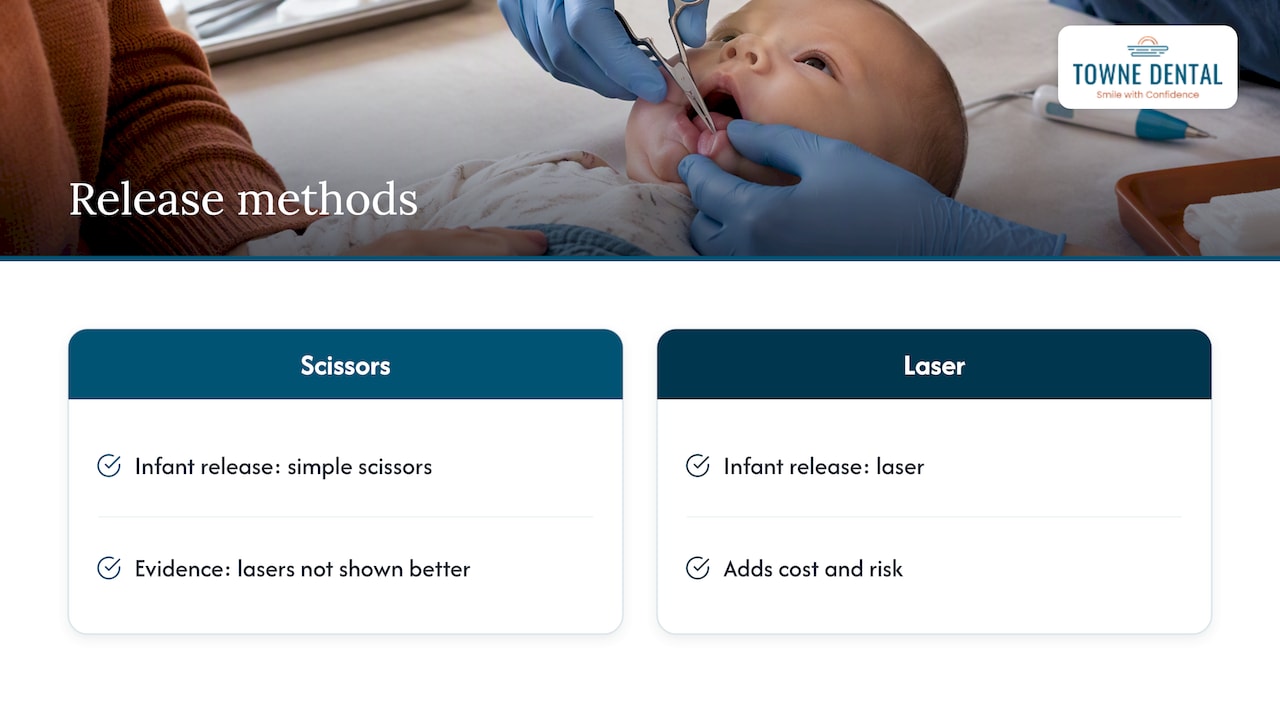
In older children and adults the instrument choice is a clinical judgment between you and your provider. Ask why they prefer one method, how bleeding is controlled and whether stitches are needed.
Where the procedure happens
Setting depends mostly on age. According to the AAO-HNS, an in-office scissor release is generally appropriate for young infants, typically up to about 3 to 6 months. Older infants and children often need general anesthesia for safety and cooperation. Older children and adults are commonly treated with local numbing, and sedation may be an option for anxious patients.
If dental anxiety is the barrier for you or your child, say so at the first visit. It changes how the appointment is planned.
Tongue tie in older children
Parents of toddlers and school-age children usually notice one of these:
- Trouble sticking the tongue out past the lower teeth, or a heart-shaped tongue tip when it lifts
- Difficulty with certain speech sounds
- Picky eating, messy eating or gagging that seems tied to tongue movement
- Food that stays stuck in the mouth because the tongue cannot sweep it away
These signs can have many causes, so a speech-language pathologist’s evaluation is a sensible first step alongside a dental or medical exam. The same principle applies as for infants: a release should address a demonstrable problem. It is not a way to prevent future ones.
Tongue tie symptoms in adults
Many adults have lived with a tight frenulum for decades without knowing it. Reasons adults ask about a release include:
- Limited tongue reach, for example trouble licking the lips or clearing food from the teeth
- Tension or fatigue in the tongue, jaw or neck
- Speech effort or clarity concerns
- Difficulty with oral hygiene along the lower back teeth
- Discomfort when kissing, or trouble with certain wind instruments
An AAO-HNS-affiliated source notes that an older person may choose a release for aesthetic or mechanical reasons, such as clearing food from the teeth. Be aware that most of the high-quality research discussed in this article concerns infants. Claims about adult releases fixing sleep, posture or chronic pain deserve the same scrutiny: ask your provider what evidence they rely on and what outcome is realistic.
A good adult evaluation covers what you can and cannot do with your tongue, how it affects your daily life and whether myofunctional therapy or speech therapy should come before or alongside surgery. A release is a mechanical fix. It does not retrain muscles that have adapted over years, which is why many providers pair it with exercises supervised by a therapist.
What recovery looks like
Your experience depends on age, the technique and how much tissue was released. These are general patterns, and your clinician’s written instructions come first.
Babies
- A pink or red diamond-shaped wound appears under the tongue. A white or yellow patch can form a few days later; this is part of normal healing, not automatically an infection. Ask your provider what to expect.
- One practitioner page describes healing taking about two weeks. Treat that as a rough timeline rather than a guarantee.
- Fussiness and mild feeding changes in the first day or two are common. Call your provider about heavy bleeding, fever, refusal to feed or signs of dehydration, such as very few wet diapers.
Stretching exercises
Many families are told to massage or stretch the wound open several times a day. The AAO-HNS piece says that many practitioners now avoid these exercises because they cause pain and have no proven benefit in preventing reattachment. Ask your provider directly whether they recommend them and why.
Older children and adults
- Expect a sore, tight feeling under the tongue for several days, along with some swelling. Soft, cool foods are easier at first.
- Avoid spicy, acidic or crunchy foods while the area is tender, and keep the mouth clean as instructed.
- A white or yellow patch is common as the wound heals. Follow your provider’s advice on rinsing.
- If you were given tongue exercises, do them as taught. Stopping early is the most common reason people feel the release “did not work.”
- Call the office for bleeding that will not stop, increasing pain after the first few days, fever or pus.
Laser frenectomy recovery is described by many offices as quick, but the healing process is the same wound-closing biology. Do not assume that a laser means no aftercare.
Questions to ask before you book
- What exactly is the functional problem we are treating, and how was it measured?
- Has a lactation consultant or speech therapist evaluated the problem, and what did they find?
- What are the alternatives, and what happens if we wait?
- What technique will you use, and why? What are the risks?
- What does aftercare involve, and who do I call at night or on a weekend?
- How many of these do you perform each year, and on what ages?
A confident clinician welcomes these questions. If you get defensiveness or a promise that a release will fix unrelated problems, seek a second opinion.
Our perspective at Towne Dental
We see dental care as a conversation about function, comfort and confidence, and that applies to oral soft tissue too. Our practice covers general, pediatric, cosmetic, emergency and oral surgery services, and many of our patients are anxious adults or parents who want a calm, gentler visit. That shapes how we think about decisions like this one.
Our view is simple. Do not rush into a procedure because a visible band of tissue looks tight. Start with what is actually going wrong: feeding, speech, hygiene, comfort. Bring in the right team, especially lactation and speech professionals for little ones. If a procedure is then warranted, you should know why, what recovery involves and what the realistic benefit is. We would rather you leave with a clear plan, even if the plan is to wait, than book a treatment you did not need.
If your concern is anxiety, we offer sedation dentistry, and our approach to every visit is built around keeping it low-stress.
— Towne Dental
Talk to our team in Southwest Florida
If you live in Fort Myers, Cape Coral, Naples, Bonita Springs, Estero, Marco Island or nearby, our team can look at your concern, explain your options and talk you through next steps. You can see our oral surgery and extraction services or browse all of our services for pediatric, emergency and sedation care. Please contact our office first to ask whether your specific situation is something we evaluate or whether we would refer you to another specialist.
FAQ
Does insurance cover tongue tie release?
Coverage varies widely by plan, by the age of the patient and by whether the procedure is billed as medical or dental. Ask your insurer before the visit, and ask the office for the procedure and diagnosis codes it will submit. We do not publish prices, so request an estimate from the clinic you choose.
How long does a tongue tie release take to heal?
The wound typically closes over about two weeks, though discomfort is usually most noticeable in the first few days. Adults and older children often feel back to normal activity within a few days, depending on the technique and how much tissue was released. Follow your provider’s aftercare instructions, because they may differ from general patterns.
At what age should a tongue tie be released?
There is no single correct age. In young infants with a clear, persistent functional problem, an office release is generally appropriate up to roughly 3 to 6 months, while older infants and children may need anesthesia. Adults can be treated at any age if a real functional issue exists.
Will a release fix my baby’s breastfeeding problems?
Not necessarily. Some babies feed better afterward, but the evidence for lasting benefit is low, and many infants improve with non-surgical support alone. See a lactation consultant and your pediatrician first.
Can adults have a tongue tie release?
Yes. Adults seek releases for limited tongue movement, speech effort or oral hygiene. Get an evaluation of how your tongue functions, ask what evidence supports the expected benefit and consider therapy alongside the procedure.
Sources
- AAP: Addresses rise in tongue-tie diagnoses for breastfeeding concerns (HealthyChildren.org)
- Tongue tie in babies: how ankyloglossia affects breastfeeding (HealthyChildren.org)
- HealthyChildren.org
- AAO-HNS Bulletin: The 12 Days of Pediatric Otolaryngology, Part 2
- ADA News: Tongue-tie may be overdiagnosed, overtreated
- JADA: Prevalence of ankyloglossia according to different assessment tools
- PubMed: Effect of frenotomy on maternal nipple pain, systematic review
- PubMed: Systematic review of tongue tie publications