Most thumb sucking is normal for toddlers and won’t hurt a thing. The concern kicks in when the habit sticks around past age 3 or 4, when the resting pressure of a thumb against the roof of the mouth starts pulling teeth and bone out of alignment. Start with calm, consistent behavior strategies now, and get your child in for a dental check if the habit is still going strong around their third birthday.
TL;DR:
- Children who suck their thumbs past age 3 are at increased risk of developing bite problems like open bite, overjet, and narrowed upper arches.
- Thumb sucking that involves deep placement of the thumb against the palate causes more significant structural damage than light or lips-only pressure.
- Interventions should start before age 4, with behavioral strategies emphasized over appliances, and dental checkups are recommended if the habit persists at age 3.
- Severe or prolonged thumb sucking habits may require orthodontic treatment such as appliances, palatal expanders, or braces once dental changes become evident.
- Natural correction is more likely if the habit stops early, especially before permanent teeth erupt, but early dental evaluation ensures proper management of any developed issues.
Table of Contents
- How Thumb Sucking Teeth Problems Develop
- When Should Thumb Sucking Stop? Warning Signs to Watch
- How to Stop Thumb Sucking: Step-by-Step Strategies That Work
- Orthodontic and Clinical Options When the Habit Won’t Quit
- Will My Child’s Teeth Fix Themselves After They Stop?
- Does Thumb Sucking Affect a Child’s Emotional Development?
- Can Thumb Sucking Cause Speech Problems?
- A Pediatric Dentist’s View on Thumb Sucking Evaluations
- Ready to Get Your Child’s Bite Checked?
- Sources
- FAQ
How Thumb Sucking Teeth Problems Develop
A thumb parked against the palate for hours a day isn’t a passive habit. It’s a steady mechanical force, and growing bone responds to steady force by moving. The upper front teeth get pushed forward and outward, the lower teeth get pushed back, and the roof of the mouth can literally narrow around the shape of the thumb sitting inside it. Kids who suck vigorously, use their thumb constantly (not just at nap time), or keep going well past age 4 see the most noticeable change.
The dental problems tied to thumb sucking show up in a predictable pattern:
- Anterior open bite — the front top and bottom teeth don’t touch when the jaw is closed, leaving a visible gap
- Increased overjet — the upper front teeth protrude out over the lower teeth, sometimes dramatically
- Posterior crossbite — the narrowed upper arch causes back teeth to sit inside (rather than outside) the lower back teeth
- Maxillary arch narrowing — the upper jaw develops a smaller, more V-shaped form instead of a broad U-shape
- High-arched palate — the roof of the mouth deepens and steepens under constant thumb pressure
Pro Tip: Watch how your child rests their thumb, not just how long they suck it. A thumb wedged deep with the tip pressing the palate does more structural damage than one that just sits lightly between the lips.
The scale of the risk isn’t small. Longitudinal research tracking children over time found that those with a history of prolonged nonnutritive sucking, thumb or pacifier, had a 4.25-fold higher risk of developing malocclusion compared with kids who never developed the habit. That’s not a minor statistical bump. It’s one of the strongest predictors of bite problems pediatric dentists see walk through the door.
When Should Thumb Sucking Stop? Warning Signs to Watch
Timing matters more than most parents realize. Sucking is a normal reflex in infancy and most children phase it out on their own between ages 2 and 4. Pacifiers tend to be a little easier to retire than thumbs, mainly because you can physically remove a pacifier. You can’t take away a thumb.

The American Academy of Pediatric Dentistry draws a clear line: if the habit is still active at age 3, it’s time to loop in a dentist, even if you haven’t noticed any visible changes yet. Waiting until permanent teeth start coming in around age 6 gives the habit years of extra time to reshape the bite.
Watch for these signs that intervention shouldn’t wait:
- Front teeth that no longer touch when your child bites down normally
- Teeth that appear to be shifting position month to month
- New lisps or trouble pronouncing certain sounds
- Cracked, calloused, or infected skin on the thumb from constant moisture and pressure
- Sucking that intensifies rather than fades as your child approaches age 4
How to Stop Thumb Sucking: Step-by-Step Strategies That Work
Behavior change comes before any clinical device, and it should. Pediatric experts consistently point out that scolding or shaming a child over thumb sucking backfires, it raises anxiety, and anxious kids suck their thumbs more, not less. The goal isn’t punishment. It’s replacing the comfort the habit provides with something else.
- Identify the trigger. Notice when the thumb goes in, boredom, car rides, TV time, falling asleep, and target that specific moment rather than the habit in general.
- Offer a hands-on substitute. A squishy toy, a fidget bracelet, or a stuffed animal to hold gives the hands something to do instead.
- Build a reward system your child helps design. Let them pick the sticker chart or the small prize; ownership matters more than the prize itself.
- Praise the dry thumb, not the absence of sucking. “Your hands were busy all afternoon!” lands better than “Good, you didn’t suck your thumb.”
- Tackle daytime habits first, nighttime later. Nighttime sucking is often unconscious, so pushing too hard on it early tends to backfire and just adds frustration.
- Keep bedtime calm and predictable. A consistent wind-down routine, dimmed lights, a favorite book, cuts down on the stress that drives kids back to their thumb at night.
- Reserve bitter-tasting nail coatings or dental appliances for stubborn cases. These work best as a last resort, under a dentist’s guidance, after consistent behavior strategies haven’t moved the needle.
Thumb sucking is fundamentally a self-soothing behavior, so the real trick isn’t removing the thumb. It’s replacing the soothing function the thumb provides. Kids who get a substitute comfort object tend to drop the habit faster than kids who just get told “no.”
Orthodontic and Clinical Options When the Habit Won’t Quit
When behavior strategies stall out, or when dental changes have already started, a dentist has a few more tools. None of them are the first move. All of them work better once the underlying habit is at least partly under control.
- Counseling and habit reminders. A pediatric dentist explaining the “why” directly to your child often lands harder than a parent saying the same thing for the tenth time.
- Removable habit appliances. Reversible devices worn in the mouth make thumb sucking physically less satisfying without being punitive, and dentists generally start here with younger kids.
- Fixed habit-breaking appliances. These come into play only when compliance is a problem or when the habit is causing rapid dental change that needs to stop now.
- Palatal expanders. For a narrowed upper arch or a developing crossbite, a slow expansion appliance widens the jaw gradually over months.
- Braces or functional appliances. Open bite and significant overjet, once permanent teeth are involved, often need active orthodontic correction rather than just habit control.
Timing depends heavily on severity. Mild changes caught early might just need monitoring. More established bite problems, especially once permanent teeth have erupted, usually call for a referral to orthodontic treatment with a realistic multi-month or multi-year commitment, not a quick fix.
Will My Child’s Teeth Fix Themselves After They Stop?
Often, yes, at least partially. Reported open-bite improvement rates range widely, roughly 50% to 100%, depending heavily on how young the child was and how quickly the habit stopped. Catch it before permanent teeth erupt and the odds of natural correction go up substantially.
That’s not a guarantee, though. A dentist needs to actually look to know which category your child falls into. Schedule a follow-up visit within a few months of the habit stopping, and keep up with routine checkups in the meantime. Early orthodontic screening around age 7, once the first permanent molars and incisors are in, catches problems that self-correction didn’t fully resolve.
Does Thumb Sucking Affect a Child’s Emotional Development?
Thumb sucking is rarely, on its own, a sign of a deeper psychological issue. It’s a self-regulation tool. Infants use it to soothe themselves before they have other coping skills, and most kids simply age out of needing it as they develop better ways to manage stress and boredom.
Where it gets more complicated is when the habit sticks around well past preschool and starts affecting a child socially. Kids who are still visibly thumb sucking at age 6 or 7 sometimes face teasing from classmates, and that can chip away at confidence in ways that have nothing to do with teeth. In those cases, the habit and the anxiety feed each other. The thumb becomes the coping mechanism for the stress the habit itself is now causing.
This is where professional support beyond a dentist’s office can help. If a habit persists despite consistent, patient behavior strategies at home, especially past age 6, or if it seems tied to a broader pattern of anxiety, sensory-seeking behavior, or difficulty self-regulating, a pediatric behavioral specialist can offer targeted techniques that go further than sticker charts. This doesn’t mean something is wrong with your child. It means the habit has outgrown home-based tools, and a specialist can work through the underlying trigger directly rather than just addressing the symptom.
Parents sometimes worry a persistent habit signals something like ADHD. It generally doesn’t. Thumb sucking is a soothing behavior seen across the developmental spectrum, and on its own it isn’t a diagnostic marker for attention or behavioral disorders. A habit that’s unusually intense, paired with other developmental concerns, or resistant to every strategy you try is worth mentioning to your pediatrician, but the thumb sucking itself isn’t the red flag.
Can Thumb Sucking Cause Speech Problems?
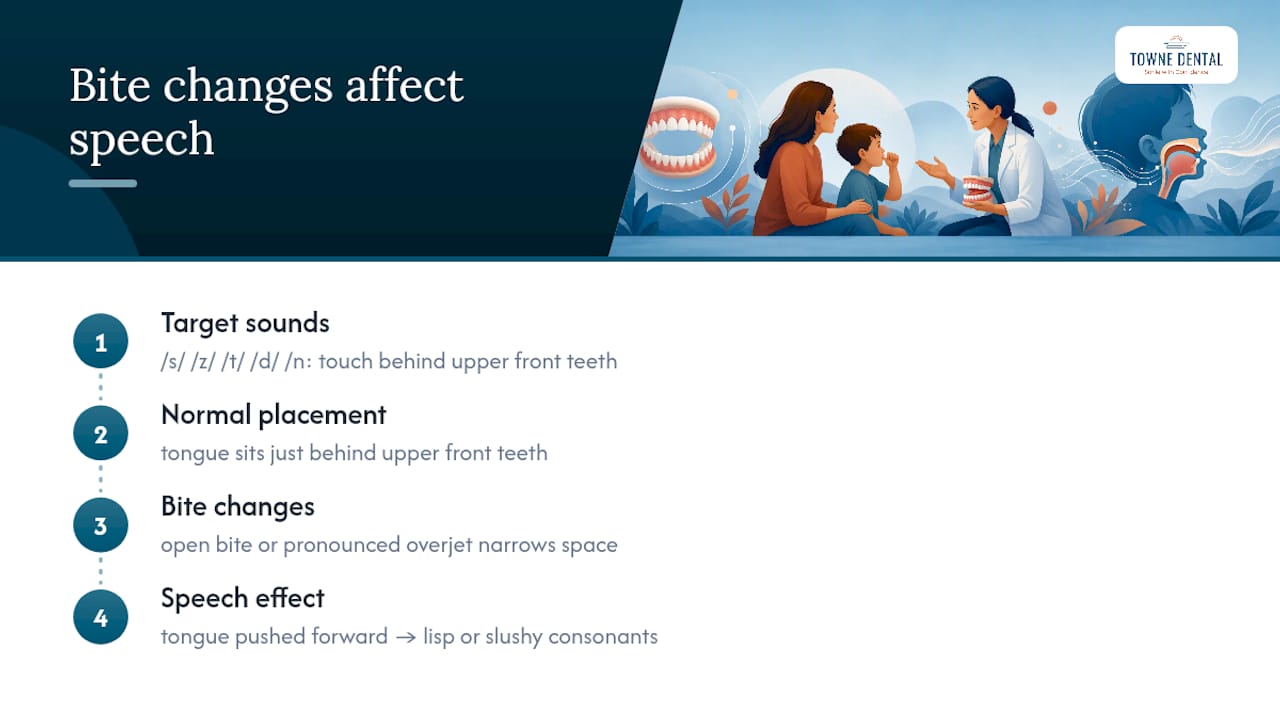
It can, particularly when the habit has already reshaped the bite. An open bite or a narrowed upper arch changes the physical space the tongue works in, and several sounds depend on precise tongue placement against the teeth and palate.
The sounds most commonly affected are the ones that need the tongue to touch just behind the upper front teeth, like /s/, /z/, /t/, /d/, and /n/. A pronounced overjet or open bite can push the tongue forward during speech, producing a lisp or a slushy quality to certain consonants. Some kids also develop a tongue-thrust pattern, pushing the tongue against or between the teeth when swallowing or talking, that reinforces the very bite problem the thumb sucking created in the first place.
Not every thumb sucker develops speech issues, and not every speech issue in a young child traces back to thumb sucking. But if you’re noticing new pronunciation changes alongside a persistent habit, that’s a legitimate reason to move up your dental visit rather than wait it out. Early correction of the bite problem often improves the speech pattern too, especially when a speech language pathologist and a dentist coordinate on timing.
A Pediatric Dentist’s View on Thumb Sucking Evaluations
A thumb-sucking evaluation at Towne Dental isn’t a lecture. It’s a look at how the habit is actually affecting your child’s specific bite, arch width, and tooth position, because two kids with the “same” habit can have very different outcomes. Our team pairs practical behavior guidance with clinical options only when the evidence supports it.
Most families never need an appliance or orthodontic referral. Early, low-pressure intervention, started while a child is still in the toddler years, resolves the majority of cases before they become dental problems at all. That’s the outcome we’re working toward with every family who comes through our doors.
— Towne Dental
Ready to Get Your Child’s Bite Checked?
If your child is still thumb sucking at age 3, or you’ve noticed a gap where their front teeth used to touch, waiting rarely makes the picture clearer. It just gives the habit more time to work. Towne Dental’s pediatric dentistry team specializes in exactly this kind of early evaluation, gentle, unhurried visits designed for kids who might be nervous about the dentist’s chair in the first place.

A pediatric exam gives you a real answer instead of a guess: whether the habit has caused any measurable change yet, and if so, what the most conservative path forward looks like. Most cases start with simple monitoring, not appliances or orthodontics. If your child’s bite does need broader attention down the road, our general dentistry and orthodontic teams work from the same records, so nothing gets duplicated or lost between visits. Book a pediatric exam now and get a clear, judgment-free read on where things stand.
Sources
For deeper reading, the StatPearls clinical review, the AAPD parent FAQ, ADA MouthHealthy, and Mayo Clinic’s guidance informed the guidance throughout this article.
This article is general information, not a substitute for advice from a qualified doctor. Consult a qualified healthcare professional about your own circumstances before acting on anything here.
- Thumb Sucking and Other Nonnutritive Sucking Habits in Children – StatPearls (NCBI Bookshelf)
- AAPD parent FAQ
- How to stop thumb sucking — Cleveland Clinic
FAQ
Is thumb sucking related to ADHD?
No solid evidence links thumb sucking to ADHD. It’s a self-soothing behavior seen across the developmental spectrum, not a diagnostic marker for attention or behavioral disorders.
How do you fix an overbite from thumb sucking?
Mild cases sometimes self-correct once the habit stops, especially before permanent teeth erupt. More established overbites usually need orthodontic treatment, such as braces or a functional appliance, guided by a dentist’s evaluation.
At what age should thumb sucking stop?
Most children stop on their own between ages 2 and 4. The AAPD recommends consulting a dentist if the habit is still active at age 3.
Does pacifier use cause the same teeth problems as thumb sucking?
The effects are similar, both can push front teeth forward and narrow the upper arch, but pacifiers are generally easier to wean since a parent can remove them.
Can a dentist tell if thumb sucking has already affected my child’s teeth?
Yes. A pediatric dental exam checks bite alignment, arch width, and tooth position to determine whether the habit has caused measurable change, which is the first step Towne Dental takes with any thumb-sucking evaluation.