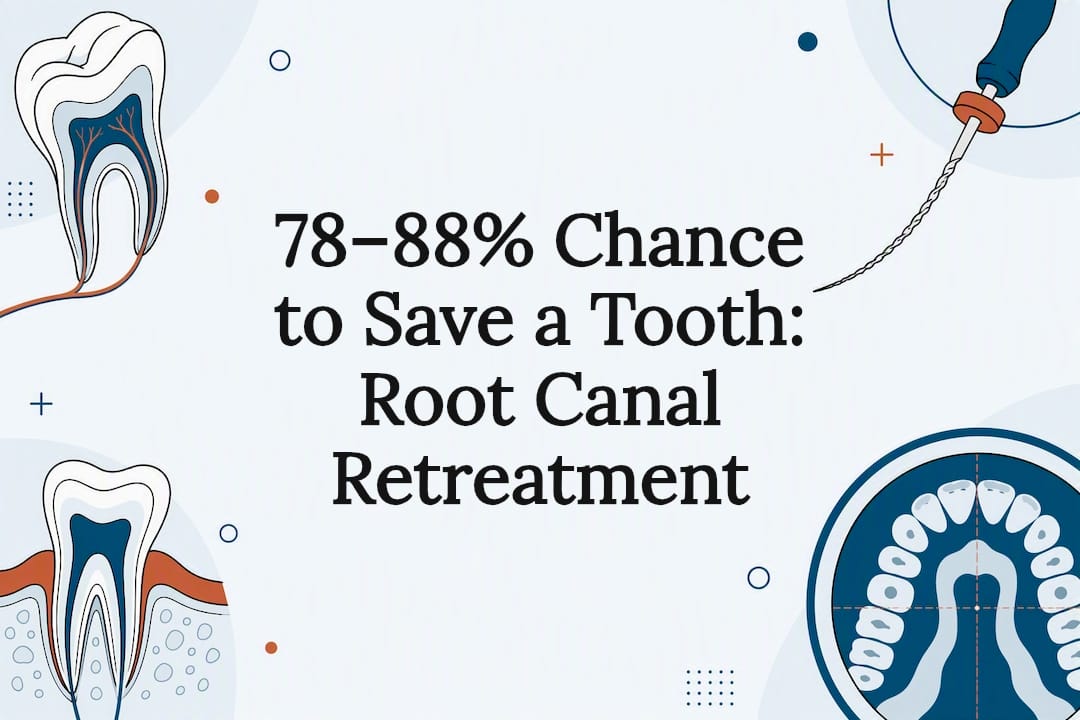
Root canal retreatment is usually the first option worth trying when an earlier root canal has failed, as long as the tooth still has enough healthy structure to restore. Dentists lean toward retreatment when the failure stems from a leaking crown, a missed canal, or lingering infection, since re-cleaning and resealing the tooth often resolves those issues. Retreatment is not the right call when a vertical root fracture is present or the tooth lacks enough remaining structure to support a new restoration.
TL;DR:
- Retreatment is most appropriate when symptoms like pain, swelling, or abnormal radiographs indicate persistent infection or seal failure, especially if the crown leaks or canals are missed.
- Cone-beam CT scans can reveal hidden canals, fractures, or lesions unseen on standard X-rays, potentially changing the treatment plan from retreatment to surgery or extraction.
- Success rates for retreatment typically range from 78% to 88%, with larger lesions and complex root anatomy decreasing the likelihood of healing.
- Postoperative pain after retreatment is similar to initial root canal therapy, peaking immediately afterward and usually subsiding within two days.
- Decisions between retreatment, apicoectomy, or extraction depend on remaining tooth structure, lesion size, and patient preferences, with imaging and case complexity guiding choice.
Table of Contents
- What Is Root Canal Retreatment and Why Dentists Recommend It?
- When Is Retreatment the Right Call, and When Is It Not?
- What Happens During Nonsurgical Retreatment?
- Does CBCT Change the Retreatment Plan?
- What Are the Success Rates for Root Canal Retreatment?
- How Much Pain Should You Expect After Retreatment?
- Apicoectomy, Extraction, or Retreatment: How Do You Choose?
- Why Does Retreatment Sometimes Fail?
- How Towne Dental Approaches Retreatment Cases
- Considering Retreatment? Here’s What to Bring to Your Consult
- Sources
- FAQ
What Is Root Canal Retreatment and Why Dentists Recommend It?
Endodontic retreatment means going back into a tooth that already had root canal therapy, taking out the old filling material, disinfecting the canal system again, and sealing it a second time. It is essentially a second attempt at the same job, done with the benefit of knowing exactly why the first attempt fell short.
The clinical goal is straightforward even when the procedure is not: clear out any bacteria that survived or reentered the canal, and rebuild a seal tight enough to keep new bacteria out. A tooth that hurts to chew on months or years after its original root canal, or one that shows a growing dark spot on an X-ray near the root tip, is telling a dentist that seal failed somewhere.
Dentists reach for nonsurgical retreatment first in most failure cases because it addresses the problem from the same angle as the original treatment, through the crown of the tooth. Surgical endodontics, known as an apicoectomy, gets reserved for cases where the infection sits at the root tip in a spot that’s hard to reach from above, or where the existing crown and post work would be destroyed by reopening the tooth. The American Association of Endodontists frames this hierarchy plainly: save the natural tooth whenever it’s realistically restorable before considering extraction.
When Is Retreatment the Right Call, and When Is It Not?
Not every root canal that looks imperfect on an X-ray needs to be redone. A poor-quality root filling by itself, with no pain, no swelling, and no sign of infection on imaging, is not automatic grounds for retreatment. Dentists weigh a mix of symptoms, imaging, and restorative history before recommending the procedure.
Retreatment tends to make sense when one or more of these show up:
- Persistent or new pain, swelling, or a draining sinus tract near a previously treated tooth
- A radiograph showing a periapical lesion that has grown or failed to heal
- A cracked, loose, or leaking crown that compromised the seal on the original root filling
- Suspicion of a missed canal, especially in molars with complex root anatomy
- Plans to replace an old crown, which gives the dentist direct access to reassess the canal underneath
Retreatment gets ruled out under a different set of conditions. A vertical root fracture is the clearest disqualifier. Once a root splits lengthwise, no amount of cleaning or resealing fixes it, and the tooth is usually headed for extraction. Insufficient remaining tooth structure to support a crown, and periodontal support so compromised that saving the root wouldn’t help the tooth survive anyway, are the other two common reasons a dentist steers a patient away from retreatment. These are judgment calls that benefit from a specialist’s eye, particularly when the case involves prior surgery, unusual canal anatomy, or a crown that would be expensive to replace.
What Happens During Nonsurgical Retreatment?
The procedure builds on the same core steps as a first root canal, but every step gets harder the second time around because there’s already material in the tooth to remove first.
- Diagnosis and planning. The dentist reviews prior treatment records and X-rays, and often orders a CBCT scan to see the root system in three dimensions rather than the flat, overlapping view a standard periapical X-ray gives.
- Access and removal of old materials. The crown or filling comes off, followed by any post, and then the old root canal filling itself. This step relies on a mix of mechanical NiTi retreatment files, ultrasonic tips, and sometimes chemical solvents to soften and extract the previous filling material.
- Cleaning and disinfection. The canals get flushed with sodium hypochlorite and EDTA, often paired with an activation method like sonic or ultrasonic agitation, to reach bacteria hiding in canal irregularities the first treatment missed.
- Managing complications. If the dentist encounters a separated instrument fragment, a ledge, or a perforation from the earlier procedure, this is the point where those get addressed, sometimes requiring a referral to an endodontist with microscope access.
- Re-obturation and restoration. Once the canal is clean and dry, it gets refilled and sealed, then capped with a temporary and eventually a permanent restoration.
Pro Tip: A tight, well-fitted final crown matters almost as much as the retreatment itself. A canal that’s perfectly cleaned and sealed can still fail if the restoration on top lets saliva and bacteria leak back in.
Removing the old filling material is widely considered the most technically demanding part of the whole procedure. Leftover remnants of the original filling can block disinfecting solutions from reaching the canal walls, which is part of why some retreatment cases take longer or need referral to a specialist with more advanced tools.
Does CBCT Change the Retreatment Plan?
A two-dimensional periapical X-ray flattens a three-dimensional root into a single image, which means it can miss a canal hiding behind another root, an early crack, or a small lesion tucked out of the beam’s path. Cone-beam CT solves that by building a 3D model of the tooth and surrounding bone.
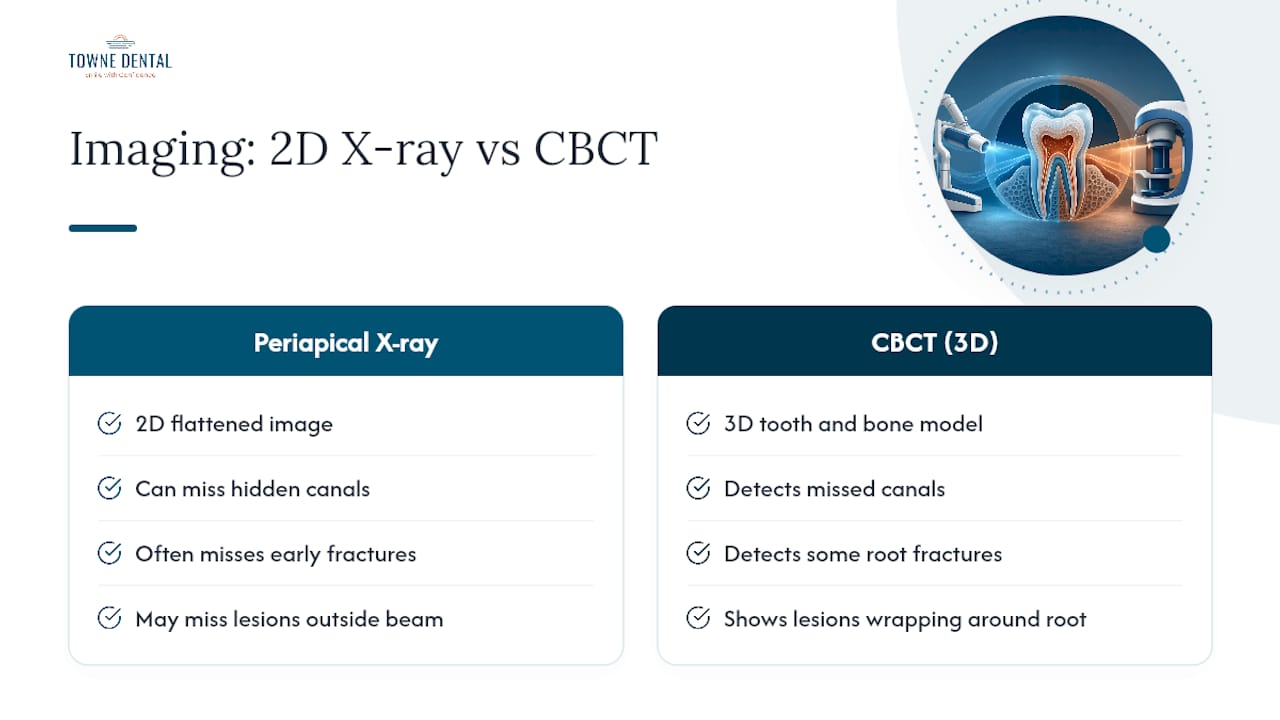
CBCT detects missed canals, hidden periapical lesions, and some root fractures that a standard X-ray simply cannot show. That extra information changes the plan in real ways: a lesion that looks isolated on a flat X-ray might turn out to wrap around the root on a CBCT scan, pushing the decision toward surgery instead of a second attempt through the crown. Finding a fracture on CBCT before starting retreatment can also save a patient from paying for a procedure that was never going to work.
If you’re heading into a retreatment consultation, bring your prior X-rays, the original treatment notes if you can get them, and a clear timeline of your symptoms. That paperwork often saves a repeat scan and gives the dentist a faster read on what went wrong the first time.
What Are the Success Rates for Root Canal Retreatment?
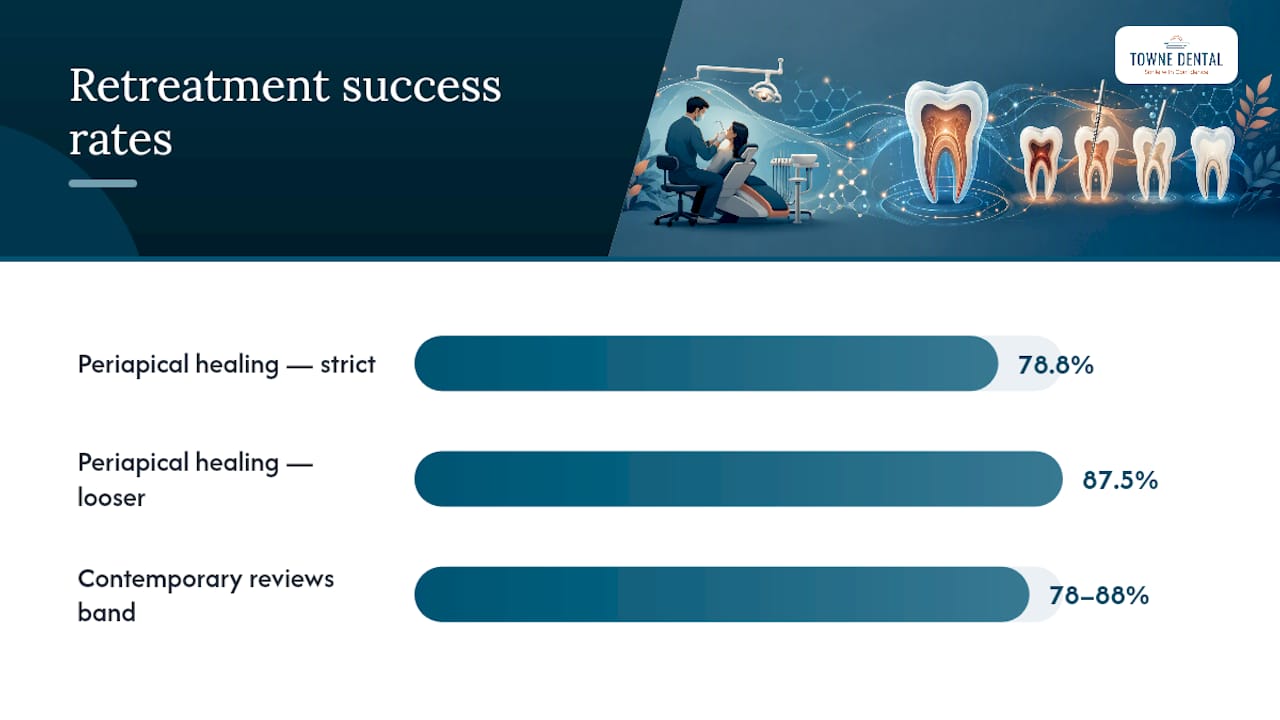
Retreatment succeeds more often than it fails, but the range depends heavily on how “success” gets defined. A systematic review of contemporary nonsurgical retreatment found pooled periapical healing rates of about 78.8% under strict criteria and 87.5% under looser criteria, with pooled success rates of roughly 78.0% to 86.4% depending on which definition a study used. Other contemporary reviews land in a similar 78% to 88% band.
The core numbers: Retreated teeth heal or succeed roughly 78 to 88 times out of 100, with the gap between those figures coming down to whether researchers require complete radiographic healing or accept a stable, symptom-free tooth with a smaller residual lesion.
A handful of factors shift a given tooth toward the better or worse end of that range. Teeth with no preoperative lesion, or only a small one, heal more predictably than teeth with a large area of bone loss at the root tip. A root filling that reaches an adequate length and density improves the odds too, as does the type of tooth involved, since molars with multiple curved canals are inherently harder to fully disinfect than single-rooted front teeth. A well-sealed, well-fitted final restoration on top of the retreated canal rounds out the list of factors that matter most.
Success and long-term survival aren’t quite the same thing. Retreatment removes more tooth structure than the original procedure, which is worth factoring into any conversation about long-term risk.
How Much Pain Should You Expect After Retreatment?
Retreatment is not meaningfully more painful than a first-time root canal, despite the extra steps involved. A randomized clinical trial on postoperative pain after retreatment found pain runs highest right after the procedure, with about 35% of patients reporting some discomfort, then drops sharply within a day.
- Immediate postoperative pain affects roughly 35% of patients.
- That figure falls to around 15% or lower by the 24 to 48 hour mark.
- Most patients stop needing pain relievers altogether after the first day or two.
- Anyone with a history of pain after a previous root canal has a higher chance of feeling more discomfort this time.
- Increasing swelling, fever, or pain that gets worse rather than better after 48 hours is not typical and warrants a call to the dentist.
Over the counter pain relievers usually cover what discomfort does show up. A tooth that feels progressively worse days after treatment, rather than better, is the signal to call rather than wait it out.
Apicoectomy, Extraction, or Retreatment: How Do You Choose?
Retreatment isn’t the only path when a root canal fails, and it isn’t automatically the best one for every case. Clinicians typically weigh it against two other routes.
An apicoectomy makes sense when the infected tissue sits at the very tip of the root in a location retreatment can’t reach from above, when the crown and post on the tooth are too valuable or difficult to remove, or when the dentist needs a tissue sample to rule out something other than a simple infection. Extraction followed by an implant or bridge becomes the more sensible option when the remaining tooth structure is too thin to support another restoration, when a root fracture is confirmed, or when repeated retreatment attempts have already failed.
A short mental checklist helps frame the decision during a consultation:
- Is there enough healthy tooth structure left to support a crown after retreatment?
- What does imaging show about the size, shape, and location of the lesion?
- How complicated was the original treatment, and are there separated instruments, ledges, or unusual canal anatomy to work around?
- What’s the realistic cost and timeline difference between retreating and replacing the tooth?
- How does the patient feel about keeping a natural tooth versus starting the implant process?
None of these questions has a universal right answer. They’re the same questions a natural tooth versus implant conversation always comes down to, weighted differently for every mouth.
Why Does Retreatment Sometimes Fail?
Retreatment fails for a mix of mechanical and biological reasons, and knowing which one applies to a given case matters for what comes next. Persistent infection inside the canal, or occasionally an extraradicular infection sitting just outside the root tip where cleaning solutions can’t reach, accounts for a share of failures. So does a root fracture that either existed before retreatment or develops afterward, since removing more tooth structure a second time leaves less material to resist chewing forces.
Mechanical issues compound the picture. A separated instrument left behind from the original treatment, or filling material that couldn’t be fully removed, can block a clean seal even when the dentist does everything else right. A leaking coronal restoration is one of the most common and most preventable causes, which is why the crown or filling placed after retreatment carries as much weight as the canal work underneath it. Long-term studies increasingly point to mechanical failure, not reinfection, as the reason retreated teeth eventually get extracted, which is part of why restorative planning and regular follow-up matter well after the retreatment itself is finished.
How Towne Dental Approaches Retreatment Cases
Dental clinics typically treat every retreatment case as a diagnosis problem first and a procedure second. That usually means CBCT imaging and a specialist-level look at the tooth’s restorability before committing to a plan, rather than assuming retreatment is automatically the right move. Coordinating the endodontic work with whoever handles the final crown or bridge matters just as much as the canal cleaning itself.
If you’re weighing retreatment, bring your prior X-rays and treatment notes to the consult, and ask directly about restorability and realistic timeline. Sedation options may be available to help patients who find repeat dental work stressful.
— Towne Dental
Considering Retreatment? Here’s What to Bring to Your Consult
A failed root canal is stressful enough without wondering whether the dentist across the table has the right tools to actually fix it. Towne Dental’s endodontic evaluations start with imaging that shows what a flat X-ray can’t, so the plan gets built around your tooth’s actual anatomy instead of a guess.

Retreatment is typically coordinated with whatever restorative work comes after it, whether that’s a new crown, a bridge, or a conversation about implants if the tooth isn’t salvageable. For patients who put off care because of dental anxiety, relaxing sedation options are available so retreatment doesn’t have to be an ordeal to get through.
Before your visit, gather your original treatment notes and any prior X-rays, a written list of your symptoms and when they started, and your insurance information. Contact a dental provider or request an appointment online to get an evaluation scheduled and find out whether your tooth is a good candidate for retreatment.
Sources
- Outcome of contemporary nonsurgical endodontic retreatment: a systematic review
- Endodontic procedures for retreatment of periapical lesions
- Contemporary endodontic retreatment outcomes (PubMed indexed review)
This article is general information, not a substitute for advice from a qualified doctor. Consult a qualified healthcare professional about your own circumstances before acting on anything here.
FAQ
Is It Worth Retreating a Root Canal?
For most patients with a restorable tooth, yes. Pooled success and healing rates run roughly 78% to 88%, and retreatment preserves the natural tooth rather than moving straight to extraction and replacement.
How Painful Is Root Canal Retreatment?
Retreatment carries pain similar to a first root canal, not worse. A clinical trial found immediate postoperative pain in about 35% of patients, dropping to around 15% or less within 24 to 48 hours, and most people stop needing pain medication after the first day.
How Many Times Can You Retreat a Root Canal?
There’s no fixed number, but each retreatment removes more tooth structure and raises the risk of fracture, which eventually limits how many attempts make sense. A dentist weighs remaining tooth structure, the cause of the latest failure, and imaging findings each time rather than applying a set limit.
Will Insurance Cover Retreatment of a Root Canal?
Many dental insurance plans cover retreatment at least partially, similar to how they cover the original root canal, though coverage details vary by plan and by whether the tooth already had a prior claim. Check your specific policy or ask Towne Dental’s office to verify benefits before your appointment.
What Should I Bring to a Retreatment Consultation at Towne Dental?
Bring any prior X-rays, treatment notes from your original root canal, a list of your current symptoms, and your insurance card. Towne Dental’s endodontic evaluation uses that history alongside CBCT imaging to determine whether retreatment, surgery, or another option fits your tooth.