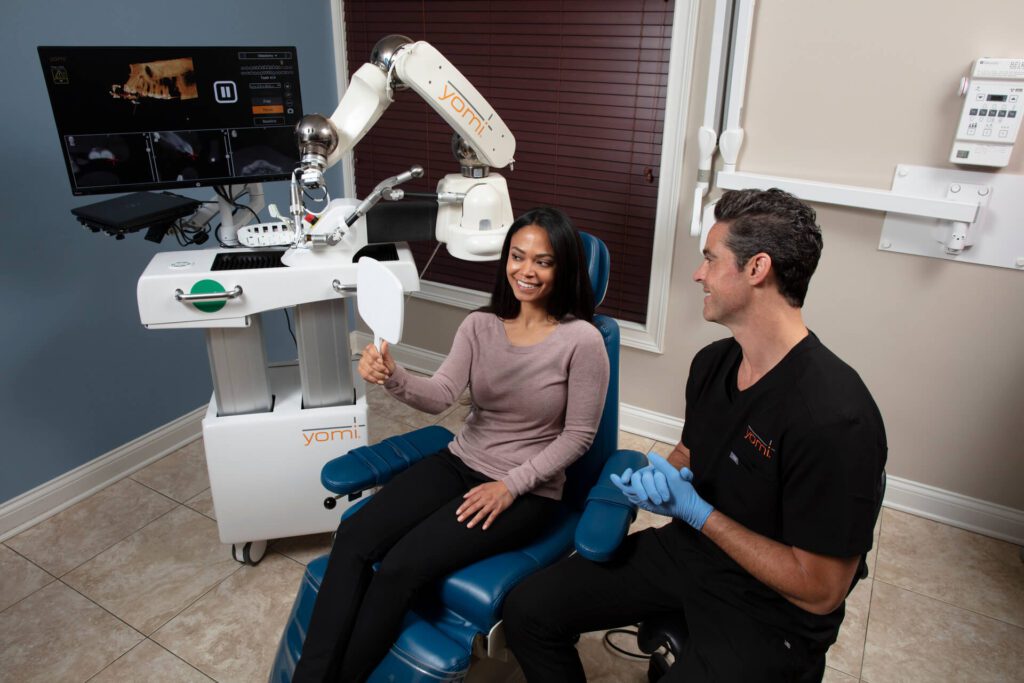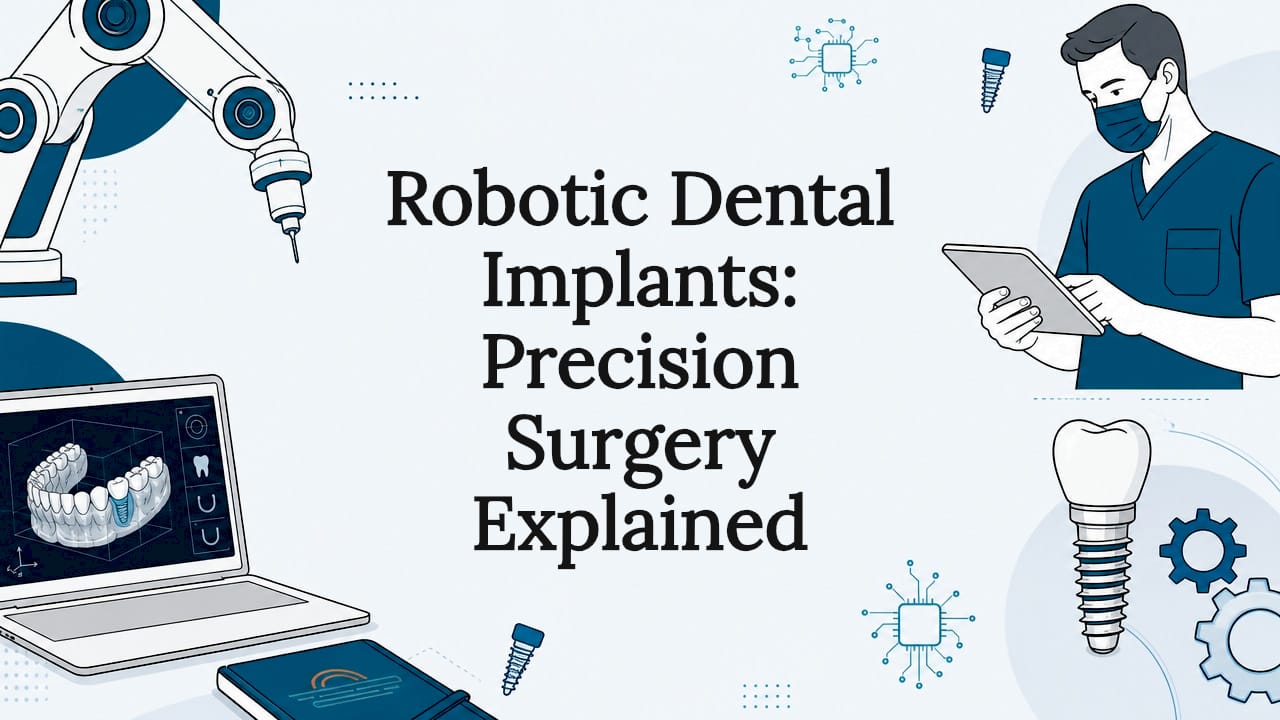
Robotic dental implants are defined as AI-planned, haptic-guided implant procedures where a robotic arm physically constrains the surgeon’s drill to a pre-approved surgical path. The industry term is “robotic-assisted implant surgery,” and it represents the most significant accuracy advancement in implant dentistry in decades. Yomi, the only FDA-cleared dental implant robotic system in the United States, had completed over 100,000 robotic osteotomies by early 2026. For patients in Fort Myers considering implants, understanding this technology is the first step toward making a genuinely informed decision about your care.
How does robotic dental implant surgery work?
Robotic-assisted implant surgery follows a three-phase workflow: digital planning, intraoperative registration, and haptic-guided drilling. Each phase builds on the last, and skipping any one of them eliminates the accuracy advantage entirely.
Phase 1: 3D imaging and AI planning. Before surgery, your dentist takes a cone-beam CT (CBCT) scan of your jaw. AI software uses that scan to build a virtual model of your bone, nerves, and sinuses. The surgeon then places the virtual implant in the exact position, angle, and depth that avoids critical structures. This plan becomes the robotic system’s operating boundary.
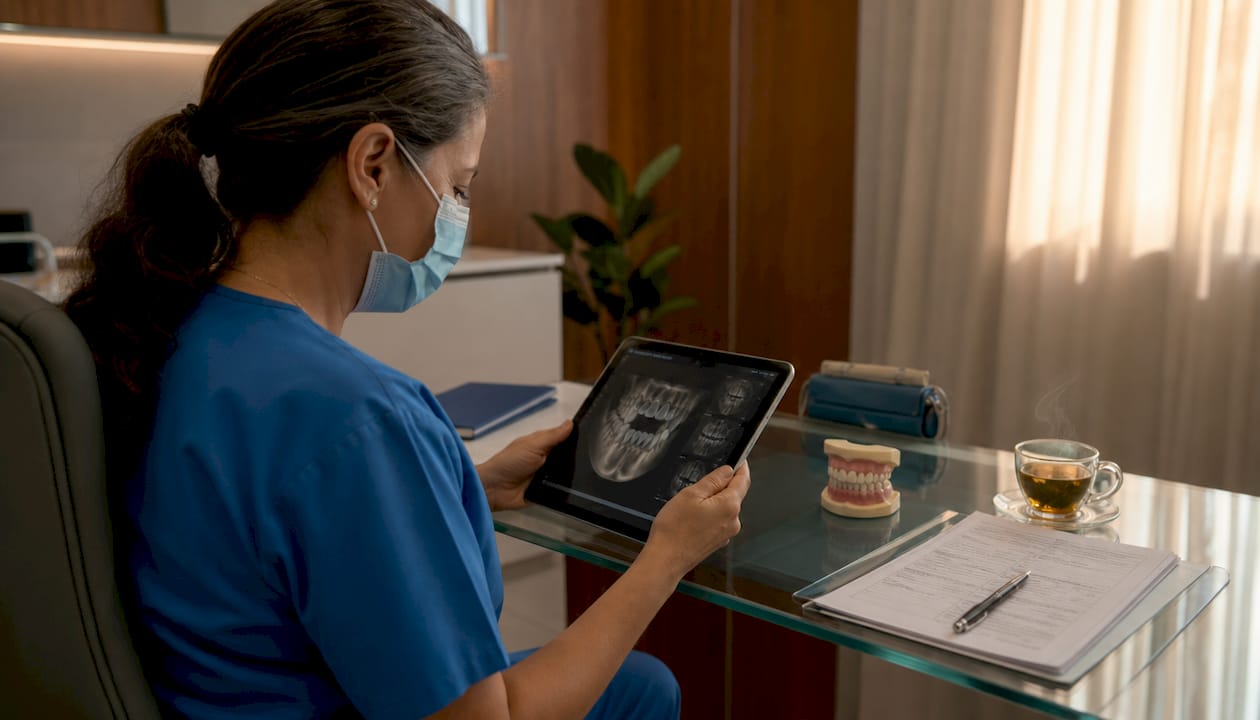
Phase 2: Intraoperative registration. On the day of surgery, fiducial markers or a custom splint are attached to your jaw. These fiducial markers allow the robotic arm to map its movements to your actual jaw position in real time, typically achieving registration accuracy under 0.3 mm. That registration step is what connects the digital plan to your physical anatomy.
Phase 3: Haptic-guided drilling. The surgeon holds the drill normally, but the robotic arm acts as a physical constraint. The system provides haptic resistance to block any movement outside the pre-planned safe zone. The surgeon maintains full control and can stop at any moment. The robot does not drill autonomously. It functions more like an intelligent guardrail than an autopilot.
The numbered steps in a typical robotic implant procedure look like this:
- CBCT scan and digital treatment planning
- Surgical guide or fiducial marker fabrication
- Intraoperative registration and system calibration
- Haptic-guided osteotomy (drilling) with real-time feedback
- Implant placement confirmed against the digital plan
- Post-operative imaging to verify final position
Pro Tip: Ask your surgeon to show you the digital plan before surgery. Seeing the exact implant position, depth, and angle on screen gives you a clear picture of what the robot is protecting against.
What are the clinical benefits of robotic dental implants?
The accuracy numbers for robotic-assisted placement are the strongest argument for the technology. Mean coronal deviations average 0.60–0.73 mm and apical deviations average 0.63–0.70 mm. Those figures represent sub-millimeter placement accuracy across the full implant length.
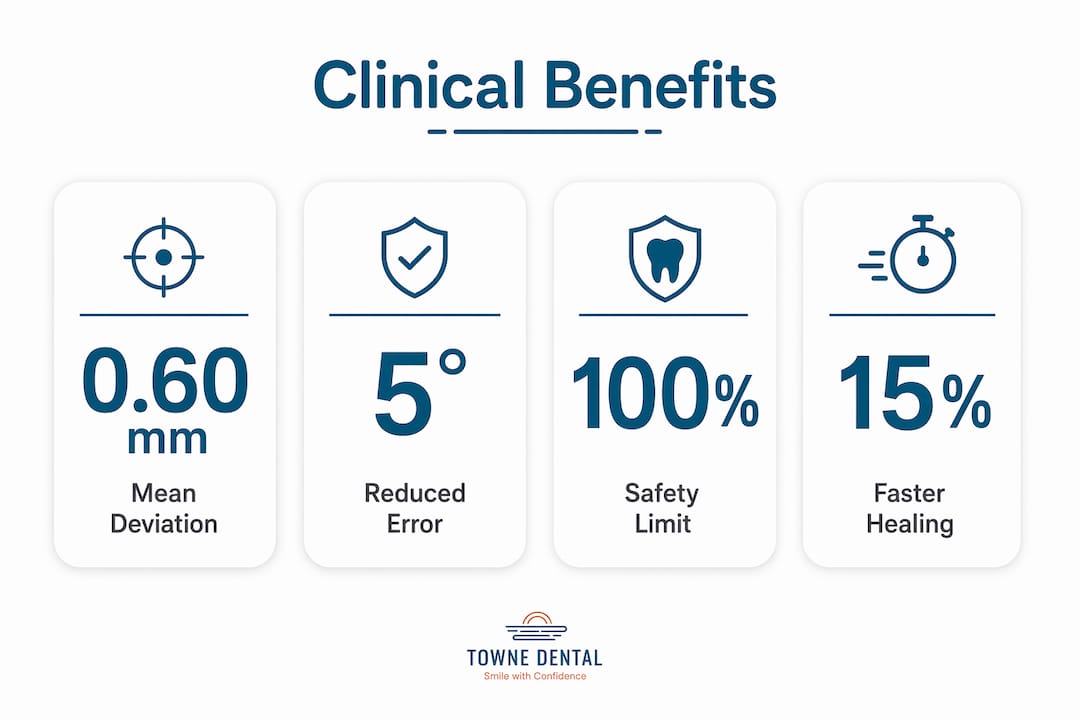
Compared to freehand surgery, robotic guidance reduces angular error by about 5 degrees and apical positional error by about 1 mm, with statistical significance at P < 0.001. That level of improvement matters most when your implant is near a nerve or sinus wall, where even a 2 mm deviation can cause permanent damage.
Beyond accuracy, robotic systems offer measurable clinical advantages:
- Reduced surgical trauma. The drill follows the planned path without wandering, which means less bone disruption and softer tissue damage.
- Faster recovery. Less trauma directly translates to less post-operative swelling and pain for most patients.
- Higher implant stability. Clinical data shows 100% osseointegration at six months in robotic groups versus 96% in conventional groups.
- Better bone preservation. Robotic placement produces lower marginal bone loss compared to freehand techniques, which supports long-term implant health.
- Reduced surgeon fatigue variability. Robotic systems reduce surgeon-dependent variability, meaning your outcome does not depend on whether your surgeon is on hour one or hour six of their day.
- Efficiency in complex cases. Robotic arm systems reduce surgical time by about 18.6% in specific case types, particularly full-arch restorations.
The safety benefit deserves special attention. The robotic arm physically prevents the drill from entering zones flagged as dangerous during planning. That physical constraint is a fundamentally different safety mechanism than a surgeon’s visual judgment alone.
What are the limitations of robotic implant surgery?
Robotic-assisted implant surgery is not the right choice for every patient or every practice. The technology has real constraints that patients should understand before committing to it.
Setup and calibration take longer than freehand or static guide procedures. Robotic surgery may not always reduce total procedural time because the setup phase offsets the faster intraoperative drilling. For straightforward single-tooth cases in patients with ample bone, the time investment may not justify the added complexity.
Cost is a genuine barrier. Robotic-assisted placement is more costly and requires specific training, so it is typically reserved for complex cases requiring maximum precision. Patients should expect higher procedure fees compared to conventional implant surgery, though the gap varies by provider and case complexity.
The table below summarizes the key differences between robotic and traditional implant methods:
| Factor | Robotic-assisted | Traditional freehand |
|---|---|---|
| Placement accuracy | Sub-millimeter (0.60–0.73 mm coronal) | Higher variability, surgeon-dependent |
| Angular deviation | Reduced by ~5 degrees vs. freehand | Higher angular error risk |
| Setup time | Longer (registration required) | Shorter |
| Cost | Higher | Lower |
| Best case type | Complex, high-risk, full-arch | Straightforward single-tooth |
| Surgeon autonomy | Full control with haptic limits | Full control, no physical constraints |
The fiducial marker or splint placement also adds a step that some patients find uncomfortable. The markers must stay firmly attached throughout surgery, and any movement compromises registration accuracy.
Pro Tip: When searching for robotic dental implants near me, verify that the provider uses an FDA-cleared system and can show you their registration accuracy data. Not all “robotic” or “guided” systems offer the same level of haptic constraint.
How do you decide if robotic dental implants are right for you?
The strongest candidates for robotic-assisted implant surgery share specific anatomical or clinical characteristics. Robotic guidance is especially beneficial in complex cases involving limited bone volume, nerve proximity, or full-arch restorations. If your situation involves any of these factors, the precision advantage becomes clinically meaningful rather than theoretical.
Patient factors that favor robotic-guided placement include:
- Limited bone volume. Thin or short bone ridges leave little margin for error. The robotic constraint keeps the drill within the safe zone even when anatomy is challenging.
- Nerve proximity. Implants near the inferior alveolar nerve or mental foramen carry serious risk if placement deviates. Physical haptic limits reduce that risk directly.
- Full-arch restorations. Multiple implants placed in a single session benefit from consistent accuracy across every site. Fatigue and cumulative error are real factors in long procedures.
- High cosmetic expectations. Anterior (front) implants require precise angulation for natural-looking crowns. Sub-millimeter accuracy matters for the final aesthetic result.
- Anxiety about surgery. Knowing the robot physically prevents the drill from going off-course is genuinely reassuring for patients who feel anxious about implant procedures.
If your case is a straightforward single-tooth implant in a patient with good bone volume and no critical anatomy nearby, traditional guided surgery may deliver equivalent results at lower cost. The honest conversation happens during a consultation with a surgeon trained in both methods.
Questions worth asking your dentist before choosing robotic-assisted surgery:
- Which robotic system do you use, and is it FDA-cleared?
- How many robotic implant cases have you completed?
- Can you show me the digital plan before we proceed?
- What is the registration accuracy you typically achieve?
- How does the cost compare to a static guide approach for my specific case?
Towne Dental’s team offers oral surgery consultations where patients can review their CBCT scans and discuss whether robotic guidance fits their anatomy and goals.
Key takeaways
Robotic-assisted implant surgery delivers sub-millimeter placement accuracy and physical safety constraints that no freehand or static guide technique can match, making it the most reliable option for complex implant cases.
| Point | Details |
|---|---|
| Accuracy advantage | Robotic systems achieve coronal deviations of 0.60–0.73 mm, far below freehand variability. |
| How the robot works | Haptic resistance constrains the drill to the planned path; the surgeon stays in full control. |
| Best patient candidates | Limited bone, nerve proximity, full-arch cases, and high cosmetic expectations benefit most. |
| Real limitations | Setup takes longer and costs more; straightforward cases may not need robotic guidance. |
| Long-term evidence | Precision gains are proven; research on long-term outcome differences versus guides is still growing. |
Why I think most patients underestimate what “robotic” actually means here
People hear “robot placing dental implants” and picture an autonomous machine drilling on its own. That mental image is wrong, and it matters because the real value of robotic-assisted surgery is subtler and more interesting than science fiction suggests.
What the robot actually does is enforce a boundary. The surgeon still makes every decision. The robot just makes it physically impossible to drill outside the pre-planned zone. That distinction changes how you should evaluate the technology. You are not choosing between a human and a machine. You are choosing between a surgeon working alone and a surgeon working with a physical safety net.
I have seen patients dismiss robotic guidance as unnecessary complexity for “simple” cases, and sometimes they are right. But the cases that look simple on a panoramic X-ray can reveal surprises on a CBCT scan. Nerve canals run in unexpected directions. Bone density varies. The margin for error in a posterior mandible implant near the inferior alveolar nerve is genuinely small, and a 2 mm apical deviation is the difference between a successful implant and a nerve injury.
The evidence that robot-assisted surgery achieves higher accuracy than static or dynamic guided systems is solid. What remains less clear is whether that precision advantage translates to measurably better long-term survival rates across all case types. That is an honest limitation, and any provider who tells you robotic implants are always superior to every alternative is overselling the current evidence.
My view: robotic guidance is the right choice for complex cases and for patients who want the highest available margin of safety. For straightforward cases, the conversation should be about your specific anatomy, not about which technology sounds most advanced.
— Krunal
Robotic implant care at Towne Dental in Fort Myers
Towne Dental uses the Yomi robotic system for implant placement, the only FDA-cleared haptic-guided robotic platform in the United States. Patients in Fort Myers and the surrounding Southwest Florida area can access this technology through a team trained in both the digital planning workflow and the intraoperative registration process that makes sub-millimeter accuracy possible.
Towne Dental’s full range of dental services includes implant consultations where your CBCT scan, bone volume, and anatomical risk factors are reviewed before any treatment plan is finalized. If robotic-assisted surgery fits your case, the team walks you through the digital plan so you see exactly what the system is protecting before you ever sit in the chair. Schedule a consultation to find out whether robotic implant placement is the right fit for your specific situation.
FAQ
What is robotic-assisted dental implant surgery?
Robotic-assisted dental implant surgery uses AI-based digital planning and a haptic-guided robotic arm to constrain the surgeon’s drill to a pre-planned safe path. The surgeon maintains full control; the robot physically prevents deviations outside the approved zone.
How accurate are robotic dental implants compared to freehand?
Robotic systems achieve mean coronal deviations of 0.60–0.73 mm and reduce angular error by about 5 degrees compared to freehand placement, with results significant at P < 0.001.
What does robotic dental implant surgery cost?
Robotic-assisted implant surgery costs more than conventional freehand or static-guide procedures due to technology and training requirements. The exact fee varies by provider and case complexity; a consultation with your surgeon will give you a specific estimate.
Is Yomi the only FDA-cleared dental implant robot?
Yes. Yomi, developed by Neocis, is the only FDA-cleared robotic system for dental implant placement in the United States, with over 100,000 robotic osteotomies completed by early 2026.
Who is the best candidate for robotic dental implants?
Patients with limited bone volume, implants near critical nerves, full-arch restorations, or high cosmetic demands benefit most from robotic guidance. Straightforward single-tooth cases in patients with ample bone may achieve equivalent results with conventional guided surgery.