If an adult tooth has been knocked out, pick it up by the crown (the chewing surface), never the root. Rinse it gently only if it is dirty. Try to place it back in the socket, or keep it moist in milk or in your cheek, and get to a dentist right away. Time matters more than anything else here. A permanent tooth that is reimplanted within 30 minutes to 1 hour has a good likelihood of reattaching, and the longer it stays out, the worse the odds of long-term success.
If this is happening right now, read the next two sections and call a dentist. The rest of the article can wait.
TL;DR
- Handle the tooth by the crown only. Do not scrub the root or let it dry out.
- A permanent tooth can often be put back in its socket if it happens quickly. A baby tooth should not be replanted.
- If you cannot replant it, store it in cold milk, saliva or an ADA Seal-accepted tooth-preservation product. Do not store it in plain water.
- See a dentist within 30 minutes if you can. If your dental office is closed, go to the nearest emergency room.
- Expect a splint, follow-up visits and often a root canal later. Cost depends on the exam and your coverage.
Table of Contents
- What to do right now, step by step
- Can a knocked out tooth be put back in?
- How to store a knocked out tooth if you cannot replant it
- Baby tooth or adult tooth: the advice is different
- Check for a head injury before you focus on the tooth
- How a dentist treats a knocked out tooth
- What to expect while it heals
- When the tooth cannot be saved
- How much does it cost to replace a knocked out tooth?
- Our perspective
- Emergency dental care in Southwest Florida
- Preventing the next knocked out tooth
- FAQ
- Sources
What to do right now, step by step
Stay calm and move in this order. These steps follow guidance from the American Dental Association’s MouthHealthy site and the Mayo Clinic.
- Find the tooth. Pick it up by the crown, the part you chew with. Avoid touching the root, because the delicate tissue on it is what lets the tooth reattach.
- Check that it is a permanent tooth. Adult teeth can be replanted. Baby teeth cannot (more on that below).
- Rinse it only if it is dirty. Use milk or saliva if needed, and do not scrub or scrape the root. Mayo Clinic specifically says not to scrub the root to remove dirt.
- Try to put it back. Gently slide the tooth into its socket with the right side facing out, the way it came out. Do not force it. Bite down softly on a clean piece of gauze or a damp cloth to hold it in place.
- If it will not go back, keep it moist. Place it in cold cow’s milk, in saliva collected in a clean container, or in an over-the-counter tooth-preservation product approved by the ADA. You can also carry it in your cheek if you are an adult and alert enough not to swallow it.
- Get to a dentist immediately. Call ahead and say a permanent tooth has been knocked out so the office can be ready for you.
- If the office is closed, go to an emergency room. The ADA advises that when your dental office is closed, you should visit your local emergency room.
While you travel, control bleeding with gentle pressure from clean gauze and hold a cold compress against the lip or cheek for comfort.
Can a knocked out tooth be put back in?
Yes, in many cases. A permanent tooth may be replanted if it is done quickly, according to Mayo Clinic first-aid guidance. That is why the advice is to try to reposition it at the scene rather than wait until you reach the chair.
A few points decide whether it works:
- Time out of the mouth. The shorter, the better. Thirty minutes is the number most guidance repeats, and the Merck Manual says reimplantation within 30 minutes to 1 hour gives a good chance of reattachment.
- How the root was handled. A root that was scrubbed, left dry or stored in tap water is harder to save.
- Whether the tooth is whole. If the tooth has a sharp or shiny surface where the root should be, a root fragment may still be in the socket. Mayo Clinic notes this complicates replantation, so tell the dentist right away.
- The state of the socket and surrounding bone. Only an exam and X-ray can show this.
Even a tooth that goes back in perfectly still needs a dentist. Replanting at home is a first-aid step, not the finished treatment.
How to store a knocked out tooth if you cannot replant it
What the tooth sits in on the way to the dentist matters. The root surface has living cells that you want to keep alive.
| Option | Good choice? | Notes |
|---|---|---|
| Back in the socket | Best | Hold it in place with gentle bite pressure on gauze |
| Cold cow’s milk | Good | A small cup is enough to cover the tooth |
| Your own saliva in a clean container | Good | Also works for children who cannot hold the tooth in their mouth |
| ADA-approved tooth-preservation product | Good | Sold over the counter, often in first-aid kits |
| Inside your cheek (adults) | Acceptable | Only if you are alert and there is no choking risk |
| Plain tap water | Avoid | It can kill cells on the root surface |
| Dry tissue or in a pocket | Avoid | The root dries out quickly |
The American Academy of Pediatrics also lists milk, balanced salt solution or saliva collected in a container as the storage choices when a permanent tooth cannot be replanted.
One practical tip: keep a tooth-preservation kit in your first-aid box, your car and your child’s sports bag. It costs little and sits there until the one day it matters.
Baby tooth or adult tooth: the advice is different
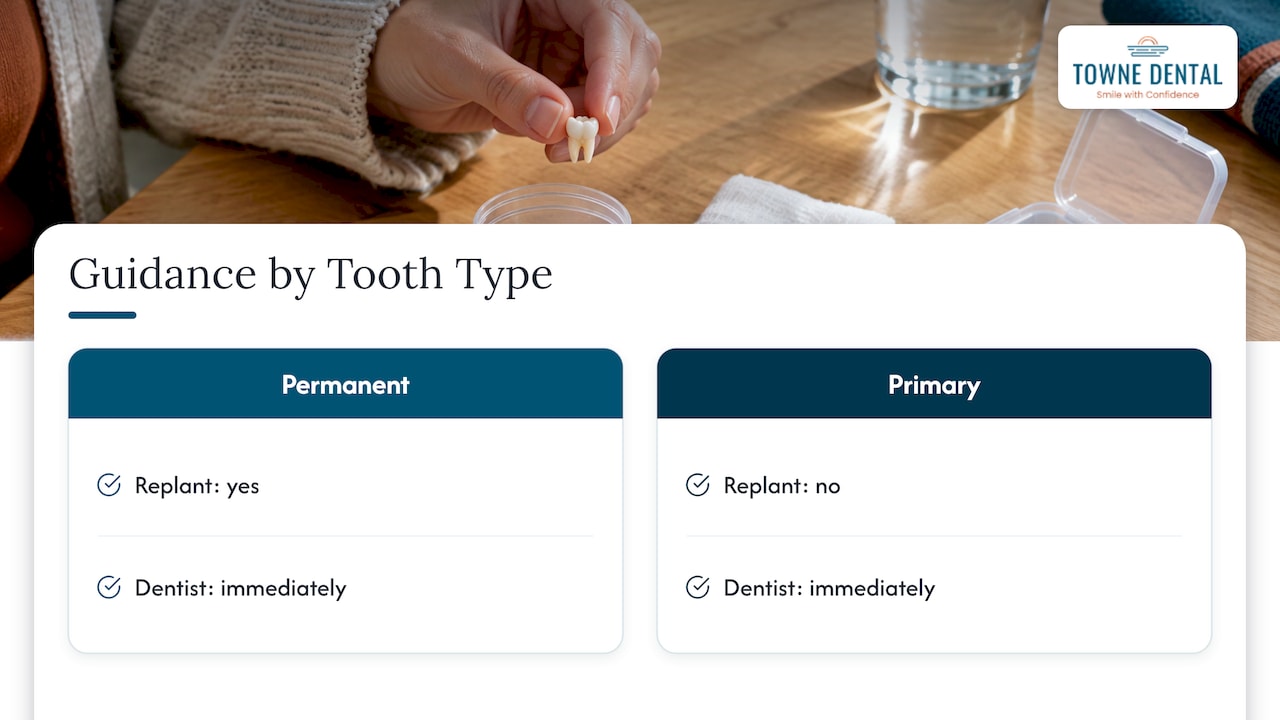
This is the question that changes everything for parents. Adult teeth are put back. Baby teeth are not.
The Merck Manual states plainly that you should not replant a knocked-out baby tooth, because it may become infected or interfere with the eruption of the permanent tooth growing underneath. It also says the child should still be taken to a dentist immediately. The dentist can check for fragments left behind and plan how to keep space open for the adult tooth.
If you are not sure whether the tooth was a baby tooth or a permanent one, treat it as permanent and head to the dentist. Children between roughly 6 and 12 have a mix of both, and it is easy to confuse a baby molar with an adult tooth. A permanent tooth is usually larger, with a longer root and less rounded edges.
If the tooth cannot be found
Sometimes the tooth is simply gone. If a child’s tooth is missing and they are having trouble breathing, that needs medical attention. The AAP notes that when a primary tooth is not found and the child has breathing difficulties, a chest radiograph may be needed to rule out aspiration. The Merck Manual adds that a swallowed tooth is generally harmless, while an inhaled one needs medical evaluation. Call 911 or go to the ER for coughing, wheezing or trouble breathing.
Check for a head injury before you focus on the tooth
A tooth is usually knocked out by a fall, a sports collision, a bike crash or a car accident. The same force can injure the head and neck. Medical guidance for dental trauma says that a history and a neurologic assessment are part of the evaluation, and that suspected concussion or a more serious head injury requires immediate medical evaluation.
Go to the emergency room first if the person:
- lost consciousness, even briefly
- is confused, vomiting or very drowsy
- has a worsening headache
- has bleeding that will not stop
- has a jaw that looks out of line or will not close properly
The tooth can wait a few minutes while you get the right care, and ER staff can arrange urgent dental follow-up.
How a dentist treats a knocked out tooth
Knowing what happens next takes some fear out of the visit. The NHS describes the process this way: the dentist checks the position of the tooth, moves it if needed, cleans it and reinserts it if you brought it in milk or saliva, then splints it to the neighboring teeth.
In practice, expect these stages:
- Exam and X-rays. The dentist looks for root fractures, bone damage and any fragments left in the socket.
- Numbing and cleaning. The socket is gently cleaned, and the tooth is rinsed.
- Replanting. The tooth is repositioned and checked on X-ray.
- Splinting. A flexible splint holds the tooth to the teeth beside it while the ligaments heal. The AAP notes that replanted permanent teeth typically need professional splinting and later root canal therapy.
- Medication and aftercare. In the US, antibiotics such as penicillin or doxycycline may be used after replantation, depending on age. The dentist will also ask about tetanus protection if the injury involved dirt or a wound.
- Follow-up. You will come back to check healing and decide on root canal treatment. A tooth that has been out of the mouth has lost its blood and nerve supply, so the nerve usually cannot recover on its own.
The American Association of Endodontists identifies endodontists as specialists in saving teeth and recommends seeking their care for knocked out teeth. A general dentist or emergency dentist is often the fastest first stop, and they can coordinate root canal care afterward. If you want to understand what that stage looks like, our guide on root canal retreatment and saving a tooth explains how we think about keeping natural teeth.
What to expect while it heals
A replanted tooth is fragile for a few weeks. Your dentist will give personal instructions, but these are the common themes:
- Eat soft foods and avoid biting into the tooth.
- Brush gently around the splint and keep the area clean as directed.
- Avoid contact sports until the dentist clears you, and use a mouthguard afterward.
- Watch for swelling, a pimple on the gum, darkening of the tooth, fever or pain that returns. Call your dentist if any of these appear.
A tooth that darkens or loosens months or years later may be telling you the root is not healing well. That is worth an exam. Our article on a loose tooth in adults and when to seek same-day care covers what to watch for.
When the tooth cannot be saved
Sometimes the tooth is too damaged, the root is fractured, or too much time has passed. That does not mean you have to live with a gap. Common replacements include:
- A dental implant, which replaces the root with a titanium post and is topped with a crown.
- A bridge, which anchors a replacement tooth to the neighboring teeth.
- A partial denture, a removable option that fills one or several gaps.
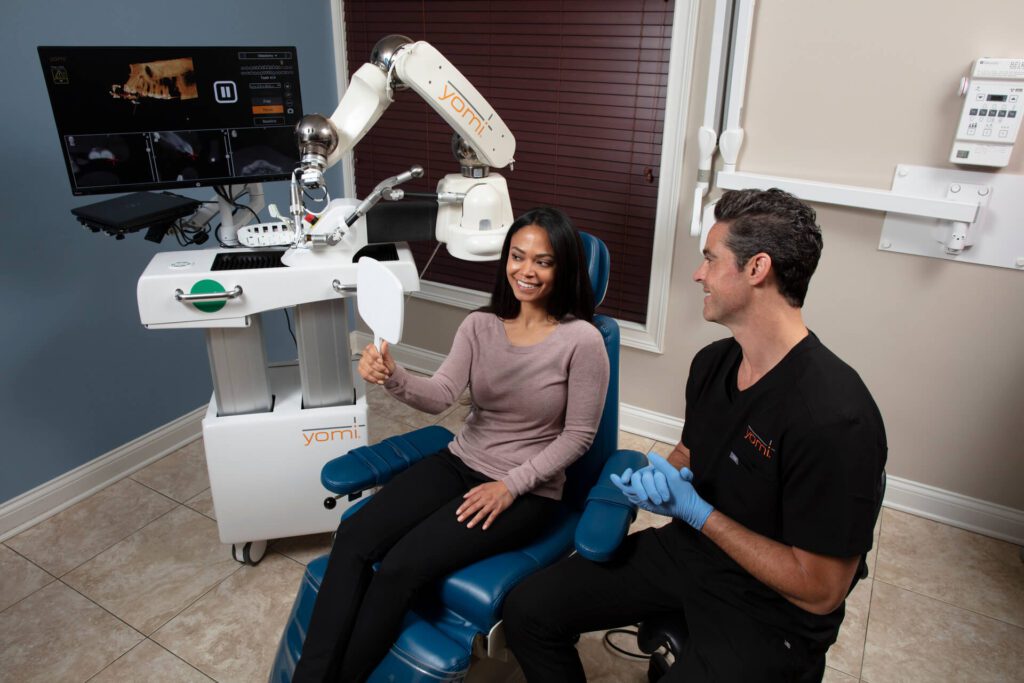
Implants are often chosen because they stand on their own and do not rely on adjacent teeth. At Towne Dental, implants can be planned and placed with Yomi® robot-assisted technology, designed to guide placement with precision and a less invasive approach. Bone grafting may be part of the plan if the injury affected the bone around the socket. You can see our oral surgery and implant services for the full list, or our general dentistry page for crowns, bridges and dentures.
If the injury also chipped or cracked neighboring teeth, those can be repaired in the same course of care. See our guides on same-day chipped tooth repair and cracked tooth treatment.
How much does it cost to replace a knocked out tooth?
There is no single number, because the bill depends on what your tooth needs. A replanted tooth may involve an emergency exam, X-rays, splinting, follow-up visits and a later root canal. A tooth that cannot be saved may involve an extraction, bone grafting and an implant, bridge or denture. Each path costs differently.
We do not publish set prices, because we want to quote after seeing the X-rays and your mouth. What we can tell you:
- Call first. Our team can explain what the first visit includes and what to bring.
- Bring your dental insurance card. Emergency exams and X-rays are often partly covered, and coverage for implants and crowns varies by plan.
- Ask for a written treatment plan that separates the emergency care from the later restorative care, so you can see each step before you decide.
Treating the tooth quickly is also the most economical path in many cases, because saving the natural tooth can avoid a more involved replacement later.
Our perspective
Most people who come to us after a knocked out tooth tell us the same thing: they did not know what to do, and they were afraid they had already lost the tooth. In many cases, the first half hour does more for the outcome than anything we do afterward.
Our view is simple. Call us first, say “knocked out permanent tooth,” and we will tell you how to carry it and when to come in. We would rather you call and not need us than lose time wondering. Emergency dentistry is a core part of what we do, and so is calming the nerves that come with it. A gentle approach, clear explanations and sedation options for anxious patients are part of how we care for people in a stressful moment.
If the tooth cannot be saved, we plan the next step with you: an extraction if needed, then a replacement that fits your mouth, whether that is an implant, a bridge or a denture. For implants, we use Yomi® robot-assisted technology, which is designed to support precise, minimally invasive placement. Each plan is tailored to the person in the chair, adults, seniors and children alike.
Keep your phone number for a dentist saved, and keep a tooth-preservation kit in your first-aid box. Those two habits give a knocked out tooth its best chance.
Towne Dental
Emergency dental care in Southwest Florida
Towne Dental provides emergency dentistry for patients across Naples, Fort Myers, Cape Coral, Bonita Springs, Estero, Marco Island, Ave Maria and the surrounding parts of Collier and Lee County. If a tooth has been knocked out, call us right away so we can prepare for your arrival. You can read about our emergency dental services before you call.

We also treat the problems that often come with an injury: chipped teeth, loosened teeth, lost fillings and lost crowns. If you have a temporary crown that has come off, our guide on what to do when a temporary crown falls out and the one on a filling that falls out will help you stabilize things until you reach us. Browse everything we offer on our services page, or start at townedentalfl.com.
Preventing the next knocked out tooth
Most knocked out teeth are preventable.
- Wear a mouthguard for football, basketball, hockey, soccer, skating, cycling and martial arts. A custom-fitted guard from your dentist is more comfortable than a boil-and-bite version, so you are more likely to wear it.
- Do not use your teeth as tools. Opening packages and bottles can damage teeth already weakened by decay or large fillings.
- Treat weak teeth early. Teeth with deep decay, cracks or failing restorations break more easily. Regular exams catch these problems.
- Protect children at play. Helmets and mouthguards matter on scooters, bikes and playground equipment.
- Wear a seat belt and secure children in the right seat.
If you grind your teeth at night, a nightguard protects against wear and cracking, which also lowers the risk of fracture.
FAQ
How long can a tooth last outside the mouth?
The sooner it goes back, the better. A permanent tooth reimplanted within 30 minutes to 1 hour has a good chance of reattaching, and the odds get worse the longer it stays out. Keep it moist in milk, saliva or an ADA-approved preservation product while you travel, and do not let it dry.
Should I put the tooth in water?
No. Plain water can kill cells on the root surface that the tooth needs to reattach. If it is dirty, rinse it very briefly with milk or saliva, handle it by the crown and do not scrub the root. Milk or a tooth-preservation product is the better way to carry it.
What if I cannot put the tooth back in?
Do not worry about getting it perfect. Place the tooth in cold milk, in saliva in a clean container or in an ADA-approved preservation product, and get to a dentist right away. The dentist will clean and reinsert it if it is still viable. If it is after hours, go to the emergency room.
Do I replant a baby tooth?
No. Baby teeth should not be put back, because replanting can cause infection or interfere with the permanent tooth growing in. Still take your child to a dentist right away so they can check for fragments in the gum and plan for the adult tooth.
Will I need a root canal after a replanted tooth?
Often, yes. A replanted permanent tooth is usually splinted and then needs root canal therapy, because the nerve and blood supply were cut when the tooth came out. Your dentist will monitor the tooth and tell you when and whether it is needed.
Sources
- Dental Emergency, MouthHealthy (American Dental Association)
- Tooth loss: First aid, Mayo Clinic
- Fractured, Loosened, or Knocked-Out Teeth, Merck Manual
- Management of Dental Trauma in a Primary Care Setting, Pediatrics (AAP)
- Knocked Out Teeth, American Association of Endodontists
- Knocked-out tooth, NHS