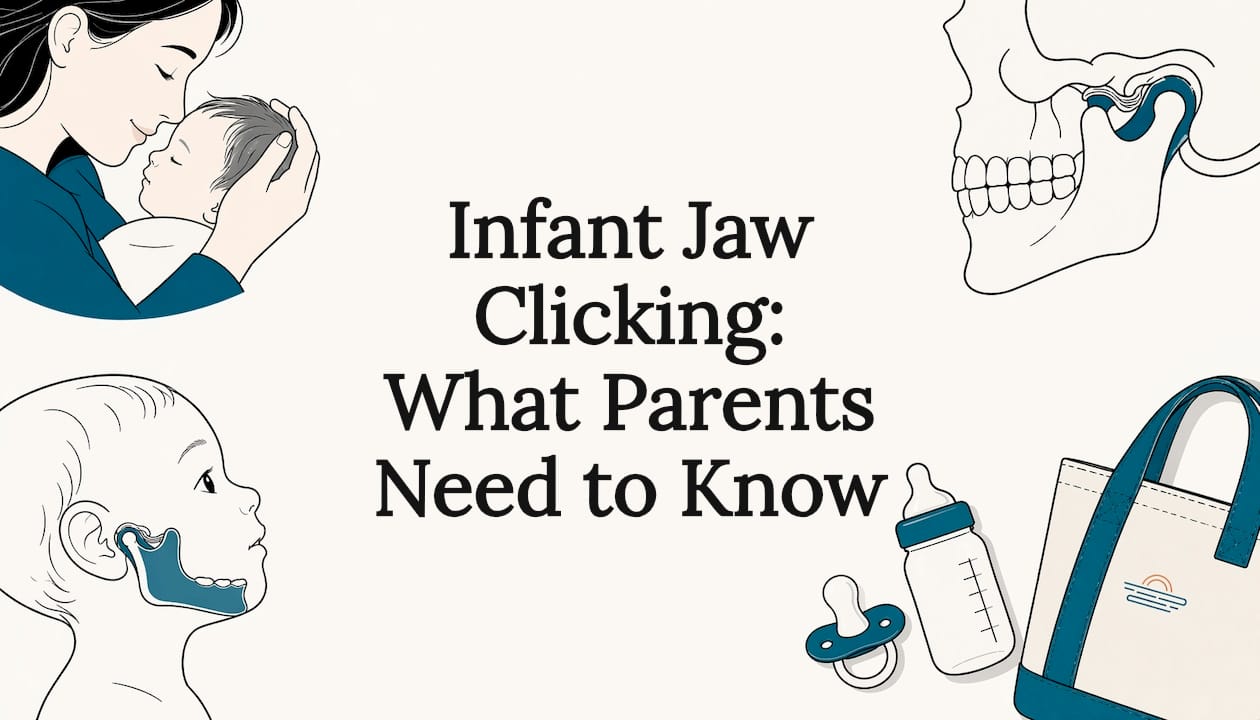
Infant jaw clicking is usually normal. The temporomandibular joint (TMJ) in newborns is anatomically immature, with a flatter socket and developing disc, and the repetitive motion of sucking can produce audible pops or clicks that alarm parents but rarely signal anything serious. Clinical case reports describe newborns with TMJ clicking who fed normally and whose sounds resolved on their own over weeks to months.
Before you read further, do three quick checks right now:
- Is your baby feeding normally, gaining weight, and showing no signs of pain or distress?
- Does the jaw open and close symmetrically, without locking or deviating to one side?
- Is there no swelling, redness, or fever near the jaw or ear?
If you answered yes to all three, observation is almost certainly the right first step. Seek urgent care immediately if your baby cannot eat or drink, the jaw appears locked open or shut, you notice fever with jaw swelling, or breathing seems labored.
Table of Contents
- What causes infant jaw clicking?
- Red flags: when does jaw clicking need prompt attention?
- What a pediatrician or pediatric dentist will check
- How infant jaw clicking is usually managed
- What the evidence and expert guidance say
- Local options in Bonita Springs: Towne Dental and Miles of Little Smiles
- How to choose and prepare for your appointment
- Key Takeaways
- A note on what we see in practice
- Towne Dental is ready to help Bonita Springs families
- Useful sources and further reading
- FAQ
What causes infant jaw clicking?
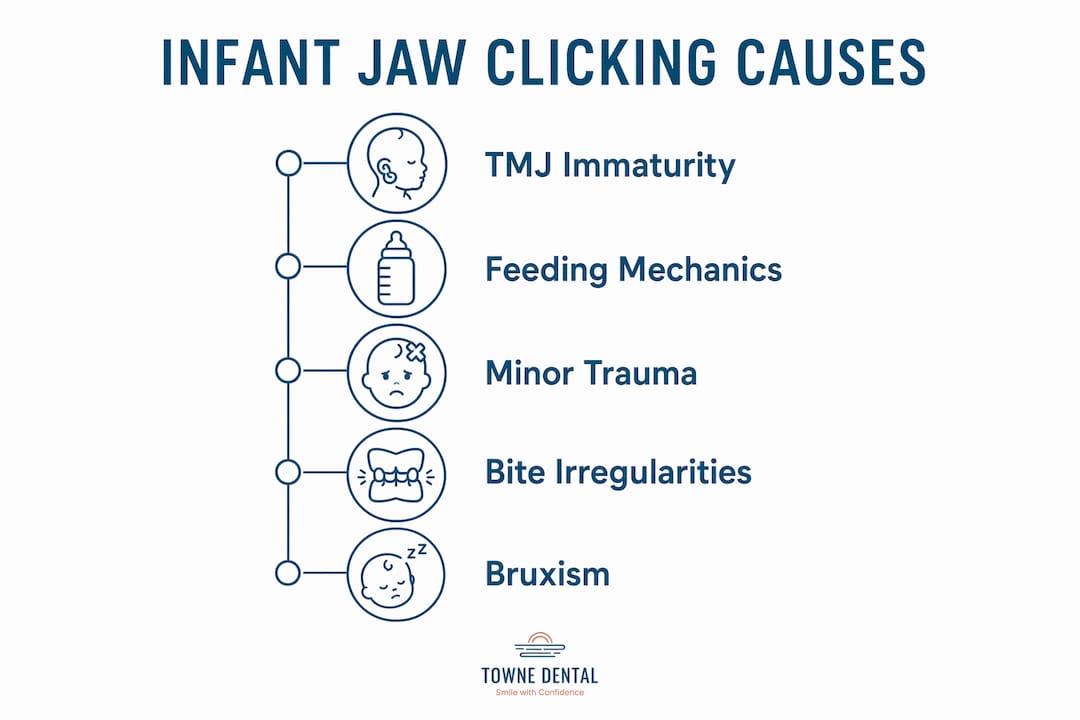
The infant TMJ starts forming as early as 14–20 weeks’ gestation, and the joint surfaces remain relatively flat well into early infancy. That structural immaturity, combined with the strong, repetitive sucking motion of feeding, is the most common explanation for a baby jaw clicking sound. The disc and surrounding ligaments simply haven’t fully matured yet, so the joint can shift slightly during each suck-swallow cycle and produce a click or pop.
Feeding mechanics also play a role. An asymmetric latch, inconsistent tongue positioning, or a fast-flow bottle nipple can load one side of the joint more than the other. That uneven pressure often produces a unilateral click that disappears once the latch improves.

Minor trauma is a less common but real cause. A difficult delivery, a sudden fall, or forceful feeding can stress the joint. Neonatal TMJ dislocation is rare and typically linked to identifiable trauma; it usually presents as a fixed or locked jaw rather than an intermittent click.
As children get older and teeth begin to erupt, early bite irregularities or bruxism (tooth grinding) can contribute to jaw movement issues. TMD signs like clicking become more prevalent with later dentition stages rather than in the newborn period, so a toddler jaw clicking concern often has a different cause than the same sound in a two-week-old.
Pro Tip: When you call your pediatrician or dentist, note whether the click is on one side or both, whether it happens only during feeding or also during yawning, and whether it has changed in frequency or loudness since you first noticed it. That history cuts the exam time in half.
Red flags: when does jaw clicking need prompt attention?
Most jaw clicking in newborns is benign. These signs are different:
- Difficulty feeding or refusing to feed — the clearest functional red flag
- Poor weight gain — suggests feeding is being compromised
- Jaw locking or severely limited opening — may indicate dislocation rather than a simple click
- Persistent asymmetry — jaw deviating consistently to one side during opening
- Swelling, redness, or warmth near the jaw or in front of the ear
- Fever alongside jaw symptoms — raises concern for infection
- Signs of pain or distress during feeding or jaw movement
A locked or fixed jaw is the most urgent scenario. Case literature distinguishes a reducible click (jaw moves freely, sound occurs but resolves) from a true dislocation (jaw stays displaced). The first needs monitoring; the second needs same-day evaluation.
Seek emergency care if: the jaw is locked and won’t close, your baby has not fed in several hours due to jaw pain or restriction, or there is visible swelling with fever.
What a pediatrician or pediatric dentist will check
The exam starts with history. Expect questions about when the clicking began, whether it is one-sided or bilateral, whether it correlates with feeding or yawning, any recent trauma or illness, and your baby’s weight trend. That context shapes everything that follows.
The physical exam covers jaw opening range, whether the jaw deviates to one side during opening, palpation over the joint for clicks or tenderness, symmetry of facial movement, and a look inside the mouth at soft tissue and any erupted teeth. For an infant, the clinician may also observe a feeding session directly.

AAPD guidance recommends imaging only when the primary pain source appears to be the joint, when crepitation or bite changes are noted, or when the infant fails to respond to conservative management. Panoramic X-rays detect gross bony changes; cone-beam CT adds detail on hard tissue; MRI is reserved for soft-tissue evaluation in more complex cases. Most infants with painless clicking never need imaging at all.
Referral to a pediatric ENT or oral surgery specialist is appropriate when there is a suspected dislocation, signs of infection, a developmental anomaly, or persistent dysfunction despite observation.
How infant jaw clicking is usually managed
Observation and reassurance are the standard first response when the baby is feeding well and pain-free. That is not a non-answer. Many infants with TMJ clicking feed and grow normally and need nothing beyond monitoring.
What parents can do at home:
- Adjust feeding position so the baby’s head is slightly elevated and the latch is centered
- Try paced bottle-feeding to reduce the force and speed of sucking
- Record a short video of the clicking during a feeding session — video often helps clinicians triage without an urgent visit
- Note the timing and any triggers in a simple log
What to avoid:
- Do not attempt to manually reposition the jaw
- Do not apply pressure or massage directly over the joint without clinical guidance
- Do not delay calling if feeding drops off or the jaw appears locked
When conservative care isn’t enough, the next step is usually a pediatric dental evaluation or referral to a pediatric ENT. Surgical intervention is rare and reserved for true structural problems.
What the evidence and expert guidance say
The clinical picture for jaw clicking in newborns is reassuring. A published case series reported neonates with bilateral TMJ clicking during feeding and yawning; the clicking resolved spontaneously over time with normal occlusal development throughout.
Anatomic research confirms why: the infant TMJ has a flatter mandibular fossa and immature disc morphology compared to the adult joint. As the joint matures and feeding mechanics become more coordinated, the structural basis for the click often disappears on its own.
“Jaw function is painless for many patients with disc displacement with reduction. These patients may present with pain-free TMJ clicking, and generally no treatment is needed aside from reassurance and explanation of the condition.” — AAPD Temporomandibular Disorders in Children guidance
The AAPD recommends a focused clinical history and exam as the foundation of any TMD evaluation in children, with targeted referral only when red flags are present.
Local options in Bonita Springs: Towne Dental and Miles of Little Smiles
| Dimension | Towne Dental Naples | Miles of Little Smiles |
|---|---|---|
| Pediatric dentistry focus | Yes — pediatric dentistry listed as a core service | Yes — exclusively pediatric preventive and restorative care |
| Emergency / same-day availability | Yes — emergency dentistry offered | Not publicly listed |
| Sedation / behavior management | Yes — sedation dentistry available | Not publicly listed |
| Relevant specializations | Pediatric dentistry, orthodontics, oral surgery, sedation | Pediatric dentistry (preventive and restorative) |
| Location / proximity | Naples, FL — serves Bonita Springs area | White Plains context. Confirm local availability when calling |
Towne Dental Naples offers pediatric dentistry alongside emergency dentistry, sedation options, orthodontics, and oral surgery under one roof. For a parent dealing with infant jaw movement issues who wants a single practice that can handle both the initial evaluation and any escalation, that breadth matters.
Miles of Little Smiles is a pediatric-focused practice with preventive and restorative care. Its exclusive pediatric focus suits parents who prefer a specialist-only environment for their infant’s first evaluation.
When you call, say this: “My infant is [age] weeks/months old and I’ve noticed a clicking sound in the jaw during feeding. I’d like to schedule an evaluation to rule out anything structural.”
How to choose and prepare for your appointment
The right choice depends on what you need. If the clicking comes with any red flag from the list above, a practice with same-day emergency access is the priority. If the click is isolated and your baby is feeding well, either practice works for a routine evaluation.
Before you book, ask:
- Do you see infants for TMJ or jaw concerns?
- Is there availability this week, or do you have urgent slots?
- What should I bring to the first appointment?
Appointment checklist:
- Infant’s age and birth history (including delivery details if relevant)
- When clicking started and whether it has changed
- A short feeding video showing the click
- Growth chart or recent weight from the pediatrician
- Insurance card and photo ID
- A familiar bottle or nursing cover for a feeding observation
At the visit, expect a focused exam lasting 15–20 minutes. Bring a pacifier or familiar comfort item. The most likely outcome is reassurance and a monitoring plan, not an immediate procedure.
Key Takeaways
Most infant jaw clicking is benign and often resolves on its own as the TMJ matures, but a few specific red flags warrant prompt evaluation by a pediatric dentist or physician.
| Point | Details |
|---|---|
| Usually benign | Jaw clicking in newborns most often reflects TMJ immaturity and resolves spontaneously over weeks to months. |
| Watch for red flags | Difficulty feeding, locked jaw, poor weight gain, fever, or swelling require same-day or urgent evaluation. |
| Record a feeding video | A short video of the clicking during feeding helps clinicians triage and often avoids an unnecessary urgent visit. |
| AAPD guidance: observe first | For painless clicking with no red flags, professional guidance supports observation and reassurance as the first step. |
| Towne Dental Naples | Offers pediatric dentistry, emergency access, and sedation options for families in the Bonita Springs area needing an evaluation. |
A note on what we see in practice
Parents who come in worried about a clicking jaw almost always leave reassured. The exam is quick, the history usually tells most of the story, and the vast majority of infants with an isolated click are feeding well and growing on track. The cases that need more attention are the ones where feeding is affected or the jaw isn’t moving freely — and those are exactly the situations where getting in promptly makes a real difference. This article is general information, not a substitute for a clinical evaluation; if any red flag applies to your child, contact a provider or go to urgent care rather than waiting.
Towne Dental is ready to help Bonita Springs families
When your infant’s jaw clicking comes with any concern at all, a same-day evaluation beats a week of worry. Towne Dental provides pediatric dentistry, emergency dental services, sedation options for anxious little patients, and specialist access including oral surgery and orthodontics, all at one Bonita Springs-area practice. There is no need to coordinate between multiple offices for a first evaluation.

Call Towne Dental or book online to schedule a pediatric jaw evaluation. Describe your infant’s age, when the clicking started, and whether feeding has been affected — the team will match you with the right appointment type. For true emergencies (locked jaw, no feeding, fever with swelling), go directly to urgent care or your nearest emergency room rather than waiting for an office visit.
This article is general information only and does not replace professional medical or dental advice. Always consult a qualified provider for your child’s specific situation.
Useful sources and further reading
- AAPD Temporomandibular Disorders in Children — Best Practices: The primary professional guideline informing the exam workflow, red-flag criteria, and observation-first approach described in this article.
- Neonatal TMJ Dislocation: A Case Report and Literature Review (PMC): Supports the distinction between benign clicking and true dislocation, and the referral guidance for persistent or structural findings.
- TMJ Clicking in the Neonate: Report of Two Cases: The case series showing spontaneous resolution of bilateral neonatal TMJ clicking with normal developmental outcomes.
- Human TMJ Disc: Anatomy and Measurements in Prenatal Development: Anatomic basis for why the infant TMJ is prone to audible sounds during feeding, cited in the causes section.
FAQ
Why does my baby’s jaw click?
The infant TMJ is structurally immature, with a flatter socket and developing disc, making it prone to audible clicks during the repetitive sucking motion of feeding. This is usually benign and often resolves as the joint matures.
When should I worry about jaw clicking in my baby?
Worry when clicking is accompanied by difficulty feeding, poor weight gain, a locked or limited jaw, persistent asymmetry, fever, or visible swelling. An isolated, painless click in a baby who feeds and grows normally is rarely cause for concern.
What is the 3-finger test for jaw?
The 3-finger test checks whether an adult can fit three stacked fingers vertically between their upper and lower front teeth; it is used to assess mouth-opening range in older children and adults, not in infants. For infants, clinicians assess jaw opening visually and by palpation during a clinical exam.
Can a newborn have TMJ problems?
True TMJ disorders are uncommon in newborns, but audible clicking during feeding is documented in clinical case reports and typically reflects joint immaturity rather than a disorder. Actual TMJ dislocation in neonates is rare and usually tied to identifiable trauma.
Should I take my baby to a dentist or a pediatrician first?
Either is a reasonable first call. If the click is isolated and feeding is normal, your pediatrician can screen and refer if needed. If feeding is affected or you notice any red flag, a practice like Towne Dental with pediatric dentistry and same-day emergency access can provide a more targeted jaw evaluation.