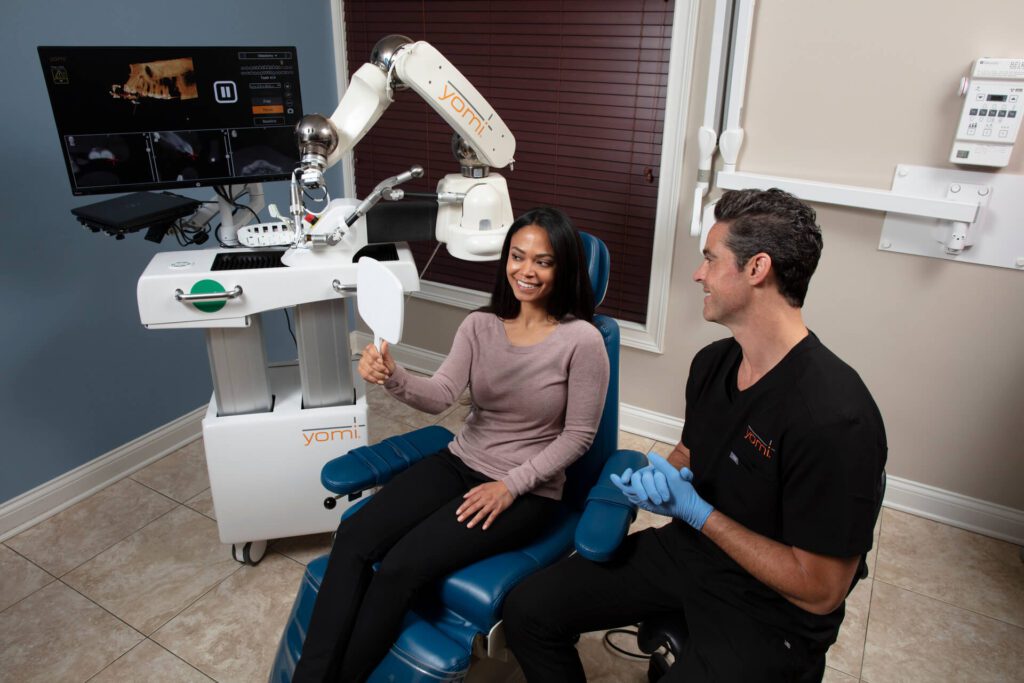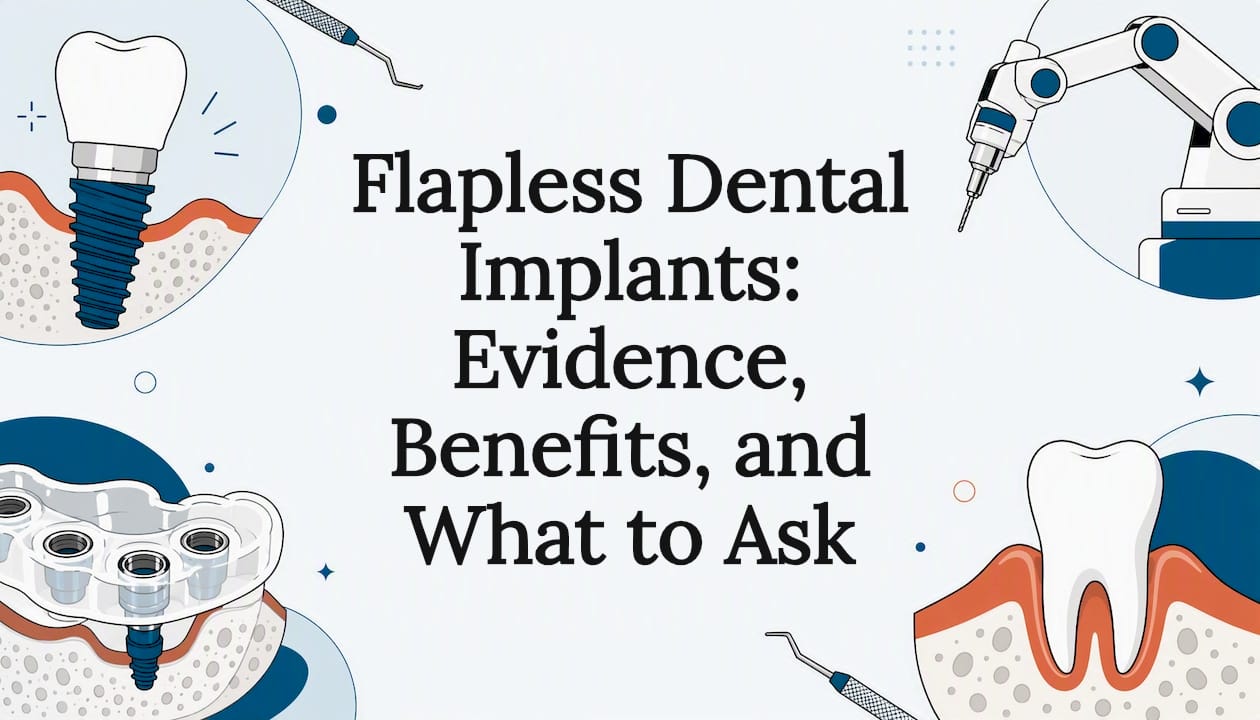
Flapless dental implant surgery is a genuinely good option for carefully selected patients. When bone volume is adequate, soft tissue is healthy, and digital planning guides the procedure, outcomes rival those of conventional flapped surgery. The catch is that “carefully selected” carries real weight. A 2020 systematic review found no significant difference in long-term implant survival, marginal bone loss, or complication rates between flapless and flapped approaches over three or more years of follow-up. However, an earlier PLOS One meta-analysis flagged a pooled relative risk signal suggesting a higher risk of implant failure for flapless versus flapped placement, a signal that narrows considerably when study quality is controlled. The technique works. It is not universally appropriate.
Quick summary:
- Main benefits: Less postoperative pain and swelling, shorter surgical time, faster return to normal oral hygiene, and better soft-tissue preservation in ideal cases
- Main risks: Reduced intraoperative visualization, higher risk of implant malposition without guided planning, and potential for bone perforation when anatomy is misjudged
- The deciding factor: Patient selection and surgical planning quality matter more than the technique itself
Suitability is everything with this procedure. If you want to know whether you are a good candidate before your next consultation, jump to the patient checklist section below.
Key Takeaways
Flapless dental implants deliver outcomes equivalent to conventional surgery over the long term, but only when patient selection, CBCT planning, and guided or robotic technique are all in place.
| Point | Details |
|---|---|
| Long-term outcomes are comparable | A systematic review found no significant difference in survival, bone loss, or complications at three or more years of follow-up. |
| Short-term benefits are real | Less postoperative pain, less swelling, and faster tissue healing are consistently reported in comparative studies for well-selected cases. |
| Guided planning is non-negotiable | Freehand flapless carries higher malposition risk; static guides, dynamic navigation, or robotic assistance are the standard for safe execution. |
| Patient selection determines risk | Adequate bone volume, keratinized tissue, and controlled systemic health are the three factors that make flapless appropriate. |
| Towne Dental uses CBCT and Yomi® | The clinic’s robotic workflow and digital planning process are designed to meet the selection and execution standards the evidence requires. |
Table of Contents
- What are flapless dental implants and how do they differ from conventional surgery?
- What does the clinical evidence show about flapless implant outcomes?
- What are the real benefits of flapless implant surgery?
- When is flapless surgery risky or inappropriate?
- How is a flapless procedure planned and performed?
- Are you a good candidate? A checklist to bring to your consultation
- What to expect after flapless implant placement
- Our perspective on when flapless surgery is the right call
- Flapless implant planning at Towne Dental
- Sources
- FAQ
What are flapless dental implants and how do they differ from conventional surgery?
In standard implant surgery, the surgeon makes an incision along the gum line and peels back a full-thickness flap of tissue to expose the underlying bone directly. Flapless implant surgery skips that step. Instead, the clinician either punches a small circle of tissue away with a tissue punch (a cylindrical blade roughly the diameter of the implant) or makes a minimal incision just large enough to access the bone, without reflecting any flap at all.
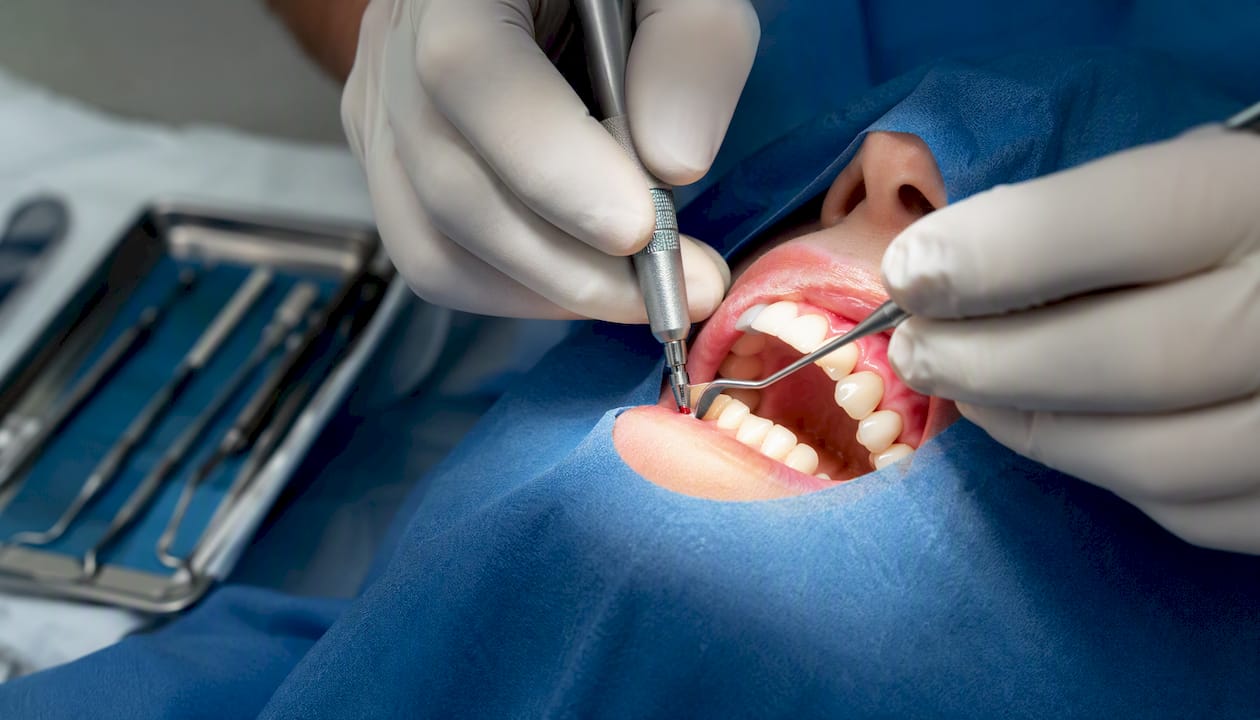
The bone is never visually exposed. That single difference drives every advantage and every limitation of the technique.
The three main technique variants
Tissue punch (transmucosal): A circular punch removes a small disc of gingival tissue. This is the most common flapless approach and works well when the gingiva is thick and keratinized.
Minimal incision: A short linear cut, smaller than a traditional flap incision, gives limited access without full tissue reflection. Used when the anatomy is slightly less predictable but a full punch is not ideal.
Guided-access (template or robotic): A 3D-printed surgical guide or robotic arm constrains the drill to a pre-planned trajectory derived from a cone-beam CT (CBCT) scan. This is the standard of care for flapless placement in most contemporary practices because it compensates for the lack of direct visualization.
Terms you will hear in consultations
- Surgical guide / static guide: A 3D-printed template that fits over the teeth or bone and physically limits drill angulation and depth
- Dynamic navigation: Real-time computer guidance that tracks the drill position without a physical template, similar to GPS for surgery
- Freehand flapless: Placement without a guide, relying entirely on the surgeon’s tactile feedback and experience
- Immediate loading: Placing a temporary crown on the implant the same day as surgery, sometimes combined with flapless placement
- Osseointegration: The biological process by which bone fuses to the implant surface, typically taking 3–6 months
Pro Tip: “Flapless” describes the incision technique, not the implant hardware. Implants placed flaplessly are still connected to crowns via screws or abutments. “Screwless implants” is a separate concept entirely. If a provider uses these terms interchangeably, ask them to clarify.
What does the clinical evidence show about flapless implant outcomes?
The short answer: flapless implants perform comparably to flapped implants over the long term when patients are selected well and planning is thorough. The nuance is that short-term data and pooled analyses tell a more complicated story.
Survival rates
An ITI consensus review reported prospective cohort survival rates of approximately 98.6% (95% CI: 97.6–99.6%) and retrospective study survival rates of approximately 95.9% (95% CI: 94.8–97.0%) for flapless procedures, with a mean follow-up of around 19 months. Those numbers look strong, but the review explicitly cautions that most evidence is short-term and technique-sensitive.
The PLOS One meta-analysis complicates the picture. Its pooled relative risk of 1.75 for implant failure in flapless versus flapped cases (95% CI: 1.07–2.86) sounds alarming until you look at the sensitivity analysis: the result shifted significantly with study quality (P = 0.03), meaning lower-quality studies drove much of the signal. When the 2020 systematic review restricted its analysis to studies with three or more years of follow-up, the difference in survival rates disappeared (OR = 1.30; P = 0.68).
Marginal bone loss
A short-term comparative study of 20 implants (10 flapless, 10 flapped) found significantly less marginal bone loss in the flapless group over three months of follow-up. The long-term systematic review found no significant difference in marginal bone loss between groups at three or more years. The pattern suggests that flapless placement may offer a short-term bone-preservation advantage that equalizes over time.
Guided versus freehand flapless
| Approach | Positional accuracy | Visualization | Evidence quality |
|---|---|---|---|
| Guided flapless (static guide) | High | None | Comparative studies, case series |
| Dynamic navigation | High | None | Emerging; limited RCTs |
| Freehand flapless | Variable | None | Lower; technique-dependent |
| Conventional flapped | Moderate to high | Direct | Extensive long-term data |
Comparative reports consistently show that guided workflows improve placement precision over freehand flapless techniques. Freehand flapless carries the highest risk of malposition precisely because there is no visual confirmation and no mechanical constraint on the drill.
What these numbers actually mean for you
A 98.6% survival rate at roughly 19 months means roughly 1 in 70 flapless implants fails within that window under prospective study conditions. The 1.75 relative risk figure from pooled data is real but unstable across study quality levels. For a patient with good bone volume, healthy soft tissue, and a guided procedure, the long-term data suggests the risk profile is similar to conventional surgery. For a patient with borderline anatomy and a freehand technique, the risk gap widens considerably.
What are the real benefits of flapless implant surgery?
The benefits are genuine, not marketing language. They are also conditional on appropriate case selection.

Reduced postoperative discomfort: Multiple small comparative studies report reduced immediate swelling, pain, and analgesic use after flapless placement compared with open-flap techniques. The short-term comparative study specifically documented lower pain scores in the flapless group over the first three months.
Shorter surgical time: Eliminating flap elevation and suturing typically reduces chair time. For patients with medical conditions that make prolonged procedures riskier, this is a clinically meaningful advantage, not just a convenience.
Better soft-tissue preservation: Because the periosteum is never reflected, blood supply to the crestal bone is less disrupted. This may explain the short-term marginal bone loss advantage seen in comparative data, and it tends to produce a more natural gingival contour around the final restoration.
Faster return to hygiene: With no sutures and minimal wound management, most patients can resume careful brushing around the site within days rather than weeks. For patients who struggle with modified oral hygiene routines, this matters.
Applicability in medically compromised patients: A case report demonstrated successful flapless guided placement in a patient with systemic comorbidities, noting reduced trauma and faster recovery. Reduced surgical time and tissue disruption make flapless a reasonable option for patients on anticoagulants, immunosuppressants, or other medications that complicate wound healing, provided planning is thorough.
Aesthetic zone advantages: Preserving the gingival architecture around the implant site can produce a more predictable papilla height and tissue contour, which matters most in the front teeth where gum aesthetics are visible.
When is flapless surgery risky or inappropriate?
The technique’s biggest limitation is that the surgeon cannot see the bone. Every risk below flows from that single fact.
Red flags that favor a conventional flapped approach
- Insufficient bone width or height: If the CBCT shows less than about 1 mm of bone on either side of the planned implant, direct visualization is needed to avoid perforation
- Inadequate keratinized tissue: A commonly accepted clinical threshold is at least 1.5 mm of circumferential keratinized gingiva at the implant site; below that, soft-tissue recession risk increases after flapless placement
- Need for simultaneous bone grafting: Grafting requires direct access to the defect. Flapless and bone augmentation cannot be combined in the same site
- Complex or unusual anatomy: Significant bone concavities, proximity to vital structures, or unusual ridge morphology all require visual confirmation during drilling
- Systemic conditions affecting healing: Uncontrolled diabetes, active chemotherapy, or bisphosphonate therapy may not be absolute contraindications, but they require careful individual assessment rather than a blanket flapless protocol
- Esthetic zone with thin biotype: A thin gingival biotype in the anterior zone can recede unpredictably after tissue punch procedures, potentially exposing the implant collar
Technique-specific risks
- Implant malposition: Without visual feedback, angulation and depth errors are harder to detect and correct intraoperatively. A misplaced flapless implant often requires removal.
- Bone fenestration or perforation: Drilling through a narrow ridge without seeing it can create a hole in the buccal or lingual cortex, compromising osseointegration.
- Thermal injury: Flapless access limits irrigation reach to the drill tip. Inadequate cooling during osteotomy preparation can cause bone necrosis, particularly in dense bone.
- Soft-tissue complications: Tissue punch procedures can damage the gingival architecture if the punch diameter is mismatched to the implant platform.
A scenario that illustrates the risk well: a patient with a narrow posterior ridge, borderline keratinized tissue, and no CBCT-guided plan is a poor candidate for flapless placement. The same patient with a CBCT-confirmed 2 mm buccal plate, adequate keratinized tissue, and a static surgical guide is a reasonable one.
How is a flapless procedure planned and performed?
Safe flapless surgery is almost entirely a pre-surgical achievement. What happens in the chair is the execution of a plan built weeks earlier.
The planning workflow
- CBCT acquisition: A cone-beam CT scan produces a 3D image of the jaw, showing bone width, height, density, and proximity to the inferior alveolar nerve or sinus floor. This is non-negotiable for guided flapless placement.
- Digital planning: Software (such as coDiagnostiX, Simplant, or similar platforms) overlays the proposed implant position on the CBCT data. The clinician adjusts angulation, depth, and platform position to optimize bone engagement and prosthetic emergence.
- Surgical guide fabrication or robotic setup: A static 3D-printed guide is milled or printed to fit the patient’s teeth or bone. Alternatively, a dynamic navigation system is calibrated, or a robotic arm (such as the Yomi® system) is programmed with the planned trajectory.
- Guide verification: Before any drilling begins, the guide is seated and its fit is confirmed, often with a radiographic check or physical verification against reference points. A poorly seated guide transfers errors directly to implant position.
- Tissue access: The tissue punch or minimal incision is made through the guide sleeve opening, matching the planned implant diameter.
- Sequential drilling with depth control: Drills advance through guide sleeves at controlled depths. Copious irrigation is critical, especially in dense bone where heat generation is highest.
- Implant placement and torque verification: The implant is placed to the planned depth and insertion torque is measured. Torque values inform whether immediate loading is feasible.
- Closure: With no flap to reposition, closure is typically a single suture or none at all.
Static guides, dynamic navigation, and robotics
Static guides are the most widely used option. They are cost-effective, well-studied, and accurate when fabricated and seated correctly. Their limitation is that they cannot adapt if intraoperative conditions differ from the CBCT data.
Dynamic navigation tracks the drill in real time and displays its position relative to the planned trajectory on a monitor. It allows mid-procedure adjustments without a physical template, which is useful in complex cases.
Robotic assistance (such as Yomi®) combines haptic feedback with real-time guidance, physically resisting movement outside the planned path. It adds a layer of mechanical safety that static guides cannot provide. You can read more about how robotic implant workflows function in practice.
Pro Tip: Before your procedure, ask to see the digital plan on screen. A clinician who can walk you through the CBCT images and show you the planned implant position relative to your bone is demonstrating exactly the kind of pre-surgical rigor that makes flapless surgery safe.
Are you a good candidate? A checklist to bring to your consultation
Most patients cannot self-assess for flapless candidacy without imaging, but this checklist tells you which factors your clinician should be evaluating and what questions to ask.
Candidate checklist
- Bone volume: Does your CBCT show at least 1 mm of bone on the buccal and lingual sides of the planned implant? If bone is borderline, grafting may be needed first. See dental implants without bone for what that process involves.
- Keratinized tissue: Is there at least 1.5 mm of firm, attached gingiva around the planned site?
- Systemic health: Are any conditions (diabetes, bleeding disorders, immunosuppression) controlled and disclosed to your surgeon?
- Mouth opening: Can you open wide enough to seat a surgical guide and operate drills at the planned site? Posterior sites in patients with limited opening can be problematic.
- Esthetic zone: If the implant is in the front of the mouth, does your clinician have a plan for preserving or recreating the papilla and gingival contour?
Questions to ask your clinician
-
“Can I see my CBCT plan before we proceed?” A reassuring answer walks you through the 3D images and shows you the planned implant position, bone margins, and proximity to nerves or sinuses.
-
“Will you use a surgical guide or robotic assistance?” A reassuring answer names the specific system and explains how guide fit will be verified before drilling starts. “I’ll do it freehand” is not reassuring for a flapless case.
-
“What happens if you encounter thin bone or unexpected anatomy during the procedure?” A reassuring answer describes a clear protocol for converting to a flapped approach or stopping and reassessing, not a promise that it won’t happen.
-
“Do I have enough keratinized tissue for a tissue punch approach?” A reassuring answer references the clinical measurement and explains what will be done if tissue is borderline.
-
“Am I a candidate for immediate loading?” A reassuring answer ties the decision to insertion torque values and bone quality, not to a blanket policy.
What to expect after flapless implant placement
Recovery after flapless surgery is genuinely faster than after conventional flap surgery for most patients. That said, the implant still needs to osseointegrate, and that timeline does not change based on the incision technique.
Typical healing timeline
- Day 1: Mild to moderate soreness at the site, minimal swelling compared with flapped surgery. Bleeding should stop within a few hours. Soft diet, no rinsing, no spitting.
- Days 2–7: Swelling peaks around day 2–3 and resolves faster than after a flap procedure. Most patients need over-the-counter analgesics for 2–4 days. Gentle saltwater rinses can begin after 24 hours.
- Week 2–4: The gingival tissue around the implant heals and tightens. Careful brushing around the site resumes, typically with a soft brush and no pressure directly on the implant.
- Months 1–3: Osseointegration is underway. The implant should feel stable and not mobile. Follow-up radiographs check marginal bone levels.
- Months 3–6: Final osseointegration is confirmed, and the restorative phase begins. The abutment and crown are placed.
Postoperative do’s and don’ts
Do:
- Take prescribed or recommended analgesics on schedule for the first 48 hours, not just when pain peaks
- Keep the site clean with gentle rinsing after the first 24 hours
- Attend all follow-up appointments, including the radiographic check at 3 months
- Report any unexpected symptoms promptly
Don’t:
- Smoke or use tobacco products during the healing period. Smoking significantly increases implant failure risk regardless of technique.
- Eat hard, crunchy, or sticky foods near the implant site during the first month
- Probe or press on the implant with your tongue or fingers
- Skip follow-up appointments because you feel fine. Marginal bone changes are often asymptomatic early.
Red-flag symptoms requiring urgent contact
- Persistent or worsening bleeding beyond 4–6 hours post-procedure
- Severe or increasing swelling after day 3 (swelling should be declining, not growing)
- Fever above 101°F (38.3°C)
- Sudden implant mobility or a sensation that the implant has shifted
- Numbness or tingling in the lip, chin, or tongue that was not present before surgery
For any of these, contact your provider immediately. If you are in the Southwest Florida area, Towne Dental’s emergency services are available for urgent post-surgical concerns.
Our perspective on when flapless surgery is the right call
Flapless implant surgery tends to get framed as either a premium, minimally invasive upgrade or a risky shortcut depending on who is writing about it. Neither framing is accurate.
The honest clinical picture is this: flapless surgery is a technique that transfers risk from the operating table to the planning room. When that planning is rigorous, including CBCT-confirmed bone volume, adequate keratinized tissue, and a verified surgical guide or robotic workflow, the intraoperative risk is well-managed and outcomes match conventional surgery over the long term. When planning is rushed or skipped, the absence of direct visualization turns a manageable procedure into a genuinely dangerous one.
What gets underestimated is how much the “flapless versus flapped” question is actually a “guided versus freehand” question in disguise. The long-term survival data that shows equivalence between the two approaches comes almost entirely from guided flapless cases. Freehand flapless has a much thinner evidence base and a higher operator-dependence. Patients who ask “is flapless safe?” are really asking “is my surgeon’s planning process thorough enough to make flapless safe?” That is the right question.
At Towne Dental, the selection criteria are applied before any technique decision is made. CBCT imaging, digital planning, and guided or robotic workflows are standard parts of the implant process, not optional upgrades. The Yomi® robotic system adds a layer of real-time mechanical guidance that static guides cannot provide, which is particularly valuable in cases where anatomy is close to critical structures. Medically compromised patients who might benefit most from reduced surgical time and tissue trauma are evaluated individually, with their physicians when appropriate, rather than excluded categorically.
The technique-sensitivity concern is real, and any clinician who dismisses it is not being honest with you. But technique sensitivity is manageable with the right infrastructure and training. The goal is not to avoid flapless surgery. It is to use it only when the conditions for safe execution are genuinely in place.
Flapless implant planning at Towne Dental
Towne Dental’s implant workflow starts with a CBCT scan and a digital treatment plan reviewed with you before any procedure is scheduled. For patients who qualify for flapless placement, that means seeing your bone volume, the planned implant position, and the safety margins on screen before a single drill touches your jaw.
The clinic’s Yomi® robotic system provides real-time haptic guidance during placement, physically constraining the drill to the planned path. That is a meaningful difference from static guides alone, particularly in cases where anatomy leaves little margin for error. For patients with anxiety about surgical procedures, sedation options are available to make the experience manageable.
If you are researching flapless implants and want to know whether you are a candidate, the first step is a consultation that includes imaging review. Schedule through Towne Dental’s oral surgery services page and bring your questions from the checklist above. The consultation is where the real decision gets made.
Sources
These are the primary sources behind the clinical claims in this article. Bringing them to your consultation gives you a basis for a more specific conversation with your clinician.
- Flapless versus conventional flapped dental implant surgery: A meta-analysis | PLOS One
- Long-term clinical performance of flapless implant surgery compared to the conventional approach with flap elevation: A systematic review and meta-analysis – PubMed
- Evaluation of efficacy and effectiveness of flapless surgery for endosseous dental implants (ITI consensus / review)
Bring these sources to your consultation if you want to discuss the evidence directly with your clinician. Most implant surgeons will welcome the conversation.
This article is general information, not a substitute for advice from a qualified doctor. Consult a qualified healthcare professional about your own circumstances before acting on anything here.
FAQ
What are the key differences between flapless and flap dental implant surgery?
Flapless surgery accesses the bone through a small tissue punch or minimal incision without reflecting a gum flap, preserving blood supply and reducing postoperative discomfort. Conventional flap surgery peels back the gum to expose bone directly, giving the surgeon full visualization but requiring sutures and a longer healing period.
What is the newest procedure for dental implants?
Robotic-assisted flapless implant placement, using systems like Yomi®, represents the current frontier. It combines real-time haptic guidance with pre-planned digital trajectories, reducing reliance on static guides and adding a mechanical safety layer that constrains the drill to the planned path.
How expensive are flapless dental implants compared to conventional implants?
Flapless implants often cost similarly to conventional implants at the procedure level, but the total cost can be higher when CBCT imaging, digital planning software, and surgical guide fabrication are factored in. Guided and robotic workflows add planning costs that freehand techniques do not carry.
What are the key things to know before getting dental implants?
Bone volume and soft-tissue quality determine whether you are a candidate for any implant technique, flapless or otherwise. Ask to see your CBCT plan before consenting to surgery, confirm whether a surgical guide or robotic system will be used, and understand the full osseointegration timeline, typically 3–6 months, before a final crown is placed.
Can medically compromised patients have flapless implants?
Yes, in selected cases. A published case report demonstrated successful guided flapless placement in a patient with systemic comorbidities using CBCT planning and a 3D-printed surgical guide, with reduced trauma and satisfactory healing. Medical clearance and individualized risk assessment are required before proceeding.