Schedule your child’s first dental visit by their first birthday, or within six months of the first tooth breaking through, whichever comes first. The American Academy of Pediatric Dentistry backs this timeline, along with the American Dental Association and the American Academy of Pediatrics. Call now to book an infant exam. That first appointment is about looking and teaching, not drilling or treating.
TL;DR:
- Visiting a pediatric dentist by age one allows early detection of decay signs, which can be reversed with simple interventions like fluoride varnish.
- The first appointment is brief, gentle, and focuses on education, risk assessment, and establishing a positive, ongoing relationship with the child’s dental team.
- Most children are scheduled for follow-ups every six months, with higher-risk patients seen more frequently to prevent more serious problems later.
- Many families delay or skip the first visit, often due to misconceptions that baby teeth do not matter or lack of awareness about early cavity signs.
- Early scheduling helps keep treatment minimal and reduces anxiety, setting the foundation for healthier teeth and habits as children grow.
Table of Contents
- Why the Age-One Dental Visit Actually Matters
- What Happens at Your Child’s First Dental Appointment?
- Is the Recommended Age Different From What Most Parents Actually Do?
- How to Prepare Your Child for a Smooth First Visit
- What Comes After the First Visit?
- How Towne Dental Handles Infant and Toddler First Visits
- Why We Push Early Scheduling So Hard
- Ready to Book Your Child’s First Dental Visit?
- Key Guidelines Referenced in This Article
- Sources
- FAQ
Why the Age-One Dental Visit Actually Matters
Tooth decay in babies and toddlers, known clinically as early childhood caries, is the most common chronic disease of childhood, and it is almost entirely preventable if someone catches it early. A dentist looking at a one-year-old’s mouth can spot the white, chalky spots that signal decay is starting, weeks or months before a parent would ever notice anything wrong.

That timing changes everything about how a problem gets treated. Kids who start seeing a dentist earlier generally rack up lower treatment costs and need fewer invasive procedures down the road, compared to kids whose first visit gets pushed to age three or four. Waiting means a dentist is more likely discovering cavities that already need drilling, instead of catching a weak spot that fluoride varnish can still reverse.
This is also where the idea of a “dental home” comes in. It’s not one checkup. It’s an ongoing relationship where one practice tracks your child’s growth, risk factors, and habits year over year, the same way a pediatrician does for general health.
What early, consistent care actually delivers:
- Fewer cavities requiring fillings or extractions by kindergarten
- Access to conservative fixes like fluoride varnish or silver diamine fluoride instead of surgery
- A dentist who knows your child’s history well enough to catch small changes fast
- Less anxiety for your kid, since dental visits become routine instead of rare
Decay is preventable, and conservative, nonsurgical options like fluoride varnish work best when a dentist gets to a lesion early. Miss that window and options narrow fast.
What Happens at Your Child’s First Dental Appointment?
Nothing about the first visit resembles the drilling-and-filling mental image most parents carry from their own childhood. It’s short, gentle, and mostly conversational.
Here’s the typical flow:
- Health history review. The dentist or hygienist asks about feeding habits, medications, fluoride exposure, and any concerns you’ve noticed.
- Visual exam. A quick look at teeth, gums, jaw alignment, and bite using a small mirror, sometimes with your child sitting in your lap.
- Caries-risk assessment. The dentist evaluates factors like diet, fluoride exposure, and family dental history to gauge how closely to watch things.
- Cleaning and brushing demonstration. A gentle polish, plus a hands-on lesson for you on brushing technique and positioning.
- Fluoride varnish, if indicated. A quick paint-on application that takes seconds and needs no numbing.
The whole appointment runs 30 to 45 minutes, and one parent typically stays right in the room. X-rays are not routine at this age. Dentists generally reserve radiographs for trauma or a specific developmental question, not a standard first look.
Pro Tip: Ask the front desk if you can fill out health history paperwork online before you arrive. It shaves ten minutes off wait time, which matters a lot when you’re managing a toddler in a lobby.
Is the Recommended Age Different From What Most Parents Actually Do?
The rule is simple: book the visit within six months of that first tooth, or by 12 months, whichever lands first. In practice, plenty of families miss that window by a wide margin.
Some clinic surveys put the average age of a child’s first dental visit closer to 2.6 years, a year and a half past the guideline. That gap usually comes down to access and awareness rather than any real disagreement about what’s best. Parents often assume baby teeth “don’t count” since they fall out anyway, or they wait for a pediatrician to bring it up, and it just never comes up.
A few situations call for moving faster than the standard timeline:
- Any white or brown spots on the teeth, which can signal early decay
- A fall or injury involving the mouth or front teeth
- A pediatrician flagging feeding or growth concerns tied to the mouth
- A family history of early, aggressive cavities
If none of those apply and your baby just got their first tooth at ten months, you have a little room. Booking within the following few weeks, rather than the same day, is perfectly reasonable.
How to Prepare Your Child for a Smooth First Visit
A little planning turns a potentially stressful morning into a nonevent. Most of it comes down to timing and how you talk about the appointment.
- Book a morning slot. Kids are more alert and cooperative earlier in the day, before naps and afternoon crankiness set in.
- Bring the paperwork basics. Insurance card, a list of any medications, and a quick summary of feeding habits (bottle, breast, sippy cup) save time at check-in.
- Pack a comfort item. A favorite small toy or blanket gives your child something familiar to hold onto in a new room.
- Talk about it simply. Skip detailed explanations. “The dentist is going to count your teeth” works better than a long buildup.
- Model calm yourself. Kids read parent body language fast, and staying relaxed and using simple, upbeat language does more to settle a child than any pep talk.
Pro Tip: Never use the dentist as a threat (“if you don’t brush, the dentist will have to fix it”). It plants fear before the first visit even happens, and it’s the single easiest mistake to avoid.
What Comes After the First Visit?
Most kids return every six months after that initial exam, the same rhythm most adults follow. But that interval isn’t fixed for everyone.
Children flagged as higher risk during that first caries-risk assessment, because of diet, enamel weakness, or family history, often get scheduled more frequently so problems get caught before they need real treatment. This is the practical value of a dental home: instead of scrambling to find a dentist during a toothache emergency, you already have a provider who knows your child’s mouth and adjusts care as they grow.
What ongoing care typically includes:
- Preventive cleanings and fluoride treatments on a risk-based schedule
- Age-specific guidance, like advice on thumb-sucking or transitioning off a bottle
- Referrals to specialists (orthodontics, oral surgery) if something outside routine care comes up
- Continuity that catches small issues while they’re still cheap and easy to fix
Consistent early follow-up is what keeps kids out of emergency rooms and operating chairs later, since problems get handled while they’re still small.
How Towne Dental Handles Infant and Toddler First Visits
Towne Dental built its pediatric dentistry program around exactly the anxiety-reduction approach the research points to: short, predictable appointments, a parent in the room the whole time, and a team trained to explain everything in language a toddler understands.
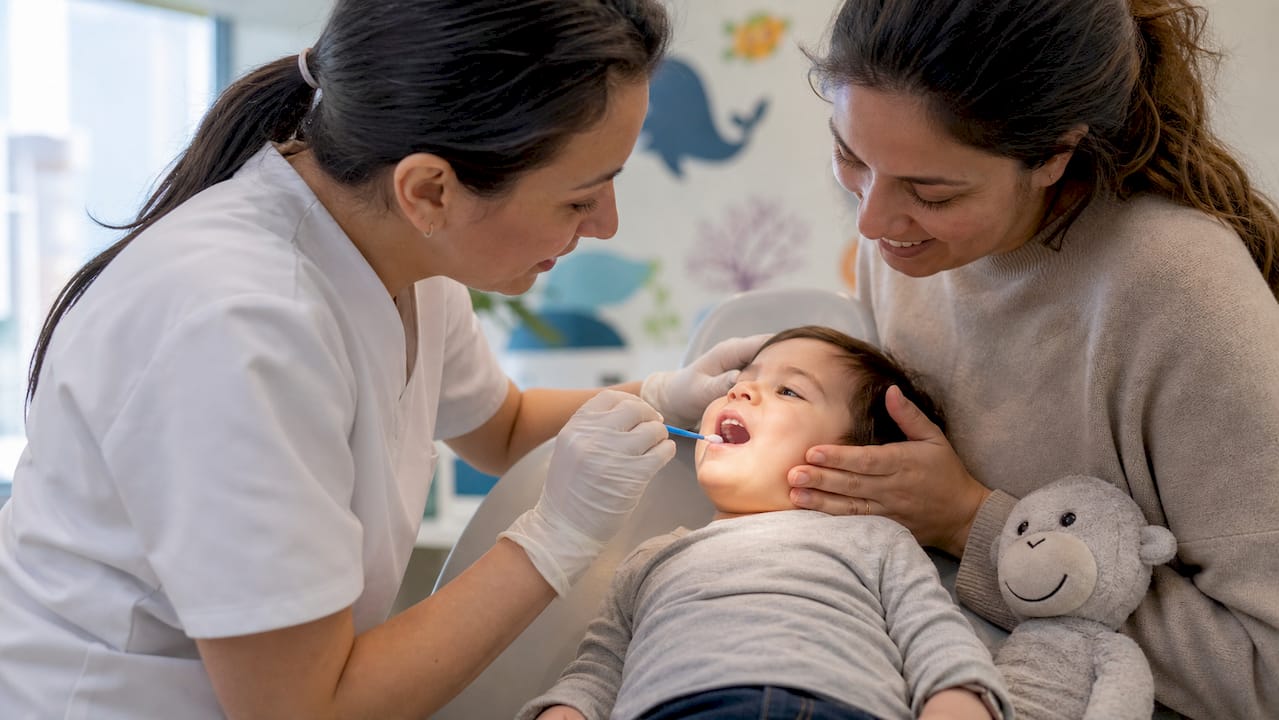
A typical infant exam here follows the same flow outlined above, a visual check, a risk assessment, and fluoride varnish if it’s called for, done in a space designed to feel unhurried rather than clinical. The goal is a first memory of the dentist that’s boring in the best possible way, so the next visit, and the one after that, feels routine instead of dreaded. For families already juggling a busy household, that predictability is often the biggest relief.
Why We Push Early Scheduling So Hard
The age-one recommendation isn’t a arbitrary number picked by a committee. It reflects a simple pattern seen again and again: children seen early get simpler problems, treated simply. Wait too long, and small chalky spots become fillings, and fillings sometimes become something worse.
We’d rather see a healthy one-year-old’s mouth and tell you everything looks great than meet a three-year-old already dealing with pain. If you have questions about timing, risk factors, or what to expect, reach out before the appointment, not after.
— Towne Dental
Ready to Book Your Child’s First Dental Visit?
Towne Dental gives families a pediatric-friendly alternative to scrambling for a same-week slot when a problem finally shows up, by getting your child established early with a team that already knows their history. Morning appointments are available specifically because young patients do better before nap time and afternoon fatigue set in, and a parent stays in the room for the entire exam.

Our team walks new parents through what to bring, how to talk to a toddler about the visit, and what the caries-risk assessment actually means for your child’s care plan going forward. Whether your family needs a first pediatric exam or wants a broader look at general dentistry for all ages, Towne Dental keeps the appointment short, calm, and genuinely useful. Call our office or book online today to get your child’s first exam on the calendar.
Key Guidelines Referenced in This Article
The recommendations above draw on the AAPD’s age-one visit policy, its periodicity and recall guidelines, and public health guidance on preparing for a baby’s first visit.
This article is general information, not a substitute for advice from a qualified doctor. Consult a qualified healthcare professional about your own circumstances before acting on anything here.
Sources
- The Importance of the Age One Dental Visit
- A Child’s First Dental Visit Fact Sheet
- Baby’s first dental visit: what to expect and how to prepare
FAQ
Should a 2-Year-Old Go to the Dentist?
Yes, and ideally they should have already gone. A child’s first visit should happen by age one, so a two-year-old who hasn’t been seen yet should be scheduled as soon as possible.
What Is the 2-2-2 Rule for Teeth?
This isn’t a recognized clinical standard, and definitions vary widely online. The consistent, evidence-backed guidance is the age-one rule: first visit within six months of the first tooth or by 12 months.
What Is the 3-3-3 Dental Rule?
Like the 2-2-2 rule, this isn’t an established guideline from major dental organizations. Parents are better served relying on the AAPD’s age-one recommendation, which is well documented and consistently cited.
What Is the “2-Year Dentist Rule”?
There’s no official “2-year rule” in pediatric dentistry guidance. The actual standard set by the AAPD, ADA, and AAP calls for a first visit by age one, not age two.
How Long Does a First Pediatric Dental Visit Last?
Most first visits run 30 to 45 minutes and focus on a visual exam, risk assessment, and possible fluoride varnish rather than any invasive treatment.