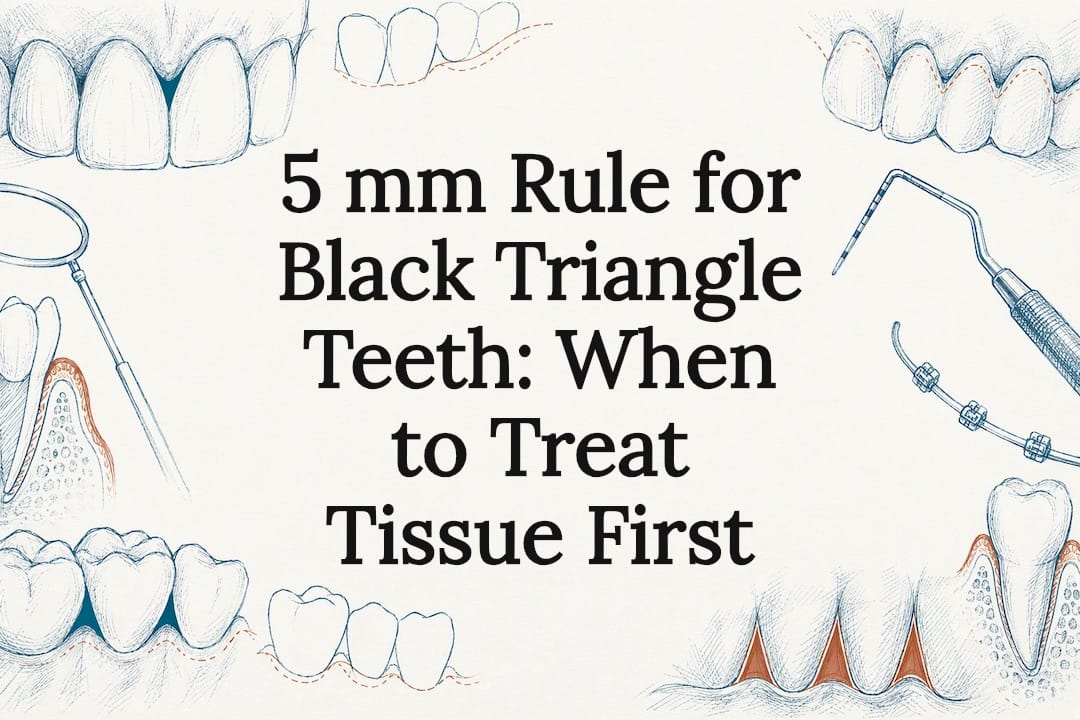
A black triangle is an open gingival embrasure, the small dark gap that appears near the gumline between teeth when the gum tissue (the interdental papilla) no longer fills the space. It is often treatable, but the right fix depends on whether the root cause is lost bone and tissue or simply tooth shape. Main solution categories include restorative bonding or veneers, orthodontic repositioning, periodontal grafting, and minimally invasive injectables, often used in combination.
TL;DR:
- Black triangles caused by bone loss or thin tissue require periodontal stabilization and may need grafting before restorative or orthodontic treatment.
- For small, healthy tissue cases, bonding or veneers are quick options, but complex cases involving tissue support often need grafting or orthodontic repositioning.
- Measuring the contact point-to-bone distance over 5 millimeters helps determine the likelihood of tissue fill and guides treatment choices.
- Regular hygiene prevents worsening but cannot regrow lost gum tissue, making professional interventions necessary for long-term correction.
- Insurance often classifies black triangle treatments as elective, so costs vary widely depending on the procedure and underlying health issues.
Table of Contents
- What black triangles are: interdental papilla, contact point, and why the geometry matters
- Common causes: bone loss, orthodontics, tooth shape, and hygiene habits
- When a black triangle signals disease versus when it is mainly cosmetic
- Treatment options explained: restorative, orthodontic, periodontal, and injectable approaches
- How dentists decide: key measurements and a simple decision framework
- Costs and insurance: why many fixes are elective and how to plan
- Prevention and home care: what helps and what will not regrow papilla
- Towne Dental clinical perspective: how we evaluate and manage black-triangle cases
- How black triangles differ from other interdental spacing issues
- The psychological and social impact of black triangle teeth
- Complications if black triangles are left untreated
- When to see a dentist and what the exam typically involves
- Editorial note: prioritize tissue health over quick cosmetic fixes
- How Towne Dental helps: from evaluation to a finished smile
- Sources
- FAQ
What black triangles are: interdental papilla, contact point, and why the geometry matters
The interdental papilla is the triangular wedge of gum tissue that normally fills the space below the contact point where two teeth touch. When that tissue recedes or fails to fill the space, light passes through and creates the dark gap patients notice in the mirror or in photos, an open gingival embrasure.
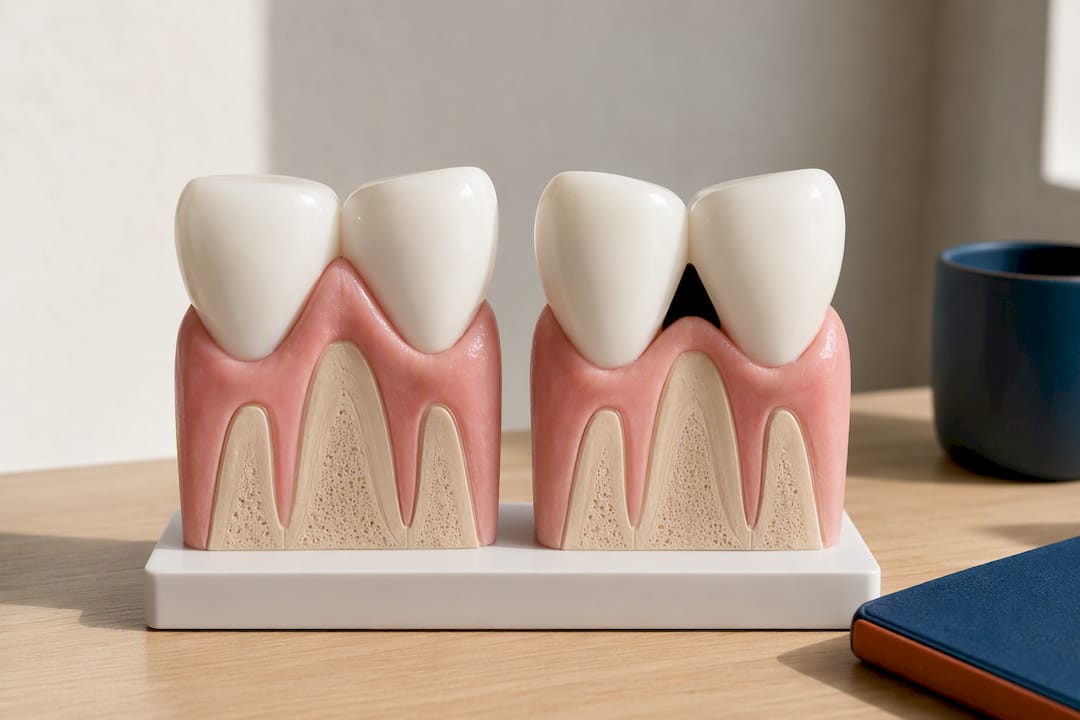
The geometry behind this is fairly predictable. Clinicians look at the distance between the contact point (where the teeth meet) and the alveolar crest (the bone ridge beneath the gum). Clinical studies have found that when this distance exceeds roughly 5 millimeters, the papilla is far less likely to fill the space completely, and the risk of a visible black triangle rises sharply, according to research on predictive parameters for gingival embrasures. Below that threshold, the tissue usually has enough support to fill in.
Certain teeth and shapes are more prone to this problem:
- Upper front teeth, especially the incisors, where gaps are most visible in a smile.
- Teeth with a triangular crown shape, since the contact point sits higher and leaves a longer, narrower gap below it.
- Teeth with a thin, delicate gum biotype, which recedes more easily than thicker, fibrous tissue.
Understanding this contact-point-to-bone relationship is the starting point for almost every treatment decision that follows.
Common causes: bone loss, orthodontics, tooth shape, and hygiene habits
Black triangles rarely have a single cause. Most patients have some combination of the following factors, and figuring out which ones apply guides the right next step.
- Periodontal bone loss. Periodontitis destroys the bone and attachment that support the papilla, and once that support is gone, the tissue cannot hold its shape. This is the most clinically serious cause because it signals active or past gum disease rather than a cosmetic quirk, as described in a clinical overview of periodontal disease.
- Orthodontic treatment. Moving teeth changes contact points and can either close gaps or open new ones. A systematic review found that gingival black triangles appear in roughly 38% to 58% of adults after fixed orthodontic treatment, with age, tooth shape, treatment duration, and the bone-to-contact-point distance all acting as risk factors, according to a systematic review on black triangles after orthodontics.
- Tooth shape. Naturally triangular crowns, common on upper lateral incisors and canines, leave less room for the papilla to fill compared to square or rectangular teeth.
- Thin periodontal biotype. Some people are simply built with thinner, more delicate gum tissue that recedes more readily under normal wear.
- Age-related changes. Gum tissue naturally loses some volume and elasticity over the decades, which is part of why black triangles become more common later in life.
- Aggressive brushing or flossing. Sawing floss into the gumline or brushing too hard can wear away papilla tissue over time, especially in people who already have thin biotypes.
Matching your own history against this list is a useful first step before booking a consultation, since it points toward whether the priority is periodontal evaluation, orthodontic review, or a straightforward cosmetic fix.
When a black triangle signals disease versus when it is mainly cosmetic
Not every black triangle is a medical concern, but some are warning signs that need attention before any cosmetic work begins. A few signs point toward active periodontal disease rather than a purely cosmetic gap:
- Bleeding gums during brushing or flossing, especially around the affected teeth.
- Deep periodontal pockets found on a dental exam, often accompanied by tenderness.
- Tooth mobility or a sense that a tooth feels loose.
- Persistent bad breath or a bad taste near the gap.
Functional problems also raise the stakes. Food constantly trapped in the space, or decay forming on the exposed root surface, both make treatment medically necessary rather than optional. This is why clinicians typically stabilize gum health first, treating any active disease and confirming the tissue is healthy, before considering cosmetic closure of the gap. Closing a black triangle over inflamed or infected tissue rarely holds up and can mask a bigger problem.
Treatment options explained: restorative, orthodontic, periodontal, and injectable approaches
There is no single gold-standard fix for black triangles. The right option depends on tissue health, tooth shape, and how much correction is needed, and an interdisciplinary review of open interproximal embrasures notes that treatment often works best when periodontics, orthodontics, and restorative dentistry are coordinated rather than treated as separate problems.
Restorative bonding. Direct composite bonding, including newer techniques like Bioclear matrix systems, reshapes the tooth to narrow or close the gap without touching the gum tissue. It is minimally invasive, can often be done in a single visit, and works best when the underlying tissue is otherwise healthy. The tradeoff is that bonding can chip or discolor over years and needs periodic maintenance or touch-ups.
Veneers. When a patient needs both gap closure and broader shape or color correction, veneers offer a more durable, comprehensive solution than bonding alone. They involve more tooth preparation and a higher cost, so they usually make sense when several teeth need correction at once rather than a single small triangle.
Orthodontic repositioning. Moving teeth to change the contact point can close a gap by shifting where the teeth touch, sometimes paired with small restorative additions afterward. This is a common route for gaps that developed or worsened during a previous course of orthodontic treatment.
Periodontal and surgical reconstruction. Connective tissue grafting and related papilla-preservation techniques directly rebuild lost gum volume. According to a systematic review of interdental papilla reconstruction, sub-epithelial connective tissue grafting shows the most robust evidence for longer-term reduction of black triangles compared to other techniques, though outcomes still vary from patient to patient and the tissue has limited blood supply, which makes full regeneration unpredictable.
Injectables and adjuncts. Hyaluronic acid fillers and platelet-rich fibrin (PRF) injections can improve papillary fill within a few months and offer a less invasive option than surgery. The same review found these approaches show real short-term improvement, but long-term data is still limited, so they are best framed as a bridge or maintenance option rather than a permanent fix on their own.
- Bonding and Bioclear: fastest, least invasive, best for healthy tissue.
- Veneers: broader correction, more durable, higher cost.
- Orthodontics: addresses the contact point directly, often needed after braces.
- Grafting: strongest long-term evidence, more involved recovery.
- Injectables: quick, short-term gains, limited long-term evidence.
Pro Tip: Ask your dentist to measure the contact-point-to-bone distance before choosing a treatment, since that single number often narrows the options faster than anything else.
Many cases combine two approaches, such as grafting followed by conservative bonding once the tissue has matured, and a realistic timeline often spans several months rather than a single appointment.
How dentists decide: key measurements and a simple decision framework
Dentists rely on a handful of objective measurements rather than guesswork to decide how to treat a black triangle.
- Contact-point-to-alveolar-crest distance. As noted earlier, a distance greater than about 5 millimeters is a practical threshold associated with higher risk of an open embrasure, as clinical studies on predictive parameters have shown.
- Gingival biotype. Thin, delicate tissue behaves differently under treatment than thick, fibrous tissue, which affects both the choice of procedure and the expected outcome.
- Interproximal width. The space between tooth roots influences how much papilla volume is physically possible to restore.
- Presence of active periodontal inflammation. Bleeding, pocketing, or other signs of disease need to be resolved before any cosmetic or reconstructive step.
A typical decision path starts by stabilizing any active gum disease. From there, if bone support can realistically be improved, grafting or other periodontal techniques are considered. If the tissue is already stable and healthy, the conversation shifts to whether restorative bonding, veneers, or orthodontic movement is the better route based on tooth shape and how many teeth are involved.
Costs and insurance: why many fixes are elective and how to plan
Most black-triangle treatments fall into a gray area between medical necessity and cosmetic preference, which affects what insurance will cover. According to ADA research on dental use and barriers, more than half of adults in the United States have private dental insurance, but procedures like composite bonding and veneers are often classified as elective and frequently excluded from standard benefits.
A few practical points to keep in mind when planning treatment:
- Bonding is usually the least expensive route, while veneers and surgical grafting cost more due to material and procedure time.
- Orthodontic correction adds the cost of a full treatment plan, not just the gap itself, so it is rarely chosen for cosmetic reasons alone.
- If periodontal disease is present, treatment to stabilize the gums is often billed as a medical necessity, which can shift some costs toward coverage rather than out-of-pocket payment.
- Ask your dental office to document any functional issues, like food impaction or bone loss, since that paperwork can support insurance claims or financing applications.
- Many dental offices offer in-house financing or third-party payment plans for procedures that insurance will not cover.
Getting a written treatment plan with itemized costs before starting helps avoid surprises partway through a multi-step process.
Prevention and home care: what helps and what will not regrow papilla
Good hygiene habits can slow or prevent further black-triangle formation, but they cannot regenerate papilla tissue that has already been lost. Once the papilla recedes, only professional treatment restores the shape.
- Use interdental brushes or soft picks instead of forcing floss straight down into a tight space, which can wear away fragile tissue.
- Angle floss gently along the side of each tooth rather than snapping it into the gumline.
- Switch to a soft-bristled brush and use light pressure, since aggressive brushing is a known contributor to recession over time.
- If you are starting orthodontic treatment, ask your orthodontist directly about black-triangle risk and how contact points will be managed during and after treatment.
Pro Tip: Bring up interdental spacing with your orthodontist before treatment starts, since planning for it early is far easier than correcting it after braces come off.
Towne Dental clinical perspective: how we evaluate and manage black-triangle cases
At Towne Dental, evaluating a black triangle starts with a full periodontal exam and digital imaging to check bone levels and tissue health before any cosmetic conversation begins. If active gum disease is present, our periodontics team stabilizes it first. Once tissue is healthy, we build a staged plan that may combine restorative work, orthodontic input, or referral for grafting, with sedation options available for patients who feel anxious about treatment.
How black triangles differ from other interdental spacing issues
Black triangles are often confused with other types of gaps between teeth, but the mechanism is different. A general diastema, the classic gap between the two front teeth, usually comes from tooth size, jaw width, or a prominent labial frenum, and the gum tissue itself is typically intact and healthy. A black triangle, by contrast, is specifically a loss of gum fill below an existing contact point, not a spacing problem caused by the teeth themselves being too far apart.
Spacing that opens up after tooth loss or shifting is also distinct. When a tooth is extracted and neighboring teeth drift, the resulting gap is a positional change in the whole tooth, while a black triangle can exist even when the teeth are touching normally at the contact point, with only the tissue beneath it missing.
This distinction matters for treatment. A diastema is usually closed with orthodontics or bonding aimed at the visible tooth structure. A black triangle may need that same restorative work, but only after confirming whether the underlying cause is bone loss, tissue biotype, or shape, since treating the wrong layer of the problem leads to a fix that does not hold. Recognizing which category applies is often the first thing a dentist sorts out during an exam, before recommending any specific procedure.
The psychological and social impact of black triangle teeth
For many patients, the concern with black triangles is not medical at all, it is how the gaps look in photos, video calls, or up close conversation. Patients often describe feeling self-conscious about smiling widely or covering their mouth when they laugh, particularly when the gaps are on the upper front teeth where they are most visible.
This kind of aesthetic self-consciousness is a legitimate reason to seek treatment, even when there is no underlying disease. Interdental papilla loss increases with age, and because it is common, some patients assume nothing can be done and simply live with it, according to a review of interdental papilla recession and reconstruction. That assumption is not always accurate. Conservative options like bonding can often make a meaningful visual difference without surgery, and knowing that a fix exists can shift a purely cosmetic concern into something addressable in a single consultation.
Dentists who work with cosmetic cases regularly see how much a small correction near the front teeth affects a patient’s willingness to smile in photos or speak confidently in social settings, even when the change from a clinical standpoint looks minor on paper.
Complications if black triangles are left untreated
Leaving a black triangle alone is not usually dangerous, but it is not always risk-free either, particularly when the underlying cause is active periodontal disease.
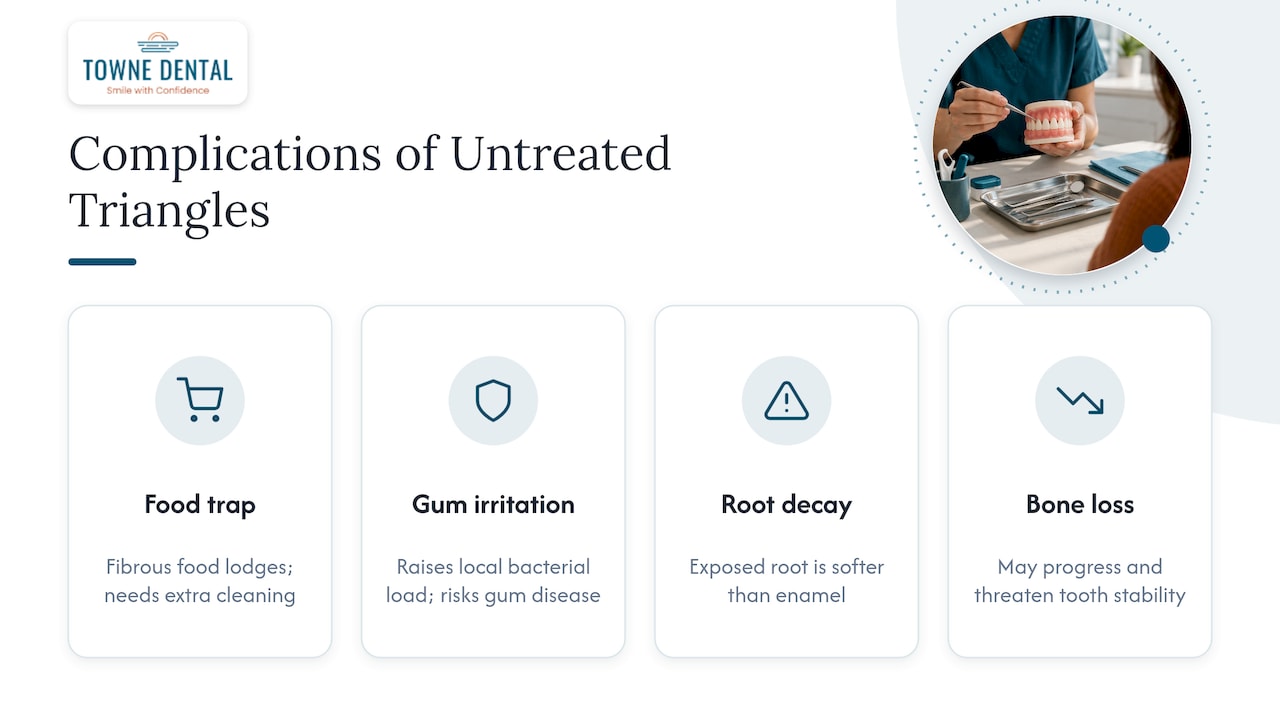
Food impaction is the most common practical complaint. Food particles, especially fibrous foods, get trapped in the open space and require extra effort to clean out, and repeated buildup in that spot increases the local bacterial load between brushings. Over time, that trapped debris can contribute to localized gum irritation or make it harder to keep the area free of plaque, which raises the risk of new or worsening gum disease right at the site of the triangle.
Exposed root surfaces near the gap are also more vulnerable to root caries, since the enamel-covered crown gives way to softer root structure right where the tissue has receded. If the original cause was periodontitis and it goes unmanaged, the bone loss driving the black triangle can continue to progress, potentially affecting the stability of the tooth itself over time, consistent with how periodontal disease is understood to progress when untreated, according to a clinical overview of periodontal disease.
None of this means every black triangle needs urgent treatment, but a gap that traps food constantly or sits next to bleeding, tender gum tissue is worth having evaluated sooner rather than later.
When to see a dentist and what the exam typically involves
A black triangle is worth mentioning at your next routine dental visit if it is new, growing, or accompanied by bleeding, tenderness, or a loose feeling in the tooth. It is worth scheduling a dedicated evaluation sooner if food constantly gets trapped in the space or if you notice sensitivity on the exposed root surface.
A typical diagnostic visit starts with a visual exam and periodontal probing to measure pocket depth around the affected teeth and check for bleeding or inflammation. Digital X-rays or other imaging let the dentist measure the distance between the contact point and the underlying bone, the key figure that predicts how likely the papilla is to respond to treatment. The dentist will also look at gum thickness, the shape of the teeth involved, and whether nearby teeth show similar risk factors.
From there, the conversation usually moves to which category of treatment fits best, restorative, orthodontic, periodontal, or some combination, based on what the measurements and exam findings show. Bringing a list of when the gap first appeared, any recent orthodontic history, and your brushing and flossing habits helps the dentist build an accurate picture faster.
Editorial note: prioritize tissue health over quick cosmetic fixes
The instinct to close a black triangle as fast as possible is understandable, but rushing to bonding or a filler injection over unstable gum tissue tends to fail. Long-term stability beats a quick fix nearly every time. Conservative bonding earns its place when tissue is healthy and the gap is small, while more complex cases involving bone loss or significant tooth movement call for periodontal or orthodontic input first. A proper clinical evaluation, not a mirror check, should decide which path applies to you.
— Towne Dental
How Towne Dental helps: from evaluation to a finished smile
Understanding the cause of your black triangle is the easy part. Getting a plan that actually holds up long term takes a team that treats the gum tissue and the tooth shape as one problem, not two separate appointments. Towne Dental structures care that way, from periodontal stabilization through the cosmetic step that closes the gap.

- Periodontics for gum evaluation, disease management, and grafting referrals.
- Cosmetic Dentistry for bonding, veneers, and whitening once tissue is stable.
- Orthodontics and clear aligners for cases where contact-point repositioning helps close the gap.
- Sedation options for patients who feel anxious about periodontal or restorative procedures.
Bring your dental history, including any past orthodontic treatment, to your first visit so the team can build an accurate timeline. Schedule an evaluation with Towne Dental to find out which treatment path fits your case.
Sources
Readers who want to dig deeper can review the systematic review on papilla reconstruction, the orthodontic incidence study, the interdisciplinary management review, and additional patient-facing context from CWD Dental Group’s explainer on black triangle fixes.
This article is general information, not a substitute for advice from a qualified doctor. Consult a qualified healthcare professional about your own circumstances before acting on anything here.
- Incidence of Gingival Black Triangles following Treatment with Fixed Orthodontic Appliance: A Systematic Review – PMC
- Interdisciplinary Management of Open Interproximal Embrasures – PubMed
- National trends in dental use, benefits, and barriers (ADA)
FAQ
Can black triangles be reversed naturally?
No, gum tissue that has already receded will not regrow on its own once the papilla is lost, since the tissue has a limited blood supply and unpredictable regenerative capacity. Good hygiene habits can prevent the problem from getting worse, but reversing an existing black triangle requires professional treatment such as bonding, grafting, or orthodontic adjustment.
How common are black triangles?
Black triangles become more common with age and are frequently seen after orthodontic treatment, with one systematic review reporting rates of roughly 38% to 58% in adults following fixed braces. They are also common in people with periodontal disease or naturally thin gum tissue.
Will black triangles go away after Invisalign or braces?
Not automatically, and in some cases clear aligners or braces can create new black triangles by changing how teeth contact each other. Whether gaps close, stay the same, or appear depends on the specific tooth movement involved, which is why discussing contact-point changes with your orthodontist before treatment matters, especially since post-orthodontic teeth can also shift afterward if retention is inconsistent.
Which treatment works best for black triangles?
There is no single best treatment for every case, since the right option depends on gum tissue health, tooth shape, and how much bone support remains. Evidence suggests sub-epithelial connective tissue grafting has the strongest support for longer-term improvement, while conservative bonding works well when the tissue is already stable, according to a systematic review of reconstruction techniques.
Does dental insurance cover black triangle treatment?
Coverage depends on whether the treatment is classified as medically necessary or purely cosmetic, and many bonding and veneer procedures fall into the cosmetic category that standard plans exclude. According to ADA data on dental benefits, documenting a functional issue like bone loss or food impaction can sometimes support a stronger insurance claim.